
multitown README

The project's README from github.com/w1u2d3i4/multitown. As one markdown file: README.md.

MultiTown

English | 简体中文

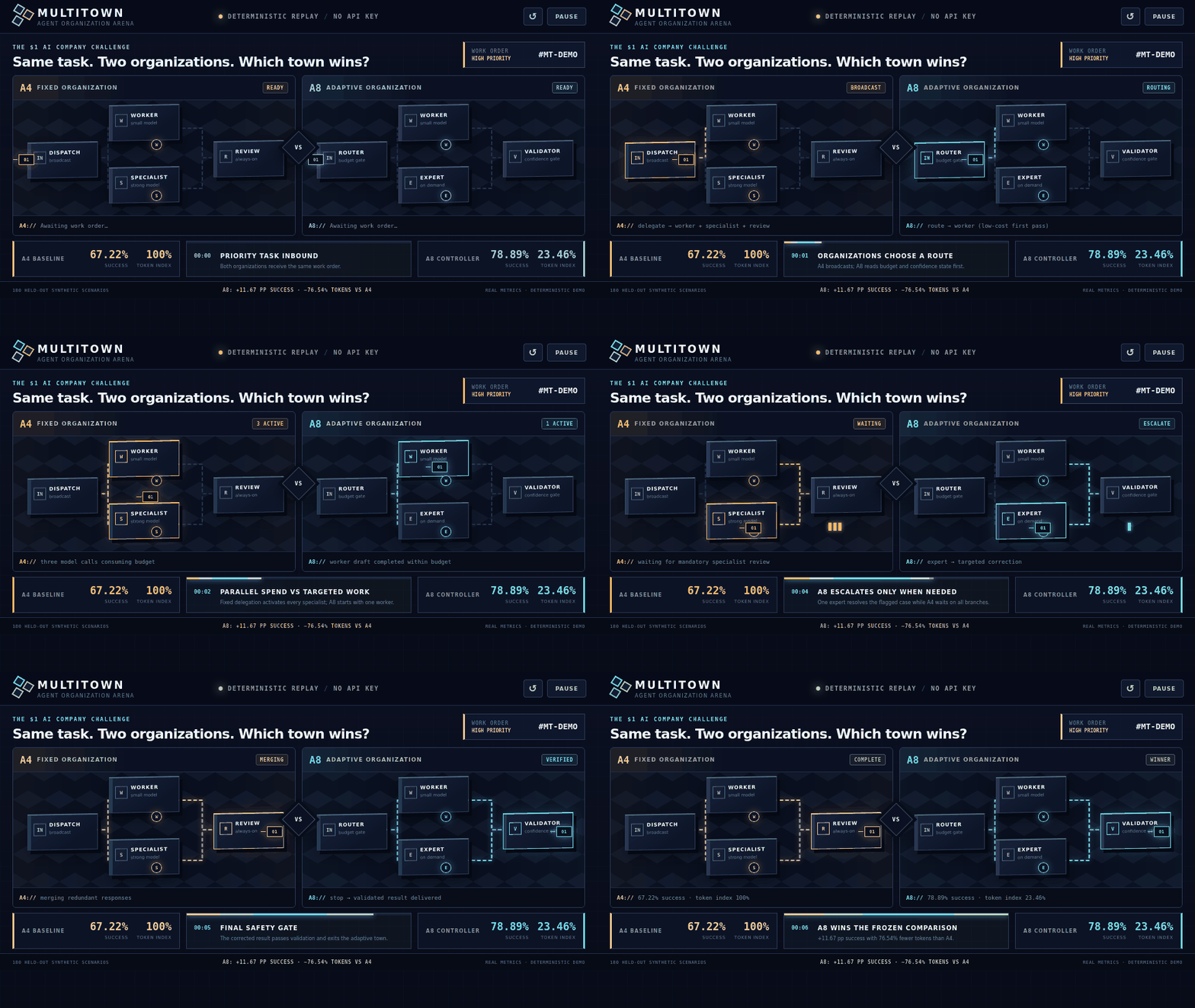
MultiTown Arena: A4 and A8 AI organizations solve the same task

A visual cyber town for AI agents — build an AI company, watch it work, spend, validate, escalate, and adapt.

MultiTown is a visual cyber town, an AI-organization digital twin, and a Python runtime for cost-aware multi-agent control. Planner, Worker, Specialist, Validator and Router agents become buildings and residents with different information, permissions and costs. The Arena turns otherwise invisible model calls, hand-offs, validation, escalation, token use and outcomes into a replay you can watch and compare.

What the cyber town can do

Capability What it looks like in MultiTown
Visual organization replay Watch task packets move through two towns, see active buildings, queues, alerts, validation and final delivery in the browser Arena.
Role and permission isolation Give Planner, Executor and Verifier different context, tools and authority instead of letting one agent propose, modify and certify its own work.
Cost-aware dispatch Start with an economical worker and activate a strong specialist or review only when the controller's evidence and budget allow it.
Validation and recovery Inspect observable runtime evidence, trigger review or escalation, enforce token guards, and preserve deterministic fallback/rollback paths.
Comparable experiments Replay fixed and adaptive organizations on frozen tasks while recording success, tokens, latency, energy and safety outcomes.
Product path Use the same town abstraction as the foundation for future characters, plots, missions and player intervention on agentic-rpg.

The current Arena is a deterministic visualization and comparison surface, not yet a free-form game. The RPG branch is where the cyber town becomes playable.

Why Multi-Agent?

MultiTown does not assume that adding agents automatically improves accuracy. It treats a multi-agent system as an organization and governance problem: different roles can receive different information and permissions, while a controller decides when extra planning, execution or review is worth its cost.

A single full-access agent is simple but can read requirements, change the work and certify itself. An always-on team separates those duties but pays the full coordination cost on every task. MultiTown studies the middle ground: start with the least expensive valid organization, validate observable work, and activate specialists only when needed. The public-bench branch tests this proposition against both single-agent and fixed-team anchors on public tasks.

Project branches

Start here on main. Each long-lived branch has one job, and experimental claims stay on the branch that owns their evidence:

Branch Purpose What to expect
main Stable project showcase The current validated MultiTown result, Arena demo, public runtime and conservative headline claims.
public-bench External evidence track Tests the method on public general-purpose benchmarks against a canonical single agent and a fixed Planner–Executor–Verifier team; reports quality, tokens, latency and energy, including negative results.
agentic-rl Learned-control research Experiments with replacing deterministic delegation rules by trained sequential policies under quality, budget and safety constraints. It is also the control research foundation for future role-playing agents.
agentic-rpg Tabletop-RPG product direction Evolves the town from an experiment viewer into a playable multi-agent role-playing prototype with characters, plots, tasks and player intervention.

The branches are not a performance ranking. public-bench asks whether the current method transfers; agentic-rl asks whether control can be learned; agentic-rpg explores how that control becomes gameplay.

This repository is a code-only public surface with concise, audited result summaries. It intentionally excludes raw experiment records, generated result files, model checkpoints, benchmark datasets, internal process notes, interrupted runs, and the private development Git history.

Launch the Arena

The bundled replay runs without a model, API key, build step, or network call:

git clone https://github.com/w1u2d3i4/multitown.git
cd multitown
python3 -m http.server 8000 --directory demo

Open http://127.0.0.1:8000. The displayed benchmark aggregates are measured frozen results. The animated work order is a deterministic explanatory scenario, not a raw experimental episode. See demo/ for the automatic GIF generation command.

How to read the experiment labels

The A numbers are organization experiment IDs, not model versions or a ranking. The result section mainly uses four designs:

ID Plain-language meaning
A4 Fixed full team: always call a strong Planner, three weak Workers and an independent strong Verifier.
A6 Statistical pre-task router: choose one complete organization before execution using cross-fitted scenario statistics and a budget.
A7 Learned pre-task router: predict quality, tokens and latency from safe task features, then choose an organization before execution.
A8 Execution-time adaptive controller: start with an economical agent and delegate, escalate or review only when validation evidence requires it.

A8 is a deterministic selective-delegation controller, not a trained RL policy. Learned-controller attempts are isolated on the agentic-rl branch.

Selected benchmark results

The strongest frozen MultiTown result is the deterministic A8 execution-time controller on the 180-scenario held-out split:

Controller Success Tokens per decision Mean E2E latency p95 E2E latency
A8 142/180 (78.89%) 621.5 1.104 s 2.275 s

Under the preregistered paired comparison:

A8 is a deterministic heuristic controller, not a trained RL policy. These results are local Qwen/llama.cpp measurements on the frozen synthetic MultiTown population; they do not establish general multi-agent superiority.

Public transfer result: TeamBench

The public-bench branch transfers MultiTown's organization ideas to 89 public TeamBench tasks with OS-level role isolation and matched model, task, seed, container and token settings:

Strategy Fully passed Mean partial Tokens/task p95 latency Energy
PlanExecute-TB 16/89 0.61603 49,579 151.96 s 67.89 Wh
Solo-TB 14/89 0.63989 84,085 237.06 s 90.94 Wh
MT-CapacityRoute-v1 20/89 0.64180 48,296 91.06 s 63.32 Wh

MT-CapacityRoute keeps Planner–Executor separation, routes strong execution to three development-selected task categories and uses the economical Executor elsewhere. It is the strongest tested point under this local frozen harness: relative to Solo it adds six passes with no lost Solo passes, cuts tokens by 42.56%, and cuts monitored energy by 30.37%. Mean-partial confidence intervals against both anchors still include zero, so this is not a literature-wide SOTA claim. Protocols, negative results and transferable runtime controls live on public-bench.

Agentic RL and safety findings

MultiTown retains both positive optimization results and safety failures:

Study Main result Required interpretation
A9-v1 offline fitted-Q 75.00% success vs 72.22% for the matched A8 baseline Difference interval crossed zero; no significant advantage claim
A9-v2 masked PPO Success 23.83% → 34.00%; +10.17 pp (95% CI +7.87 to +12.47); tokens −25.41% Train-only controller result; unsafe episodes rose 15.73% → 66.00%
A9-v3 hard-shield diagnostic Unsafe episodes 66.00% → 5.84% Autonomous success fell 34.00% → 0%; safety–utility negative result
A22 constrained-PPO follow-up 60 fits, 345,600 rollouts, 36,000 calibration rows and 9,000 outer rows Measured safety margins recovered, but success noninferiority was not stable and tokens increased

The historical A10 long-horizon run is not listed as a positive result because a later audit found that policy-visible fields deterministically revealed the correct action. A23 was invalidated by snapshot-binding failure, and the Stage W CR axis was inert. These failures are preserved in the research evidence but their raw records are intentionally outside this code-only repository.

Install

MultiTown requires Linux and Python 3.12 or newer.

python3 -m venv .venv
. .venv/bin/activate
python -m pip install --upgrade pip
python -m pip install -e '.[dev]'

Optional controller-training dependencies are installed separately:

python -m pip install -e '.[rl]'

Public benchmark adapters use a separate optional dependency set:

python -m pip install -e '.[reproduction]'

Explore the runtime

multitown-bench --help
multitown-validate-serving-trace --help

After installing .[reproduction], the routing and A8 commands are available; after installing .[rl], the PPO commands are available:

multitown-run-a8 --help
multitown-a10-ppo --help

Model-backed commands expect user-supplied OpenAI-compatible endpoints and model identifiers. The package does not download weights and no credentials belong in tracked files.

Test

pytest -q \
  tests/test_contracts.py \
  tests/test_a8_controller.py \
  tests/test_stateful_ops.py \
  tests/test_stateful_behavior.py \
  tests/test_stateful_groups.py \
  tests/test_stateful_pomdp.py \
  tests/test_serving_trace.py

The tests in this repository exercise only the published runtime surface. They do not reproduce or validate private experiments.

Repository boundary

Included:

Excluded by design:

License

MultiTown is released under the MIT License. See LICENSE.

multitown (w1u2d3i4/multitown)

Searching Database…

What is this?MultiTown is a code-only Python runtime toolkit for cost-aware multi-agent organization and control, where Planner, Worker, Specialist, Validator and Router agents become buildings and residents in a visual 'cyber town' you can watch, compare and control.
Is this a game, or a research toolkit?It's primarily a Python runtime library plus a browser-based Arena for deterministic replay and benchmarking of multi-agent control strategies, not yet a free-form game; a playable agentic-rpg branch is where it becomes a game.
How do I get the Arena running?The bundled replay runs without a model, API key, build step, or network call: you just open it in the browser; the demo/ folder has the command for automatic GIF generation.
What do I need installed to run this?You need Linux and Python 3.12 or newer; optional extras add routing/A8 commands (.[reproduction]) or PPO commands (.[rl]), and model-backed commands require your own OpenAI-compatible endpoint.
How solid are the benchmark results?The headline numbers are local Qwen/llama.cpp measurements on a frozen synthetic task population and don't establish general multi-agent superiority; some confidence intervals for public TeamBench comparisons still cross zero.
Does this run on Windows or macOS too?No — the README states it requires Linux specifically, with no mention of Windows or macOS support.
What do the A4/A6/A7/A8 labels mean?They are organization experiment IDs, not model versions: A4 is a fixed full team, A6 a statistical pre-task router, A7 a learned pre-task router, and A8 a deterministic execution-time controller that escalates only when validation evidence requires it.
What is TeamBench and why does it matter?TeamBench is an 89-task public benchmark used on the public-bench branch to test whether MultiTown's routing approach (MT-CapacityRoute) transfers beyond its own frozen synthetic tasks, under matched model, seed, container and token settings.
Why does the project have so many branches?main holds the stable showcase and Arena demo, public-bench tests transfer to external tasks, agentic-rl experiments with trained control policies, and agentic-rpg turns the town abstraction into a playable multi-agent role-playing prototype.
Did training a reinforcement-learning controller make things safer?A masked-PPO controller (A9-v2) raised success but also pushed unsafe episodes from about 16% to 66%; a follow-up hard-shield fix (A9-v3) cut unsafe episodes to under 6% but dropped autonomous success to 0%, showing a direct safety-utility tradeoff.
Creator
w1u2d3i4
Size
1.9 MB
Stars
201
Updated
CommitAug 27
Age
1mo
Commits · 90 Days