code-review-graph

Stop burning tokens. Start reviewing smarter.
English |
简体中文 |
日本語 |
한국어 |
हिन्दी







Usage ·
Commands ·
FAQ ·
Troubleshooting ·
GitHub Action ·
Reproducing the benchmarks ·
Roadmap
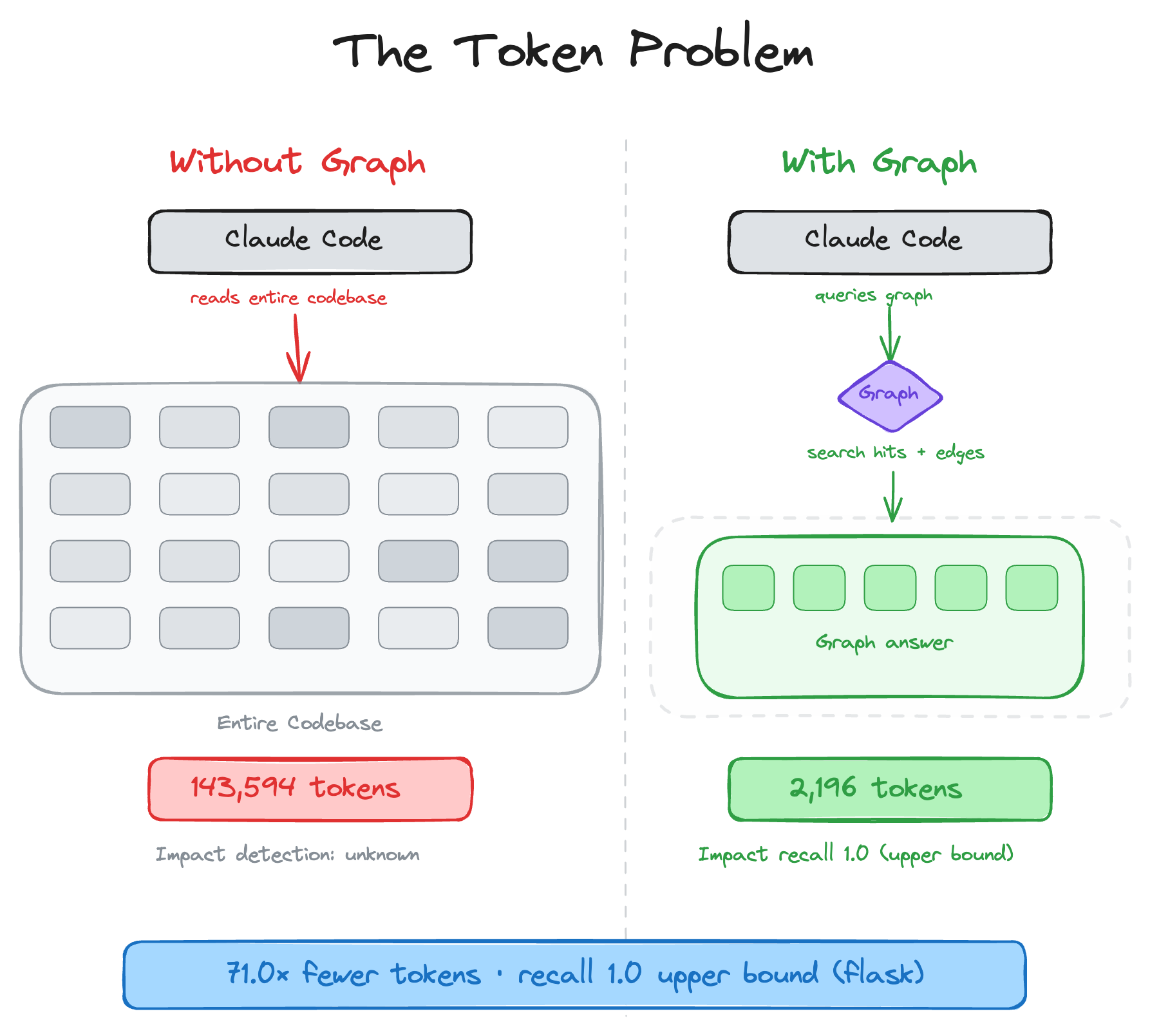
AI coding tools can end up re-reading large parts of your codebase on review tasks. code-review-graph fixes that. It builds a structural map of your code with Tree-sitter, tracks changes incrementally, and gives your AI assistant precise context via MCP so it reads only what matters.
Quick Start
pip install code-review-graph                     # or: pipx install code-review-graph
code-review-graph install          # auto-detects and configures all supported platforms
code-review-graph build            # parse your codebase
One command sets up everything. install detects which AI coding tools you have, writes the correct MCP configuration for each one, installs platform-native hooks/skills where supported, and injects graph-aware instructions into your platform rules. It auto-detects whether you installed via uvx or pip/pipx and generates the right config. Restart your editor/tool after installing.
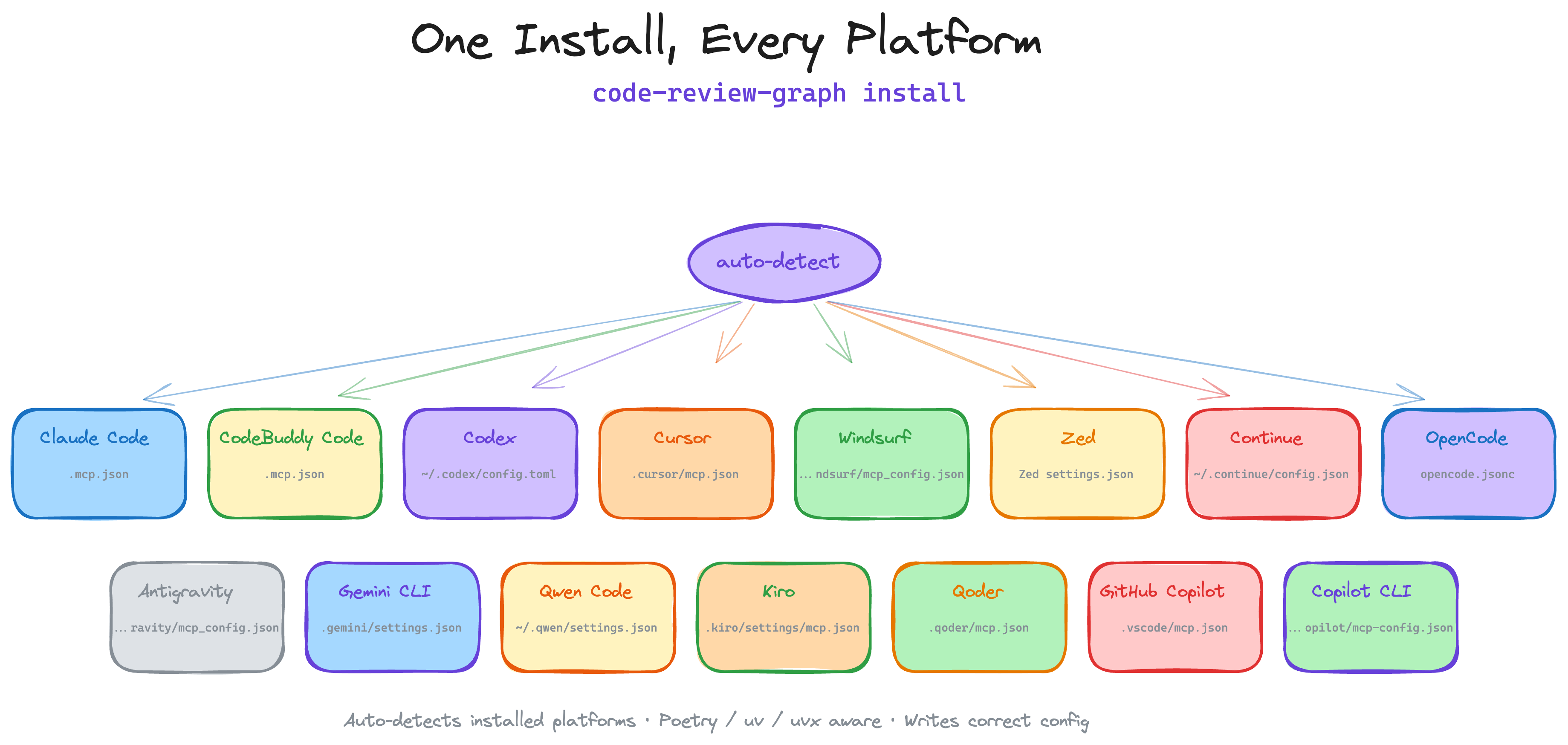
To target a specific platform:
code-review-graph install --platform codex       # configure only Codex
code-review-graph install --platform cursor      # configure only Cursor
code-review-graph install --platform claude-code  # configure only Claude Code
code-review-graph install --platform gemini-cli   # configure only Gemini CLI
code-review-graph install --platform antigravity   # configure only Antigravity
code-review-graph install --platform windsurf     # configure only Windsurf
code-review-graph install --platform zed          # configure only Zed
code-review-graph install --platform continue     # configure only Continue
code-review-graph install --platform opencode     # configure only OpenCode
code-review-graph install --platform qwen         # configure only Qwen
code-review-graph install --platform qoder        # configure only Qoder
code-review-graph install --platform kiro         # configure only Kiro
code-review-graph install --platform copilot      # configure only GitHub Copilot (VS Code)
code-review-graph install --platform copilot-cli  # configure only GitHub Copilot CLI
code-review-graph install --platform codebuddy    # configure only CodeBuddy Code
code-review-graph install --platform hermes       # configure only Hermes Agent
Requires Python 3.10+. For the best experience, install uv (the MCP config will use uvx if available, otherwise falls back to the code-review-graph command directly).
To remove CRG from a Git or SVN project, use the symmetric uninstall command
from anywhere inside its working tree. The target is normalized to the working
tree root, and non-repository directories are refused. It removes only
CRG-owned files and entries; unrelated MCP servers, hooks, skills, and JSONC
comments remain untouched. Shared configuration changes use atomic replacement
so a failed write leaves the original file intact.
code-review-graph uninstall --dry-run    # preview every action; write nothing
code-review-graph uninstall              # preview, ask for confirmation, then apply
code-review-graph uninstall --yes        # apply without prompting
code-review-graph uninstall --all-repos  # also clean every registered repository
code-review-graph uninstall --keep-data  # remove integrations but keep graph databases
code-review-graph uninstall --keep-user-configs --repo .  # clean this project only
Then open your project and ask your AI assistant:
Build the code review graph for this project
The initial build takes ~10 seconds for a 500-file project. After that, watch mode and supported hooks can keep the graph updated automatically.
How It Works
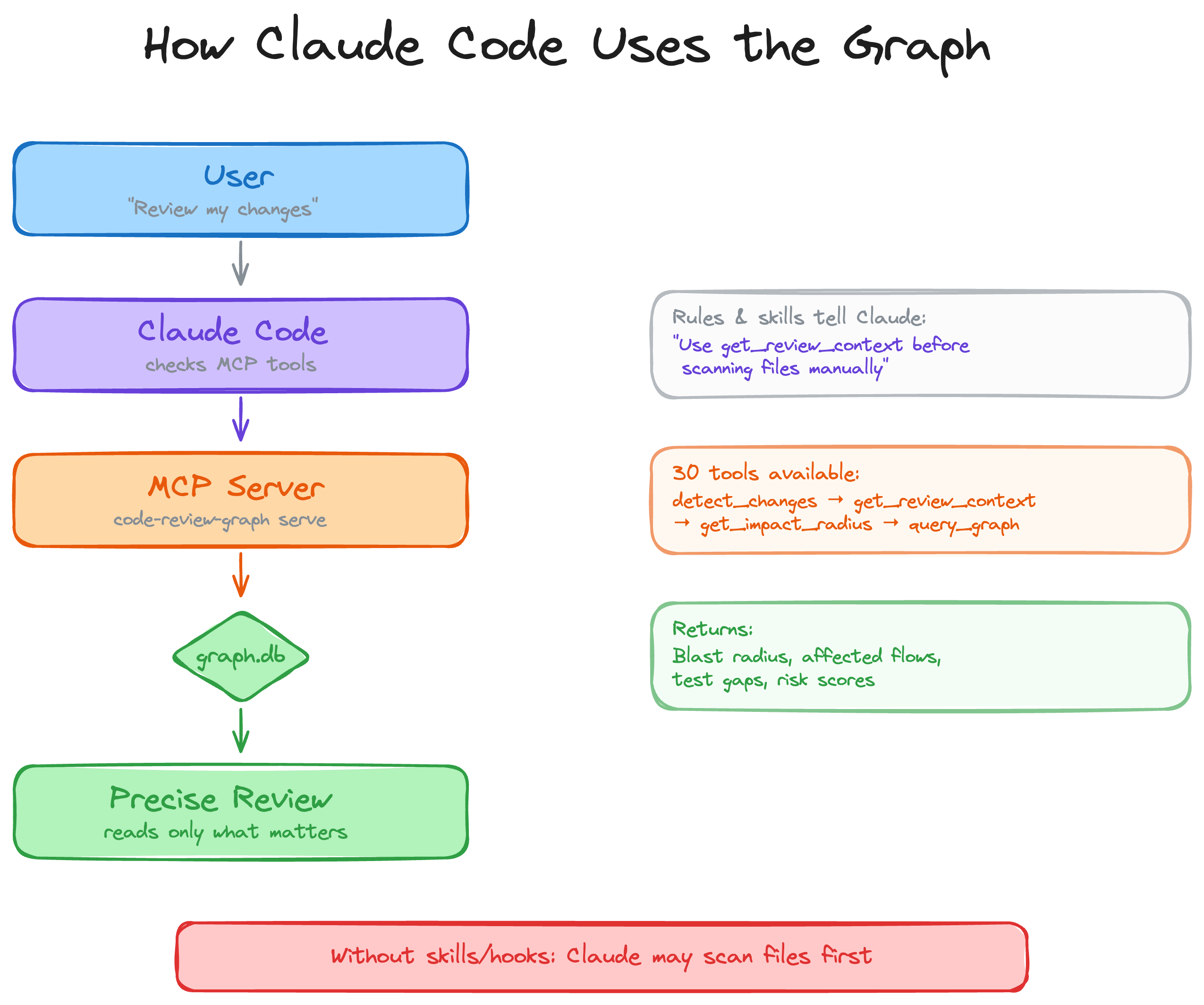
Your repository is parsed into an AST with Tree-sitter, stored as a graph of nodes (functions, classes, imports) and edges (calls, inheritance, test coverage), then queried at review time to compute the minimal set of files your AI assistant needs to read.

Blast-radius analysis
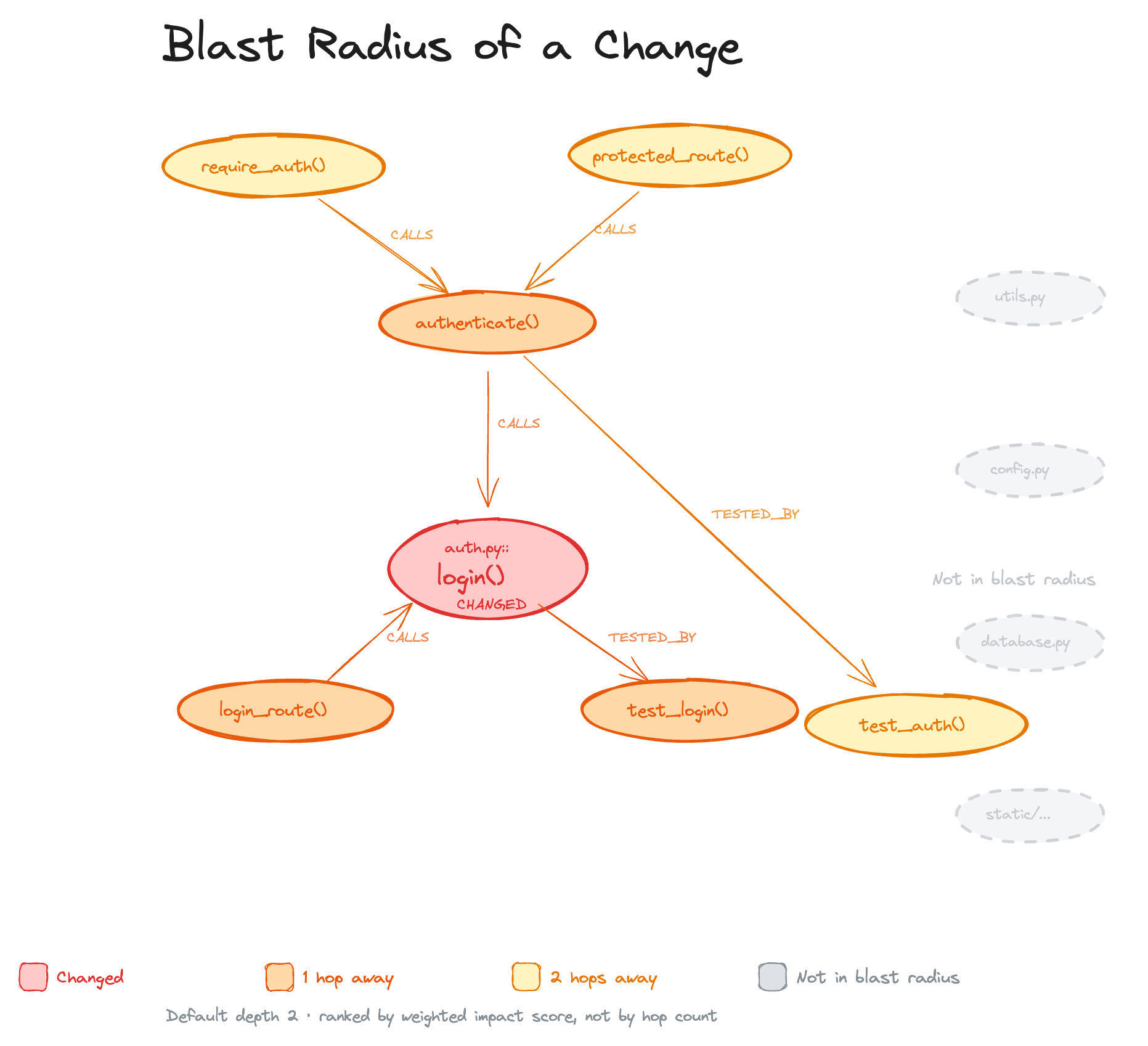
When a file changes, the graph traces every caller, dependent, and test that could be affected. This is the "blast radius" of the change. Your AI reads only these files instead of scanning the whole project.
Incremental updates in seconds
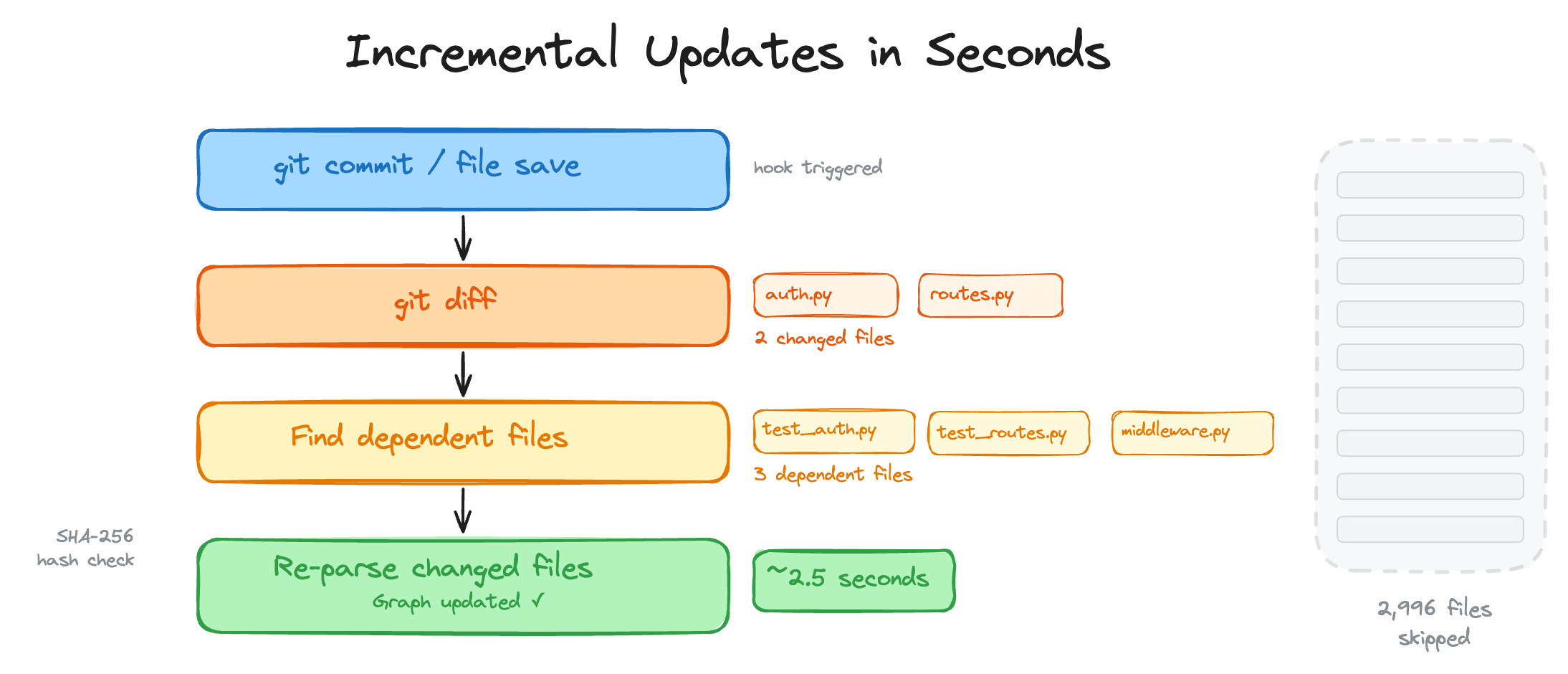
When hooks or watch mode are enabled, file saves and supported commit hooks trigger incremental updates. The graph diffs changed files, finds their dependents through the graph's own import and call edges, and re-parses only the files whose SHA-256 hash actually changed. On a ~3,000-file project (django) a two-file edit re-indexes in about 2.5 seconds on the path the hooks use, of which ~1.4 s is process start-up; a no-op update costs only that start-up. See Incremental update latency for the full measurement.
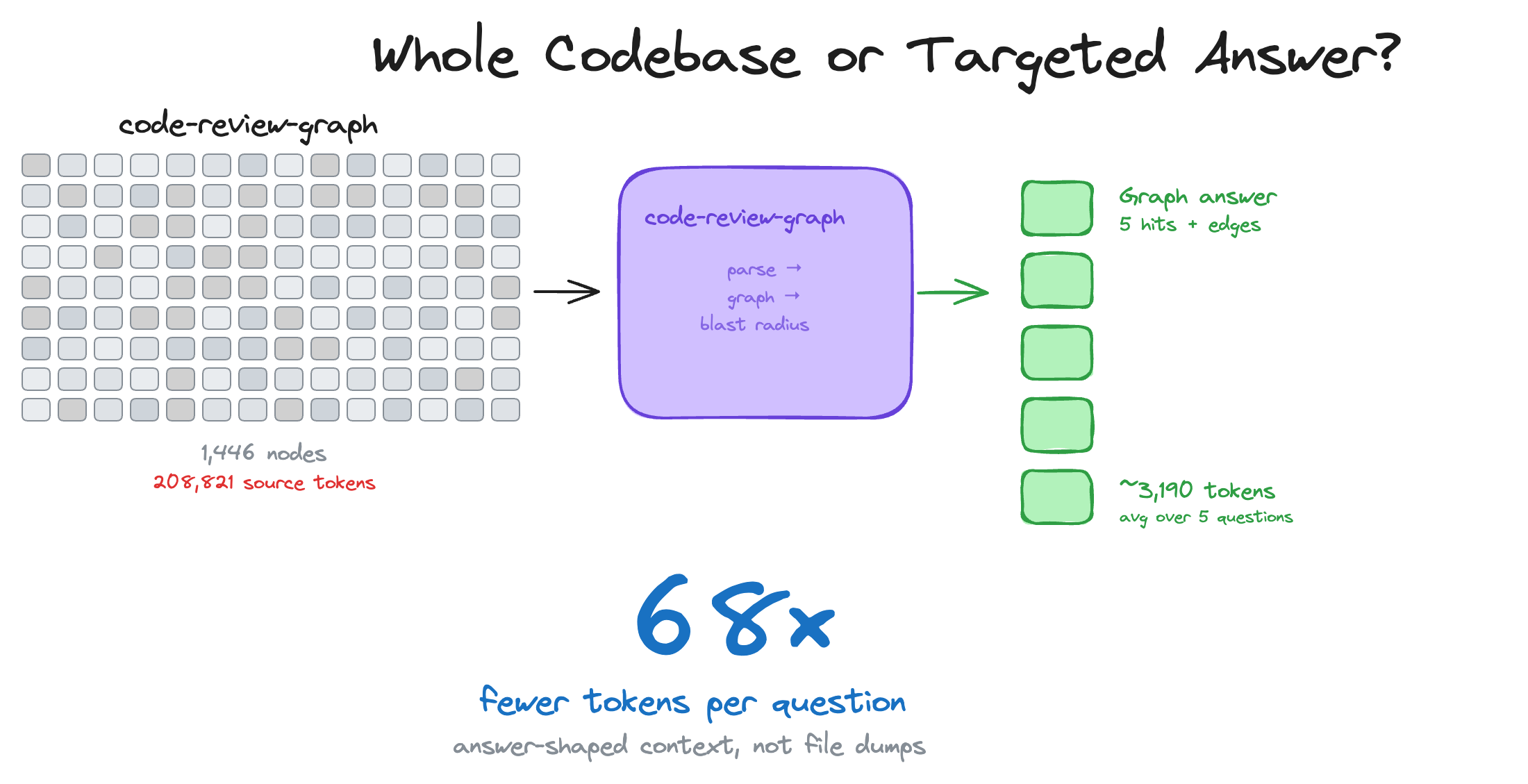
Whole codebase or targeted answer?
The bigger the repository, the more token waste hurts. Instead of feeding a whole corpus to the model, the graph returns an answer-shaped slice of it: on this repository, 208,821 source tokens become ~3,190 tokens per question.
Broad language coverage + Jupyter notebooks
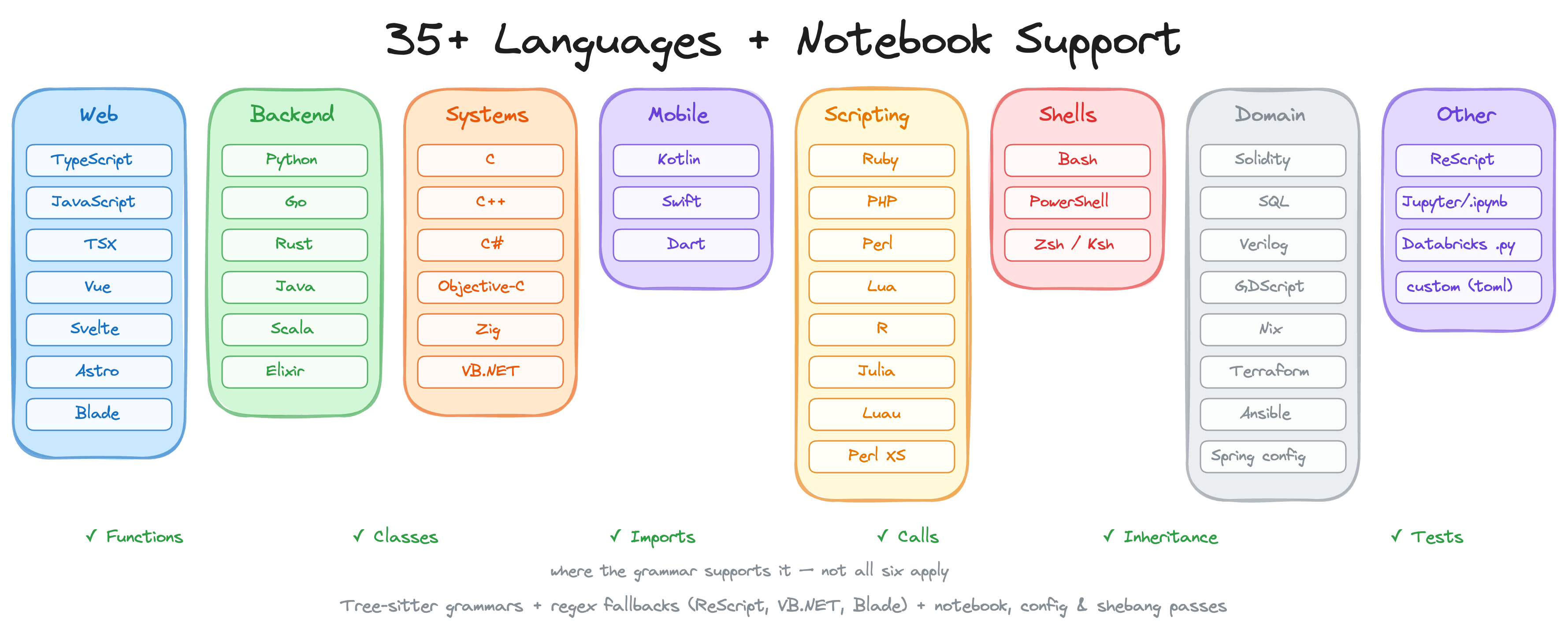
Parser support covers functions, classes, imports, call sites, inheritance, and test detection across the current parser surface, using Tree-sitter where available and targeted fallbacks where needed. Current support includes Python, JavaScript/TypeScript/TSX, Go, Rust, Java, C/C++, C#, VB.NET, Ruby, Kotlin, Swift, PHP, Scala, Solidity, Dart, R, Perl, Lua/Luau, Objective-C, shell scripts, Elixir, Zig, PowerShell, Julia, ReScript, GDScript, Nix, Verilog/SystemVerilog, SQL, Terraform/OpenTofu structure (.tf; generic .hcl files are recognized as file nodes), Ansible playbooks/roles/tasks, Vue/Svelte SFCs, Astro files parsed through the TypeScript parser, Jupyter/Databricks notebooks (.ipynb), and Perl XS files (.xs). Generic YAML is not treated as source code.
PHP projects additionally get repository-bounded Composer PSR-4 resolution,
Blade template references, and Laravel Route/Eloquent semantic edges when the
source includes explicit framework imports, model inheritance, and receiver
evidence.
Add your own language (no fork needed)
If your repo uses a language the parser does not cover yet, drop a languages.toml into .code-review-graph/ mapping file extensions to any grammar bundled in tree_sitter_language_pack, plus the tree-sitter node types for functions, classes, imports, and calls:
[languages.erlang]
extensions = [".erl"]
grammar = "erlang"
function_node_types = ["function_clause"]
class_node_types = ["record_decl"]
import_node_types = ["import_attribute"]
call_node_types = ["call"]
The generic tree-sitter walker handles extraction from there — no code changes, and built-in languages can never be overridden. See docs/CUSTOM_LANGUAGES.md for the schema reference, validation rules, and a worked end-to-end example.
Risk-scored PR reviews in CI (GitHub Action)
The same analysis runs as a composite GitHub Action — and it stays local-first: the knowledge graph is built and queried entirely on your CI runner, with no source code sent to any external service. On each pull request the action posts a single sticky comment with risk-scored functions, affected execution flows, and test gaps, updated in place on every push. An optional fail-on-risk input turns the review into a merge gate.
# .github/workflows/code-review-graph.yml
on:
  pull_request:

permissions:
  contents: read
  pull-requests: write

jobs:
  review:
    runs-on: ubuntu-latest
    steps:
      - uses: actions/checkout@v7
      - uses: tirth8205/[email protected]
        with:
          github-token: ${{ secrets.GITHUB_TOKEN }}
See docs/GITHUB_ACTION.md for inputs, risk levels, and caching details, or the dogfood workflow this repo runs on itself in .github/workflows/pr-review.yml.
Benchmarks
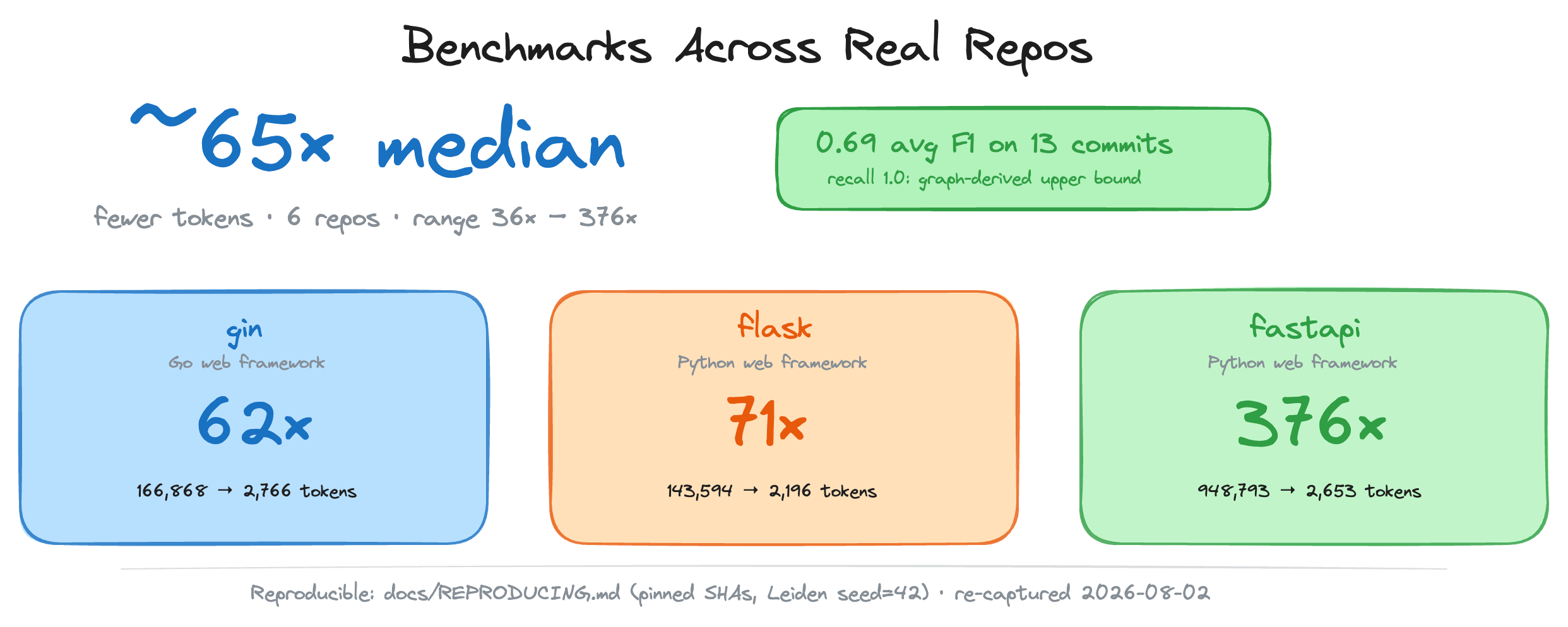
Headline number: the median per-question token reduction across the 6 repos is ~65x (whole-corpus baseline vs graph query). The 376x maximum is a single best-case repo (fastapi, the largest corpus) — not the typical result.
All numbers come from the automated evaluation runner against 6 real open-source repositories (13 commits total). Every config pins an upstream SHA, the Leiden community detector runs with a fixed seed, and embeddings are deterministic on CPU — so two runs on different machines produce identical numbers. The full reproduction recipe with expected outputs is in docs/REPRODUCING.md. A weekly report-only run on the two smallest configs lives in .github/workflows/eval.yml.
Token efficiency: ~65x median per-question reduction (range 36x – 376x; whole-corpus vs graph query)
For a typical agent question ("how does authentication work", "what is the main entry point", etc.), the graph returns ~2,000–3,500 tokens of targeted search hits + neighbor edges instead of forcing the agent to read every source file. The table below averages over the 5 sample questions defined in code_review_graph/token_benchmark.py.
| Repo |
Snapshot SHA |
naive_corpus_tokens |
avg graph_tokens |
Reduction |
| fastapi |
22381558 |
948,793 |
2,653 |
375.6x |
| flask |
a29f88ce |
143,594 |
2,196 |
71.0x |
| code-review-graph |
84bde354 |
208,821 |
3,190 |
68.1x |
| gin |
5c00df8a |
166,868 |
2,766 |
61.9x |
| httpx |
b55d4635 |
142,356 |
2,661 |
60.6x |
| express |
b4ab7d65 |
136,052 |
3,936 |
36.0x |
Median per-question reduction across the 6 repos: ~65x. The range is 36x – 376x, where 376x is the best case (fastapi, the largest corpus), not the headline.
Re-captured 2026-08-02 from clean clones at the pinned SHAs (crg 2.3.7, local all-MiniLM-L6-v2 embeddings). These numbers are lower than the 2026-05-25 capture they replace: the graph response grew as node embedding text became richer, so avg graph_tokens rose across every repo. fastapi is now measured at its current pin 22381558 rather than the retired 0227991a.
The whole-corpus baseline above is an upper bound no real agent pays: a competent agent greps for identifiers and reads only the best-matching files. The agent_baseline eval benchmark measures that realistic baseline — a pure-python grep over the corpus, top-3 files by match count, token-counted and compared to the graph query cost (evaluate/results/<repo>_agent_baseline_*.csv).
The formal eval/benchmarks/token_efficiency.py benchmark measures a different scenario — full get_review_context() JSON versus just the changed-file content of a commit — and reports ratios below 1 for small commits, because the review-context response carries impact-radius edges plus source snippets that exceed a tiny single-file diff. That is not a bug; the two benchmarks answer different questions. See docs/REPRODUCING.md for the full methodology.
Since v2.3.4, review and impact tools attach a compact context_savings estimate so MCP clients can see the approximate context saved per call. In v2.3.5 the CLI surfaces this as the boxed Token Savings panel shown above (see "Token Savings panel" in the Usage section) and adds --verify to cross-check against OpenAI's cl100k_base tokenizer. Calibration data in docs/REPRODUCING.md shows the estimate is within ~1% of real GPT-4 tokens in aggregate across 222 sample files.
Impact accuracy: 0.69 average F1 against graph-derived ground truth (recall 1.0 is a circular upper bound, not "100% recall")
Blast-radius analysis recovers every file in the ground truth on all 13 evaluation commits — but read that as an upper bound, not as "100% recall": in this mode the ground truth (changed files + files with call/import edges into them) is derived from the same graph the predictor traverses, so it is circular by construction. The over-prediction visible in the precision column is a deliberate trade-off: better to flag too many files than miss a broken dependency.
| Repo |
Commits |
Avg F1 |
Avg Precision |
Recall (graph-derived upper bound) |
| httpx |
2 |
0.863 |
0.785 |
1.0 |
| code-review-graph |
2 |
0.734 |
0.584 |
1.0 |
| fastapi |
2 |
0.697 |
0.539 |
1.0 |
| express |
2 |
0.667 |
0.500 |
1.0 |
| flask |
2 |
0.633 |
0.485 |
1.0 |
| gin |
3 |
0.609 |
0.439 |
1.0 |
| Average |
13 |
0.693 |
0.546 |
1.000 |
The benchmark also runs an honest co-change mode: the predictor is seeded with a single changed file and graded against the other files the author actually touched in the same commit — independent-ish evidence from git history, not from the graph. Both modes appear side by side in the result CSVs (ground_truth_mode column). As of the 2026-08-02 capture that mode returns predicted_files = 0 on every graded commit, so it is not yet a usable measurement and no co-change number is quoted here — the harness needs fixing before the mode says anything about accuracy.
Build performance
| Repo |
Files |
Nodes |
Edges |
Flow Detection |
Search Latency |
| express |
141 |
1,910 |
17,553 |
106ms |
0.7ms |
| fastapi |
1,122 |
6,285 |
27,117 |
128ms |
1.5ms |
| flask |
83 |
1,446 |
7,974 |
95ms |
0.7ms |
| gin |
99 |
1,286 |
16,762 |
111ms |
0.5ms |
| httpx |
60 |
1,253 |
7,896 |
96ms |
0.4ms |
Limitations and known weaknesses
- Impact "recall 1.0" is graph-derived and circular: the historical ground truth comes from the same graph edges the predictor walks, so it is an upper bound by construction. The honest co-change mode (grade against files actually co-changed in the same commit) is measured alongside it; expect those numbers to be substantially lower.
- Small single-file changes: Graph context can exceed naive file reads for trivial edits (see express results above). The overhead is the structural metadata that enables multi-file analysis.
- Search quality (MRR 0.35): Keyword search finds the right result in the top-4 for most queries, but ranking needs improvement. Express queries return 0 hits due to module-pattern naming.
- Flow detection (33% recall): Framework and conventional entry patterns are strongest for Python and PHP/Laravel. JavaScript and Go flow detection needs work.
- Precision vs recall trade-off: Impact analysis is deliberately conservative. It flags files that might be affected, which means some false positives in large dependency graphs.
Features
| Feature |
Details |
| Incremental updates |
Re-parses only the files whose hash changed. On a ~3,000-file repo a two-file edit takes ~2.5s on the hook path (measured). |
| * |
|

 A local-first code intelligence tool: it builds a persistent graph of your codebase so AI coding assistants read only the files that matter on review and large-repo tasks, instead of re-reading everything.