




Early access to the graphify platform is open before the public v1 launch: app.graphify.com
Type /graphify in your AI coding assistant and it maps your entire project (code, docs, PDFs, images, videos) into a knowledge graph you can query instead of grepping through files.
- Code maps for free, fully local. Code is parsed with tree-sitter AST: deterministic, no LLM, nothing leaves your machine. (Docs, PDFs, images and video use your assistant's model, or a configured API key, for a semantic pass.)
- Every edge is explained. Each connection is tagged
EXTRACTED (explicit in the source) or INFERRED (resolved by graphify), so you can tell what was read directly from what was inferred.
- Not a vector index. No embeddings, no vector store: a real graph you traverse. Ask a question, trace the path between two things, or explain one concept.
Want this always-on, updating in the background across your code, docs, and meetings rather than only on demand? That is what we are building at graphify.com, and early access is open now at app.graphify.com.
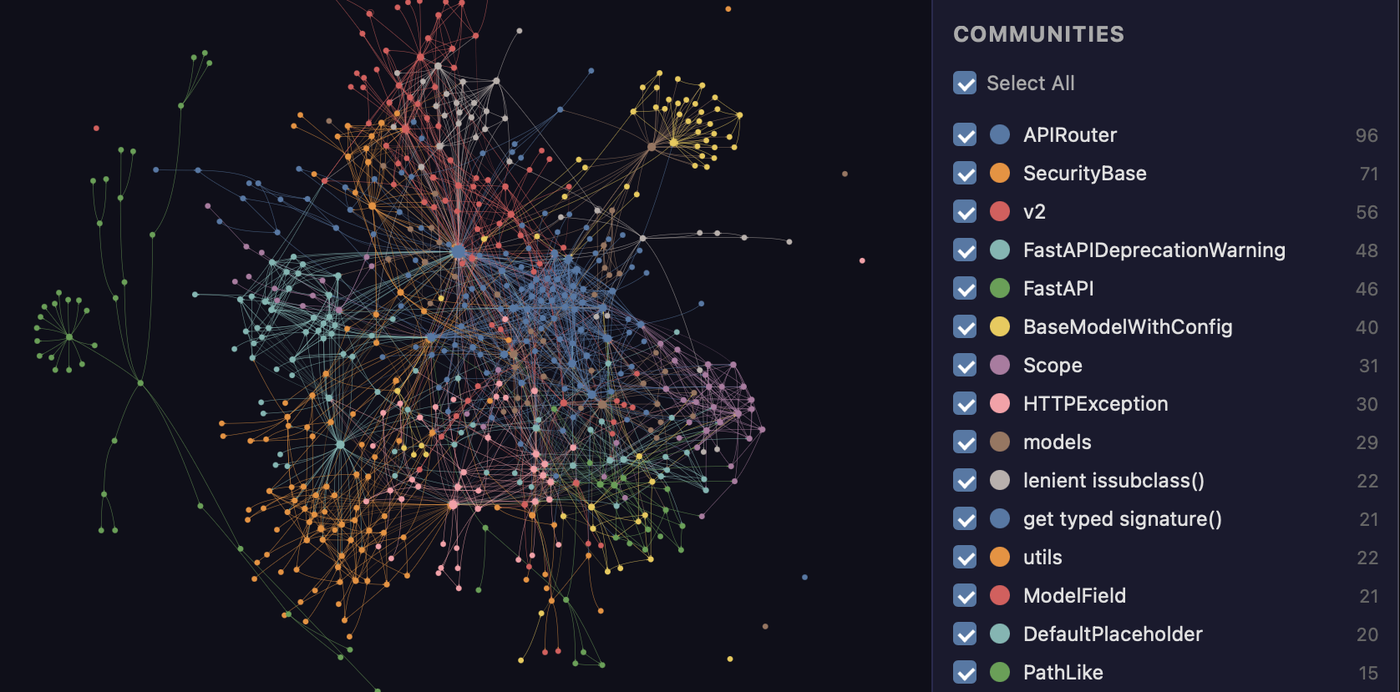
The FastAPI codebase mapped by graphify. Every node is a concept, colors are detected communities, and the whole thing is clickable in graph.html.
Get started (30 seconds):
uv tool install graphifyy      # install the CLI (or: pipx install graphifyy)
graphify install               # register the skill with your AI assistant
Then, in your AI assistant:
/graphify .
That's it. You get three files:
graphify-out/
├── graph.html       open in any browser — click nodes, filter, search
├── GRAPH_REPORT.md  the highlights: key concepts, surprising connections, suggested questions
└── graph.json       the full graph — query it anytime without re-reading your files
Works in Claude Code, Cursor, Codex, Gemini CLI, GitHub Copilot, and 15+ more — pick your platform.
See it in action
Once the graph is built you query it instead of reading files. Real output, graphify run on the FastAPI codebase shown above:
$ graphify explain "APIRouter"
Node: APIRouter
  Source:    routing.py L2210
  Community: 2
  Degree:    47

Connections (47):
  --> RequestValidationError [uses] [INFERRED]
  --> Dependant [uses] [INFERRED]
  --> .get() [method] [EXTRACTED]
  <-- __init__.py [imports] [EXTRACTED]
  ...

$ graphify path "FastAPI" "ModelField"
Shortest path (3 hops):
  FastAPI --uses--> DefaultPlaceholder <--references-- get_request_handler() --references--> ModelField
Every edge carries a confidence tag (EXTRACTED = explicit in the source, INFERRED = derived by resolution), so you can tell what was read directly from what was inferred. graphify query "<question>" returns a scoped subgraph for a plain-language question, and graphify path A B traces how any two things connect.
What it does
What you get out of the box:
| Capability |
What you get |
| God nodes |
The most-connected concepts, so you see what everything flows through |
| Communities |
The graph split into subsystems (Leiden), with LLM-free labels |
| Cross-file links |
calls / imports / inherits / mixes_in resolved across ~40 languages via tree-sitter AST |
| Query, path, explain |
Ask a question, trace the path between two things, or explain one concept, all against graph.json |
| Rationale + doc refs |
# NOTE: / # WHY: comments and ADR/RFC citations become first-class nodes linked to the code |
| Beyond code |
Docs, PDFs, images, and video/audio all map into the same graph |
| Local-first |
Code is parsed locally with tree-sitter (no LLM, nothing leaves your machine); only the semantic pass over docs/media calls a backend, and only if you configure one |
Benchmarks
| Benchmark |
Metric |
graphify |
Field |
| LOCOMO (n=300) |
recall@10 |
0.497 |
mem0 0.048, supermemory 0.149 |
| LOCOMO (n=300) |
QA accuracy |
45.3% |
supermemory 49.7%, mem0 27.3% |
| LongMemEval-S (n=50) |
QA accuracy |
76% |
tied with dense RAG |
| Graph build |
LLM credits |
0 |
per-token for most systems |
Every system ran on the same harness with the same model and budgets, scored by a judge blind-validated against a second judge (90.6% agreement, Cohen's kappa 0.81). Full per-system tables, the code-intelligence result, and reproduction commands: BENCHMARKS.md.
Prerequisites
| Requirement |
Minimum |
Check |
Install |
| Python |
3.10+ |
python --version |
python.org |
| uv (recommended) |
any |
uv --version |
curl -LsSf https://astral.sh/uv/install.sh | sh |
| pipx (alternative) |
any |
pipx --version |
pip install pipx |
macOS quick install (Homebrew):
brew install [email protected] uv
Windows quick install:
winget install astral-sh.uv
Ubuntu/Debian:
sudo apt install python3.12 python3-pip pipx
# or install uv:
curl -LsSf https://astral.sh/uv/install.sh | sh
Install
Official package: The PyPI package is graphifyy (double-y). Other graphify* packages on PyPI are not affiliated. The CLI command is still graphify.
Step 1 — install the package:
# Recommended (isolated env; if 'graphify' isn't found after, run: uv tool update-shell):
uv tool install graphifyy

# Alternatives:
pipx install graphifyy
pip install graphifyy  # may need PATH setup — see note below
Step 2 — register the skill with your AI assistant:
graphify install
That's it. Open your AI assistant and type /graphify .
To install the assistant skill into the current repository instead of your user
profile, add --project:
graphify install --project
graphify install --project --platform codex
Project-scoped installs write under the current directory, for example
.claude/skills/graphify/SKILL.md or .agents/skills/graphify/SKILL.md (plus a
references/ sidecar the skill loads on demand), and
print a git add hint for files that can be committed.
Per-platform commands that support project-scoped installs accept the same flag,
for example graphify claude install --project or graphify codex install --project.
PowerShell note: Use graphify . not /graphify . — the leading slash is a path separator in PowerShell.
graphify: command not found? uv tool install / pipx install put the graphify command in their tool bin dir (~/.local/bin). If your shell can't find it right after install — common on a fresh macOS + zsh setup — that dir isn't on your PATH yet: run uv tool update-shell (or pipx ensurepath), then open a new terminal. With plain pip, add ~/.local/bin (Linux) or ~/Library/Python/3.x/bin (Mac) to your PATH, or run python -m graphify.
Running with uvx / uv tool run instead of installing? Name the package, not the command: uvx --from graphifyy graphify install. Plain uvx graphify … fails (No solution found … no versions of graphify) because uv tool run reads the first word as a package, and the package is graphifyy — the graphify command lives inside it.
Avoid pip install on Mac/Windows if possible. The skill resolves Python at runtime from graphify-out/.graphify_python; if that points to a different environment than where pip installed the package, you'll get ModuleNotFoundError: No module named 'graphify'. uv tool install and pipx install isolate the package in their own env and avoid this entirely.
Git hooks and uv tool / pipx: graphify hook install embeds the current interpreter path directly into the hook scripts at install time, so the post-commit hook fires correctly even in GUI git clients and CI runners where ~/.local/bin is not on PATH. If you reinstall or upgrade graphify, re-run graphify hook install to refresh the embedded path.
Strict mode (Claude Code): graphify install --project --strict makes the assistant actually use the graph. The default install nudges it to run graphify query before reading files; strict mode blocks the first raw source read of a session and redirects it to the graph, then reverts to the nudge (so it fires at most once per session and never gets stuck). Toggle at runtime with GRAPHIFY_HOOK_STRICT=1/0; the default install is unchanged (soft nudge).
Pick your platform (20+ assistants, click to expand)
| Platform |
Install command |
| Claude Code (Linux/Mac) |
graphify install |
| Claude Code (Windows) |
graphify install (auto-detected) or graphify install --platform windows |
| CodeBuddy |
graphify install --platform codebuddy |
| Codex |
graphify install --platform codex |
| OpenCode |
graphify install --platform opencode |
| Kilo Code |
graphify install --platform kilo |
| GitHub Copilot CLI |
graphify install --platform copilot |
| VS Code Copilot Chat |
graphify vscode install |
| Aider |
graphify install --platform aider |
| OpenClaw |
graphify install --platform claw |
| Factory Droid |
graphify install --platform droid |
| Trae |
graphify install --platform trae |
| Trae CN |
graphify install --platform trae-cn |
| Gemini CLI |
graphify install --platform gemini |
| Hermes |
graphify install --platform hermes |
| Kimi Code |
graphify install --platform kimi |
| Amp |
graphify amp install |
| Agent Skills (cross-framework) |
graphify install --platform agents (alias --platform skills) |
| Kiro IDE/CLI |
graphify kiro install |
| Pi coding agent |
graphify install --platform pi |
| Cursor |
graphify cursor install |
| Devin CLI |
graphify devin install |
| Google Antigravity |
graphify antigravity install |
Codex users also need multi_agent = true under [features] in ~/.codex/config.toml for parallel extraction. CodeBuddy uses the same Agent tool and PreToolUse hook mechanism as Claude Code. Factory Droid uses the Task tool for parallel subagent dispatch. OpenClaw and Aider use sequential extraction (parallel agent support is still early on those platforms). Trae uses the Agent tool for parallel subagent dispatch and does not support PreToolUse hooks, so AGENTS.md is the always-on mechanism.
--platform agents (alias --platform skills) targets the generic cross-framework Agent-Skills locations: the spec's user-global ~/.agents/skills/ (read by npx skills and spec-compliant frameworks) for a global install, and ./.agents/skills/ for a project (--project) install. The bare graphify install stays single-platform (Claude Code) by design — use the named agents platform when you want the skill discoverable by any framework that reads .agents/skills.
Codex uses $graphify instead of /graphify.
Optional extras (install only what you need)
| Extra |
What it adds |
Install |
pdf |
PDF extraction |
uv tool install "graphifyy[pdf]" |
office |
.docx and .xlsx support |
uv tool install "graphifyy[office]" |
google |
Google Sheets rendering |
uv tool install "graphifyy[google]" |
video |
Video/audio transcription (faster-whisper + yt-dlp) |
uv tool install "graphifyy[video]" |
mcp |
MCP stdio server |
uv tool install "graphifyy[mcp]" |
neo4j |
Neo4j push support |
uv tool install "graphifyy[neo4j]" |
falkordb |
FalkorDB push support |
uv tool install "graphifyy[falkordb]" |
svg |
SVG graph export |
uv tool install "graphifyy[svg]" |
leiden |
Leiden community detection (Python < 3.13 only) |
uv tool install "graphifyy[leiden]" |
ollama |
Ollama local inference |
uv tool install "graphifyy[ollama]" |
openai |
OpenAI / OpenAI-compatible APIs |
uv tool install "graphifyy[openai]" |
gemini |
Google Gemini API |
uv tool install "graphifyy[gemini]" |
anthropic |
Anthropic Claude API (--backend claude, uses ANTHROPIC_API_KEY) |
uv tool install "graphifyy[anthropic]" |
bedrock |
AWS Bedrock (uses IAM, no API key) |
uv tool install "graphifyy[bedrock]" |
azure |
Azure OpenAI Service (--backend azure, uses AZURE_OPENAI_API_KEY + AZURE_OPENAI_ENDPOINT) |
uv tool install "graphifyy[openai]" |
sql |
SQL schema extraction |
uv tool install "graphifyy[sql]" |
postgres |
Live PostgreSQL introspection (--postgres DSN) |
uv tool install "graphifyy[postgres]" |
dm |
BYOND DreamMaker .dm/.dme AST extraction (may need a C compiler + python3-dev if no wheel matches your platform) |
uv tool install "graphifyy[dm]" |
terraform |
Terraform / HCL .tf/.tfvars/.hcl AST extraction |
uv tool install "graphifyy[terraform]" |
pascal |
Pascal / Delphi .pas/.dpr/.dpk/.inc AST extraction (more accurate calls/inherits edges; falls back to a regex extractor when absent) |
uv tool install "graphifyy[pascal]" |
ocaml |
OCaml .ml/.mli AST extraction |
uv tool install "graphifyy[ocaml]" |
commonlisp |
Common Lisp .lisp/.cl/.lsp/.asd AST extraction |
uv tool install "graphifyy[commonlisp]" |
robot |
Robot Framework .robot/.resource extraction (suites, test cases, keywords, keyword-call and resource/library import edges) |
uv tool install "graphifyy[robot]" |
chinese |
Chinese query segmentation (jieba) |
uv tool install "graphifyy[chinese]" |
all |
Everything above |
uv tool install "graphifyy[all]" |
Make your assistant always use the graph
Run this once in your project after building a graph:
| Platform |
Command |
| Claude Code |
graphify claude install |
| CodeBuddy |
graphify codebuddy install |
| Codex |
graphify codex install |
| OpenCode |
graphify opencode install |
| Kilo Code |
graphify kilo install |
| GitHub Copilot CLI |
graphify copilot install |
| VS Code Copilot Chat |
graphify vscode install |
| Aider |
graphify aider install |
| OpenClaw |
graphify claw install |
| Factory Droid |
graphify droid install |
| Trae |
graphify trae install |
| Trae CN |
graphify trae-cn install |
| Cursor |
graphify cursor install |
| Gemini CLI |
graphify gemini install |
| Hermes |
graphify hermes install |
| Kimi Code |
graphify install --platform kimi |
| Amp |
graphify amp install |
| Agent Skills (cross-framework) |
graphify agents install (alias graphify skills install) |
| Kiro IDE/CLI |
graphify kiro install |
| Pi coding agent |
graphify pi install |
| Devin CLI |
graphify devin install |
| Google Antigravity |
graphify antigravity install |
This writes a small config file that tells your assistant to consult the knowledge graph for codebase questions, preferring scoped queries like graphify query "<question>" over reading the full report or grepping raw files.
- Hook platforms (Claude Code, Gemini CLI): a hook fires automatically before search-style tool calls (and, on Claude Code, before reading source files one by one via the Read/Glob tools) and nudges your assistant toward the graph path.
- Instruction-file platforms (Codex, OpenCode, Cursor, etc.): persistent instruction files (
AGENTS.md, .cursor/rules/, etc.) provide the same qu

 Graphify turns a whole codebase — plus its docs, SQL schemas, configs, and PDFs — into a queryable knowledge graph you traverse instead of grepping files.