awesome-rsi README

The project's README from github.com/theseus-labs-rsi/awesome-rsi. As one markdown file: README.md.

Awesome Recursive Self-Improvement (RSI)

A taxonomy-first, auditable map of recursive self-improvement research.

Papers Companion survey Taxonomy

📄 Survey  •  📝 Cite  •  🧭 Taxonomy  •  📚 Catalog  •  🏭 Industry Cases  •  🆕 Updates  •  🤝 Contribute

This repository accompanies The Last AI Built by Humans: Toward Genuine Recursive Self-Improvement (Yi Duan et al., 2026; arXiv:2609.11873).

Every listed paper retains its arXiv identifier, primary autonomy level, and updated-object classification.

RSI is the capability of an intelligent system to transform acquired experience and feedback into persistent changes to itself across interaction rounds, such that those changes can affect how later improvements are generated, evaluated, selected, and consolidated. The updated object may be model weights, prompts, code, memory, skills, task distributions, or the improvement mechanism itself. Levels capture autonomy over what is changed, how it is changed, and where later learning experience comes from; they are not paper-quality rankings.

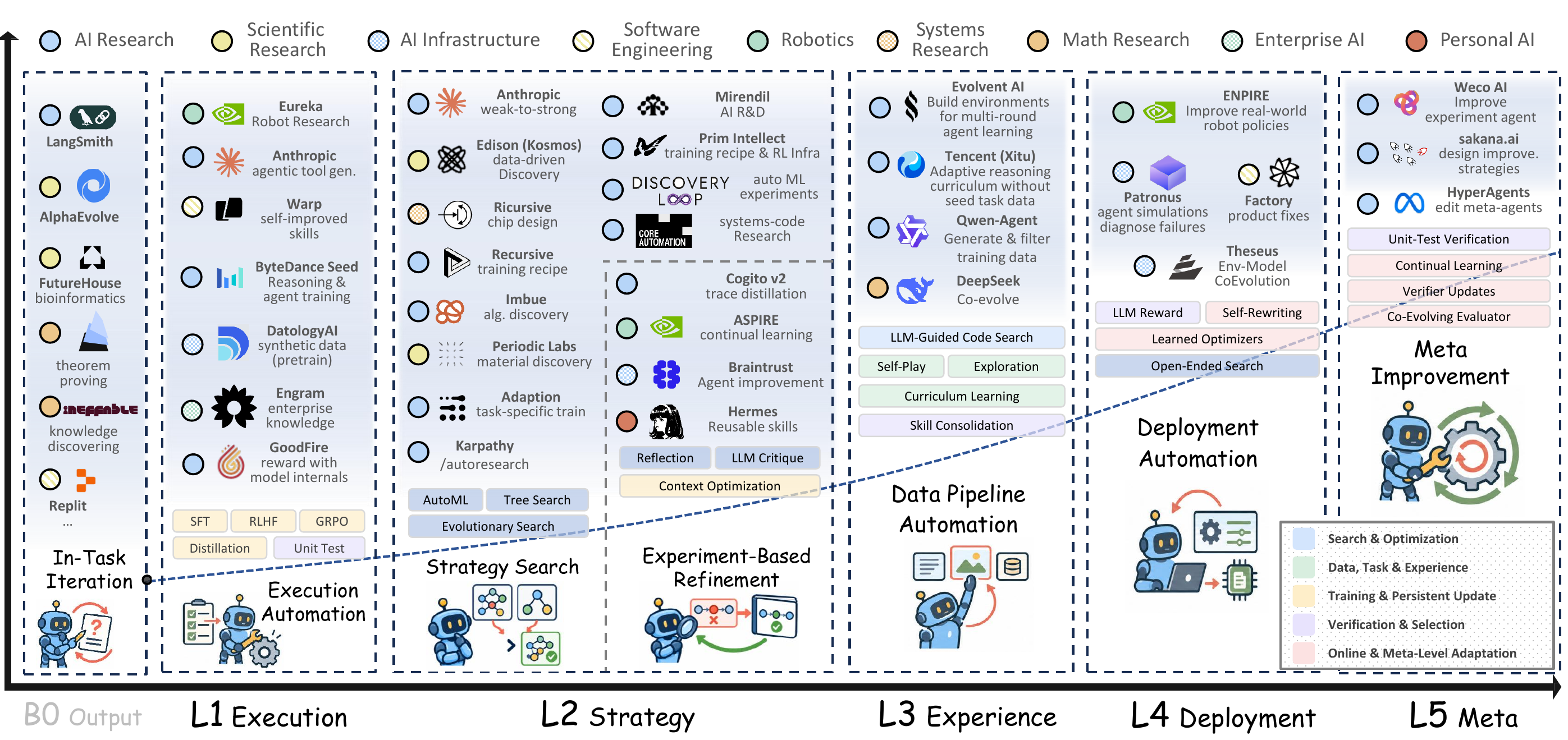
RSI autonomy taxonomy overview: from in-task iteration and execution automation, through strategy search and experience acquisition, to deployment automation and meta-level improvement.
Figure 1. RSI autonomy overview: from in-task iteration and execution automation, through strategy search and experience acquisition, to deployment automation and meta-level improvement.

Latest Updates ↑ top

This section logs material updates to this repository, including new source-verified research, industry coverage, and curation. It is editorially separate from the 519-paper taxonomy, so a release, project page, or repository update is never presented as a peer-reviewed paper by default.

  1. 2026-09-19 — Public Industry Practices added: A new source-verified timeline records 11 publicly disclosed cases in which AI systems contribute to AI R&D, training or inference infrastructure, or retained self-improvement loops. Each entry distinguishes the reported result from the limits of its RSI claim. [Browse the timeline]

  2. 2026-09-10 — Companion survey released: The Last AI Built by Humans: Toward Genuine Recursive Self-Improvement introduces HCI and the L1-L5 RSI roadmap used by this repository. [Paper]

Update policy
  • Include a repository update only when it adds or materially revises source-verified coverage; sources remain limited to primary research, official organization posts, technical reports, release notes, or maintained project pages.
  • Tag source items as Research or Industry and state their material type (Paper, Survey, Technical Report, Official Blog, Release, or Project); tag repository-maintenance entries as Repository and state the affected coverage. State the update date and a neutral, one-sentence explanation of RSI relevance.
  • Link research to an official proceedings page, DOI, or arXiv record; link industry items to the organization's original publication, never to a repost or social-media summary; link repository updates to the affected section.
  • An update is not automatically an in-scope taxonomy paper. It enters the L1-L5 catalog only after the same paper-level relevance review.

Public Industry Practices ↑ top

This timeline records publicly disclosed cases in which AI systems participate in their organization's AI R&D, training or inference infrastructure, or a retained self-improvement loop. It is deliberately separate from the paper catalog: each item is linked to a primary organization source and is not evidence that the system autonomously trained a successor frontier model. Results below are organization-reported, not independently reproduced.

Entries are ordered by publication date (newest first). “Boundary” names the most important limitation on the RSI claim rather than treating all feedback-driven optimization as equivalent.

Date Organization / primary source Publicly disclosed practice Reported result and boundary
2026-09-17 Z.ai — How GLM Built Its Own Inference Infrastructure GLM-5.3 proposed and validated optimizations for the production inference infrastructure serving GLM-5.3-Flash, using correctness checks, execution traces, microbenchmarks, and end-to-end measurements. Production-ready in under two weeks; end-to-end throughput reached about 3× the initial version. This improves serving infrastructure, not GLM's own weights.
2026-09-17 Anthropic — Measurements for Understanding the Pace of AI Development Inside Frontier Labs Anthropic measured Claude's participation across its internal AI-development work. As of August 2026, Claude was reported to lead about 26% of measured AI-R&D work and to collaborate on over 90%; no measured task category was fully autonomous.
2026-08-28 Tencent Hunyuan — Tencent Releases and Open-Sources Tencent Hy4 Preview Hy4 preview participated in its own R&D, including training methods, data strategy, evaluation, and low-level operator optimization; it also iterated on inference-system bottlenecks using experimental feedback. Tencent reports 31.8% end-to-end inference-throughput improvement. The objectives and acceptance process remain externally defined.
2026-07-29 OpenAI — How GPT-5.6 Fuses Frontier Intelligence with Frontier Efficiency GPT-5.6 Sol analyzed production workloads, tested routing and forward-pass changes, rewrote production Triton/Gluon operators, and ran architecture experiments for speculative-decoding models. OpenAI reports 20% lower end-to-end serving cost and over 15% token-generation efficiency improvement for speculative decoding. Neither figure means the base model retrained itself.
2026-07-16 Moonshot AI — Kimi K3: Open Frontier Intelligence Early K3 versions performed most of the team's operator-optimization work late in K3 development, including attention-kernel work and a MiniTriton compiler demonstration. This is model-assisted development of the software stack; the post does not establish a corresponding whole-training speedup or autonomous model development.
2026-06-23 ByteDance Seed — Seed2.1 Officially Released: Advancing AI Productivity Through “Seed for Seed,” Seed2.1 entered internal model R&D for evaluation, diagnosis, SFT data, RL-framework optimization, paper reproduction, and experiment validation, with multi-round use of intermediate artifacts and feedback. Some tasks reportedly run for hours to tens of days. The post does not quantify an independent contribution to the final model or claim end-to-end autonomy.
2026-06 Anthropic — When AI Builds Itself Claude investigated training-cluster failures, modified training code, ran experiments, and reviewed code in Anthropic's development workflow. Anthropic reports that over 80% of merged code was attributable to Claude as of May 2026. Controlled training-code experiments should not be read as whole-frontier-training speedups.
2026-05 OpenBMB — ForgeTrain: An LLM Pretraining Framework Built End-to-End by an Autonomous Agent Loop An autonomous coding-agent loop wrote, debugged, and optimized an LLM pretraining framework end-to-end, repeatedly launching training jobs, parsing logs, diagnosing failures, patching code, and passing validation gates. The resulting framework completed MiniCPM4-0.5B pretraining and produced usable model weights. OpenBMB reports 44.13% MFU on 64×H100, about 10% above its Megatron-LM baseline. The coding agent was external to MiniCPM; the harness, gates, objectives, and reference stack remained externally designed.
2026-04-02 Meta — KernelEvolve Meta's Ranking Engineer Agent autonomously designed, executed, and analyzed model experiments; KernelEvolve retained a search tree while iterating through code generation, compilation, correctness checks, and performance tests for kernels. Meta reports over 60% inference-throughput improvement for an Andromeda advertising model on NVIDIA GPUs and over 25% training-throughput improvement for an advertising model on MTIA. These are not Llama results.
2026-03-18 MiniMax — M2.7: Early Echoes of Self-Evolution M2.7 participated in RL-team workflows and repeatedly improved its own agent framework, tools, skills, and memory from failed trajectories and evaluation feedback. MiniMax reports coverage of 30–50% of selected workflows; one autonomous framework experiment ran for over 100 rounds and improved an internal evaluation by 30%. These are workflow and internal-evaluation results, not a general base-model gain.
2025-05-14 Google DeepMind — AlphaEvolve AlphaEvolve used Gemini to generate algorithm candidates that were automatically evaluated and evolved; applications included Google infrastructure and a matrix-multiplication kernel used in Gemini training. DeepMind reports a 23% speedup for that training kernel, corresponding to roughly 1% lower overall Gemini-training time. The search-and-verification harness remains a fixed, externally designed system.

The companion catalog retains research prototypes and papers—such as Darwin Gödel Machine and Hyperagents—under their primary L1–L5 mechanism rather than presenting them here as deployed industrial practice. This separation preserves a useful distinction: current public evidence most strongly supports human-supervised, verifier-mediated loops around infrastructure, experiments, and agent workflows—not fully autonomous successor-model development.

Table of Contents

Reading Paths ↑ top

The full catalog is designed for reference, but these short routes provide a faster entry point:

Goal Suggested route
Understand the field map Start with the companion survey, then read the improvement-loop anatomy and the L1-L5 overview.
Study persistent agent improvement Read Voyager for reusable skills and automatic curricula, then browse L3 and L4.
Study recursive meta-improvement Read Darwin Gödel Machine and Gödel Agent, then browse L5.

Companion Survey ↑ top

This collection accompanies The Last AI Built by Humans: Toward Genuine Recursive Self-Improvement, by Yi Duan, Ying Liu, Zirui Tang, Haodong Chen, Jun Zhou, Yumou Liu, Bangrui Xu, Yukai Wu, Sidi Chen, Yuhan Zhou, Haoyu Wang, Xiaoyou Yu, Shaokun Han, Xuzhou Zhu, Le Zhou, Bolin Lu, Wei Zhou, Jiachen Liu, Nuozhou Fang, Jiaxin Tian, Ruoyu Chen, Yuxuan Li, Kai Zuo, Kaiyan Zhang, Jiantao Qiu, Conghui He, Guoliang Li, Bowen Zhou, Zhiyuan Liu, Zhoufutu Wen, Jihua Kang, Xuanhe Zhou, and Fan Wu.

The survey introduces the Headroom-Closed Index (HCI), develops the RSI roadmap represented by the L1-L5 taxonomy, and examines RSI in scientific discovery, embodied intelligence, and software engineering. This repository provides the paper-level, auditable companion to that roadmap.

Read on arXiv · PDF

Scope and Relevance Decision ↑ top

The 491 baseline papers and 28 table-derived extensions in this collection are retained as RSI-related under the L1-L5 taxonomy. The taxonomy intentionally includes bounded forms and precursors:

Thus, inclusion does not claim that every entry is a fully autonomous or open-ended RSI system. The L1 and L2 labels make their bounded autonomy explicit.

RSI Improvement-Loop Anatomy ↑ top

Each entry can be interpreted through the same loop: experience -> candidate modification -> verifier / acceptance rule -> retained improvement -> successor re-entry. The relevant components are:

Component Role in the loop
System state Persistent state inherited by the next round.
Experience Prior interaction outcomes, failures, feedback, or observations that inform an update.
Target The object directly modified in the current round.
Improver and strategy The mechanism that proposes candidates and decides where or how to search.
Verifier The evaluator that applies an acceptance rule, such as tests, rewards, formal checks, or human feedback.
Improvement and successor An accepted, retained state change and the next system version that inherits it.

This anatomy supplies three tests for every claimed RSI loop: Where does the loop close? What is updated and inherited? Which decisions remain external?

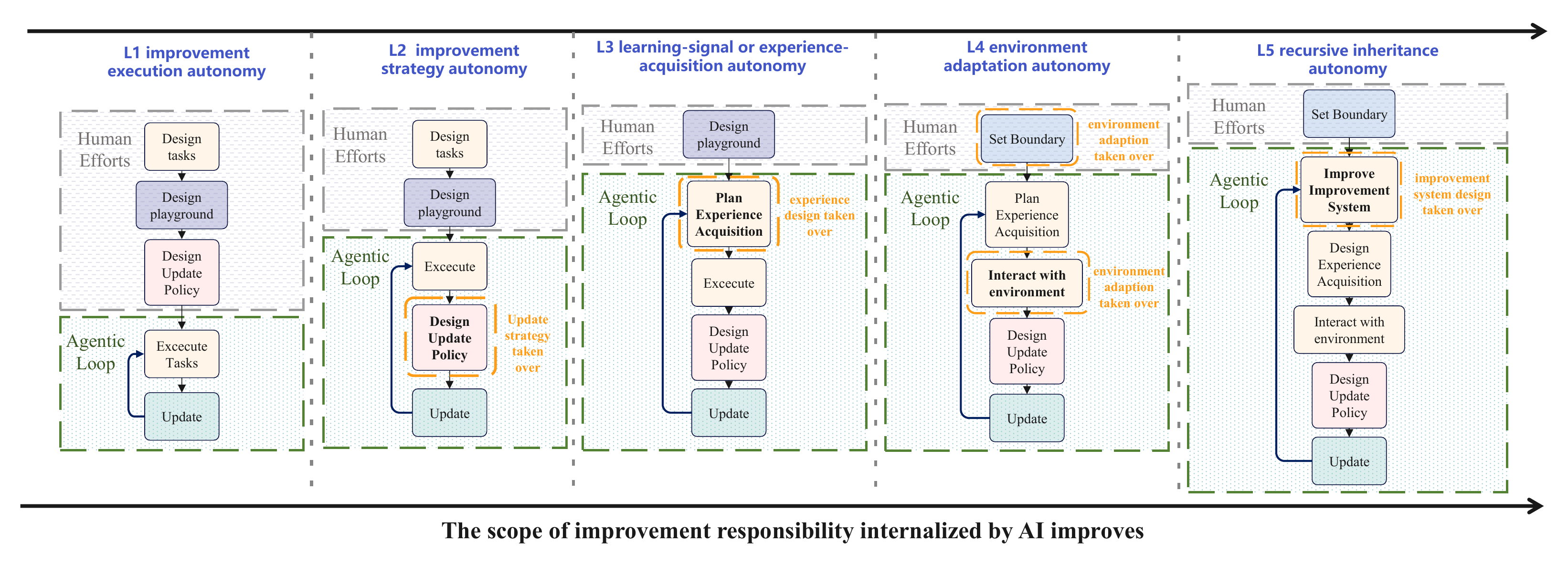
Five RSI loop patterns from L1 improvement-execution autonomy to L5 recursive inheritance autonomy. Human-controlled components are shown with gray dashed frames; the agentic loop expands as more improvement responsibilities are internalized.
Figure 2. Loop patterns across L1-L5. The agentic loop expands as AI internalizes more of the improvement process, while human-controlled constraints remain explicit.

How to Read the Tags ↑ top

Each entry has three colored badges:

Badge Meaning
Level-L1 to Level-L5 Autonomy level and locus in the improvement loop
In scope-RSI Retained by the source taxonomy's RSI relevance screen
Target-... Primary family of the updated or searched object

Blue, purple, orange, green, and red encode L1 through L5. Target colors distinguish the ten updated-object families. Each paper appears exactly once under its primary level; all available target codes are preserved in the entry.

Taxonomy at a Glance ↑ top

Level Papers Interpretation
L1 219 Autonomy over improvement execution.
L2 159 Autonomy over improvement strategies.
L3 65 Autonomy over future learning experience.
L4 45 Autonomy in deployment and environmental adaptation.
L5 31 From environmental adaptation to meta-improvement.

Each level begins with a small set of featured representative papers, selected to cover its defining mechanisms and important research landmarks. They are entry points for reading, not quality rankings; the complete catalog remains available in the expandable section below each level.

Updated-Object Families

Code prefix Family
1 Prompt & Context
2 Memory & Knowledge
3 Harness / Workflow
4 Tools & Skills
5 Model
6 Trainer / Optimization
7 Evaluator & Feedback
8 Data & Environment
9 External Artifact
10 Full-system / Co-evolution

1. L1 - Autonomy over Improvement Execution ↑ top

The system executes a human-defined improvement procedure and retains accepted results for later tasks or rounds. 219 papers.

Paper Representative mechanism
STaR Bootstraps model-generated rationales into a fixed, correctness-filtered self-training loop.
Constitutional AI Establishes critique-and-revision with AI feedback under a human-specified constitution.
ReST Generates an offline dataset with the current policy, then improves that policy with offline reinforcement learning.
SPIN Generates training data from earlier policy iterations and refines the policy against human-annotated responses.
Self-Rewarding Language Models Uses model-generated judgments as a fixed-protocol training signal.
Meta-Rewarding Language Models Extends AI-feedback training to iterative refinement of the judging signal.
Browse the full L1 catalog (219 papers)

Table-derived extensions

The following additions are explicitly discussed in Table 3 of the survey, which organizes representative L1 systems by AI development pipeline level.

  1. Phi-4-reasoning Technical Report
    [Paper] · arXiv:2504.21318

    Survey-table rationale: Training-data selection through LLM evaluation and boundary filtering; selection criteria remain human-defined. Updated object(s): 8.1 Training / Experience Data.

  2. NVIDIA Nemotron-4 340B Technical Report
    [Paper] · arXiv:2406.11704

    Survey-table rationale: Synthetic supervision is generated and reward-filtered under human-defined quality dimensions. Updated object(s): 8.1 Training / Experience Data.

  3. EDIT: Evidence-Diagnosed Intervention Training for Rule-Faithful LLM Grading
    [Paper] · arXiv:2606.06350

    Survey-table rationale: Diagnosed-step revisions refine a training signal while diagnostic criteria remain human-defined. Updated object(s): 6.1 Training Objective.

  4. AIPC: Agent-Based Automation for AI Model Deployment with Qualcomm AI Runtime
    [Paper] · arXiv:2604.14661

    Survey-table rationale: Skill-guided deployment adaptation follows a human-defined deployment procedure. Updated object(s): 3.6 Harness Implementation / Scaffold Code.

  5. $V_1$: Unifying Generation and Self-Verification for Parallel Reasoners
    [Paper] · arXiv:2603.04304

    Taxonomy: L1. Updated object(s): 5.1 Model Weights.

  6. A Co-Evolving Agentic AI System for Medical Imaging Analysis
    [Paper] · arXiv:2509.20279

    Taxonomy: L1. Updated object(s): 5.2 Adapter; 2.1 Experience Memory; 3.3 Harness / Workflow.

  7. A Context Engineering Framework for Improving Enterprise AI Agents based on Digital-Twin MDP
    [Paper] · arXiv:2603.22083

    Taxonomy: L1. Updated object(s): 1.5 Context; 3.1 Workflow.

  8. A Dynamic Self-Evolving Extraction System
    [Paper] · arXiv:2603.06915

    Taxonomy: L1. Updated object(s): 2.2 Knowledge Memory; 1.5 Context.

  9. A Model Can Help Itself: Reward-Free Self-Training for LLM Reasoning
    [Paper] · arXiv:2510.18814

    Taxonomy: L1. Updated object(s): 5.1 Model Weights.

  10. A Self-Improvable Polymer Discovery Framework Based on Conditional Generative Model
    [Paper] · arXiv:2312.04013

    Taxonomy: L1. Updated object(s): 5.1 Model Weights; 8.1 Experience Data.

  11. ACE: Self-Evolving LLM Coding Framework via Adversarial Unit Test Generation and Preference Optimization
    [Paper] · arXiv:2605.16299

    Taxonomy: L1. Updated object(s): 5.1 Model Weights; 8.1 Experience Data.

  12. AceSearcher: Bootstrapping Reasoning and Search for LLMs via Reinforced Self-Play
    [Paper] · arXiv:2509.24193

    Taxonomy: L1. Updated object(s): 5.1 Model Weights.

  13. Active-GRPO: Adaptive Imitation and Self-Improving Reasoning for Molecular Optimization
    [Paper] · arXiv:2607.00531

    Taxonomy: L1. Updated object(s): 5.1 Model Weights; 6.1 Objective.

  14. AdaExplore: Failure-Driven Adaptation and Diversity-Preserving Search for Efficient Kernel Generation
    [Paper] · arXiv:2604.16625

    Taxonomy: L1. Updated object(s): 1.1 Instruction; 2.2 Knowledge Memory.

  15. Agent Hospital: A Simulacrum of Hospital with Evolvable Medical Agents
    [Paper] · arXiv:2405.02957

    Taxonomy: L1. Updated object(s): 2.1 Experience Memory; 2.3 Procedural Memory.

  16. Agent0-VL: Exploring Self-Evolving Agent for Tool-Integrated Vision-Language Reasoning
    [Paper] · arXiv:2511.19900

    Taxonomy: L1. Updated object(s): 5.1 Model Weights.

  17. AgentGym: Evolving Large Language Model-based Agents across Diverse Environments
    [Paper] · arXiv:2406.04151

    Taxonomy: L1. Updated object(s): 5.1 Model Weights.

  18. Agentic-Ideation: Sample Efficient Agentic Trajectories Synthesis for Scientific Ideation Agents
    [Paper] · arXiv:2606.31229

    Taxonomy: L1. Updated object(s): 5.1 Model Weights.

  19. AlgoSkill: Learning to Design Algorithms by Scheduling Human-Like Skills
    [Paper] · arXiv:2606.29999

    Taxonomy: L1. Updated object(s): 5.1 Model Weights.

  20. AMR-SD: Asymmetric Meta-Reflective Self-Distillation for Token-Level Credit Assignment
    [Paper] · arXiv:2605.18529

    Taxonomy: L1. Updated object(s): 5.1 Model Weights; 6.1 Objective.

  21. Anyprefer: An Agentic Framework for Preference Data Synthesis
    [Paper] · arXiv:2504.19276

    Taxonomy: L1. Updated object(s): 5.1 Model Weights; 1.1 Instruction.

  22. APR: Penalizing Structural Redundancy in Large Reasoning Models via Anchor-based Process Rewards
    [Paper] · arXiv:2602.00760

    Taxonomy: L1. Updated object(s): 5.1 Model Weights; 6.1 Objective.

  23. AutoMalDesc: Large-Scale Script Analysis for Cyber Threat Research
    [Paper] · arXiv:2511.13333

    Taxonomy: L1. Updated object(s): 5.1 Model Weights; 8.1 Experience Data.

  24. AutoResearchClaw: Self-Reinforcing Autonomous Research with Human-AI Collaboration
    [Paper] · arXiv:2605.20025

    Taxonomy: L1. Updated object(s): 2.1 Experience Memory.

  25. Better, Faster: Harnessing Self-Improvement in Large Reasoning Models
    [Paper] · arXiv:2605.24998

    Taxonomy: L1. Updated object(s): 5.1 Model Weights; 6.1 Objective.

  26. Beyond Imitation: Self-Improving Robot Policies via Off-Policy Q-Planning
    [Paper] · arXiv:2608.21204

    Taxonomy: L1. Updated object(s): 5.2 Adapter.

  27. Beyond Self-Play: Hierarchical Reasoning for Continuous Motion in Closed-Loop Traffic Simulation
    [Paper] · arXiv:2605.09153

    Taxonomy: L1. Updated object(s): 5.1 Model Weights.

  28. Binary Decompilation LLM with Feedback-Driven Multi-Turn Refinement
    [Paper] · arXiv:2606.16162

    Taxonomy: L1. Updated object(s): 5.1 Model Weights.

  29. BiWM: Advancing Open-Source Interactive Video World Models with Bidirectional Autoregression
    [Paper] · arXiv:2606.10135

    Taxonomy: L1. Updated object(s): 5.1 Model Weights; 6.1 Objective.

  30. Breaking the Self-Confirming Loop: Diagnosing and Mitigating Systemic Reward Bias in Self-Rewarding RL
    [Paper] · arXiv:2510.08977

    Taxonomy: L1. Updated object(s): 5.1 Model Weights.

  31. Bridging What the Model Thinks and How It Speaks: Expressive Speech Generation via Self-Aware Intent-Realization Alignment
    [Paper] · arXiv:2604.11424

    Taxonomy: L1. Updated object(s): 5.1 Model Weights.

  32. Can Large Reasoning Models Self-Train?
    [Paper] · arXiv:2505.21444

    Taxonomy: L1. Updated object(s): 5.1 Model Weights.

  33. Can Recommender Systems Teach Themselves? A Recursive Self-Improving Framework with Fidelity Control
    [Paper] · arXiv:2602.15659

    Taxonomy: L1. Updated object(s): 5.1 Model Weights; 8.1 Experience Data.

  34. CAST: Non-Privileged Clipped Asymmetric Self-Teaching with Advantage Flipping for GRPO
    [Paper] · arXiv:2606.00172

    Taxonomy: L1. Updated object(s): 5.1 Model Weights.

  35. CATPO: Critique-Augmented Tree Policy Optimization
    [Paper] · arXiv:2606.08346

    Taxonomy: L1. Updated object(s): 5.1 Model Weights; 6.4 Curriculum.

  36. CEPO: RLVR Self-Distillation using Contrastive Evidence Policy Optimization
    [Paper] · arXiv:2605.19436

    Taxonomy: L1. Updated object(s): 5.1 Model Weights; 6.1 Objective.

  37. CIIR@LiveRAG 2025: Optimizing Multi-Agent Retrieval Augmented Generation through Self-Training
    [Paper] · arXiv:2506.10844

    Taxonomy: L1. Updated object(s): 5.2 Adapter.

  38. Cleansing the Artificial Mind: A Self-Reflective Detoxification Framework for Large Language Models
    [Paper] · arXiv:2601.11776

    Taxonomy: L1. Updated object(s): 5.1 Model Weights.

  39. Co-rewarding: Stable Self-supervised RL for Eliciting Reasoning in Large Language Models
    [Paper] · arXiv:2508.00410

    Taxonomy: L1. Updated object(s): 5.1 Model Weights.

  40. CoAct: Co-Active LLM Preference Learning with Human-AI Synergy
    [Paper] · arXiv:2604.17501

    Taxonomy: L1. Updated object(s): 5.1 Model Weights.

  41. Consistent Paths Lead to Truth: Self-Rewarding Reinforcement Learning for LLM Reasoning
    [Paper] · arXiv:2506.08745

    Taxonomy: L1. Updated object(s): 5.1 Model Weights.

  42. Constitutional AI: Harmlessness from AI Feedback
    [Paper] · arXiv:2212.08073

    Taxonomy: L1. Updated object(s): 5.1 Model Weights; 7.2 Reward / Fitness.

  43. Continual Self-Improvement with Lightweight Experiential Latent Memories
    [Paper] · arXiv:2606.17803

    Taxonomy: L1. Updated object(s): 5.2 Adapter; 2.1 Experience Memory.

  44. Continuous Self-Improvement of Large Language Models by Test-time Training with Verifier-Driven Sample Selection
    [Paper] · arXiv:2505.19475

    Taxonomy: L1. Updated object(s): 5.2 Adapter.

  45. CoVerRL: Breaking the Consensus Trap in Label-Free Reasoning via Generator-Verifier Co-Evolution
    [Paper] · arXiv:2603.17775

    Taxonomy: L1. Updated object(s): 5.1 Model Weights.

  46. CREAM: Consistency Regularized Self-Rewarding Language Models
    [Paper] · arXiv:2410.12735

    Taxonomy: L1. Updated object(s): 5.1 Model Weights.

  47. CritiCal: Can Critique Help LLM Uncertainty or Confidence Calibration?
    [Paper] · arXiv:2510.24505

    Taxonomy: L1. Updated object(s): 5.1 Model Weights.

  48. Deciphering Scientific Reasoning Steps from Outcome Data for Molecule Optimization
    [Paper] · arXiv:2603.20262

    Taxonomy: L1. Updated object(s): 5.1 Model Weights.

  49. Decouple to Generalize: Context-First Self-Evolving Learning for Data-Scarce Vision-Language Reasoning
    [Paper] · arXiv:2512.06835

    Taxonomy: L1. Updated object(s): 5.1 Model Weights; 8.1 Experience Data.

  50. DeepInnovator: Triggering the Innovative Capabilities of LLMs
    [Paper] · arXiv:2602.18920

    Taxonomy: L1. Updated object(s): 5.1 Model Weights; 8.1 Experience Data.

  51. DeepSeekMath-V2: Towards Self-Verifiable Mathematical Reasoning
    [Paper] · arXiv:2511.22570

    Taxonomy: L1. Updated object(s): 5.1 Model Weights; 7.3 Verifier.

  52. DemoPSD: Disagreement-Modulated Policy Self-Distillation
    [Paper] · arXiv:2607.02502

    Taxonomy: L1. Updated object(s): 5.1 Model Weights; 6.1 Objective.

  53. Depression Diagnosis Dialogue Simulation: Self-improving Psychiatrist with Tertiary Memory
    [Paper] · arXiv:2409.15084

    Taxonomy: L1. Updated object(s): 2.1 Experience Memory; 2.3 Procedural Memory.

  54. DermoGPT: Open Weights and Open Data for Morphology-Grounded Dermatological Reasoning MLLMs
    [Paper] · arXiv:2601.01868

    Taxonomy: L1. Updated object(s): 5.1 Model Weights; 6.1 Objective.

  55. Differentiable Mixture-of-Agents Incentivizes Swarm Intelligence of Large Language Models
    [Paper] · arXiv:2605.15706

    Taxonomy: L1. Updated object(s): 3.3 Harness / Workflow; 5.2 Adapter.

  56. Distilling LLM Feedback for Lean Theorem Proving
    [Paper] · arXiv:2605.30861

    Taxonomy: L1. Updated object(s): 5.1 Model Weights.

  57. Double-Checker: Enhancing Reasoning of Slow-Thinking LLMs via Self-Critical Fine-Tuning
    [Paper] · arXiv:2506.21285

    Taxonomy: L1. Updated object(s): 5.1 Model Weights.

  58. DRIFT: Difficulty Routing Self-DIstillation with Rhythm-Gated Exploration and Success BuFfer Training
    [Paper] · arXiv:2606.30345

    Taxonomy: L1. Updated object(s): 5.1 Model Weights.

  59. Dual-Modality Multi-Stage Adversarial Safety Training: Robustifying Multimodal Web Agents Against Cross-Modal Attacks
    [Paper] · arXiv:2603.04364

    Taxonomy: L1. Updated object(s): 5.1 Model Weights; 8.1 Experience Data.

  60. DuPO: Enabling Reliable LLM Self-Verification via Dual Preference Optimization
    [Paper] · arXiv:2508.14460

    Taxonomy: L1. Updated object(s): 5.1 Model Weights; 6.1 Objective.

  61. Dynamic Alignment for Collective Agency: Toward a Scalable Self-Improving Framework for Open-Ended LLM Alignment
    [Paper] · arXiv:2512.05464

    Taxonomy: L1. Updated object(s): 5.1 Model Weights.

  62. EARS: Explanatory Abstention for Reliable Sub-Agent Modeling in Large-scale Multi-Agent Systems
    [Paper] · arXiv:2606.18668

    Taxonomy: L1. Updated object(s): 5.1 Model Weights; 8.1 Experience Data.

  63. Easy Samples Are All You Need: Self-Evolving LLMs via Data-Efficient Reinforcement Learning
    [Paper] · arXiv:2604.18639

    Taxonomy: L1. Updated object(s): 5.1 Model Weights.

  64. Emulating Clinician Cognition via Self-Evolving Deep Clinical Research
    [Paper] · arXiv:2603.10677

    Taxonomy: L1. Updated object(s): 2.1 Experience Memory.

  65. Endless Terminals: Scaling RL Environments for Terminal Agents
    [Paper] · arXiv:2601.16443

    Taxonomy: L1. Updated object(s): 5.1 Model Weights; 8.3 Environment.

  66. Enhancing Mathematical Reasoning in LLMs with Background Operators
    [Paper] · arXiv:2412.04110

    Taxonomy: L1. Updated object(s): 5.1 Model Weights.

  67. EpiCaR: Knowing What You Don't Know Matters for Better Reasoning in LLMs
    [Paper] · arXiv:2601.06786

    Taxonomy: L1. Updated object(s): 5.1 Model Weights; 6.1 Objective.

  68. Evo-MedAgent: Beyond One-Shot Diagnosis with Agents That Remember, Reflect, and Improve
    [Paper] · arXiv:2604.14475

    Taxonomy: L1. Updated object(s): 2.1 Experience Memory; 2.3 Procedural Memory.

  69. EvoDefense: Co-Evolving Black-Box Defense with Large Language Models
    [Paper] · arXiv:2605.31140

    Taxonomy: L1. Updated object(s): 5.2 Adapter; 2.1 Experience Memory.

  70. EVOLVE-VLA: Test-Time Training from Environment Feedback for Vision-Language-Action Models
    [Paper] · arXiv:2512.14666

    Taxonomy: L1. Updated object(s): 5.1 Model Weights.

  71. ExpeL: LLM Agents Are Experiential Learners
    [Paper] · arXiv:2308.10144

    Taxonomy: L1. Updated object(s): 2.1 Experience Memory; 2.2 Knowledge Memory.

  72. Exploring and Exploiting the Inherent Efficiency within Large Reasoning Models for Self-Guided Efficiency Enhancement
    [Paper] · arXiv:2506.15647

    Taxonomy: L1. Updated object(s): 5.1 Model Weights.

  73. ExpRL: Exploratory RL for LLM Mid-Training
    [Paper] · arXiv:2606.17024

    Taxonomy: L1. Updated object(s): 5.1 Model Weights.

  74. FiRe: Fine-grained Multimodal Reasoning for Enhanced Image Generation
    [Paper] · arXiv:2604.13491

    Taxonomy: L1. Updated object(s): 5.1 Model Weights.

  75. First SFT, Second RL, Third UPT: Continual Improving Multi-Modal LLM Reasoning via Unsupervised Post-Training
    [Paper] · arXiv:2505.22453

    Taxonomy: L1. Updated object(s): 5.1 Model Weights; 8.1 Experience Data.

  76. Forward-Free Diffusion Language Models with BPTT-Free Looped Refinement
    [Paper] · arXiv:2606.08357

    Taxonomy: L1. Updated object(s): 5.1 Model Weights; 6.1 Objective.

  77. From Memorization to Creativity: LLM as a Designer of Novel Neural Architectures
    [Paper] · arXiv:2601.02997

    Taxonomy: L1. Updated object(s): 5.2 Adapter; 8.1 Experience Data.

  78. Generating on Generated: An Approach Towards Self-Evolving Diffusion Models
    [Paper] · arXiv:2502.09963

    Taxonomy: L1. Updated object(s): 5.1 Model Weights.

  79. GRAM-R^2: Self-Training Generative Foundation Reward Models for Reward Reasoning
    [Paper] · arXiv:2509.02492

    Taxonomy: L1. Updated object(s): 5.1 Model Weights.

  80. GSEM: Graph-based Self-Evolving Memory for Experience Augmented Clinical Reasoning
    [Paper] · arXiv:2603.22096

    Taxonomy: L1. Updated object(s): 2.1 Experience Memory; 2.4 Memory & Knowledge.

  81. Heterogeneous Self-Play for Realistic Highway Traffic Simulation
    [Paper] · arXiv:2604.16406

    Taxonomy: L1. Updated object(s): 5.1 Model Weights.

  82. How to Train Your Long-Context Visual Document Model
    [Paper] · arXiv:2602.15257

    Taxonomy: L1. Updated object(s): 5.1 Model Weights; 7.1 Judge.

  83. HS-STaR: Hierarchical Sampling for Self-Taught Reasoners via Difficulty Estimation and Budget Reallocation
    [Paper] · arXiv:2505.19866

    Taxonomy: L1. Updated object(s): 5.1 Model Weights; 6.4 Curriculum.

  84. ICRL: Learning to Internalize Self-Critique with Reinforcement Learning
    [Paper] · arXiv:2605.15224

    Taxonomy: L1. Updated object(s): 5.1 Model Weights; 6.1 Objective.

  85. Improving LLM Code Reasoning via Semantic Equivalence Self-Play with Formal Verification
    [Paper] · arXiv:2604.17010

    Taxonomy: L1. Updated object(s): 5.1 Model Weights; 5.2 Adapter.

  86. Improving Reasoning in Vision-Language Models via Perception Verified Self-Training
    [Paper] · arXiv:2606.22158

    Taxonomy: L1. Updated object(s): 5.1 Model Weights.

  87. IRIS: Interpolative Rényi Iterative Self-play for Large Language Model Fine-Tuning
    [Paper] · arXiv:2604.20933

    Taxonomy: L1. Updated object(s): 5.1 Model Weights.

  88. Iterative Compositional Data Generation for Robot Control
    [Paper] · arXiv:2512.10891

    Taxonomy: L1. Updated object(s): 5.1 Model Weights; 8.1 Experience Data.

  89. JailDAM: Jailbreak Detection with Adaptive Memory for Vision-Language Model
    [Paper] · arXiv:2504.03770

    Taxonomy: L1. Updated object(s): 2.2 Knowledge Memory; 2.5 Memory & Knowledge.

  90. KBSpec: LLM-driven Formal Specification Generation with Evolving Domain Knowledge Base
    [Paper] · arXiv:2606.21339

    Taxonomy: L1. Updated object(s): 2.2 Knowledge Memory; 2.3 Procedural Memory.

  91. Keep Policy Gradient in Charge: Sibling-Guided Credit Distillation for Long-Horizon Tool-Use Agents
    [Paper] · arXiv:2606.12634

    Taxonomy: L1. Updated object(s): 5.1 Model Weights; 6.1 Objective.

  92. Know When to Stop: Segment-Level Credit Assignment for Reducing Overthinking
    [Paper] · arXiv:2607.00482

    Taxonomy: L1. Updated object(s): 5.1 Model Weights; 6.1 Objective.

  93. KVerus: Scalable and Resilient Formal Verification Proof Generation for Rust Code
    [Paper] · arXiv:2605.03822

    Taxonomy: L1. Updated object(s): 9.1 Program Code; 2.2 Knowledge Memory.

  94. Latent Preference Modeling for Cross-Session Personalized Tool Calling
    [Paper] · arXiv:2604.17886

    Taxonomy: L1. Updated object(s): 2.2 Knowledge Memory.

  95. Learn from Your Mistakes: Tree-like Self-Play for Secure Code LLMs
    [Paper] · arXiv:2606.03489

    Taxonomy: L1. Updated object(s): 5.1 Model Weights; 6.1 Objective.

  96. Learn Your Reference Model for Real Good Alignment
    [Paper] · arXiv:2404.09656

    Taxonomy: L1. Updated object(s): 5.1 Model Weights.

  97. Learning from Language Feedback via Variational Policy Distillation
    [Paper] · arXiv:2605.15113

    Taxonomy: L1. Updated object(s): 5.1 Model Weights.

  98. Learning from Supervision with Semantic and Episodic Memory: A Reflective Approach to Agent Adaptation
    [Paper] · arXiv:2510.19897

    Taxonomy: L1. Updated object(s): 2.1 Experience Memory; 2.2 Knowledge Memory.

  99. Learning from Your Own Mistakes: Constructing Learnable Micro-Reflective Trajectories for Self-Distillation
    [Paper] · arXiv:2606.18844

    Taxonomy: L1. Updated object(s): 5.1 Model Weights; 6.1 Objective.

  100. Learning Steerable Clarification Policies with Collaborative Self-play
    [Paper] · arXiv:2512.04068

    Taxonomy: L1. Updated object(s): 5.1 Model Weights.

  101. Learning to Better Search with Language Models via Guided Reinforced Self-Training
    [Paper] · arXiv:2410.02992

    Taxonomy: L1. Updated object(s): 5.1 Model Weights.

  102. Learning to Plan & Reason for Evaluation with Thinking-LLM-as-a-Judge
    [Paper] · arXiv:2501.18099

    Taxonomy: L1. Updated object(s): 5.1 Model Weights.

  103. Learning to Plan Before Answering: Self-Teaching LLMs to Learn Abstract Plans for Problem Solving
    [Paper] · arXiv:2505.00031

    Taxonomy: L1. Updated object(s): 5.1 Model Weights.

  104. Learning to Self-Verify Makes Language Models Better Reasoners
    [Paper] · arXiv:2602.07594

    Taxonomy: L1. Updated object(s): 5.1 Model Weights; 6.1 Objective.

  105. Learning to Solve and Verify: A Self-Play Framework for Code and Test Generation
    [Paper] · arXiv:2502.14948

    Taxonomy: L1. Updated object(s): 5.1 Model Weights.

  106. LLM-Personalize: Aligning LLM Planners with Human Preferences via Reinforced Self-Training for Housekeeping Robots
    [Paper] · arXiv:2404.14285

    Taxonomy: L1. Updated object(s): 5.1 Model Weights.

  107. Meta-Rewarding Language Models: Self-Improving Alignment with LLM-as-a-Meta-Judge
    [Paper] · arXiv:2407.19594

    Taxonomy: L1. Updated object(s): 5.1 Model Weights.

  108. MiGrATe: Mixed-Policy GRPO for Adaptation at Test-Time
    [Paper] · arXiv:2508.08641

    Taxonomy: L1. Updated object(s): 5.2 Adapter.

  109. MobileIPL: Enhancing Mobile Agents Thinking Process via Iterative Preference Learning
    [Paper] · arXiv:2505.12299

    Taxonomy: L1. Updated object(s): 5.1 Model Weights; 8.1 Experience Data.

  110. Monte Carlo Tree Search with Reasoning Path Refinement for Small Language Models in Conversational Text-to-NoSQL
    [Paper] · arXiv:2602.12574

    Taxonomy: L1. Updated object(s): 5.1 Model Weights.

  111. Motus2: A Self-Evolving General World Model for Dexterous Manipulation
    [Paper] · arXiv:2608.30237

    Taxonomy: L1. Updated object(s): 5.1 Model Weights; 8.4 Data & Environment; 7.2 Reward / Fitness.

  112. Not All Synthetic Data Is Yours to Learn From
    [Paper] · arXiv:2605.31126

    Taxonomy: L1. Updated object(s): 5.1 Model Weights.

  113. Object-Centric Residual RL for Zero-Shot Sim-to-Real VLA Enhancement
    [Paper] · arXiv:2606.18953

    Taxonomy: L1. Updated object(s): 5.1 Model Weights; 5.2 Adapter.

  114. Observations and Remedies for Large Language Model Bias in Self-Consuming Performative Loop
    [Paper] · arXiv:2601.05184

    Taxonomy: L1. Updated object(s): 5.1 Model Weights; 8.1 Experience Data.

  115. OmniOPSD: Rationale-Privileged On-Policy Self-Distillation for Affective Computing
    [Paper] · arXiv:2606.15920

    Taxonomy: L1. Updated object(s): 5.1 Model Weights.

  116. OWL: Unsupervised 3D Object Detection by Occupancy Guided Warm-up and Large Model Priors Reasoning
    [Paper] · arXiv:2512.05698

    Taxonomy: L1. Updated object(s): 5.1 Model Weights; 8.1 Experience Data.

  117. PaperSearchQA: Learning to Search and Reason over Scientific Papers with RLVR
    [Paper] · arXiv:2601.18207

    Taxonomy: L1. Updated object(s): 5.1 Model Weights; 8.1 Experience Data.

  118. PARNESS: A Paper Harness for End-to-End Automated Scientific Research with Dynamic Workflows, Full-Text Indexing, and Cross-Run Knowledge Accumulation
    [Paper] · arXiv:2605.05258

    Taxonomy: L1. Updated object(s): 2.2 Knowledge Memory; 2.1 Experience Memory.

  119. Paying More Attention to Visual Tokens in Self-Evolving Large Multimodal Models
    [Paper] · arXiv:2606.27373

    Taxonomy: L1. Updated object(s): 5.2 Adapter; 6.1 Objective.

  120. PBSD: Privileged Bayesian Self-Distillation for Long-Horizon Credit Assignment
    [Paper] · arXiv:2606.09348

    Taxonomy: L1. Updated object(s): 5.1 Model Weights; 6.1 Objective.

  121. PEARL: Training Socratic Tutors with Pedagogically Aligned Reinforcement Learning
    [Paper] · arXiv:2605.29582

    Taxonomy: L1. Updated object(s): 5.1 Model Weights; 6.1 Objective.

  122. Peer-Predictive Self-Training for Language Model Reasoning
    [Paper] · arXiv:2604.13356

    Taxonomy: L1. Updated object(s): 5.1 Model Weights.

  123. Perception, Verdict, and Evolution: Hindsight-Driven Self-Refining Forensics Agent for AI-Generated Image Detection
    [Paper] · arXiv:2606.26552

    Taxonomy: L1. Updated object(s): 5.1 Model Weights.

  124. PLLM: Pseudo-Labeling Large Language Models for CAD Program Synthesis
    [Paper] · arXiv:2602.12561

    Taxonomy: L1. Updated object(s): 5.2 Adapter.

  125. Policy-Guided Stepwise Model Routing for Cost-Effective Reasoning
    [Paper] · arXiv:2605.06116

    Taxonomy: L1. Updated object(s): 3.3 Harness / Workflow.

  126. Post-Training Probability Manifold Correction via Structured SVD Pruning and Self-Referential Distillation
    [Paper] · arXiv:2602.00372

    Taxonomy: L1. Updated object(s): 5.1 Model Weights.

  127. Poster: ClawdGo: Endogenous Security Awareness Training for Autonomous AI Agents
    [Paper] · arXiv:2604.24020

    Taxonomy: L1. Updated object(s): 2.3 Procedural Memory; 2.5 Memory & Knowledge; 8.2 Task Generator.

  128. PRefLexOR: Preference-based Recursive Language Modeling for Exploratory Optimization of Reasoning and Agentic Thinking
    [Paper] · arXiv:2410.12375

    Taxonomy: L1. Updated object(s): 5.1 Model Weights.

  129. PRISMA: Preference-Reinforced Self-Training Approach for Interpretable Emotionally Intelligent Negotiation Dialogues
    [Paper] · arXiv:2604.18354

    Taxonomy: L1. Updated object(s): 5.1 Model Weights.

  130. Probing Visual Language Priors in VLMs
    [Paper] · arXiv:2501.00569

    Taxonomy: L1. Updated object(s): 5.1 Model Weights.

  131. Procedural Memory Distillation: Online Reflection for Self-Improving Language Models
    [Paper] · arXiv:2607.01480

    Taxonomy: L1. Updated object(s): 5.1 Model Weights.

  132. Process-based Self-Rewarding Language Models
    [Paper] · arXiv:2503.03746

    Taxonomy: L1. Updated object(s): 5.1 Model Weights.

  133. ProcessThinker: Enhancing Multi-modal Large Language Models Reasoning via Rollout-based Process Reward
    [Paper] · arXiv:2606.11209

    Taxonomy: L1. Updated object(s): 5.1 Model Weights.

  134. PsychAgent: An Experience-Driven Lifelong Learning Agent for Self-Evolving Psychological Counselor
    [Paper] · arXiv:2604.00931

    Taxonomy: L1. Updated object(s): 5.1 Model Weights; 4.4 Skill Library.

  135. Pythagoras-Prover: Advancing Efficient Formal Proving via Augmented Lean Formalisation
    [Paper] · arXiv:2606.12594

    Taxonomy: L1. Updated object(s): 5.1 Model Weights; 8.1 Experience Data.

  136. Quiet-STaR: Language Models Can Teach Themselves to Think Before Speaking
    [Paper] · arXiv:2403.09629

    Taxonomy: L1. Updated object(s): 5.1 Model Weights.

  137. Reasoning and Learning a Perceptual Metric for Self-Training of Reflective Objects in Bin-Picking with a Low-cost Camera
    [Paper] · arXiv:2503.20207

    Taxonomy: L1. Updated object(s): 5.1 Model Weights; 8.1 Experience Data.

  138. Reasoning-Enhanced Self-Training for Long-Form Personalized Text Generation
    [Paper] · arXiv:2501.04167

    Taxonomy: L1. Updated object(s): 5.1 Model Weights.

  139. RebuttalAgent: Strategic Persuasion in Academic Rebuttal via Theory of Mind
    [Paper] · arXiv:2601.15715

    Taxonomy: L1. Updated object(s): 5.1 Model Weights.

  140. Red-Bandit: Test-Time Adaptation for LLM Red-Teaming via Bandit-Guided LoRA Experts
    [Paper] · arXiv:2510.07239

    Taxonomy: L1. Updated object(s): 5.2 Adapter; 3.3 Harness / Workflow.

  141. ReGuide: From Test-Time Guidance to Self-Improving Diffusion Policies
    [Paper] · arXiv:2606.28939

    Taxonomy: L1. Updated object(s): 5.1 Model Weights; 8.1 Experience Data.

  142. Reinforced Self-Training (ReST) for Language Modeling
    [Paper] · arXiv:2308.08998

    Taxonomy: L1. Updated object(s): 5.1 Model Weights.

  143. Reinforcement Learning for Self-Improving Agent with Skill Library
    [Paper] · arXiv:2512.17102

    Taxonomy: L1. Updated object(s): 5.1 Model Weights; 4.4 Skill Library.

  144. Reinforcement Learning from Rich Feedback with Distributional DAgger
    [Paper] · arXiv:2606.05152

    Taxonomy: L1. Updated object(s): 5.1 Model Weights; 6.1 Objective.

  145. ReNIO: Reweighting Negative Trajectory Importance for LLM On-Policy Distillation
    [Paper] · arXiv:2606.23104

    Taxonomy: L1. Updated object(s): 5.1 Model Weights.

  146. ReST-MCTS: LLM Self-Training via Process Reward Guided Tree Search*
    [Paper] · arXiv:2406.03816

    Taxonomy: L1. Updated object(s): 5.1 Model Weights; 7.2 Reward / Fitness.

  147. ReSteer: Quantifying and Refining the Steerability of Multitask Robot Policies
    [Paper] · arXiv:2603.17300

    Taxonomy: L1. Updated object(s): 5.1 Model Weights.

  148. Rethinking Reward Supervision: Rubric-Conditioned Self-Distillation
    [Paper] · arXiv:2606.19327

    Taxonomy: L1. Updated object(s): 5.1 Model Weights.

  149. RetroAgent: From Solving to Evolving via Retrospective Dual Intrinsic Feedback
    [Paper] · arXiv:2603.08561

    Taxonomy: L1. Updated object(s): 5.1 Model Weights; 2.1 Experience Memory.

  150. Right in the Right Way: LM Training with Verifiable Rewards and Human Demonstrations
    [Paper] · arXiv:2607.01181

    Taxonomy: L1. Updated object(s): 5.1 Model Weights; 6.1 Objective; 5.2 Adapter.

  151. RLSR: Reinforcement Learning from Self Reward
    [Paper] · arXiv:2505.08827

    Taxonomy: L1. Updated object(s): 5.1 Model Weights.

  152. Robot Self-Improvement via Human-Video Dynamics Models
    [Paper] · arXiv:2606.21406

    Taxonomy: L1. Updated object(s): 5.1 Model Weights; 8.1 Experience Data.

  153. ROSD: Reflective On-Policy Self-Distillation for Language Model Reasoning across Domains
    [Paper] · arXiv:2605.28014

    Taxonomy: L1. Updated object(s): 5.1 Model Weights; 6.1 Objective.

  154. Route, Retrieve, Reflect, Repair: Self-Improving Agentic Framework for Visual Detection and Linguistic Reasoning in Medical Imaging
    [Paper] · arXiv:2601.08192

    Taxonomy: L1. Updated object(s): 2.1 Experience Memory; 1.4 Prompt & Context.

  155. S-SPPO: Semantic-Calibrated Self-Play Preference Optimization
    [Paper] · arXiv:2606.01561

    Taxonomy: L1. Updated object(s): 5.1 Model Weights; 6.1 Objective.

  156. SAEExplainer: Interpreting SAE Features with Activation-Guided Preference Optimization
    [Paper] · arXiv:2606.08496

    Taxonomy: L1. Updated object(s): 5.1 Model Weights.

  157. Safe Autoregressive Image Generation with Iterative Self-Improving Codebooks
    [Paper] · arXiv:2606.27147

    Taxonomy: L1. Updated object(s): 5.1 Model Weights.

  158. SafeCtrl-RL: Inference-Time Adaptive Behaviour Control for LLM Dialogue via RL-Driven Prompt Optimisation
    [Paper] · arXiv:2605.25984

    Taxonomy: L1. Updated object(s): 5.2 Adapter; 3.4 Harness / Workflow.

  159. SafeSteer: Localized On-Policy Distillation for Efficient Safety Alignment
    [Paper] · arXiv:2606.02530

    Taxonomy: L1. Updated object(s): 5.1 Model Weights; 6.1 Objective.

  160. SD-Search: On-Policy Hindsight Self-Distillation for Search-Augmented Reasoning
    [Paper] · arXiv:2605.18299

    Taxonomy: L1. Updated object(s): 5.1 Model Weights; 6.1 Objective.

  161. Search-E1: Self-Distillation Drives Self-Evolution in Search-Augmented Reasoning
    [Paper] · arXiv:2605.22511

    Taxonomy: L1. Updated object(s): 5.1 Model Weights.

  162. See, Think, Learn: A Self-Taught Multimodal Reasoner
    [Paper] · arXiv:2512.02456

    Taxonomy: L1. Updated object(s): 5.1 Model Weights.

  163. Self-Adapting Improvement Loops for Robotic Learning
    [Paper] · arXiv:2506.06658

    Taxonomy: L1. Updated object(s): 5.1 Model Weights.

  164. Self-Alignment with Instruction Backtranslation
    [Paper] · arXiv:2308.06259

    Taxonomy: L1. Updated object(s): 5.1 Model Weights.

  165. Self-Consistency of the Internal Reward Models Improves Self-Rewarding Language Models
    [Paper] · arXiv:2502.08922

    Taxonomy: L1. Updated object(s): 5.1 Model Weights.

  166. SELF-EMO: Emotional Self-Evolution from Recognition to Consistent Expression
    [Paper] · arXiv:2604.18003

    Taxonomy: L1. Updated object(s): 5.1 Model Weights.

  167. Self-Evolution for Multi-Turn Tool-Calling Agents via Divergence-Point Preference Learning
    [Paper] · arXiv:2606.23112

    Taxonomy: L1. Updated object(s): 5.1 Model Weights.

  168. Self-evolving LLM agents with in-distribution Optimization
    [Paper] · arXiv:2606.07367

    Taxonomy: L1. Updated object(s): 5.1 Model Weights; 5.2 Adapter.

  169. Self-Improving Embodied Foundation Models
    [Paper] · arXiv:2509.15155

    Taxonomy: L1. Updated object(s): 5.1 Model Weights.

  170. Self-Improving Tabular Language Models via Iterative Reward-Guided Post-Training
    [Paper] · arXiv:2604.18966

    Taxonomy: L1. Updated object(s): 5.1 Model Weights.

  171. Self-Improving VLM Judges Without Human Annotations
    [Paper] · arXiv:2512.05145

    Taxonomy: L1. Updated object(s): 5.1 Model Weights.

  172. Self-Play Enhancement via Advantage-Weighted Refinement in Online Federated LLM Fine-Tuning with Real-Time Feedback
    [Paper] · arXiv:2605.07977

    Taxonomy: L1. Updated object(s): 5.1 Model Weights; 6.1 Objective.

  173. Self-Play Fine-Tuning Converts Weak Language Models to Strong Language Models (SPIN)
    [Paper] · arXiv:2401.01335

    Taxonomy: L1. Updated object(s): 5.1 Model Weights; 8.1 Experience Data.

  174. Self-playing Adversarial Language Game Enhances LLM Reasoning (SPAG)
    [Paper] · arXiv:2404.10642

    Taxonomy: L1. Updated object(s): 5.1 Model Weights.

  175. Self-Policy Distillation via Capability-Selective Subspace Projection
    [Paper] · arXiv:2605.22675

    Taxonomy: L1. Updated object(s): 5.1 Model Weights.

  176. Self-Reasoning Language Models: Unfold Hidden Reasoning Chains with Few Reasoning Catalyst
    [Paper] · arXiv:2505.14116

    Taxonomy: L1. Updated object(s): 5.1 Model Weights; 8.1 Experience Data.

  177. Self-rewarding correction for mathematical reasoning
    [Paper] · arXiv:2502.19613

    Taxonomy: L1. Updated object(s): 5.1 Model Weights.

  178. Self-Rewarding Language Models
    [Paper] · arXiv:2401.10020

    Taxonomy: L1. Updated object(s): 5.1 Model Weights; 8.1 Experience Data.

  179. Self-Rewarding Large Vision-Language Models for Optimizing Prompts in Text-to-Image Generation
    [Paper] · arXiv:2505.16763

    Taxonomy: L1. Updated object(s): 5.1 Model Weights.

  180. Self-Rewarding PPO: Aligning Large Language Models with Demonstrations Only
    [Paper] · arXiv:2510.21090

    Taxonomy: L1. Updated object(s): 5.1 Model Weights.

  181. Self-Rewarding Rubric-Based Reinforcement Learning for Open-Ended Reasoning
    [Paper] · arXiv:2509.25534

    Taxonomy: L1. Updated object(s): 5.1 Model Weights.

  182. Self-Taught Evaluators
    [Paper] · arXiv:2408.02666

    Taxonomy: L1. Updated object(s): 5.1 Model Weights.

  183. Self-Trained Verification for Training- and Test-Time Self-Improvement
    [Paper] · arXiv:2605.30290

    Taxonomy: L1. Updated object(s): 5.1 Model Weights; 6.1 Objective.

  184. Self-Training Large Language Models for Improved Visual Program Synthesis With Visual Reinforcement
    [Paper] · arXiv:2404.04627

    Taxonomy: L1. Updated object(s): 5.1 Model Weights.

  185. Semi-supervised Instruction Tuning for Large Language Models on Text-Attributed Graphs
    [Paper] · arXiv:2601.12807

    Taxonomy: L1. Updated object(s): 5.2 Adapter.

  186. SeRL: Self-Play Reinforcement Learning for Large Language Models with Limited Data
    [Paper] · arXiv:2505.20347

    Taxonomy: L1. Updated object(s): 5.1 Model Weights; 8.1 Experience Data.

  187. Skill-Conditioned Gated Self-Distillation for LLM Reasoning
    [Paper] · arXiv:2605.28791

    Taxonomy: L1. Updated object(s): 5.1 Model Weights; 2.3 Procedural Memory; 6.1 Objective.

  188. Skill-Guided Continuation Distillation for GUI Agents
    [Paper] · arXiv:2606.18890

    Taxonomy: L1. Updated object(s): 5.1 Model Weights; 8.1 Experience Data.

  189. SmartSnap: Proactive Evidence Seeking for Self-Verifying Agents
    [Paper] · arXiv:2512.22322

    Taxonomy: L1. Updated object(s): 5.1 Model Weights; 6.1 Objective.

  190. SocraticPO: Policy Optimization via Interactive Guidance
    [Paper] · arXiv:2606.09887

    Taxonomy: L1. Updated object(s): 5.1 Model Weights; 6.1 Objective.

  191. Soft-NBCE: Entropy-Weighted Chunk Fusion for Long-Context
    [Paper] · arXiv:2606.01101

    Taxonomy: L1. Updated object(s): 5.1 Model Weights.

  192. SPPD: Self-training with Process Preference Learning Using Dynamic Value Margin
    [Paper] · arXiv:2502.13516

    Taxonomy: L1. Updated object(s): 5.1 Model Weights.

  193. SRPO: Self-Referential Policy Optimization for Vision-Language-Action Models
    [Paper] · arXiv:2511.15605

    Taxonomy: L1. Updated object(s): 5.1 Model Weights; 7.2 Reward / Fitness.

  194. STaR: Self-Taught Reasoner—Bootstrapping Reasoning With Reasoning
    [Paper] · arXiv:2203.14465

    Taxonomy: L1. Updated object(s): 5.1 Model Weights.

  195. STEP: Enhancing Video-LLMs' Compositional Reasoning by Spatio-Temporal Graph-guided Self-Training
    [Paper] · arXiv:2412.00161

    Taxonomy: L1. Updated object(s): 5.1 Model Weights.

  196. StepPRM-RTL: Stepwise Process-Reward Guided LLM Fine-Tuning for Enhanced RTL Synthesis
    [Paper] · arXiv:2606.04246

    Taxonomy: L1. Updated object(s): 5.1 Model Weights; 7.2 Reward / Fitness.

  197. Stratagem: Learning Transferable Reasoning via Trajectory-Modulated Game Self-Play
    [Paper] · arXiv:2604.17696

    Taxonomy: L1. Updated object(s): 5.1 Model Weights.

  198. Structured Reasoning for Large Language Models
    [Paper] · arXiv:2601.07180

    Taxonomy: L1. Updated object(s): 5.1 Model Weights; 6.1 Objective.

  199. Synergizing Discriminative Exemplars and Self-Refined Experience for MLLM-based In-Context Learning in Medical Diagnosis
    [Paper] · arXiv:2603.27737

    Taxonomy: L1. Updated object(s): 1.4 Prompt & Context; 2.3 Procedural Memory.

  200. Synthetic Computers at Scale for Long-Horizon Productivity Simulation
    [Paper] · arXiv:2604.28181

    Taxonomy: L1. Updated object(s): 4.4 Skill Library; 8.3 Environment.

  201. Teach-to-Reason: Competition-Guided Reasoning with a Self-Improving Teacher
    [Paper] · arXiv:2606.25407

    Taxonomy: L1. Updated object(s): 5.1 Model Weights; 6.1 Objective.

  202. Teaching Large Reasoning Models Effective Reflection
    [Paper] · arXiv:2601.12720

    Taxonomy: L1. Updated object(s): 5.1 Model Weights.

  203. Team-Based Self-Play With Dual Adaptive Weighting for Fine-Tuning LLMs
    [Paper] · arXiv:2605.09922

    Taxonomy: L1. Updated object(s): 5.1 Model Weights; 6.1 Objective.

  204. Temporal Self-Rewarding Language Models: Decoupling Chosen-Rejected via Past-Future
    [Paper] · arXiv:2508.06026

    Taxonomy: L1. Updated object(s): 5.1 Model Weights; 7.1 Judge.

  205. The Attacker in the Mirror: Breaking Self-Consistency in Safety via Anchored Bipolicy Self-Play
    [Paper] · arXiv:2605.08427

    Taxonomy: L1. Updated object(s): 5.1 Model Weights.

  206. Think Longer to Explore Deeper: Learn to Explore In-Context via Length-Incentivized Reinforcement Learning
    [Paper] · arXiv:2602.11748

    Taxonomy: L1. Updated object(s): 5.1 Model Weights; 6.1 Objective.

  207. Thinking Before Running! Efficient Code Generation with Thorough Exploration and Optimal Refinement
    [Paper] · arXiv:2502.17442

    Taxonomy: L1. Updated object(s): 5.1 Model Weights.

  208. Training-Free Test-Time Contrastive Learning for Large Language Models
    [Paper] · arXiv:2604.13552

    Taxonomy: L1. Updated object(s): 2.3 Procedural Memory; 1.5 Context.

  209. Transformers Provably Learn Chain-of-Thought Reasoning with Length Generalization
    [Paper] · arXiv:2511.07378

    Taxonomy: L1. Updated object(s): 5.1 Model Weights; 8.1 Experience Data.

  210. Transitivity Meets Cyclicity: Explicit Preference Decomposition for Dynamic Large Language Model Alignment
    [Paper] · arXiv:2605.17342

    Taxonomy: L1. Updated object(s): 5.1 Model Weights; 7.2 Reward / Fitness.

  211. TRON: Targeted Rule-Verifiable Online Environments for Visual Reasoning RL
    [Paper] · arXiv:2606.01599

    Taxonomy: L1. Updated object(s): 5.1 Model Weights; 8.2 Task Generator.

  212. Unsupervised Process Reward Models
    [Paper] · arXiv:2605.10158

    Taxonomy: L1. Updated object(s): 5.1 Model Weights; 7.1 Judge.

  213. Utilizing and Calibrating Hindsight Process Rewards via Reinforcement with Mutual Information Self-Evaluation
    [Paper] · arXiv:2604.11611

    Taxonomy: L1. Updated object(s): 5.1 Model Weights.

  214. VeriGate: Verifier-Gated Step-Level Supervision for GRPO
    [Paper] · arXiv:2605.30451

    Taxonomy: L1. Updated object(s): 5.1 Model Weights; 6.1 Objective.

  215. VibeThinker-3B: Exploring the Frontier of Verifiable Reasoning in Small Language Models
    [Paper] · arXiv:2606.16140

    Taxonomy: L1. Updated object(s): 5.1 Model Weights.

  216. VideoSAVi: Self-Aligned Video Language Models without Human Supervision
    [Paper] · arXiv:2412.00624

    Taxonomy: L1. Updated object(s): 5.1 Model Weights.

  217. When Good Verifiers Go Bad: Self-Improving VLMs Can Regress on New Tasks
    [Paper] · arXiv:2606.14629

    Taxonomy: L1. Updated object(s): 5.2 Adapter.

  218. World Model Self-Distillation: Training World Models to Solve General Tasks
    [Paper] · arXiv:2606.12072

    Taxonomy: L1. Updated object(s): 5.1 Model Weights; 8.1 Experience Data.

  219. ZAS-SQL: Distilling Rules from Failures for Zero-Shot Text-to-SQL
    [Paper] · arXiv:2606.08245

    Taxonomy: L1. Updated object(s): 1.3 Prompt & Context; 3.4 Harness / Workflow.

2. L2 - Autonomy over Improvement Strategies ↑ top

The system chooses how to improve a specified target, while the objective, evaluation criterion, or acceptance rule remains externally specified. 159 papers.

Paper Representative mechanism
AutoPrompt Uses gradient-guided search to generate discrete prompt tokens for a fixed task.
Automatic Prompt Engineer Uses an LLM to propose prompt instructions and an external evaluator to select them.
ProTeGi Optimizes prompts through textual gradients and beam search.
EvoPrompt Treats prompt optimization as evolutionary search.
Eureka Uses LLM-guided evolutionary optimization over reward code for externally specified RL tasks.
ADAS Proposes, evaluates, and archives improved agentic system designs.
AFlow Searches code-represented agent workflows with execution feedback.
Browse the full L2 catalog (159 papers)

Table-derived extensions

The following additions are explicitly listed in Table 4, which groups representative L2 systems by the object of improvement-strategy search.

  1. Multimodal Prompt Optimization: Why Not Leverage Multiple Modalities for MLLMs
    [Paper] · arXiv:2510.09201

    Survey-table rationale: Evaluation-derived semantic feedback guides multimodal prompt candidates under a fixed task metric. Updated object(s): 1.1 Instruction; 1.2 Task Prompt / Template.

  2. Agentic Neural Architecture Search
    [Paper] · arXiv:2607.07984

    Survey-table rationale: An LLM constructs a task-specific architecture search space, but the validation metric remains fixed. Updated object(s): 5.3 Architecture.

  3. Auto Research with Specialist Agents Develops Effective and Non-Trivial Training Recipes
    [Paper] · arXiv:2605.05724

    Survey-table rationale: Specialist agents search over training recipes with a shared lineage under an external evaluator. Updated object(s): 6.5 Search / Meta-optimization Procedure.

  4. AutoKernel: Autonomous GPU Kernel Optimization via Iterative Agent-Driven Search
    [Paper] · arXiv:2603.21331

    Survey-table rationale: A profile-rewrite-benchmark loop searches kernel implementations under fixed correctness and speed criteria. Updated object(s): 9.1 Program / Solution Code.

  5. Adapting AlphaEvolve to Optimize Fully Homomorphic Encryption on TPUs
    [Paper] · arXiv:2605.14718

    Taxonomy: L2. Updated object(s): 9.1 Program Code.

  6. AI-PROPELLER: Warehouse-Scale Interprocedural Code Layout Optimization with AlphaEvolve
    [Paper] · arXiv:2606.00131

    Taxonomy: L2. Updated object(s): 9.2 Algorithm.

  7. Magellan: Autonomous Discovery of Novel Compiler Optimization Heuristics with AlphaEvolve
    [Paper] · arXiv:2601.21096

    Taxonomy: L2. Updated object(s): 9.1 Program Code.

  8. Scientific Algorithm Discovery by Augmenting AlphaEvolve with Deep Research
    [Paper] · arXiv:2510.06056

    Taxonomy: L2. Updated object(s): 9.2 Algorithm; 2.1 Experience Memory.

  9. A Self-Improving Coding Agent
    [Paper] · arXiv:2504.15228

    Taxonomy: L2. Updated object(s): 3.6 Scaffold Code; 4.3 Tool Code; 1.1 Instruction.

  10. Adaptive Self-improvement LLM Agentic System for ML Library Development
    [Paper] · arXiv:2502.02534

    Taxonomy: L2. Updated object(s): 1.4 Prompt & Context; 1.5 Context.

  11. Advanced For-Loop for QML algorithm search
    [Paper] · arXiv:2506.18260

    Taxonomy: L2. Updated object(s): 9.2 Algorithm; 9.1 Program Code.

  12. AFlow: Automating Agentic Workflow Generation
    [Paper] · arXiv:2410.10762

    Taxonomy: L2. Updated object(s): 3.6 Scaffold Code; 1.2 Task Prompt.

  13. AgentDisCo: Towards Disentanglement and Collaboration in Open-ended Deep Research Agents
    [Paper] · arXiv:2605.11732

    Taxonomy: L2. Updated object(s): 1.1 Instruction; 3.6 Scaffold Code.

  14. Agentic Context Engineering: Evolving Contexts for Self-Improving Language Models
    [Paper] · arXiv:2510.04618

    Taxonomy: L2. Updated object(s): 1.5 Context; 2.4 Memory & Knowledge.

  15. Agentic Discovery of Neural Architectures: AIRA-Compose and AIRA-Design
    [Paper] · arXiv:2605.15871

    Taxonomy: L2. Updated object(s): 9.2 Algorithm; 9.3 External Artifact.

  16. Agentic Harness Engineering: Observability-Driven Automatic Evolution of Coding-Agent Harnesses
    [Paper] · arXiv:2604.25850

    Taxonomy: L2. Updated object(s): 3.6 Scaffold Code; 4.3 Tool Code.

  17. Agentic MIP Research: Accelerated Constraint Handler Generation
    [Paper] · arXiv:2605.09186

    Taxonomy: L2. Updated object(s): 9.1 Program Code; 9.2 Algorithm.

  18. AgenticRL: Self-Refining Agentic Reinforcement Learning for Vision-Conditioned UAV Navigation
    [Paper] · arXiv:2606.03963

    Taxonomy: L2. Updated object(s): 6.1 Objective; 5.1 Model Weights.

  19. Ask, Don't Judge: Binary Questions for Interpretable LLM Evaluation and Self-Improvement
    [Paper] · arXiv:2606.27226

    Taxonomy: L2. Updated object(s): 1.1 Instruction.

  20. ASPIRE: Agentic Skills Discovery for Robotics
    [Paper] · arXiv:2607.00272

    Taxonomy: L2. Updated object(s): 4.4 Skill Library; 9.1 Program Code.

  21. Auto-Configuring Scientific Simulators with Lightweight Coding-Agent Adapters
    [Paper] · arXiv:2606.09774

    Taxonomy: L2. Updated object(s): 2.3 Procedural Memory; 1.1 Instruction; 4.4 Skill Library.

  22. Automated Design of Agentic Systems (ADAS)
    [Paper] · arXiv:2408.08435

    Taxonomy: L2. Updated object(s): 3.6 Scaffold Code.

  23. Automated Heuristic Design for Unit Commitment Using Large Language Models
    [Paper] · arXiv:2506.12495

    Taxonomy: L2. Updated object(s): 9.2 Algorithm; 9.1 Program Code.

  24. AutoMegaKernel: A Statically-Checked Agent Harness for Self-Retargeting Megakernel Synthesis
    [Paper] · arXiv:2606.09682

    Taxonomy: L2. Updated object(s): 9.1 Program Code.

  25. AutoPass: Evidence-Guided LLM Agents for Compiler Performance Tuning
    [Paper] · arXiv:2606.20373

    Taxonomy: L2. Updated object(s): 9.2 Algorithm.

  26. AutoPrompt: Eliciting Knowledge from Language Models with Automatically Generated Prompts
    [Paper] · arXiv:2010.15980

    Taxonomy: L2. Updated object(s): 1.2 Task Prompt.

  27. AutoPyVerifier: Learning Compact Executable Verifiers for Large Language Model Outputs
    [Paper] · arXiv:2604.22937

    Taxonomy: L2. Updated object(s): 7.3 Verifier; 7.1 Judge.

  28. AutoVQA-G: Self-Improving Agentic Framework for Automated Visual Question Answering and Grounding Annotation
    [Paper] · arXiv:2604.17488

    Taxonomy: L2. Updated object(s): 1.2 Task Prompt; 1.1 Instruction.

  29. Beyond Algorithm Evolution: An LLM-Driven Framework for the Co-Evolution of Swarm Intelligence Optimization Algorithms and Prompts
    [Paper] · arXiv:2512.09209

    Taxonomy: L2. Updated object(s): 9.2 Algorithm; 1.1 Instruction.

  30. Beyond Scalar Rewards: Dense Feedback for LLM Policy Synthesis in Sequential Social Dilemmas
    [Paper] · arXiv:2603.19453

    Taxonomy: L2. Updated object(s): 9.1 Program Code.

  31. Beyond Static Tools: Test-Time Tool Evolution for Scientific Reasoning
    [Paper] · arXiv:2601.07641

    Taxonomy: L2. Updated object(s): 4.1 Tool Set; 4.2 Tool Interface.

  32. BT-APE: A Computationally Light Backtracking Approach to Automatic Prompt Engineering for Requirements Classification
    [Paper] · arXiv:2607.00427

    Taxonomy: L2. Updated object(s): 1.2 Task Prompt.

  33. CausalEvolve: Towards Open-Ended Discovery with Causal Scratchpad
    [Paper] · arXiv:2603.14575

    Taxonomy: L2. Updated object(s): 9.1 Program Code; 2.1 Experience Memory.

  34. CHIA: An open-source framework for principled, agentic AI-driven hardware/software co-design research
    [Paper] · arXiv:2606.27350

    Taxonomy: L2. Updated object(s): 9.1 Program Code.

  35. Co-evolving Agent Architectures and Interpretable Reasoning for Automated Optimization
    [Paper] · arXiv:2604.17708

    Taxonomy: L2. Updated object(s): 3.1 Workflow; 2.2 Knowledge Memory.

  36. CodeEvolve: an open source evolutionary coding agent for algorithmic discovery and optimization
    [Paper] · arXiv:2510.14150

    Taxonomy: L2. Updated object(s): 9.1 Program Code; 1.2 Task Prompt.

  37. CoEvoSkills: Self-Evolving Agent Skills via Co-Evolutionary Verification
    [Paper] · arXiv:2604.01687

    Taxonomy: L2. Updated object(s): 4.4 Skill Library.

  38. Combee: Scaling Prompt Learning for Self-Improving Language Model Agents
    [Paper] · arXiv:2604.04247

    Taxonomy: L2. Updated object(s): 1.1 Instruction; 1.5 Context.

  39. Combining Large Language Models and Gradient-Free Optimization for Automatic Control Policy Synthesis
    [Paper] · arXiv:2510.00373

    Taxonomy: L2. Updated object(s): 9.1 Program Code.

  40. Competing with AI Scientists: Agent-Driven Approach to Astrophysics Research
    [Paper] · arXiv:2604.09621

    Taxonomy: L2. Updated object(s): 9.1 Program Code.

  41. Continually self-improving AI
    [Paper] · arXiv:2603.18073

    Taxonomy: L2. Updated object(s): 6.5 Meta-optimization; 6.1 Objective; 5.1 Model Weights.

  42. CORAL: Towards Autonomous Multi-Agent Evolution for Open-Ended Discovery
    [Paper] · arXiv:2604.01658

    Taxonomy: L2. Updated object(s): 9.1 Program Code; 4.4 Skill Library.

  43. DataEvolver: Automatic Data Preparation for Large Language Models through Multi-Level Self-Evolving
    [Paper] · arXiv:2606.07001

    Taxonomy: L2. Updated object(s): 8.1 Experience Data; 9.1 Program Code.

  44. Defining Cost Function of Steganography with Large Language Models
    [Paper] · arXiv:2512.09769

    Taxonomy: L2. Updated object(s): 9.2 Algorithm.

  45. DeltaEvolve: Accelerating Scientific Discovery through Momentum-Driven Evolution
    [Paper] · arXiv:2602.02919

    Taxonomy: L2. Updated object(s): 9.1 Program Code.

  46. Discovering Multiagent Learning Algorithms with Large Language Models
    [Paper] · arXiv:2602.16928

    Taxonomy: L2. Updated object(s): 9.2 Algorithm.

  47. DrugSAGE: Self-evolving Agent Experience for Efficient State-of-the-Art Drug Discovery
    [Paper] · arXiv:2605.15461

    Taxonomy: L2. Updated object(s): 4.4 Skill Library; 2.2 Knowledge Memory.

  48. Each Judge Its Own Yardstick: Discovering Per-VLM Taxonomies for Physical Video Evaluation
    [Paper] · arXiv:2606.22918

    Taxonomy: L2. Updated object(s): 7.1 Judge.

  49. EEVEE: Towards Test-time Prompt Learning in the Real World for Self-Improving Agents
    [Paper] · arXiv:2606.11182

    Taxonomy: L2. Updated object(s): 1.1 Instruction; 3.3 Harness / Workflow.

  50. Effective Harness Engineering for Algorithm Discovery with Coding Agents
    [Paper] · arXiv:2605.15221

    Taxonomy: L2. Updated object(s): 9.1 Program Code; 9.2 Algorithm.

  51. ELMES+: Automated Construction of Fine-Grained Evaluation Rubrics for Large Language Models in Long-Tail Educational Scenarios
    [Paper] · arXiv:2606.06546

    Taxonomy: L2. Updated object(s): 7.1 Judge; 8.2 Task Generator.

  52. EmbodiSkill: Skill-Aware Reflection for Self-Evolving Embodied Agents
    [Paper] · arXiv:2605.10332

    Taxonomy: L2. Updated object(s): 4.4 Skill Library.

  53. Enhancing Operational Safety via Agentic Dialogue Hazard Identification Analysis
    [Paper] · arXiv:2606.03812

    Taxonomy: L2. Updated object(s): 3.5 Multi-agent; 1.1 Instruction.

  54. Environment-Grounded Automated Prompt Optimization for LLM Game Agents
    [Paper] · arXiv:2606.17838

    Taxonomy: L2. Updated object(s): 1.1 Instruction; 1.2 Task Prompt.

  55. EpiAgent: An Agent-Centric System for Ancient Inscription Restoration
    [Paper] · arXiv:2604.09367

    Taxonomy: L2. Updated object(s): 2.1 Experience Memory; 2.3 Procedural Memory.

  56. Eureka: Human-Level Reward Design via Coding Large Language Models
    [Paper] · arXiv:2310.12931

    Taxonomy: L2. Updated object(s): 7.2 Reward / Fitness.

  57. Eureka: Intelligent Feature Engineering for Enterprise AI Cloud Resource Demand Prediction
    [Paper] · arXiv:2605.25297

    Taxonomy: L2. Updated object(s): 9.1 Program Code; 5.1 Model Weights.

  58. EvoClinician: A Self-Evolving Agent for Multi-Turn Medical Diagnosis via Test-Time Evolutionary Learning
    [Paper] · arXiv:2601.22964

    Taxonomy: L2. Updated object(s): 1.1 Instruction; 2.1 Experience Memory.

  59. EvoLattice: Persistent Internal-Population Evolution through Multi-Alternative Quality-Diversity Graph Representations for LLM-Guided Program Discovery
    [Paper] · arXiv:2512.13857

    Taxonomy: L2. Updated object(s): 9.1 Program Code; 9.2 Algorithm.

  60. Evolution of Heuristics: Towards Efficient Automatic Algorithm Design Using Large Language Model
    [Paper] · arXiv:2401.02051

    Taxonomy: L2. Updated object(s): 9.2 Algorithm; 9.1 Program Code.

  61. EvolveSignal: A Large Language Model Powered Coding Agent for Discovering Traffic Signal Control Strategies
    [Paper] · arXiv:2509.03335

    Taxonomy: L2. Updated object(s): 9.1 Program Code.

  62. Evolving Deception: When Agents Evolve, Deception Wins
    [Paper] · arXiv:2603.05872

    Taxonomy: L2. Updated object(s): 1.1 Instruction.

  63. Evolving Medical Imaging Agents via Experience-Driven Self-Skill Discovery
    [Paper] · arXiv:2603.05860

    Taxonomy: L2. Updated object(s): 4.4 Skill Library; 5.1 Model Weights; 2.1 Experience Memory.

  64. EVOM: Agentic Meta-Evolution of Actor-Critic Architectures for Reinforcement Learning
    [Paper] · arXiv:2606.26327

    Taxonomy: L2. Updated object(s): 5.3 Architecture.

  65. EvoPrompt: Connecting LLMs with Evolutionary Algorithms Yields Powerful Prompt Optimizers
    [Paper] · arXiv:2309.08532

    Taxonomy: L2. Updated object(s): 1.2 Task Prompt.

  66. EvoScientist: Towards Multi-Agent Evolving AI Scientists for End-to-End Scientific Discovery
    [Paper] · arXiv:2603.08127

    Taxonomy: L2. Updated object(s): 2.2 Knowledge Memory; 1.5 Context.

  67. EvoTest: Evolutionary Test-Time Learning for Self-Improving Agentic Systems
    [Paper] · arXiv:2510.13220

    Taxonomy: L2. Updated object(s): 1.1 Instruction; 2.1 Experience Memory; 5.4 Model.

  68. Experience Graphs: The Data Foundation for Self-Improving Agents
    [Paper] · arXiv:2606.29823

    Taxonomy: L2. Updated object(s): 2.1 Experience Memory; 2.4 Memory & Knowledge.

  69. Experience Makes Skillful: Enabling Generalizable Medical Agent Reasoning via Self-Evolving Skill Memory
    [Paper] · arXiv:2606.09365

    Taxonomy: L2. Updated object(s): 2.3 Procedural Memory; 2.5 Memory & Knowledge.

  70. ExpGraph: Model-Agnostic Experience Learning with Graph-Structured Memory for LLM Agents
    [Paper] · arXiv:2605.30712

    Taxonomy: L2. Updated object(s): 2.1 Experience Memory; 2.4 Memory & Knowledge; 5.2 Adapter.

  71. FederatedSkill: Federated Learning for Agentic Skill Evolution
    [Paper] · arXiv:2606.03143

    Taxonomy: L2. Updated object(s): 4.4 Skill Library; 2.2 Knowledge Memory.

  72. Feedback Over Form: Why Execution Feedback Matters More Than Pipeline Topology in 1-3B Code Generation
    [Paper] · arXiv:2604.21950

    Taxonomy: L2. Updated object(s): 3.1 Workflow.

  73. Feedback-to-Rubrics: Can We Learn Expert Criteria from Inline Comments?
    [Paper] · arXiv:2605.29857

    Taxonomy: L2. Updated object(s): 7.1 Judge; 1.1 Instruction.

  74. From AI Assistant to AI Scientist: Autonomous Discovery of LLM-RL Algorithms with LLM Agents
    [Paper] · arXiv:2603.23951

    Taxonomy: L2. Updated object(s): 6.1 Objective; 6.2 Trainer / Optimization.

  75. From Failed Trajectories to Reliable LLM Agents: Diagnosing and Repairing Harness Flaws
    [Paper] · arXiv:2606.06324

    Taxonomy: L2. Updated object(s): 3.6 Scaffold Code; 1.2 Task Prompt; 4.2 Tool Interface.

  76. From Self-Evolving Synthetic Data to Verifiable-Reward RL: Post-Training Multi-turn Interactive Tool-Using Agents
    [Paper] · arXiv:2601.22607

    Taxonomy: L2. Updated object(s): 8.1 Experience Data; 5.1 Model Weights.

  77. From Understanding to Excelling: Template-Free Algorithm Design through Structural-Functional Co-Evolution
    [Paper] · arXiv:2503.10721

    Taxonomy: L2. Updated object(s): 9.1 Program Code; 9.2 Algorithm; 6.5 Meta-optimization.

  78. From User Interface to Agent Interface: Efficiency Optimization of UI Representations for LLM Agents
    [Paper] · arXiv:2512.13438

    Taxonomy: L2. Updated object(s): 9.1 Program Code.

  79. FuzzAgent: Multi-Agent System for Evolutionary Library Fuzzing
    [Paper] · arXiv:2605.14431

    Taxonomy: L2. Updated object(s): 9.1 Program Code.

  80. GeoEvolve: Automating Geospatial Model Discovery via Multi-Agent Large Language Models
    [Paper] · arXiv:2509.21593

    Taxonomy: L2. Updated object(s): 9.2 Algorithm.

  81. GEPA: Reflective Prompt Evolution Can Outperform Reinforcement Learning
    [Paper] · arXiv:2507.19457

    Taxonomy: L2. Updated object(s): 1.1 Instruction.

  82. GigaEvo: An Open Source Optimization Framework Powered By LLMs And Evolution Algorithms
    [Paper] · arXiv:2511.17592

    Taxonomy: L2. Updated object(s): 9.2 Algorithm; 9.1 Program Code; 1.1 Instruction.

  83. Hardening Agent Benchmarks with Adversarial Hacker-Fixer Loops
    [Paper] · arXiv:2606.08960

    Taxonomy: L2. Updated object(s): 7.3 Verifier; 8.3 Environment.

  84. Healthcare Mechanisms from Policy-as-Code Search under Strategic Provider Response
    [Paper] · arXiv:2605.30680

    Taxonomy: L2. Updated object(s): 9.2 Algorithm.

  85. Heuresis: Search Strategies for Autonomous AI Research Agents Across Quality, Diversity and Novelty
    [Paper] · arXiv:2606.25198

    Taxonomy: L2. Updated object(s): 9.1 Program Code; 9.2 Algorithm.

  86. Hierarchical Experimentalist Agents
    [Paper] · arXiv:2606.29315

    Taxonomy: L2. Updated object(s): 4.4 Skill Library.

  87. HSEvo: Elevating Automatic Heuristic Design with Diversity-Driven Harmony Search and Genetic Algorithm Using LLMs
    [Paper] · arXiv:2412.14995

    Taxonomy: L2. Updated object(s): 9.1 Program Code; 6.5 Meta-optimization.

  88. HypoForge: A Self-Improving Multi-Agent Framework for Automated Hypothesis Generation and Testing via Scientific Skill Learning
    [Paper] · arXiv:2608.25770

    Taxonomy: L2. Updated object(s): 4.4 Skill Library.

  89. ImprovEvolve: Basin-Hopping Meets LLM-Guided Evolutionary Search
    [Paper] · arXiv:2602.10233

    Taxonomy: L2. Updated object(s): 9.1 Program Code; 9.2 Algorithm.

  90. InvEvolve: Evolving White-Box Inventory Policies via Large Language Models with Performance Guarantees
    [Paper] · arXiv:2605.00369

    Taxonomy: L2. Updated object(s): 9.1 Program Code; 5.1 Model Weights.

  91. ISM: Self-Improving Strategy Memory for Continual Mathematical Reasoning
    [Paper] · arXiv:2606.31191

    Taxonomy: L2. Updated object(s): 2.3 Procedural Memory; 2.4 Memory & Knowledge.

  92. **IterInject: Indirect Prompt Injection Against LLM Agents

awesome-rsi (theseus-labs-rsi/awesome-rsi)

Searching Database…

Что это такое?Тематический каталог исследований по рекурсивному самоулучшению (RSI) — системам ИИ, которые превращают опыт и обратную связь в устойчивые изменения самих себя. Он построен по таксономическому принципу и сопровождает обзор «The Last AI Built by Humans» (arXiv:2609.11873).
Что я здесь реально получу — программу, набор данных или список для чтения?Список для чтения в формате markdown, а не программный продукт: 519 статей (491 плюс 28 из таблиц), каждая снабжена arXiv ID, уровнем автономии и объектом обновления, плюс отраслевая хронология из 11 кейсов и три предложенных маршрута чтения.
С чего мне начать, если я новичок в этой области?Воспользуйтесь таблицей Reading Paths: для карты области начните со сопутствующего обзора, затем изучите анатомию цикла улучшений и обзор уровней L1–L5; Voyager подводит к темам L3–L4 об устойчивом улучшении агентов, а Darwin Gödel Machine — к уровню L5.
Насколько строгий отбор — туда может попасть что угодно?Отбор проверяется только по источникам: допускаются лишь первичные исследования, официальные публикации организаций, технические отчёты, release notes или поддерживаемые страницы проектов, и обновление попадает в каталог L1–L5 только после той же рецензии на уровень значимости статьи.
Коллекция до сих пор обновляется?Да. Журнал Latest Updates фиксирует существенные изменения: отраслевая хронология добавлена 2026-09-19, а сопутствующий обзор — 2026-09-10; каждая запись помечена как Research, Industry или Repository, датирована и содержит ссылку на первичный источник.
О чём сопутствующий обзор (survey)?«The Last AI Built by Humans» (arXiv:2609.11873) вводит индекс Headroom-Closed Index (HCI), развивает дорожную карту L1–L5, которую повторяет этот каталог, и разбирает RSI в научных открытиях, воплощённом интеллекте и разработке ПО.
Какие статьи или проекты выделяются в каталоге?Среди исследовательских прототипов — Voyager с переиспользуемыми навыками и автоматическими учебными планами, а также Darwin Gödel Machine и Gödel Agent для мета-улучшения; среди отраслевых примеров — AlphaEvolve и агент поиска ядра KernelEvolve от Meta.
Репозиторий утверждает, что ИИ уже способен полностью улучшать себя сам?Нет — в нём прямо подчёркивается, что нынешние открытые данные подтверждают лишь циклы под наблюдением человека и с участием верификаторов вокруг инфраструктуры, экспериментов и рабочих процессов агентов, а не полностью автономную разработку моделей-преемников.
Size
3.1 MB
Stars
164
Updated
CommitOct 01
Age
1mo
Commits · 90 Days