
compromise

modest natural language processing
npm install compromise
don't you find it strange,
compromise
tries its best to turn text into data.
it makes limited and sensible decisions.
it's not as smart as you'd think.
import nlp from 'compromise'

let doc = nlp('she sells seashells by the seashore.')
doc.verbs().toPastTense()
doc.text()
// 'she sold seashells by the seashore.'
don't be fancy, at all:
if (doc.has('simon says #Verb')) {
  return true
}
grab parts of the text:
let doc = nlp(entireNovel)
doc.match('the #Adjective of times').text()
// "the blurst of times?"
and get data:
import plg from 'compromise-speech'
nlp.extend(plg)

let doc = nlp('Milwaukee has certainly had its share of visitors..')
doc.compute('syllables')
doc.places().json()
/*
[{
  "text": "Milwaukee",
  "terms": [{
    "normal": "milwaukee",
    "syllables": ["mil", "wau", "kee"]
  }]
}]
*/
avoid the problems of brittle parsers:
let doc = nlp("we're not gonna take it..")

doc.has('gonna') // true
doc.has('going to') // true (implicit)

// transform
doc.contractions().expand()
doc.text()
// 'we are not going to take it..'
and whip stuff around like it's data:
let doc = nlp('ninety five thousand and fifty two')
doc.numbers().add(20)
doc.text()
// 'ninety five thousand and seventy two'
-because it actually is-
let doc = nlp('the purple dinosaur')
doc.nouns().toPlural()
doc.text()
// 'the purple dinosaurs'
Use it on the client-side:
<script src="https://unpkg.com/compromise"></script>
<script>
  var doc = nlp('two bottles of beer')
  doc.numbers().minus(1)
  document.body.innerHTML = doc.text()
  // 'one bottle of beer'
</script>
or likewise:
import nlp from 'compromise'

var doc = nlp('London is calling')
doc.verbs().toNegative()
// 'London is not calling'
compromise is ~250kb (minified):
it's pretty fast. It can run on keypress:
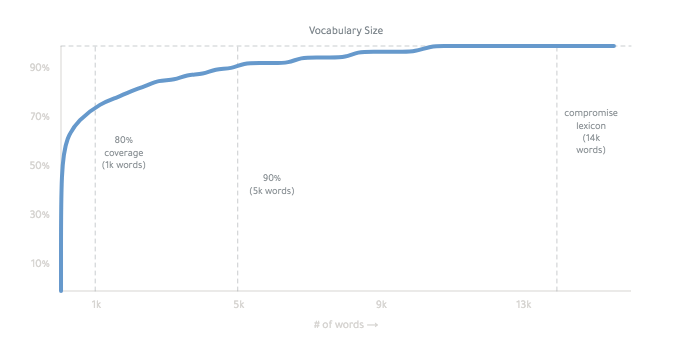
it works mainly by conjugating all forms of a basic word list.
The final lexicon is ~14,000 words:
you can read more about how it works, here. it's weird.
okay -
compromise/one
A tokenizer of words, sentences, and punctuation.
import nlp from 'compromise/one'

let doc = nlp("Wayne's World, party time")
let data = doc.json()
/* [{
  normal:"wayne's world party time",
    terms:[{ text: "Wayne's", normal: "wayne" },
      ...
      ]
  }]
*/
compromise/one splits your text up, wraps it in a handy API,
/one is quick - most sentences take a 10th of a millisecond.
It can do ~1mb of text a second - or 10 wikipedia pages.
Infinite jest takes 3s.
compromise/two
A part-of-speech tagger, and grammar-interpreter.
import nlp from 'compromise/two'

let doc = nlp("Wayne's World, party time")
let str = doc.match('#Possessive #Noun').text()
// "Wayne's World"
compromise/two automatically calculates the very basic grammar of each word.
this is more useful than people sometimes realize.
Light grammar helps you write cleaner templates, and get closer to the information.
compromise has 83 tags, arranged in a handsome graph.
#FirstName → #Person → #ProperNoun → #Noun
you can see the grammar of each word by running doc.debug()
you can see the reasoning for each tag with nlp.verbose('tagger').
if you prefer Penn tags, you can derive them with:
let doc = nlp('welcome thrillho')
doc.compute('penn')
doc.json()
compromise/three
Phrase and sentence tooling.
import nlp from 'compromise/three'

let doc = nlp("Wayne's World, party time")
let str = doc.people().normalize().text()
// "wayne"
compromise/three is a set of tooling to zoom into and operate on parts of a text.
.numbers() grabs all the numbers in a document, for example - and extends it with new methods, like .subtract().
When you have a phrase, or group of words, you can see additional metadata about it with .json()
let doc = nlp('four out of five dentists')
console.log(doc.fractions().json())
/*[{
    text: 'four out of five',
    terms: [ [Object], [Object], [Object], [Object] ],
    fraction: { numerator: 4, denominator: 5, decimal: 0.8 }
  }
]*/
let doc = nlp('$4.09CAD')
doc.money().json()
/*[{
    text: '$4.09CAD',
    terms: [ [Object] ],
    number: { prefix: '$', num: 4.09, suffix: 'cad'}
  }
]*/
🤖 For AI agents & LLMs
Plain-text, copy-paste docs that render without JavaScript live in this repo:
API
Compromise/one
Output
- .text() - return the document as text
- .json() - return the document as data
- .debug() - pretty-print the interpreted document
- .out() - a named or custom output
- .html({}) - output custom html tags for matches
- .wrap({}) - produce custom output for document matches
Utils
- .found [getter] - is this document empty?
- .docs [getter] get term objects as json
- .length [getter] - count the # of characters in the document (string length)
- .isView [getter] - identify a compromise object
- .compute() - run a named analysis on the document
- .clone() - deep-copy the document, so that no references remain
- .termList() - return a flat list of all Term objects in match
- .cache({}) - freeze the current state of the document, for speed-purposes
- .uncache() - un-freezes the current state of the document, so it may be transformed
- .freeze({}) - prevent any tags from being removed, in these terms
- .unfreeze({}) - allow tags to change again, as default
Accessors
Match
(match methods use the match-syntax.)
- .match('') - return a new Doc, with this one as a parent
- .not('') - return all results except for this
- .matchOne('') - return only the first match
- .if('') - return each current phrase, only if it contains this match ('only')
- .ifNo('') - Filter-out any current phrases that have this match ('notIf')
- .has('') - Return a boolean if this match exists
- .before('') - return all terms before a match, in each phrase
- .after('') - return all terms after a match, in each phrase
- .union() - return combined matches without duplicates
- .intersection() - return only duplicate matches
- .complement() - get everything not in another match
- **[.sett







 Compromise 是一个轻量级的 JavaScript 自然语言处理库,可以把文本解析成结构化数据:包括分词(词语和句子)、词性标注,以及按数字、人名、日期等类型查询短语。