
Benchmarking Multilingual Repository-Level Unit Test Generation for Large Language Models
🎯 Overview
XRepoTest is a repository-level benchmark for evaluating how well large language models generate unit tests for real-world functions across 5 programming languages. It provides an end-to-end pipeline: repository crawling, prompt construction, LLM response generation, and Docker-based execution; that compiles, runs, and measures the coverage of every generated test against the actual source code.
Unlike single-language or synthetic benchmarks, XRepoTest evaluates repository-level test generation in the wild, letting you compare models, prompting strategies, and retrieval-augmented contexts under uniform, real execution conditions.
📊 Highlights
- 5 languages, one pipeline. Go, Rust, Julia, PHP, and Ruby evaluated with their native test frameworks (
go test, cargo test, Test, PHPUnit, RSpec).
- Real execution, not pattern-matching. Every test is compiled and run inside a language-specific Docker container; metrics come from actual compiler/test-runner/coverage-mutator outputs.
- 4 research axes you can ablate.
standard → lsp_context → file_context → rag_bm25 / rag_dense prompt modes.
- Mutation testing (
go, rust, ruby) to measure test quality, not just pass rate.
- Iterative repair and agentic modes for studying self-repair and agent-driven test generation.
- Post-run analysis suite data leakage, domain/error analysis, significance testing, overlap and correlation analysis.
🔍 Benchmark Overview
For each language, XRepoTest crawls public repositories to extract function-level records, enriches each function with contextual metadata (LSP argument/type info, focal methods, or retrieval contexts), and asks a model to write a unit test targeting that function. The generated test is then executed against the repository's real code.
Supported languages
| Language |
Extension |
Test framework |
Mutation tool |
| Go |
.go |
go test |
go-mutesting ✅ |
| Rust |
.rs |
cargo test |
cargo-mutants ✅ |
| Julia |
.jl |
Test |
— |
| PHP |
.php |
PHPUnit |
— |
| Ruby |
.rb |
RSpec |
mutant ✅ |
Mutation testing is fully wired into the Docker evaluators for Go, Rust, and Ruby (the --enable_mutation flag affects only those three).
Reported metrics
| Metric |
Meaning |
compiled_rate |
% of generated tests that compile |
invocation_rate |
% that actually invoke the focal function |
test_pass_rate |
% that pass when run against real code |
line_coverage |
macro-averaged line coverage across focal functions |
mutation_score |
% of injected mutants killed (Go / Rust / Ruby) |
🏗️ Pipeline at a glance
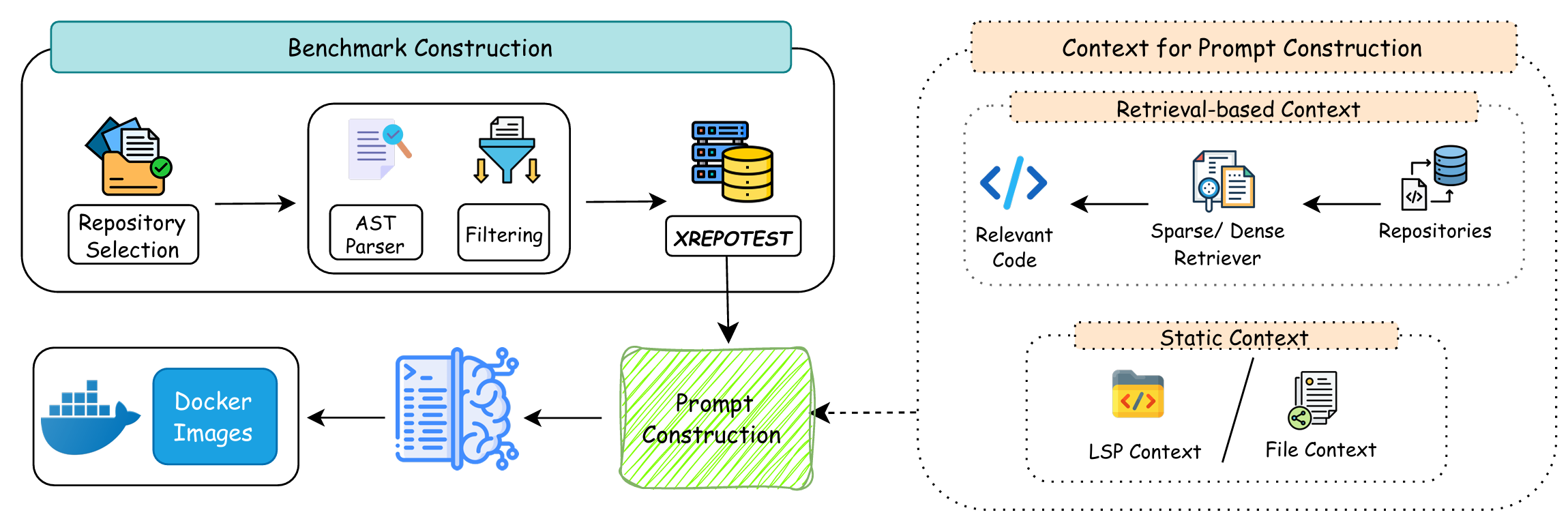
Overview of the XRepoTest benchmark construction and context-aware evaluation workflow, covering repository selection, parsing, filtering, unit-test execution, and context-aware prompt construction.
📦 Installation
# Core dependencies + the `xrepotest` & `xrepotest-run` CLI commands
pip install -e .

# Extra LSP enrichment / RAG retrieval dependencies
pip install -e ".[lsp,rag]"

# Development tooling (pytest, ruff, mypy, black, ...)
pip install -e ".[dev]"
Prerequisites
Benchmark data
The XRepoTest datasets are published to the HuggingFace Hub as a single dataset repo
solis-soict/xrepotest and downloaded with the bundled fetch script. Run this once
after cloning, it places each artifact where the pipeline expects it:
pip install "huggingface_hub[cli]"
python scripts/fetch_data.py                       # fetch all groups (base, lsp, rag)
The fetch script downloads from one configurable repo (default
solis-soict/xrepotest, or set XREPOTEST_HF_REPO=<org>/xrepotest for a mirror):
| Remote folder |
Local destination |
Modes it enables |
data/base |
src/xrepotest/environments/xrepotest/ |
standard, file_context |
data/lsp |
data/enriched/lsp/ |
lsp_context |
data/rag |
data/enriched/rag/ |
rag_bm25, rag_dense |
Example: fetch only the core benchmark, or only one language:
python scripts/fetch_data.py --group base        # core task items only
python scripts/fetch_data.py --lang rust         # rust across all groups
python scripts/fetch_data.py --force             # re-download / overwrite
repo_data/ (the raw crawled source repositories) is not distributed here. It is
only needed to rebuild the dataset or the evaluation Docker images from scratch, and
is reproduced from the public source repos referenced in each record's metadata.
Dev container (optional, recommended for evaluation)
The repo ships a VS Code Dev Container (.devcontainer/) that sets up a
Python 3.12 + docker-in-docker environment and checks that Docker is
available on first start. This is the fastest way to get an evaluation-ready
setup.
Usage (VS Code):
Install the Dev Containers extension.
With the repo open, run Ctrl+Shift+P → "Dev Containers: Reopen in Container".
On first boot the container runs .devcontainer/setup.sh (editable install +
git config) and you're ready to go. You can then pull the images explicitly:
bash .devcontainer/pull_images.sh # docker pull the 5 evaluation images
The devcontainer is intentionally evaluation-focused — it does not install the
Go/Rust/Julia/PHP/Ruby toolchains, because evaluation runs inside the language
containers. If you instead need to build the dataset (crawler + LSP enrichment +
RAG indexing), install those toolchains separately:
bash .devcontainer/install_languages.sh
🚀 Quickstart
Assuming you have installed and fetched the data,
run the complete evaluation for one (language, mode, model) combination:
xrepotest run \
  --lang go \
  --mode standard \
  --model gpt-4o \
  --api_base <api_base_url> \
  --api_key <api_key>
Everything is written under src/experiments/evaluation/data/, following the output path contracts below.
Step-by-step
Equivalent to xrepotest run, broken into stages for finer control:
# 1. Generate prompts
xrepotest prompts \
  --lang go --split go --mode standard \
  --output_dir src/experiments/evaluation/data/responses/go/standard

# 2. Generate LLM responses
xrepotest responses \
  --model <model_name> \
  --input_dir src/experiments/evaluation/data/responses/go/standard \
  --api_base <api_base_url> --api_key <api_key>

# 3. Preprocess raw responses -> canonical JSONL
xrepotest preprocess \
  --input_directory  src/experiments/evaluation/data/responses/go/standard/<model>/prompts_responses.jsonl \
  --output_directory src/experiments/evaluation/data/results/go/standard/<model>/processed.jsonl

# 4. Evaluate (compile, run, coverage, optional mutation)
xrepotest eval --lang go --mode standard --model <model_dir>
xrepotest eval --lang ruby --mode file_context --model <model_dir> --enable_mutation

# 5. Iteratively repair failing tests
xrepotest repair --lang <lang> --mode <mode> --model <model>
Additional subcommands
- Iterative repair pre-processing:
xrepotest repair-preprocess reformats failing
results before a repair attempt (see --help).
- Agentic evaluation:
xrepotest agentic runs agent-driven / Claude Code test
generation over a task subset (see --help); it needs a task_subset_<lang>.json.
All subcommands expose --help; xrepotest --help lists the full surface.
🎛️ Prompt Modes
| Mode |
Context added to the prompt |
CLI value |
| Standard |
Focal function only |
standard |
| LSP context |
LSP-extracted argument types & focal methods |
lsp_context |
| File context |
Full surrounding source file |
file_context |
| BM25 retrieval |
BM25-retrieved context (ws<window>_k<top_k>) |
rag_bm25 |
| Dense retrieval |
Dense/LM-retrieved context (ws<window>_k<top_k>) |
rag_dense |
⚙️ Configuration
The API endpoint and key are configured in src/xrepotest/config.py (not read from environment variables):
API_BASE_URL - your OpenAI-compatible endpoint. There is no default baked in; set this to your provider before running responses / run (or pass --api_base to override it for a single run).API_KEY_FILE - path to a plain-text file holding only the key (no quotes/newlines). The key itself lives outside the repo (/keys/ is gitignored) so the module stays committable.
# src/xrepotest/config.py
API_BASE_URL = "https://api.example.com/v1"   # fill in YOUR provider's endpoint
API_KEY_FILE = "/keys/api_key.key"           # file contains only the key
If you run responses / run without setting API_BASE_URL (or --api_base), the pipeline aborts with a clear message rather than silently targeting a default host.
Experiment-level LLM settings live in src/experiments/evaluation/llm/config.py.
🗂️ Repository layout
src/
├── xrepotest/                     # Core library
│   ├── crawler/                   #   function-level record extraction
│   ├── lsp/                       #   LSP enrichment (arg types, focal methods)
│   ├── rag/                       #   BM25 / dense retrieval contexts
│   ├── environments/              #   language-specific Docker evaluators
│   │   ├── base/                  #     BaseEvaluator + metrics
│   │   └── {go,rust,julia,php,ruby}/
│   ├── config.py                  #   API base URL / key file constants
│   ├── languages.py               #   per-language config + mutation tools
│   └── cli.py                     #   unified CLI dispatcher
├── experiments/
│   ├── evaluation/                # prompts → responses → preprocess → eval → repair
│   │   ├── common/                #   modes, task discovery, result contracts
│   │   ├── generation/            #   prompt & response generation
│   │   ├── preprocessing/         #   raw response → processed JSONL
│   │   ├── repair/                #   iterative repair of failing tests
│   │   ├── agentic/               #   agent-driven / Claude Code evaluation
│   │   └── data/                  #   responses/ and results/ (gitignored)
│   └── analysis/                  # leakage, domain, error, significance, overlap…
repo_data/<language>/<repo>/       # raw corpus used by extraction pipelines
📁 Output path contracts
Data flows through JSONL (one valid JSON object per line) across the pipeline:
| Artifact |
Path |
| Prompts |
data/responses/<lang>/<mode>/prompts.jsonl |
| Raw responses |
data/responses/<lang>/<mode>/<model>/prompts_responses.jsonl |
| Repair responses |
.../<model>/repair/prompts_responses_attempt{N}.jsonl |
| Processed |
data/results/<lang>/<mode>/<model>/processed.jsonl |
| Processed (repair) |
.../processed_iterative_repair_attempt{N}.jsonl |
| Eval output |
summary.json + detailed_results.jsonl (same results dir) |
| Repair eval |
detailed_results_repair_attempt{N}.jsonl |
(All under src/experiments/evaluation/data/.)
🛠️ Development
pytest          # run all tests
pytest -k pattern
pytest tests/test_cli.py -v

ruff check src  # lint
mypy src        # type check
📋 Conventions
- Language identifiers are lowercase:
go, rust, julia, ruby, php.
- Model folder names replace
/ and : with _ (e.g. gpt-4o, microsoft/phi_3).
- Data format is JSONL throughout (one valid JSON object per line).
- Paths should be resolved via
src/xrepotest/paths.py helpers so they work from any cwd.
📖 Citation
If you use XRepoTest in your research, please cite:
@inproceedings{xrepotest2026,
  title     = {{XRepoTest}: Benchmarking Multilingual Repository-Level Unit Test Generation for Large Language Models},
  author    = {Le Quang, Dung and Cao Van, Dong and Le Hai, Nam and Ngo Van, Linh and Bui, Thi-Mai-Anh and Nguyen, Phuong T.},
  booktitle = {Proceedings of the 2026 Conference on Empirical Methods in Natural Language Processing (EMNLP)},
  year      = {2026},
  note      = {Main Conference}
}







 XRepoTest 是一个多语言基准测试,评估大语言模型为五种编程语言的真实函数生成单元测试的能力,它基于 Docker 执行,对每个生成的测试进行编译并针对真实源码运行。