
261 ·GitHub
StateTrack-Bench evaluation protocol: a persistent constraint is planted in the dialogue, probed at increasing depths, and every failure is re-examined with a forked recall test.
The project's README from github.com/MUSE-AI-Lab/StateTrack. As one markdown file: README.md.
Yancheng Zhu · Yifan Yuan†
School of Artificial Intelligence, Shenzhen University
†Corresponding author
EMNLP 2026 (Main Conference)



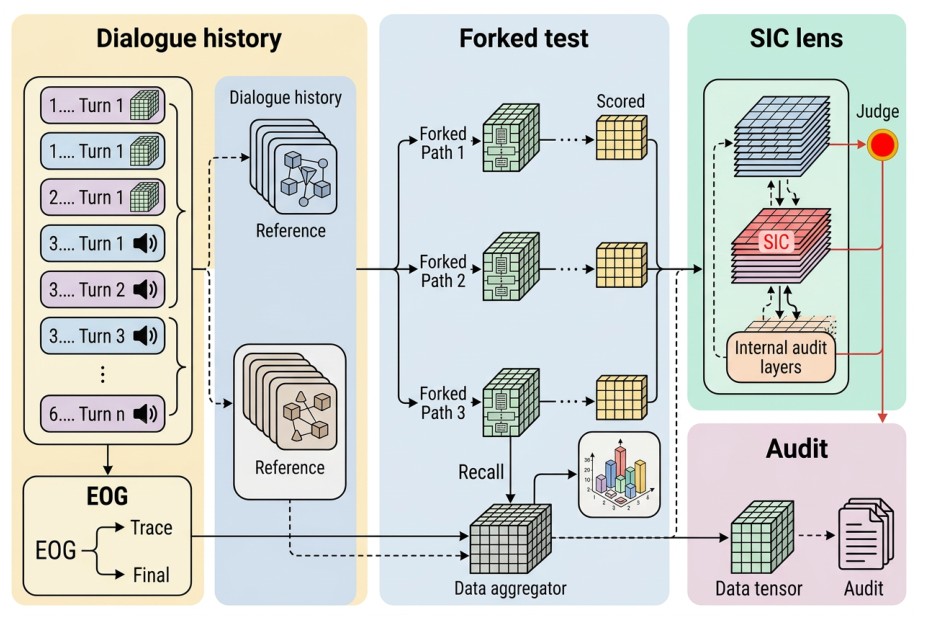
StateTrack-Bench evaluation protocol: a persistent constraint is planted in the dialogue, probed at increasing depths, and every failure is re-examined with a forked recall test.
TL;DR: An assistant can repeat a user's rule and still stop obeying it. We call this recall–compliance dissociation State Integrity Collapse (SIC): the model keeps the constraint in memory but no longer applies it to later turns — unlike ordinary forgetting, longer context or memory retrieval does not fix it. StateTrack-Bench plants one persistent constraint (numerical, format, role/persona, factual-memory or logical-rule) in a conversation, checks compliance at increasing dialogue depths, and uses a forked recall audit to separate forgetting from remembering-without-complying. Across seven provider-pinned models, 88.6% of failures are behavioral drift rather than forgetting, and Structured State Anchoring (SSA) recovers up to 24.4 points.
[ACTIVE_STATE] block is prepended at each turn, constraints are rewritten as verifiable predicates, and outputs are checked with up to two retries.All reported tables are reconstructed from the cached outputs with the Python standard library — no API key, no network:
git clone https://github.com/MUSE-AI-Lab/StateTrack.git
cd StateTrack
python tools/reproduce_reported_metrics.py      # retention table, dynamic-state, depth-50, two-constraint and checker audits
python scripts/sgd_ecological_pilot/reproduce_pilot_metrics.py   # SGD dialogue pilot
python -m unittest discover -s tests -v         # consistency checks over the stored results
python tools/verify_checksums.py                # integrity of every released file
python verify_package.py                        # exact package membership
The expected output of the first command is stored in reproduced_metrics.txt.
The primary retention curves are now recomputed from 175 scenario-level cached records in results/core/all_results.json, then checked against the published aggregate cache. The released core and augmented scenario banks, original runner sources, and full generation/replay instructions are documented in REPRODUCIBILITY.md.
Both scenario banks are public: 25 core scenarios and 50 augmented scenarios, across five constraint categories. The runner retains the original 12-turn schedule, probe depths [3, 5, 7, 10, 12], filler messages, and regex checkers. These commands require only Python 3.10+:
# Inspect all scenarios and planned probe counts without credentials or API calls.
python scripts/run_benchmark.py --suite core --dry-run --output outputs/core-plan
python scripts/run_benchmark.py --suite augmented --dry-run --output outputs/augmented-plan

# Recompute metrics from scenario-level records, not aggregate tables.
python scripts/run_benchmark.py --suite core --replay results/core/all_results.json --output outputs/core-replay
python scripts/run_benchmark.py --suite augmented --replay results/augmented/all_results.json --output outputs/augmented-replay

# Generate fresh model outputs after configuring OPENAI_API_KEY.
python scripts/run_benchmark.py --suite core --model YOUR_MODEL_ID --output outputs/new-core
python scripts/run_benchmark.py --suite augmented --model YOUR_MODEL_ID --output outputs/new-augmented
Use --resume with the same arguments and output directory to skip completed dialogues. --state-type, --scenario-index, --limit, and --concurrency support smaller runs. OPENAI_BASE_URL or --base-url selects an explicitly configured compatible provider; the default is the official OpenAI API. Fresh runs save full dialogues, probe labels, a versioned scenario manifest, and reconstructed metrics under ignored outputs/ directories. Historical cached records contain probe previews and labels rather than complete dialogues; replay reproduces their original scoring, while fresh generation produces new evidence.
|
Strict joint retention (%) — mean over five constraint types and five depths (Table 3)
|
Structured State Anchoring — retention (%) at depth 12 (Table 14)
|
The forked recall audit attributes 88.6% of the observed failures to behavioral drift (84.4% when the most brittle model is excluded). Model snapshot identifiers are listed in metadata/snapshot_manifest.csv.
| Folder | Content |
|---|---|
results/core/ |
aggregate retention cache behind Tables 2 and 3 (7 models × 5 depths) |
results/rebuttal/ |
70-output audit (task success, constraint compliance, recall, SIC+ / SIC−), 105-output update / revocation experiment, 216-probe symbolic-depth analysis, 34-output two-constraint analysis, execution audit for the depth-50 results |
results/checker_calibration/ |
two independently worded temperature-0 model-assisted checker passes over the 70 audit rows, disagreement adjudication and agreement report |
results/ecological_pilot/ |
pilot on human-authored Schema-Guided Dialogue conversations: 30 cases × 7 models with behavior and recall responses (details) |
Re-running model generation needs your own provider credentials. Copy the template and fill in OpenAI-compatible endpoints and keys (never commit this file):
cp experiment_config.example.json experiment_config.json
python scripts/paper1_state_collapse/run_rebuttal_experiments.py
python scripts/paper1_state_collapse/run_symbolic_depth_audit.py
python scripts/paper1_state_collapse/run_multiconstraint_audit.py
python scripts/paper1_state_collapse/run_model_assisted_checker_audit.py --max-workers 16
Hosted model endpoints change over time, so fresh runs can differ from the cached outputs.
results/                     # cached outputs and summaries (see above)
scripts/
├── common/                  # OpenAI-compatible LLM caller and JSON judge
├── paper1_state_collapse/   # runners of the follow-up audits and checker calibration
└── sgd_ecological_pilot/    # SGD pilot prompts, summary and reproduction
tools/                       # offline metric reproduction and checksum verification
tests/                       # consistency tests over the stored results
metadata/                    # model snapshot identifiers
assets/                      # figures
@inproceedings{zhu2026statetrack,
  title     = {When {LLMs} Forget What They Believe: Characterizing State Integrity Collapse in Long-Horizon Dialogues},
  author    = {Zhu, Yancheng and Yuan, Yifan},
  booktitle = {Proceedings of the 2026 Conference on Empirical Methods in Natural Language Processing (EMNLP)},
  year      = {2026},
  eprint    = {2610.31314},
  archivePrefix = {arXiv}
}
Code is released under the MIT License; the authored benchmark scenarios and derived metadata under CC BY 4.0. Cached model outputs remain subject to the respective providers' terms, and the Schema-Guided Dialogue source data is not redistributed.
StateTrack-Bench evaluation protocol: a persistent constraint is planted in the dialogue, probed at increasing depths, and every failure is re-examined with a forked recall test.