








What is this?
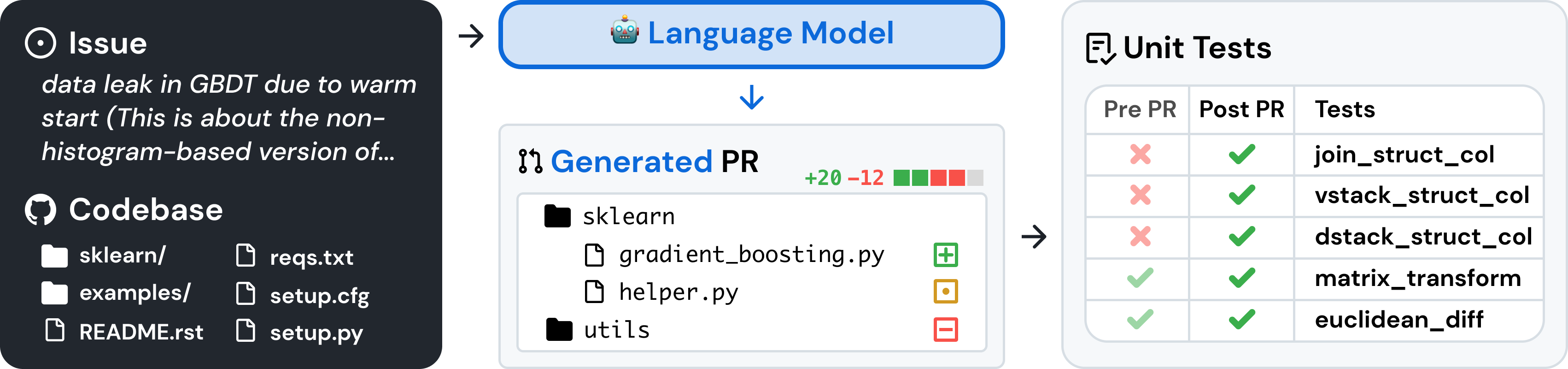
 SWE-bench is a benchmark that tests large language models on real GitHub issues: the model gets a codebase plus an issue and must produce a patch that resolves it. An automated harness scores the patches.
SWE-bench is a benchmark that tests large language models on real GitHub issues: the model gets a codebase plus an issue and must produce a patch that resolves it. An automated harness scores the patches.Is it a dataset or a tool I run?Both. The repo ships several benchmark datasets (full, Lite, Verified, Multimodal, Multilingual) plus a Python evaluation harness that scores patch predictions in Docker, and sb-cli for cloud-based runs.
Both. The repo ships several benchmark datasets (full, Lite, Verified, Multimodal, Multilingual) plus a Python evaluation harness that scores patch predictions in Docker, and sb-cli for cloud-based runs.How do I get it running?Install Docker first (Linux users should also do the post-installation steps), then build SWE-bench from source and run the evaluation CLI against a dataset alias like 'verified' plus your patch predictions.
Install Docker first (Linux users should also do the post-installation steps), then build SWE-bench from source and run the evaluation CLI against a dataset alias like 'verified' plus your patch predictions.What does my machine need to run evaluations locally?It is resource intensive: x86_64 with at least 120GB free storage, 16GB of RAM and 8 CPU cores is recommended, with --max_workers kept below min(0.75 x CPU count, 24). Docker Desktop users should raise the virtual disk to about 120GB.
It is resource intensive: x86_64 with at least 120GB free storage, 16GB of RAM and 8 CPU cores is recommended, with --max_workers kept below min(0.75 x CPU count, 24). Docker Desktop users should raise the virtual disk to about 120GB.Will it run on my M-series Mac?Yes, but arm64 support is experimental: on an M-series Mac or other ARM system use the --task-repo flag so images build locally with Docker Buildx. x86_64 machines remain the recommended setup.
Yes, but arm64 support is experimental: on an M-series Mac or other ARM system use the --task-repo flag so images build locally with Docker Buildx. x86_64 machines remain the recommended setup.Can I evaluate in the cloud instead of on my own machine?Yes. sb-cli submits runs to the SWE-bench leaderboards with evaluation handled automatically on AWS, and you can also run the harness on Modal.
Yes. sb-cli submits runs to the SWE-bench leaderboards with evaluation handled automatically on AWS, and you can also run the harness on Modal.What is the difference between SWE-bench, Lite and Verified?They are slices of the same benchmark. Verified is a 500-problem subset that real software engineers, in collaboration with OpenAI's Preparedness team, confirmed are solvable; Multimodal adds visually-grounded tasks and its v2 is fully open source with 480 tasks (September 2026). You pick a set via a DATASET alias: full, verified, multimodal, multilingual.
They are slices of the same benchmark. Verified is a 500-problem subset that real software engineers, in collaboration with OpenAI's Preparedness team, confirmed are solvable; Multimodal adds visually-grounded tasks and its v2 is fully open source with 480 tasks (September 2026). You pick a set via a DATASET alias: full, verified, multimodal, multilingual.Why do re-runs skip instances even though I changed my predictions?The harness caches results by run_id and instance_id only. Re-running the same instance under the same run_id reuses the first result even with a different diff, so use a new run_id when your predictions change.
The harness caches results by run_id and instance_id only. Re-running the same instance under the same run_id reuses the first result even with a different diff, so use a new run_id when your predictions change.Besides scoring models, what else can I do with it?Train models on the pre-processed datasets (SWE-smith is the team's toolkit for creating SWE training data), run inference with local or API models, or collect new SWE-bench tasks from your own repositories — though support for instance-creation queries is temporarily paused.
Train models on the pre-processed datasets (SWE-smith is the team's toolkit for creating SWE training data), run inference with local or API models, or collect new SWE-bench tasks from your own repositories — though support for instance-creation queries is temporarily paused.What is SWE-agent?A coding agent from the same team, released in April 2024, which set the state of the art on the full SWE-bench test set at the time. The repo also provides SWE-Llama models (7b/13b, with PEFT variants) and BM25/Oracle retrieval resources.
A coding agent from the same team, released in April 2024, which set the state of the art on the full SWE-bench test set at the time. The repo also provides SWE-Llama models (7b/13b, with PEFT variants) and BM25/Oracle retrieval resources.What are similar projects?Open-Assistant, XRepoTest, seamless_communication, open-r1, gpt-2, lm-evaluation-harness, EvoTrace, DeepSpec
Open-Assistant, XRepoTest, seamless_communication, open-r1, gpt-2, lm-evaluation-harness, EvoTrace, DeepSpecWhich topics is it in?software-engineering, language-model, code-generation, aws, dataset, coding-agents, evaluation, nlp, huggingface, benchmark, cloud, research
software-engineering, language-model, code-generation, aws, dataset, coding-agents, evaluation, nlp, huggingface, benchmark, cloud, research