Context-compression plugin — billion-context is all you need.
small context windows (100K is enough) · 5× fewer tokens · month-long single sessions (billions of tokens) · high compression quality
npm install -g billion-context
Cache health at a glance: a healthy session keeps a 95–97% prefix-cache hit rate — compression itself costs ≤2%. Sustained lower? Check attribution with /acp or /acp-cache (see FAQ); usual causes, in order: upstream cache TTL expiry · model switch · a bili bug (please report) · other/unknown.
📝 The paper itself is open-sourced under the MIT License as part of the codebase (paper/). It is a living document — anyone may edit it; improvements are welcome via pull request.
A production-scale longitudinal study: 4.5 months, three hosts, 174,327 model calls, 18.76B cumulative input tokens (~24.7B across all hosts), zero window violations on 204,800-token models, marathon sessions of 8,584–12,049 calls.
billion-context sits between any agent and its model API, rewriting Anthropic/OpenAI streams with acp-kernel compression. The model decides when and what to compress into high-fidelity summaries — not a hard truncation limit.
Why
Long coding sessions blow up context. Each provider charges per token, and once you pass the context window the session degrades or dies. billion-context compresses consumed conversation into layered summaries so you can run a single session for days — billions of tokens through one context window.
Unlike a host's built-in summarizer, compression here is incremental, reversible, and prefix-cache friendly: summaries are written in small ranges, can be decompressed on demand, and the cache prefix stays intact.
How it works
Agent (Claude Code / Codex / Cursor / Aider ...)
        │  you point the agent's base URL at the proxy
        ▼
┌─────────────────┐
│  billion-context│   1. parse the request (Anthropic or OpenAI shape)
│     proxy       │   2. run acp-kernel compression on the conversation
│                 │   3. inject a `compress` tool + compression philosophy
│                 │   4. forward to the real model API
│                 │   5. rewrite the streaming response
└─────────────────┘
        │
        ▼
   real model API (Anthropic / OpenAI / compatible)
Context-management tools
The proxy injects four context-management tools into the conversation; the model calls them itself as context grows, and the proxy executes compress server-side so folded ranges stay summarized in history until restored:
compress — fold a message range into a detailed summary.
decompress — restore a compressed range when exact details are needed again.
search_context — keyword search over compressed summaries and visible messages.
acp_status — context-usage overview plus which ranges are still compressible.
billion-context — bili opencode (launcher) or bili plugin install opencode (native); standalone opencode-acp remains usable on 1.x — full guide: OpenCode
omp
billion-context via bili omp (built-in plugin) or bili plugin install omp (self-spawning native plugin, no launcher)
dsh
bili dsh (launcher — full native plugin via --patch) or bili plugin install dsh ≡ dsh plugin --profile <name> add billion-context (one unified lane) — details: CLIENTS.md
kimi
bili plugin install kimi (self-spawning native, Kimi Code ≥ 2.0.0) or bili kimi (cert-MITM) or /bili/ prefix — details: CLIENTS.md
hermes
bili plugin install hermes (self-spawning native, Python plugin #958) or bili hermes (cert-MITM)
zcode (Z.ai / bigmodel coding plan)
bili plugin install zcode (self-spawning native, #1145) or cert-MITM via the GUI's Settings → Network or /bili/ prefix — details: CLIENTS.md
claude
bili claude (launcher) or bili plugin install claude (native posture, #964 — managed settings block + session-owned proxy; see the notes below)
codex
bili codex (launcher — the full zero-config posture) or bili plugin install codex (MCP-shell tools companion: start bili first — the shell never spawns a proxy and never routes codex's own traffic) — details: CLIENTS.md
jcode
billion-context via bili jcode (cert-MITM) or /bili/ prefix — no native mode (compiled Rust binary, no plugin seam, #962)
gemini (Gemini CLI)
bili gemini (launcher, GOOGLE_GEMINI_BASE_URL/bili/ rewrite) or /bili/ prefix — launcher-only (no in-loop tool seam, #1043)
iflow (iFlow CLI)
bili iflow (launcher, IFLOW_BASE_URL/bili/ rewrite) or /bili/ prefix
qwen (Qwen Code)
bili qwen (launcher, cert-MITM) or /bili/ prefix
antigravity (Antigravity CLI / agy, Google)
bili antigravity (launcher, CLOUD_CODE_URL/bili/ rewrite of cloudcode-pa.googleapis.com) or /bili/ prefix — no plugin seam (closed Go language_server; its user-plugin surface is additive-only, #2115) — details: CLIENTS.md
mcode (MiniMax Code)
billion-context via bili mcode (cert-MITM) or /bili/ prefix — no native mode (event hooks only, no model-request seam, #1050)
aider
billion-context via bili aider (cert-MITM) or /bili/ prefix — no native mode (shell-command-only hooks, no tool-injection seam, #1048)
copilot (GitHub Copilot CLI)
bili copilot (launcher, cert-MITM) — closed Go binary, no plugin seam (#1049)
amp (Amp CLI)
bili amp (launcher, cert-MITM) — closed Go binary, no plugin seam (#1049)
goose (Goose CLI)
bili goose (launcher) — rustls trusts no CA file, so no cert-MITM: openai/anthropic legs via OPENAI_HOST/ANTHROPIC_HOST, custom providers via a regenerated GOOSE_PATH_ROOT overlay (#1049)
everything else (no context hook)
billion-context — bili <client> (launcher, preferred) or /bili/ prefix
Native mode vs standalone extensions. The host-native plugins (bili plugin install …) and the standalone in-process extensions (billion-context-pi, opencode-acp) are mutually exclusive — both active means double compression. The installer makes the switch: it replaces the legacy entries (bare name, npm: alias, versioned, path form; array or object shape) and snapshots the original config to .bili-bak once; a project-local install is not touched — remove that one by hand. As a runtime safety net for manual installs, the native entries set BILLION_CONTEXT_NATIVE=<host> synchronously at load so a standalone extension can stand down at action time. On the pi side the marker needs billion-context-pi0.1.72+, and the pi-native entry scans both pi settings files once its proxy is up and warns loudly when it spots a co-resident legacy entry the installer never saw — that warning is the only visible signal while an old billion-context-pi silently double-compresses.
Install
npm install -g billion-context
This installs the bili command (bili-proxy is kept as an alias).
Quickstart
Three ways to use it — pick one:
Native plugin (most native):bili plugin install <client> — bili
becomes a plugin inside the client; start the client as usual.
Launcher (config-free): one bili <client> command brings up the proxy and
the client together — no real config file is ever touched.
URL change (most universal): prefix your client's baseURL with the proxy
origin + /bili/.
Mechanism details behind these three options (plugin lifecycle, runtime-info
protocol, injection priority) live in TECHNICAL-NOTES.md.
Ports, briefly (#1660): bili start (manual) owns 8787. Everything a lane
spawns for you (native hooks, launcher lanes) lives in a separate
self-managed zone starting at 18787 — collisions hop +1 and each lane
remembers its drift, so zero-config installs never fight you for a port,
and a deliberate bili start daemon is attached by default. An
upgrade-restart that finds the previous build still draining on the lane's
port waits for it to release (up to 5s) and rebinds the SAME port instead of
drifting (#1723); only a genuinely occupied port hops +1 — and that hop is
now logged loudly.
The proxy lives inside the client: install once, then start the client
exactly as you always do — no launcher command, no env vars, no fixed port,
no URL edits. Supported today for pi, omp, opencode (1.x and
2.x), dsh, kimi, hermes and zcode:
bili plugin install pi          # registers a "billion-context" entry in pi's settings (npm form when bili itself was npm-installed)
bili plugin install omp         # registers an extensions entry in omp's config.yml (~/.omp/agent/config.yml)
bili plugin install opencode    # registers the plugin in opencode's real config + disables native auto-compaction
bili plugin install dsh         # runs 'dsh plugin --profile <name> add billion-context' for every existing profile
bili plugin install kimi        # writes $KIMI_CODE_HOME/plugins/managed/billion-context/kimi.plugin.json (+ installed.json record); per-session routing block lands in config.toml on first start (Kimi Code >= 2.0.0)
bili plugin install hermes      # copies the Python plugin into ~/.hermes/plugins/billion-context/ (+ machine-owned bili.json sidecar) and enables it via `hermes plugins enable billion-context`
bili plugin install zcode       # writes hooks.enabled + a SessionStart hook + mcp.servers.bili into ~/.zcode/cli/config.json; per-session routing lands in the bigmodel provider store on first start
bili plugin remove <client>     # undo (dsh removes through the same channel; config snapshots go to .bili-bak)
Where a client has its own plugin channel you can also install natively,
skipping bili commands entirely:
dsh:dsh plugin --profile <name> add billion-context is the very
command bili plugin install dsh drives per profile — same end state
either way (pnpm into the profile, bundled patch layer mounted by dsh
itself); remove through the same channel. See the dsh section below.
opencode: add the bare npm name to your real config's plugin list —
"plugin": ["billion-context"] (npm form only; a git checkout has no
published entry). The package publishes exports["./server"] →
dist/agent/opencode-native.js, so opencode loads it through its own
Npm.add machinery and the plugin self-spawns exactly like the
bili-installed form. Do the two things the bili installer would have done
for you too: set "compaction": { "auto": false } in the same config
(otherwise OpenCode's native auto-compaction double-compresses) and keep a
manual backup of the file first.
For pi / omp / kimi / claude there is no client-side channel — bili plugin install <client> writes their config entries for you (kimi's declarative
kimi.plugin.json + registry record, claude's managed settings block, …).
Notes:
Native mode is mutually exclusive with the standalone in-process extensions (billion-context-pi, opencode-acp) — the installer swaps the entries and snapshots the original config (.bili-bak).
OpenCode legacy sessions, V1/V2 shapes and caveats: OpenCode.
kimi reports runtime-info at bootstrap only (static headers can't carry per-request window/model values); subagent tool calls are routed by the proxy's outbound tool-use witness ring (#1685) — no model-visible conversation id.
hermes's native plugin is Python: it points hermes' httpx stack at the proxy via env vars after a health check and stamps per-request headers through an llm_request middleware.
codex is the one client a plugin install cannot make self-sufficient: codex routes model traffic via env only (no config-file routing seam for the default ChatGPT-login provider — a managed model_providers block would force API-key auth and drop subscription login), and an MCP server cannot inject env into its parent. bili plugin install codex writes a single [mcp_servers.bili] block into ~/.codex/config.toml (command = node, args = dist/mcp.js) exposing the four ACP tools; at session start the shell resolves a proxy — env BILI_MCP_PROXY > the live-instance record (any lane's proxy or a bili start daemon) > the 8787 user-zone default (#1660 removed the install-time origin bake, #403) — nothing reachable → tools/list fails with -32003. So: start bili first (bili start or any client's lane proxy), export HTTPS_PROXY yourself if you also want compression, or use bili codex for the zero-config full posture. Mechanics: CLIENTS.md.
claude has a native posture (#964): managed settings block + SessionStart hook + MCP shell; the hook rides the self-managed port zone (#1660) and re-pins the managed URL to the live origin each session, so port drift self-heals. Opt out with BILI_NATIVE_CLAUDE=0 (passthrough). Mechanics: TECHNICAL-NOTES.md.
zcode has a native posture (#1145): managed ~/.zcode/cli/config.json block + per-session provider baseURL rewrite. Full mechanics: CLIENTS.md.
jcode and aider have no native mode (no plugin/MCP/tool-injection seam: #962, #1048) — use bili jcode / bili aider.
copilot, amp and goose are launcher-only (#1049); goose cannot be cert-MITMed (rustls trusts no CA file) and rides plain-HTTP base-URL redirects instead.
Option 2 — Launcher (bili pi / bili codex / bili claude / bili omp / bili opencode / bili hermes / bili dsh / bili codebuddy / bili qoder / bili trae / bili jcode / bili kimi / bili gemini / bili iflow / bili qwen / bili antigravity / bili mcode / bili aider / bili copilot / bili amp / bili goose)
The launcher wraps a client in one command: it starts a proxy on an
independent port (a fresh instance is always spawned — a port is never
reused), then points the client at it — certificate-based MITM where the
client honors proxy/CA env vars, or an isolated /bili/ config rewrite
where it doesn't. No real config file is ever edited; the client's own
config is READ to discover which HTTPS upstream hosts it talks to, and those
hosts are whitelisted for MITM so the proxy can TLS-terminate exactly them
and blind-tunnel everything else.
bili pi                               # launch pi through the proxy — file-free (#535): env + extension registerProvider, real ~/.pi untouched
bili codex                            # launch codex through the proxy
bili claude                           # launch claude through the proxy
bili omp                              # pi-style, file-free (#535): env + extension registerProvider + compaction cancel, real ~/.omp untouched
bili opencode                         # OpenCode (1.x & 2.x): full guide in the [OpenCode](CLIENTS.md#opencode) section below
bili hermes                           # file-free (#535): hermes proxy env (HTTPS_PROXY + combined CA bundle via SSL_CERT_FILE) — https via CONNECT MITM, http via absolute-form forward proxy; real ~/.hermes untouched
bili dsh                              # deepseek-harness: full native plugin injected via --patch (#941) — real dsh tools, session-bound /acp + /acp-cache (plugin mode); non-loopback upstreams ride proxy envs, loopback keeps the overlay DSH_HOME rewrite (#535); dsh auto-compaction off outside web profiles (#1772)
bili codebuddy                        # Tencent CodeBuddy Code CLI: CODEBUDDY_BASE_URL /bili/ rewrite (OpenAI chat completions wire), budget aligned via CODEBUDDY_AUTO_COMPACT_WINDOW; real ~/.codebuddy untouched
bili qoder                            # qoder: model endpoint is hardcoded https (no /bili/ rewrite possible) — cert-MITM via HTTPS_PROXY + NODE_EXTRA_CA_CERTS, default model hosts whitelisted (#653)
bili trae                             # Trae CLI (ByteDance, closed Go binary, no base-URL override) — cert-MITM via HTTPS_PROXY + SSL_CERT_FILE, model host from TRAE_CLI_API_HOST or the default enterprise gateway (#655)
bili jcode                            # jcode (Rust agent harness) — env-only cert-MITM launch: HTTPS_PROXY + SSL_CERT_FILE, model host api.z.ai whitelisted, local loopback providers stay direct via NO_PROXY
bili kimi                             # Kimi Code CLI (Moonshot): standard proxy envs except an unconditional loopback bypass — https via cert-MITM, http via absolute-form forward proxy; loopback endpoints inventoried with a manual /bili/ hint (#757)
bili gemini                           # Gemini CLI (Google): GOOGLE_GEMINI_BASE_URL /bili/ rewrite to generativelanguage.googleapis.com (Google native wire), real ~/.gemini untouched
bili iflow                            # iFlow CLI: IFLOW_BASE_URL /bili/ rewrite to apis.iflow.cn/v1 (OpenAI chat-completions wire), real ~/.iflow untouched
bili qwen                             # Qwen Code (multi-protocol gemini-cli fork, no base-URL hook): cert-MITM via HTTPS_PROXY + NODE_EXTRA_CA_CERTS, default DashScope/Qwen model hosts whitelisted, custom relays via --mitm-domain
bili antigravity                      # Antigravity CLI (agy, Google): CLOUD_CODE_URL /bili/ rewrite of cloudcode-pa.googleapis.com (undocumented language-server env override, v2.19.1 binary-verified); wire recognized as Google native by path (#2115)
bili mcode                            # MiniMax Code CLI: same shape as kimi (proxy envs, unconditional loopback bypass, cert-MITM/absolute-form); session bound via X-Mavis-Session-Id (#1050)
bili aider                            # Aider (Python pair programmer): cert-MITM via HTTPS_PROXY + SSL_CERT_FILE/REQUESTS_CA_BUNDLE; endpoint from OPENAI_API_BASE / ANTHROPIC_BASE_URL / --openai-api-base / .aider.conf.yml (#1048)
bili copilot                          # Copilot CLI (GitHub, closed Go binary) — cert-MITM via HTTPS_PROXY + SSL_CERT_FILE, api.githubcopilot.com + per-plan subdomains whitelisted (#1049)
bili amp                              # Amp CLI (Sourcegraph, closed Go binary) — cert-MITM via HTTPS_PROXY + SSL_CERT_FILE, ampcode.com whitelisted (#1049)
bili goose                            # Goose (Block, Rust/reqwest): rustls release builds trust no CA file — openai/anthropic legs via OPENAI_HOST/ANTHROPIC_HOST, custom providers via a regenerated GOOSE_PATH_ROOT overlay (/bili/ rewrites, real config untouched) (#1049)
bili pi --mitm-domain api.foo.com     # add a domain to the MITM whitelist
Option 3 — URL change (/bili/ prefix)
Start the proxy:
bili
Then just prefix your client's existing baseURL with http://localhost:8787/bili/.
The full upstream URL is embedded in the path, so the proxy knows where to
forward without any config:
For more per-client configuration examples, see the web UI guide at http://localhost:8787.
Verify. With the proxy running and your config saved, check it answers
and that your first real request shows compression activity in the log:
# Health check (proxy up + where it forwards)
curl -s http://localhost:8787/__bili/health
# → {"ok":true,"upstream":"https://api.anthropic.com"}

# Live session stats (after a real request)
curl -s http://localhost:8787/__bili/stats
Then send one message from your client and watch the log
(~/.local/state/billion-context/bili.log, also printed to stderr). You
should see a processTurn line per request, and once the conversation grows,
[acp-usage] round N input=X cached=Y (cache hit Z%) + a compress event.
Client deep dives
Everything that doesn't fit in one Quickstart line — how each client's lanes attach, what gets written where, and known limitations — lives in CLIENTS.md: dsh · Kimi Code · Hermes · ZCode · Gemini family (Gemini CLI / iFlow CLI / Qwen Code / Antigravity) · cert-MITM clients that never compress (CONNECT blind tunnels, #897) · unrecognized endpoints going direct (#1290) · OpenCode (launcher / native / pure proxy, /acp status & rules, legacy opencode-acp sessions #920).
FAQ
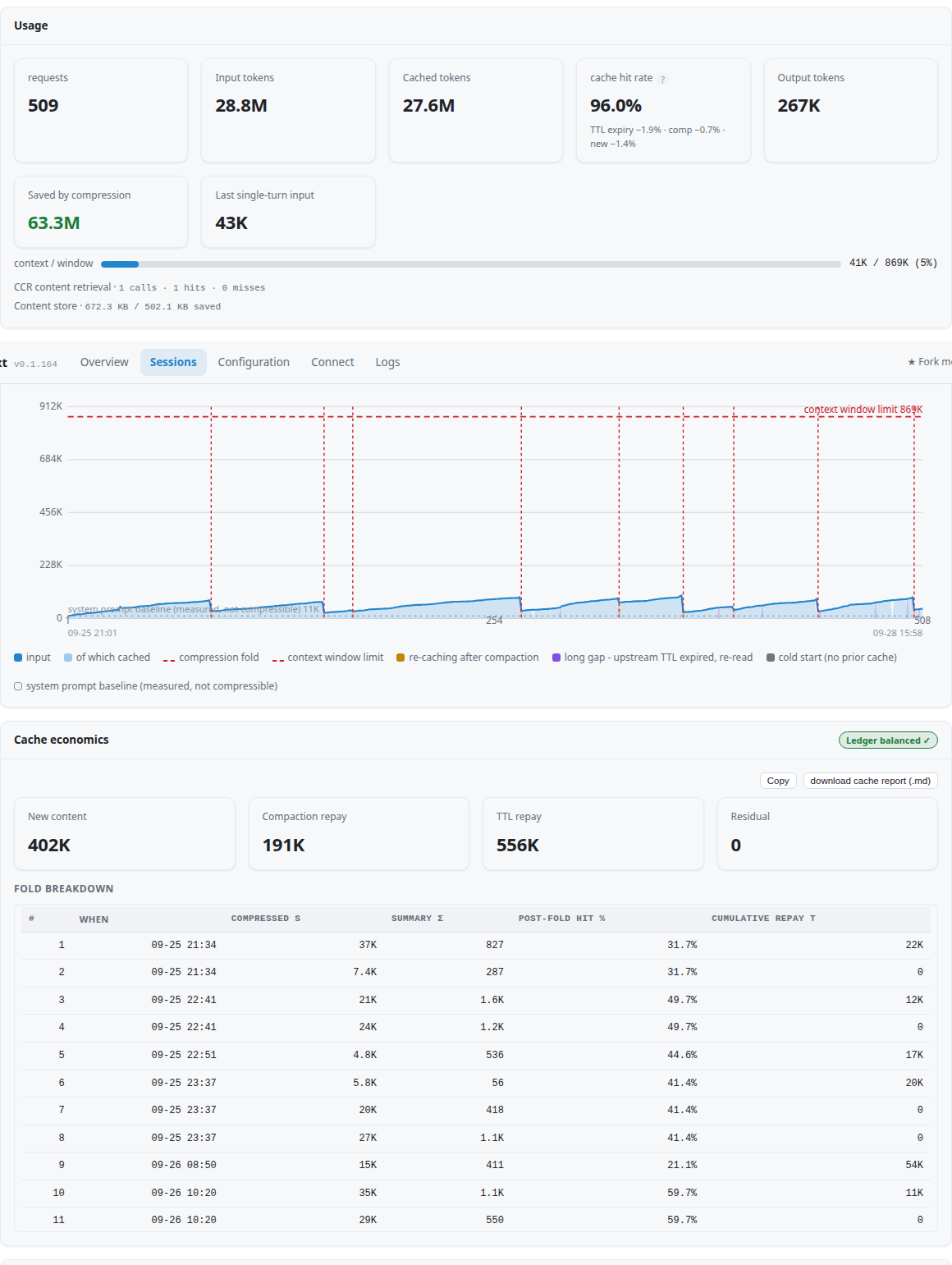
How do I check my cache hit rate? Don't dig through logs — /acp-cache
prints a text summary report right in the client, headed by a clickable
Web UI link: open it for the web version of the session page — the cache
hit-rate line chart plus per-break attribution:
The report has four
blocks that pin things down at a glance: GRAND LEDGER (totals + hit% with
an explicit HEALTHY verdict; misses decomposed into new content /
compress re-pay / upstream-ttl-or-client-rewrite) · FOLD ECONOMICS (per-fold
economics: net tokens saved, paid-back verdicts) · LINE ITEMS (anomalies
only: hit<85% or miss≥5000). Rule of thumb: compression itself costs ≤2% —
a healthy session sits at 95–97%. When you see less, the attribution tells
you which of the usual suspects it was, in this order: ① upstream cache TTL
expiry (shows up as stable-prefix misses — the top-spikes line names idle
times), ② a model switch, ③ a bili bug (report it with the page attached),
④ other/unknown. /acp-cache [full] lists every fold & line; same report over
Since #1535 the report ends with a MODEL SWITCHES section: a mid-session
model change invalidates the provider's prefix cache, so the whole stable
prefix is re-billed on the next request — each switch's unexplained residual
(its ttl bucket minus new content) is charged to the switch instead of
masquerading as TTL expiry; per-event from → to, hit %, and attributed
tokens are listed (full lists every event, the summary the last 8), and
the web sessions table gains a matching model-switch column. Since #2131 the
same machinery fingerprints the outbound credential (a 12-hex sha256 of the
authorization/x-api-key-family headers — the raw key is never stored) and
attributes a key switch — the relay behind a stable URL rotated to a
different account — in a dedicated KEY SWITCHES section, a key switch:
line in CACHE INVALIDATION, and a 🔑 badge in the web sessions column.
HTTP: GET /__bili/cache-report; the raw per-request [acp-usage] lines still
land in the log file for deep dives.
What does /acp show? In clients with the native plugin (opencode, dsh),
/acp renders the ACP status panel of the current conversation straight from
the proxy (session, blocks, compressible ranges, usage); before the first model
request it shows an idle notice instead. /acp-cache [full] prints the cache
report above.
Can I query sessions and config over the web? Yes — open
http://localhost:8787: an overview dashboard, session
list with per-session detail, live logs, a config editor, and an upstream
connectivity test. Everything is also plain JSON for scripting
(/__bili/stats, /__bili/sessions, /__bili/config, …).
When does compression happen? It is model-driven: the injected context
tools are called by the model as context grows, gentle growth nudges
(~50K-token steps by design, adjustable via compress.nudgeGrowthTokens)
prompt it along the way, and preflight fires as a hard backstop when the input
alone exceeds the window (#470). Watch it live with /acp or the web UI.
Why does the first compaction wait until ~200k? Compaction does not
trigger on absolute window position but on growth intervals: by default the
first soft compaction fires 50k tokens past the boot content
(compress.nudgeGrowthTokens, flat and window-independent). With a boot around
100k — or with the growth step set to ~100k — the first compaction may wait
until ~200k. To make it fire earlier: 1) trim the system prompt, disable
unneeded tools, prune skills; 2) lower compress.nudgeGrowthTokens to ~50k;
3) enable lean mode. Worked example in
CONFIGURATION.md.
Is bili transparent? How do I turn it off? Unrecognized endpoints forward
unchanged (CLIENTS.md), and every mode reverses cleanly:
bili plugin remove <client> for native installs, stop using the launcher
command / env vars / /bili/ prefix for the other two — traffic goes direct
again immediately.
Where are logs and session data stored? Log:
~/.local/state/billion-context/bili.log (also mirrored to stderr); session
state: ~/.local/share/billion-context/ (XDG-overridable; Windows AV exclusion
#362, opt-in cleanup #1082) — full paths in CONFIGURATION.md.
Running the proxy
Flags
bili --port 9000              # change listen port
bili --host 0.0.0.0           # listen on all interfaces (see host note below)
bili --debug                 # verbose logging (also: set "debug": true in config)
bili --passthrough           # forward without compression (smoke-test mode)
bili --config ~/my-bili.json # use a different config file
bili update                  # check & install a newer version now (bypasses throttle)
bili --no-auto-update        # disable self-update for this run
bili --auto-restart-on-update   # self-restart when a new version is installed (default off)
Flags override env vars and the config file. bili --help lists them all.
Remote agents (--host)
By default the proxy binds 127.0.0.1 and only accepts loopback connections. To serve agents on other machines: bili --host 0.0.0.0 (or your LAN IP); remote agents point their model baseURL at http://<this-host>:<port>/bili/….
MITM-mode CONNECT then also accepts remote clients — for whitelisted model hosts only. Blind tunnels to arbitrary hosts stay loopback-only, so the proxy can never be used as an open relay.
/bili/<absolute-url> destination admission (#409): the proxy itself and link-local/metadata addresses are always denied; loopback/private destinations are allowed for local clients (self-hosted upstreams) and denied for remote clients unless listed in BILI_TUNNEL_ALLOWED_HOSTS (host or host:port, comma-separated). One exception (#1073): a local client relaying a management path (/__bili/*, /__acp/*) to a loopback IP-literal destination is forwarded unmarked; remote peers and hostname destinations keep the internal tunnel marker unconditionally, and management paths stay unreachable through the tunnel even via NAT hairpin. An absolute-form request addressed to the instance's own endpoint on a management path is served locally instead of tunneled (a forward-proxy-style health probe gets a real answer).
There is no authentication: only do this on a trusted LAN or behind a firewall. The /__bili/ management endpoints remain loopback-only. A startup [security] warning reminds you of the above.
Debugging
bili --debug (or env ACP_DEBUG=1, or "debug": true in config — flag > env > config) logs every processTurn (tag counts, token usage), the nudge decision (growth/usage/pendingT1/shouldInject), client headers, and SSE rewrites.
Log file
All logs tee to ~/.local/state/billion-context/bili.log by default (XDG state dir) and still print to stderr. Override with "logFile" in config or ACP_LOG_FILE (off disables the file). Auto-rotates at 10 MB (bili.log.old). Per-request cache-hit stats log as [acp-usage] round N input=X cached=Y (cache hit Z%) so you can measure prefix-cache health directly from the log.
Connection lifecycle tuning (#1982)
Client-facing connections close gracefully after the final response: when the proxy initiates the close (Connection: close), it waits up to BILI_POST_RESPONSE_LINGER_MS (default 5000) for the client's close signal before releasing the socket, so pooled clients see a clean EOF instead of a possible RST from racing bytes. Related knobs: BILI_KEEP_ALIVE_TIMEOUT_MS (idle-reap budget, default 5000) and BILI_CLIENT_ERROR_BACKSTOP_MS (terminal backstop for the error-drain path, default 30000) — full semantics in CONFIGURATION.md.
Self-update
The proxy checks npm on startup and every 3 minutes; a newer version is installed in place and a notice is logged — restart bili to pick it up, unless you enable opt-in self-restart (--auto-restart-on-update flag, env ACP_AUTO_RESTART_ON_UPDATE=1, or "autoRestartOnUpdate": true in config — default OFF): with zero in-flight requests it verifies the new install, stops accepting connections, drains, spawns a replacement on the same port, and exits once it accepts connections (clients reconnect automatically; session state survives on disk). Safety gates: zero in-flight through the drain window, an install sanity check before re-exec, and a 10-minute cooldown marker so a flapping version can never loop-restart; any failure resumes the original listener and falls back to the plain reminder.
While the running process is behind the on-disk install ("stale"), the web UI shows a banner (running vs installed version, auto-restart state) and GET /__bili/status returns {version, diskVersion, stale, autoRestartOnUpdate, advisory, inFlight} for scripting (advisory is the active critical-defect entry or null, see below). Disable permanently via "autoUpdate": false in config or ACP_AUTO_UPDATE=0.
In plugin mode (bili opencode / bili pi / bili dsh — the proxy runs embedded in a long-lived host), "restart bili" means restarting the host: the embedded process cannot exit on its own, so a host left open keeps serving whatever code it started with, silently missing every fix auto-update reports as installed (#1603). Enable --auto-restart-on-update to have it self-restart at a safe point, or run /acp (OpenCode hosts today — pi/dsh coverage tracked in #2084) — the status panel appends a one-line staleness warning (running vs installed version) whenever the on-disk install is ahead of the live process.
Update visibility is silent by default since v0.1.183 (#1977): routine/recommended releases no longer render an update line on the /acp panel footer or in acp_status — only a critical-tier release surfaces there (CRITICAL UPDATE READY/AVAILABLE). The standing ways to check an installed-but-not-restarted release are the stale cues above: web UI banner, the /acp one-line warning, and GET /__bili/status. Deliberately no always-on nag; the advisory channel (#1481) remains the only auto-visible critical path.
When an install keeps failing (unwritable or host-managed dir, network error, …), auto-update no longer re-downloads and retries on every 3-minute cycle forever. After three consecutive failures it backs off exponentially (5 min → 10 → 20 …, capped at 6 h), logs a one-time actionable hint (fix permissions / npm prefix, reinstall user-level, or disable via "autoUpdate": false / ACP_AUTO_UPDATE=0), and logs nothing further about the failure while cooling down (no download, no retry line); it resumes as soon as the failure clears or a different version is targeted (#1603).
The same bounded retry now covers the owner-managed lanes the global self-update drives instead of writing the copy itself — the dsh desktop in-place copy, the dsh profile bundles, and pi's npm copy (#2192). Each lane keeps its own failure streak keyed by lane + target version, so a persistently broken desktop layout no longer re-downloads the full tarball every cycle (up to ~480 downloads/day per affected machine before the fix); three strikes arms the same exponential cooldown, and the one-time hint names the failing lane and its manual fix (dsh plugin --profile <name> add …, pi update --extension …, or recreate the desktop profile). Host-managed instances additionally check on their own slower cadence — 30 minutes plus up to 15 minutes of jitter, tracked under a separate throttle marker — instead of consuming the global 3-minute budget. Failure streaks are shared across every bili process on the machine through a small state file in the cache dir (.install-backoff.json), so several running instances don't each burn their own retry budget; a clean bili plugin update disarms the dsh profile lane immediately. The file is written atomically (tmp+rename) and every writer merges with what is already on disk, so concurrent instances cooperate instead of overwriting each other's streaks; long-lived processes re-read it when it changes, so a manual disarm by one copy is visible to the others on their next check. It is fail-safe in the retry direction — a corrupt file or jumped clock is dropped, never allowed to silence a lane for long. bili plugin update clears the dsh-profile lane's key; a repaired desktop lane clears its own key on its next successful in-place refresh.
Critical-defect advisories (forced updates)
Independent of auto-update (#1481): even with autoUpdate off, the proxy polls a small companion npm package (billion-context-advisories, published by CI from this repo's advisories/ directory) on the same 3-minute cadence. Each advisory names a semver range of broken versions (affected), the exact version to install (target — which may be older than the current one, i.e. a rollback), and a user-facing reason. When the local version falls inside affected, bili force-installs target through the self-updater's full safety chain (cross-process lock, backup + verify + rollback; source checkouts and host-managed installs are refused with manual instructions instead) and warns prominently: a one-time [advisory] ⚠️ … log line per process per advisory id, a banner on the web UI showing the reason and the exact manual upgrade command, and the active entry under advisory in /__bili/status. The check is fail-open by design: an unreachable or malformed advisory source only produces a warning — model traffic is never blocked by it. Disable via config ("advisoryCheck": false) or env (BILI_ADVISORY_CHECK=0); point at a custom document with "advisoryUrl" / BILI_ADVISORY_URL.
Configuration
The full configuration reference — config file location, top-level keys,
providers, compression tuning, environment variables — lives in
CONFIGURATION.md.
Config file
One JSON document at ~/.config/billion-context/billion-context.json
($XDG_CONFIG_HOME/billion-context/; override the path with BILI_CONFIG_FILE).
Precedence when several sources set the same knob: CLI flag (where one exists) > env var > config file > built-in default — every env var keeps working as the override tier.
Upstream proxy (firewall/GFW) — routing the proxy's own outbound traffic through v2rayA/clash: full resolution order, empty-string = explicit direct, SOCKS5 rejection, both egress paths, and the mitm:// vs https:// key schemes live in CONFIGURATION.md (Server Settings → proxy; Providers → key schemes).
Wire-compat role rewrite (compat.roles) — an upstream that rejects the developer role? Covered by CONFIGURATION.md (Server Settings → compat) — including the learn-on-failure auto-fix that needs no configuration at all.
Signed upstreams (body-covering signatures) — a gateway whose requests carry a body-covering signature (CodeArts APIG's SDK-HMAC-SHA256, or gateway-invented headers like x-ofm-signature): the built-in scheme re-signs transparently on dsh; every other detected scheme is ALWAYS refused locally — signed requests are either re-signed+compressed or refused, never passed through unsigned — and bili keeps reminding at startup and in the web UI until it ships the scheme's re-signer (#1884/#2090). Detection rules, per-scheme overrides, and BILI_RESIGN / BILI_RESIGN_PASSTHROUGH / BILI_CODEARTS_REF live in CONFIGURATION.md (Server Settings → resign).
How sessions work
The proxy keys compression state on the conversation value the client itself provides, verbatim (src/session-id.ts) — no hashing, no protocol/upstream/API-key dimensions (those mutate mid-conversation and orphaned state exactly when users kept talking, #280/#286). The id stays inside the proxy (state store, persistence, UI label); it is never sent upstream.
Where the value comes from, first hit wins: the plugin's
x-bili-plugin-conversation (honored only alongside the x-bili-plugin
marker header), then per-client headers (x-claude-code-session-id,
x-grok-session-id/x-grok-conv-id, x-mavis-session-id), then generic
headers (x-session-affinity, x-acp-session, x-session-id,
x-opencode-session, session-id/session_id), then body fields:
session_id / metadata.session_id on the Responses wire, and
prompt_cache_key promoted over the content-fingerprint fallback on the
Responses/OpenAI/Anthropic wires.
prompt_cache_key promoted over any fingerprint (#268)
pi (bare)
❌ no
nothing → anonymous prefix affinity below
Header-less clients (pi-like): anonymous prefix affinity. With no conversation signal at all, the proxy resolves the session from the replayed history itself (src/prefix-affinity.ts, #309): a request reattaches to a stored session only when its history reproduces that session's message chain byte-exactly from position 0; otherwise it gets its own deterministic pfa-… session. Consequences (#1262): a resumed conversation reattaches to its own session (even after a proxy restart, #499); a new task with an identical opener does NOT inherit another conversation's blocks — it mints a fresh, fully separate session; a request with no usable signal at all gets an explicit 400 instead of silently colliding.
Design record and threat model: SESSION-IDENTITY.md. The
message-granularity sibling (why identity is content-derived, not an
assigned id) is MESSAGE-IDENTITY.md.
For upstream sticky-routing, the proxy forwards only identity values the
client already supplied (e.g. a body session_id is forwarded upstream as
x-session-id); it never synthesizes one itself.
Recommendation: explicit-id clients are safe to run concurrently. For header-less multi-agent use, prefer the client plugin (stamps a stable id per conversation) or pass an explicit x-acp-session header — otherwise prefix affinity still keeps distinct tasks apart (a diverged fork costs one raw resend plus a compression-ladder restart).
Derived (child) sessions inherit the parent's compressed context (#1333, #1362)
A child session (subagent/fork starting from an empty history) reports its lineage at birth — its identity registration carries parentConversationId and the proxy records a read-only derivedFrom link — so decompress / search_context fall back along the parent chain for content the child never saw itself (cycle-guarded, depth cap 8). Nothing is copied into the child, the parent is never modified; if the parent is unknown the child simply starts fresh. Per-lane parent signals (pi/omp parentSession header, OpenCode V1/V2 parentID): SESSION-IDENTITY.md. claude/codex/dsh need nothing here: they share one session id across subagents or have no child-session concept at all.
Windows: exclude the sessions dir from antivirus (#362)
The proxy rewrites each session's state file every turn of a long session; on Windows, real-time AV (Defender), the search indexer, or a sync tool (OneDrive) can lock the sessions dir mid-write, so persists fail with EPERM until the lock clears. Fix at the root: add %USERPROFILE%\.local\share\billion-context\ to your antivirus exclusions (Defender steps included) and keep sync tools off that path — CONFIGURATION.md.
Session file cleanup (#1082)
Short-lived sessions leave small state files behind that are never resumed. Cleanup is opt-in (BILI_SESSION_GC=1; off by default — session files are user data, no silent deletion policy): when enabled, bili sweeps the sessions dir at boot and hourly and deletes a file only when BOTH hold — older than BILI_SESSION_GC_MAX_AGE_DAYS (default 7 days) AND never compressed with its newest request body ≤ BILI_SESSION_GC_MAX_TOKENS tokens (default 1M) — so deletion loses nothing but bytes. CCR content stores follow their session file's lifecycle; compressed sessions are never deleted; every deletion is audit-logged. Full policy: CONFIGURATION.md.
Status
Early. Protocol handling and compression work against mock tests (500+ passing). Real-model integration testing is the next milestone. Expect rough edges.
Client-side plugins for pi / omp / opencode ship inside billion-context (dist/agent/*.js) for the cooperative-proxy path. See the "Which do I need?" section above for how billion-context, the standalone billion-context-pi, and opencode-acp relate.
Attribution requirement (one term on top of MIT)
This project is MIT-licensed plus one additional term: any product or service (commercial or open source) whose users can see or interact with it and which uses this software must attribute it — stating that it uses billion-context with a link back to this repository — on its home page, documentation, or About/Credits page. Pure server-side/embedded use satisfies this via shipped documentation. See the Additional Term at the end of LICENSE.
If you build on this project, we'd love to hear about it: open an issue (no obligation) so we can track where it's used.
What is this?billion-context is a context-compression proxy that sits between any coding agent and its model API, rewriting Anthropic/OpenAI streams so a 100K context window is enough and a single session can run for months across billions of tokens.
Is it a plugin inside my coding agent or a separate tool?It's an npm CLI (the bili command) with three postures: a native plugin inside the client, a launcher that brings up the proxy and the client together without touching config files, or a universal /bili/ baseURL prefix.
How do I get it running?Run npm install -g billion-context, then pick one mode: bili plugin install (native plugin), a launcher like bili claude or bili codex, or prefix your client's baseURL with the proxy origin plus /bili/.
Which coding agents does it work with?About twenty clients: pi, omp, opencode, dsh, kimi, hermes, zcode, claude, codex, jcode, gemini, iflow, qwen, antigravity, mcode, aider, copilot, amp and goose, plus a generic fallback for anything else. Native in-client plugins exist for pi, omp, opencode (1.x/2.x), dsh, kimi, hermes and zcode.
Any gotchas before I install it?Native mode and the standalone in-process extensions are mutually exclusive — running both means double compression. Some clients have no native mode at all (jcode, aider, copilot, amp), and codex needs bili started before its session.
Is the code open source?The code ships without a standard open-source license (GitHub lists it as NOASSERTION); only the bundled research paper is explicitly MIT, so check the terms before commercial use.
How does the compression actually work?The proxy injects four context-management tools — compress, decompress, searchcontext and acpstatus — and the model calls them itself as context grows. Compressed ranges stay summarized in history until restored, and searchcontext can find details inside them.
How is this different from my agent's built-in summarizer?Compression is incremental, reversible and prefix-cache friendly: summaries are written in small ranges, can be decompressed on demand, and the cache prefix stays intact instead of being rebuilt.
Does it hold up over really long sessions?A bundled paper reports a 4.5-month, three-host study: 174,327 model calls, 18.76B cumulative input tokens, zero window violations on 204,800-token models, and marathon sessions of 8,584-12,049 calls.
How do I check it's compressing well?Run /acp or /acp-cache: a healthy session keeps a 95-97% prefix-cache hit rate, with compression itself costing at most 2%. Sustained drops usually mean upstream cache TTL expiry or a model switch.








 The report has four
blocks that pin things down at a glance: GRAND LEDGER (totals + hit% with
an explicit
The report has four
blocks that pin things down at a glance: GRAND LEDGER (totals + hit% with
an explicit 
 billion-context is a context-compression proxy that sits between any coding agent and its model API, rewriting Anthropic/OpenAI streams so a 100K context window is enough and a single session can run for months across billions of tokens.