BDH (Dragon Hatchling)
BDH (Dragon Hatchling) is a biologically inspired large language model architecture that connects principles of deep learning with the foundations of neuroscience. Developed by researchers at Pathway, BDH provides a theoretical and practical framework for understanding the emergence of reasoning and generalization in artificial systems.
This repository contains the official implementation from the paper:
A. Kosowski, P. Uznański, J. Chorowski, Z. Stamirowska, M. Bartoszkiewicz.
The Dragon Hatchling: The Missing Link between the Transformer and Models of the Brain, arXiv (2025).
Overview
BDH represents a scale-free, locally interacting network of neurons capable of intrinsic reasoning dynamics. BDH scales like a Transformer on performance benchmarks—yet retains full interpretability and theoretical grounding in the fine-grained dynamics of neuron interactions.
Key properties:
- Scale-free network topology mimicking biological connectivity
- Locally interacting neuron particles with excitatory/inhibitory dynamics
- Hebbian working memory based on synaptic plasticity, displaying monosemanticity
- GPU-friendly state-space formulation for efficient implementation
- Interpretable activations that are sparse and positive
BDH formalizes a bridge between neural computation and machine-based language understanding. It shows how macro reasoning behavior in large AI models emerges from micro-level neuron dynamics, guided by principles of graph theory and local computation.
Empirically, BDH matches GPT-2–scale Transformers across language and translation tasks at equivalent parameter scales (10M–1B).
Architecture
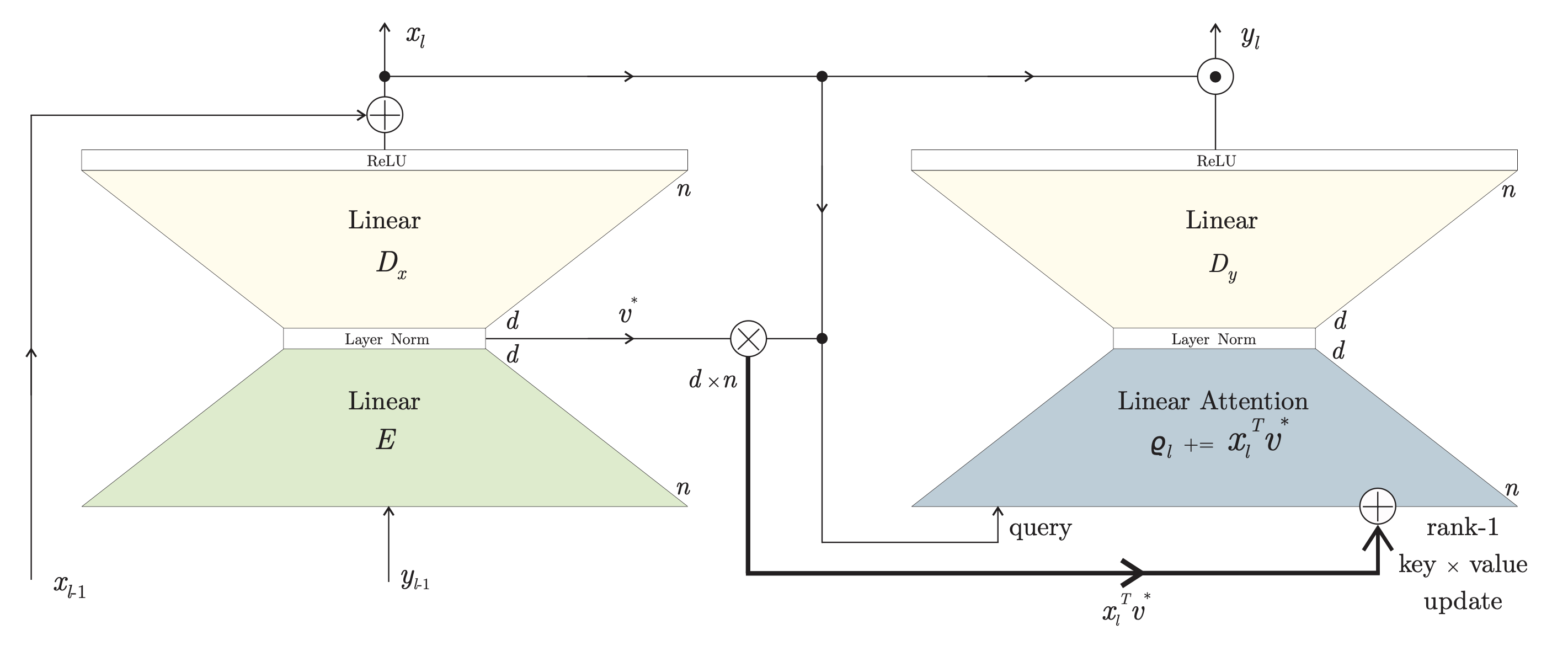
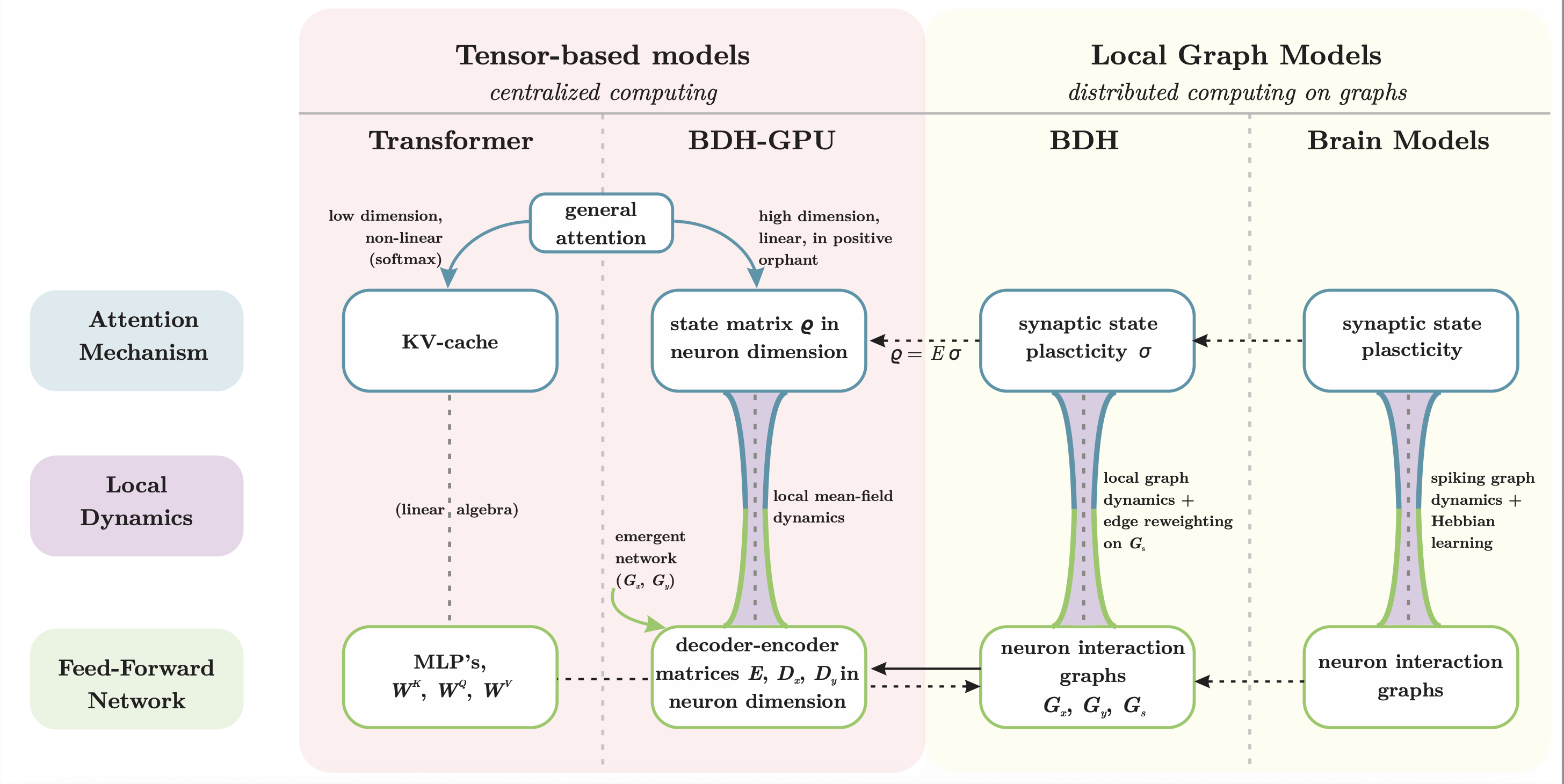
BDH and the Transformer share attention-inspired computation; however, BDH’s graph-based architecture makes its attention emerge naturally from neuron-level interactions, reflecting attention as seen in biological systems.
Scaling Laws
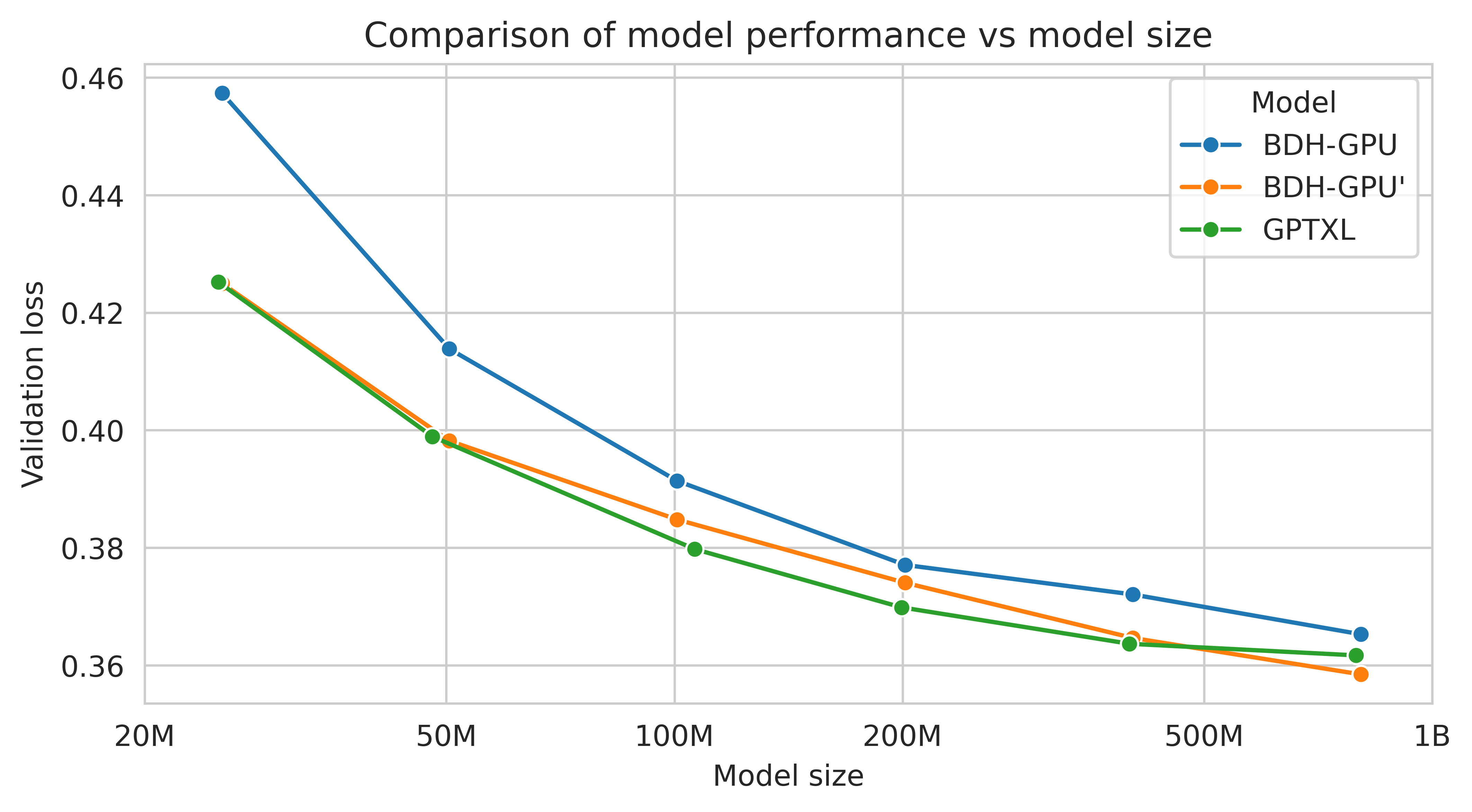
BDH follows Transformer-like scaling laws, maintaining parameter efficiency while achieving interpretability at any scale.
Latest research update: Sudoku Benchmark
Note: The Sudoku Extreme result refers to Pathway’s internal BDH implementation, not to the current open-source repository. This repository contains the implementation of the baseline variant as described in our public paper and does not reproduce the 97.4% benchmark result out of the box. See the dedicated Extreme Sudoku research blog post for additional benchmark context and the reported results.
On Sudoku Extreme, BDH reaches 97.4% accuracy across roughly 250,000 difficult puzzles, without chain-of-thought, solution backtracking, or external tool use, while leading LLMs struggle to perform on the benchmark at all.
Language is not enough for intelligence. Transformers process information token by token with limited internal state, which makes search-heavy, non-linguistic reasoning tasks like Sudoku awkward. BDH uses a larger latent reasoning space with intrinsic memory that supports learning and adaptation during use.
We believe that the future of AI will belong to systems that can reason natively across domains, that can hold multiple possibilities in a rich latent space, and that can converge on solutions without needing to verbalize every step. BDH is our answer to that challenge. It is designed to be a universal reasoning system that can speak our language without being trapped inside it. And yes, it solves Sudoku.
Read more: Post-transformers: Sudoku Bench
| Model |
Sudoku Extreme Accuracy |
Relative Cost |
| Pathway BDH |
97.4% |
10× lower, No chain-of-thought |
| Leading LLMs (O3-mini, DeepSeek R1, Claude 3.7 8K) |
~0% |
High (chain-of-thought) |
Table 1: Performance comparison on extreme Sudoku benchmarks (~250,000 difficult puzzles).
Source: Pathway internal data and https://arxiv.org/pdf/2506.21734 for the Leading LLMs’ accuracy score. Pathway’s approach reflects top-1 accuracy and does not rely on chain-of-thought nor solution backtracking.
Installation and Training
# install dependencies
pip install -r requirements.txt

# train BDH on a toy dataset
python train.py
Learn and Discuss
Acknowledgements
We thank Andrej Karpathy for the nanoGPT code and the tiny Shapespeare dataset used in this demonstration.
BDH research stands at the intersection of AI architecture, biological learning models, and theoretical computer science—an effort to map the equations of reasoning between artificial and biological intelligence.

 BDH(Dragon Hatchling,幼龙)是一种受生物学启发的大语言模型架构,它把深度学习与神经科学联系起来,旨在从单个神经元相互作用的层面解释 AI 系统中的推理和泛化能力是如何涌现的。