


241 ·GitHub
What is this?
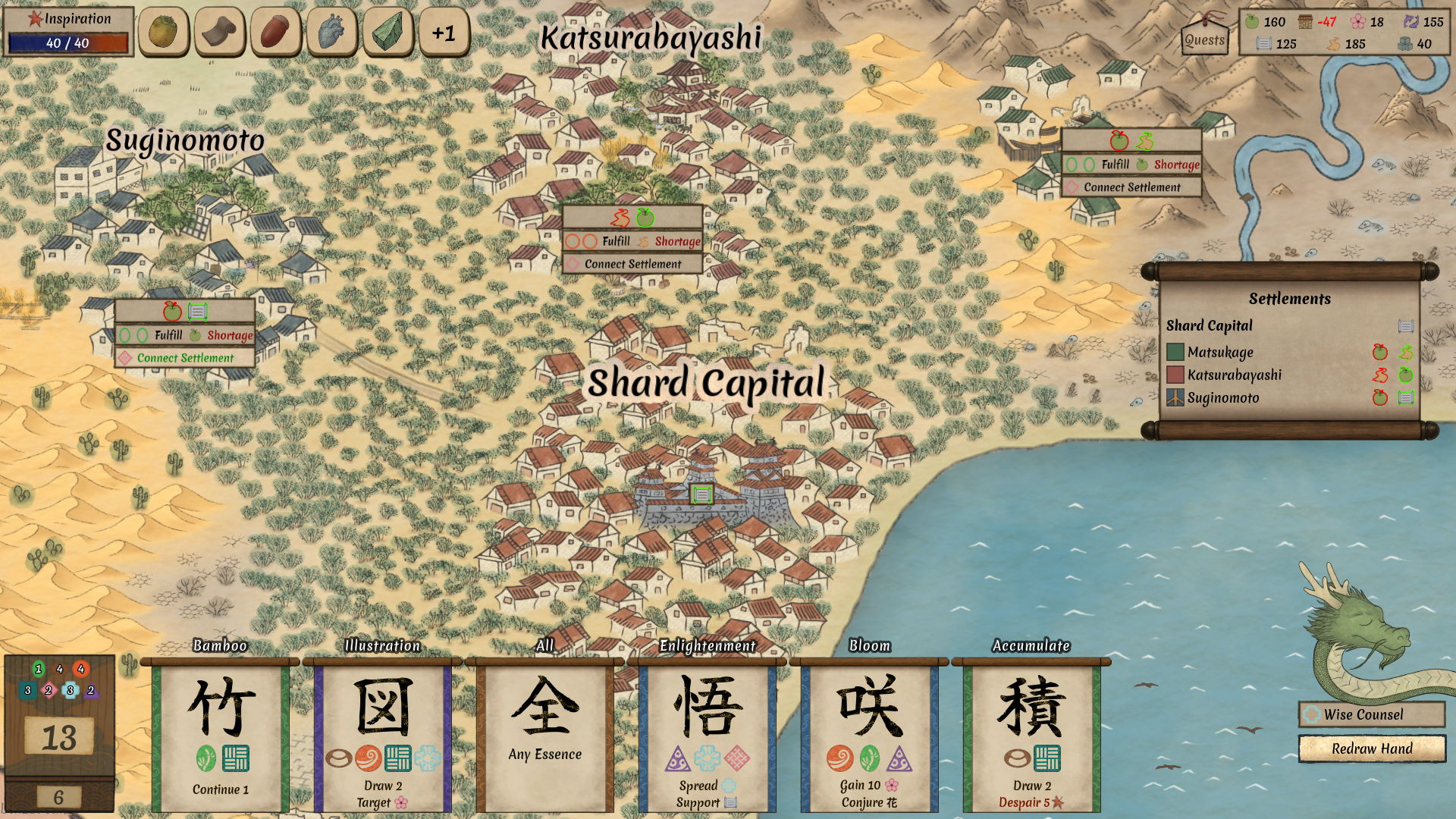
 The complete public domain release of Worlds Upon The Wind, a peaceful roguelite deckbuilder sold on Steam, where you resettle the shards of a shattered world. The repo contains the full Godot project, source code, and art assets.
The complete public domain release of Worlds Upon The Wind, a peaceful roguelite deckbuilder sold on Steam, where you resettle the shards of a shattered world. The repo contains the full Godot project, source code, and art assets.Is this repository meant for players or for developers?For developers: players can simply buy the game on Steam, while this repo is a production-tested reference project — GDScript game logic, a C++ map-generation extension, source art, and the scripts that build and publish to Steam.
For developers: players can simply buy the game on Steam, while this repo is a production-tested reference project — GDScript game logic, a C++ map-generation extension, source art, and the scripts that build and publish to Steam.How do I get it running?Install Godot 4.7, clone the repo, then click Import in the Godot Project Manager and select wutw-public/wutw/project.godot. If the console shows errors, wait for the import to finish and reopen the project, then press F5 to play.
Install Godot 4.7, clone the repo, then click Import in the Godot Project Manager and select wutw-public/wutw/project.godot. If the console shows errors, wait for the import to finish and reopen the project, then press F5 to play.Do I need to install anything besides Godot?No. The C++ GDExtension ships as prebuilt Windows, Linux, and MacOS binaries inside the project, so cloning and importing is enough — build scripts are only needed if you want to recompile the extension yourself.
No. The C++ GDExtension ships as prebuilt Windows, Linux, and MacOS binaries inside the project, so cloning and importing is enough — build scripts are only needed if you want to recompile the extension yourself.Does the game play the same when run from this repo?Almost. Music and sound effects are excluded due to third-party licensing, so the game plays silently except for voiced cutscenes; the audio-system code itself is still included.
Almost. Music and sound effects are excluded due to third-party licensing, so the game plays silently except for voiced cutscenes; the audio-system code itself is still included.Which systems can run and edit it?Windows, Linux, and MacOS — both the released game and the editor project work on all three, with matching GDExtension binaries bundled in res://bin.
Windows, Linux, and MacOS — both the released game and the editor project work on all three, with matching GDExtension binaries bundled in res://bin.Can I reuse the code or art in my own projects?Yes — except for third-party libraries and the excluded audio, everything is public domain (CC0). You can reuse art or code in commercial projects without attribution, and even translate and sell the game royalty-free.
Yes — except for third-party libraries and the excluded audio, everything is public domain (CC0). You can reuse art or code in commercial projects without attribution, and even translate and sell the game royalty-free.What does the gameplay actually look like?You build decks of Glyphs and go on expeditions across a shard map, with the Essences and Slots system as the core mechanic. Between runs there is a hub (Haven) with a museum, skills, crafting, and story characters.
You build decks of Glyphs and go on expeditions across a shard map, with the Essences and Slots system as the core mechanic. Between runs there is a hub (Haven) with a museum, skills, crafting, and story characters.How long is the game and how much content is in it?A 20-30 hour campaign with hundreds of glyphs (cards), relics, events, and other content. As of September 2026 it holds a 99% positive rating on Steam.
A 20-30 hour campaign with hundreds of glyphs (cards), relics, events, and other content. As of September 2026 it holds a 99% positive rating on Steam.Where does the game's art come from?Public domain historical Japanese art, mainly ukiyo-e woodblock prints and e-maki picture scrolls. The game includes an art wiki covering hundreds of these prints, and the repo ships the full PSD and SVG source files.
Public domain historical Japanese art, mainly ukiyo-e woodblock prints and e-maki picture scrolls. The game includes an art wiki covering hundreds of these prints, and the repo ships the full PSD and SVG source files.What are the Japanese practice minigames?Built-in Japanese study tools: practice minigames with thousands of vocabulary entries and annotated example sentences, backed by JMdict, KANJIDIC2, tatoeba sentences, and KanjiVG stroke data.
Built-in Japanese study tools: practice minigames with thousands of vocabulary entries and annotated example sentences, backed by JMdict, KANJIDIC2, tatoeba sentences, and KanjiVG stroke data.What are similar projects?Pixelorama, 3d-game-shaders-for-beginners, GATE, godogen, awesome-godot, nobodywho, GDevelop, nakama
Pixelorama, 3d-game-shaders-for-beginners, GATE, godogen, awesome-godot, nobodywho, GDevelop, nakamaWhich topics is it in?godot-engine, indiedev, glsl, godot, language-learning, japanese, steam, art, localization, gamedev, game-development, game
godot-engine, indiedev, glsl, godot, language-learning, japanese, steam, art, localization, gamedev, game-development, game