Three primitives. Every pattern below is built out of them, and the asymmetry in the last row is the single most common source of bugs.
Six things in reading order. Hand-picked, because "most starred" is not the same as "read this first".
Every decision pattern, sized by how many entries this catalogue contains. Use the pattern index below the chart to jump to a section. A zero is a research gap, not a rendering bug.
All 18 patterns have at least one catalogue entry. Coverage does not imply runtime testing or equal maturity. See docs/status.md.
Hermes Agent: Jev compaction evaluation
Ported the Jev compaction approach, measured it against their shipping summariser, and published the conclusion not to adopt it.
Benchmark · ★248,479 · Py · noul
The single most credible row in this catalog. Recall came out below their existing summariser, and at a matched context budget it tied plain recency ordering. Cost was genuinely far lower. Publishing a negative result on a hyped model is rare.
worldmonitor: news threat classification
Two Choice questions over threat level and category, held in shadow mode after a blind evaluation found Jev merely tied the incumbent model.
Benchmark · ★87,298 · TS · choice
Caveats: shadow mode
Wired in but deliberately inert: by their own statement nothing Jev returns reaches a label, a cache row or an alert. Ships a golden fixture. A model to copy for how to trial a new model without betting production on it.
no-mistakes: Jev review pre-brief, measured and retired
One Score per candidate file to pre-brief code review — measured twice, then removed: more billed input for essentially no wall-clock gain, and offline replay showed the candidate list could not reach where review findings land.
Benchmark · ★8,617 · Go · score
Removed in PR #1165 (2026-09-22). Their offline measurement found the candidate generator excluded changed files by construction while nearly all review findings sit in changed files, and that per-file excerpts made the list less precise at higher token cost. The code is gone from the default branch, so this row cites the change that removed it.
hippo-memory
Biologically-inspired memory for AI agents. Decay, retrieval strengthening, consolidation. Zero runtime deps, SQLite, MCP. Benchmarked retrieval with an opt-in TypeSafe Jev reranker.
Benchmark · ★756 · kitfunso · TS
Probing Jev's behaviour with repeated API calls
Independent Korean-language notes reporting that reversing the order of options shifted a probability enough to flip a 0.9 threshold.
Benchmark · ★190 · Py
Caveats: no licence · unverified claims
The most actionable engineering caveat found anywhere: if option order alone can move a probability past your threshold, your threshold is not as stable as it looks. Independent and unreplicated, so treat the magnitude as indicative.
jevbench
JevBench v1 - a benchmark for Jev-class typed decision models: smart, cheap, fast, reliable, open.
Benchmark · ★107 · fstandhartinger · Py
jev-arena
An introduction to Jev with hands-on tests: Choice, Score and Noul turn natural language into typed judgements for classification, scoring and routing, compared with DeepSeek on comment labelling, speed and results, with CSV import, replay and offline reports.
Benchmark · ★97 · nanmicoder · JS
windtunnel
A WebMCP benchmark, measures WebMCP against other browser-agent interfaces.
Benchmark · ★80 · nekuda-ai · TS
jev-robot-control
Jev against two LLMs on direct Cartesian control of an xArm7 in MuJoCo — intent, movement and gripper each step — with recorded responses, trajectories and replays. One seed-0 trial per controller, not a success rate.
Benchmark · ★44 · openroboto-ai · Py
typesafe-ai-benchmark
A gateway that mimics the structured-output shape, used to benchmark against it.
Benchmark · ★38 · iammrduncan · TS
jev-capability-atlas
Independent, evidence-based map of when TypeSafe's Jev actually holds up vs. breaks down — real API-call receipts, not a leaderboard. 中文為主的雙語 repo。
Benchmark · ★26 · zaious · Py
smartmoney-cub
Read-only trading journal and review harness: Jev typed judgments, agent integration, and a reproducible finance benchmark. No orders, no advice.
Benchmark · ★26 · myc0576 · Py
jev-benchmarks
Probability-aware evaluation for typed decision models: calibration, selective risk, latency, and reproducible benchmarks.
Benchmark · ★17 · abdelstark · Py
jev-rag-benchmark
Reproducible benchmark for measuring Jev reranking quality, latency, and cost in RAG
Benchmark · ★14 · erendikmenn · Py
pdf-race
Docling → Jev vs Docling → Gemini 3.8 Flash vs Gemini reading the PDF: same documents, one clock, scored against arXiv's own metadata
Benchmark · ★9 · goodrahstar · JS
jev-dspy-lab
Reproducible calibration and selective-risk benchmarks for Jev/TypeSafe decisions in DSPy workflows
Benchmark · ★7 · jmanhype · Py
jev-rerank-bench
An independent head-to-head against dedicated rerankers across fourteen datasets.
Benchmark · ★7 · anessbelbati · Py
An independent measurement rather than a vendor figure, and a direct comparison against purpose-built rerankers — the comparison that matters for the search-ranking pattern.
jev-benchmark
Benchmarks and a playground for TypeSafe's Jev (System One) model: chess, and who-is-the-player-talking-to for speech-to-text game NPCs
Benchmark · ★6 · wondertwins · Py
jev-korean-benchmark
Reproducible early-access evaluation of Jev on Korean understanding and medical text, with runtime and cost evidence
Benchmark · ★6 · mahlernim · Py
Caveats: no licence
jev-ood-calibration
Independent calibration test of TypeSafe's Jev on a task it cannot have seen: 900 rule-generated support tickets (choice / score / boolean) plus 3 public benchmarks via Vercel AI Gateway. Raw responses, ECE with noise floor, temperature refit, per-type sign of miscalibration. Reproducible for ~
Benchmark · ★6 · scienthoon · Py
jev-search-rerank-eval
Does a TypeSafe Jev rerank beat embedding search? Graded relevance eval (9,831 pairs, 164 zh/en queries) over the Agent Skills Hub catalog, with the judge-circularity bias measured.
Benchmark · ★6 · zhuyansen · Py
jev-code-review-benchmark
Comparing Jev, Gemini Flash, and Claude Fable on Python code review rules: cost, speed, accuracy, and consistency. Includes results, charts, and reproducible experiments.
Benchmark · ★5 · gemanor · Py
jev-little-airways
A show-and-tell capability study for Jev, TypeSafe's System One decision model.
Benchmark · ★5 · lbotinelly · TS
jev-phishing-bench
Jev (TypeSafe) vs Claude Haiku 4.5 on 2 000 phishing emails: accuracy, calibration, latency, cost. Reproducible benchmark.
Benchmark · ★5 · anisselbd · Py
Caveats: no licence
legalforecastbench
LegalForecast-MTD benchmark alpha and official evaluation workflows
Benchmark · ★5 · johnhughes3 · Py
jevarena
Open-source BYOK arena for Jev and other AI judges. Find failures, compare quality, cost, and latency.
Benchmark · ★4 · chenmingtang830 · TS
sysone-bench
First independent head-to-head benchmark of System One decision models (Laya vs Jev) on byte-identical inputs
Benchmark · ★4 · instax-dutta · Py
ego-jev-ultrafast
Jev drives your Ego Lite browser: one typed-choice request per step. Single-file, zero-dependency port of browser-use/jev-ultrafast with multi-model benchmarks and extra guardrails. Unofficial.
Benchmark · ★3 · shikaizhong-design · JS
jev-does-not-play-dice
Experiments on Jev’s probability calibration, uncertainty reporting, and forecast probability preservation.
Benchmark · ★3 · kantahayashiai · JS
jev-exploration
Jev (TypeSafe) exploratory thread: claim audit, live demos, and runnable code
Benchmark · ★3 · samuelsacco · Py
Caveats: no licence
jev-plays
A System One model plays Craftax while an LLM sets the goals: five agents on the same map, from Jev on raw actions to an LLM controlling every step, compared in logged episodes.
Benchmark · ★3 · mansicer · Py
origin-civilization
AI life-and-civilization simulation: TypeSafe Jev makes every decision (typed, probabilistic, auditable); LLMs plan — OpenAI-compatible APIs, local models (Ollama, LM Studio), Claude Code, Codex.
Benchmark · ★3 · jacquesgariepy · TS
typesafe-jev-calibrate-for-code-review
About calibrating Jev for code reviews
Benchmark · ★3 · selmar · Py
Caveats: no licence
jev-agent-failure-benchmark
Benchmarking Jev (Typesafe.ai) against a strong LLM on the Who&When Pro agent-failure-attribution benchmark (text subset).
Benchmark · ★2 · tokentrim · Py
jev-play-ping-pong
Jev plays browser table tennis in real time: structured telemetry, typed decisions, ordinary Chrome inputs, and auditable evidence.
Benchmark · ★2 · icohen007 · JS
jev-routing-experiment
Benchmarking TypeSafe's Jev decision model as a cost-efficient LLM router on RouterArena
Benchmark · ★2 · tokentrim · Py
zerosweep
Autonomous System-One Triage Engine & Benchmark powered by TypeSafe AI (Jev). 75ms inference, $0 output tokens, and RLCD epistemic safety gates.
Benchmark · ★2 · sysadarsh · TS
Caveats: no licence
antigravity-mcp-semantic-search-with-typesafeai
Fast semantic code search & diff sanity auditor for AI coding assistants (Antigravity, Cursor, Claude Code) powered by TypeSafe System One.
Benchmark · ★1 · greenyamao · Py
Caveats: no licence
can-jev-bayes
Jev Bayes, No? Testing TypeSafe AI's Jev against Bayesian-optimal strategies, and testing if Jev can effectivly use Bayesian priors.
Benchmark · ★1 · tomrichner · Py
decision-bench
Open benchmark runtime for document-grounded decision models
Benchmark · ★1 · hanno-labs · Py
dsh-jev-verify
Jev (TypeSafe System One) decision tools + live verification benchmark for DeepSeek Harness: jev_decision (choice/score/noul) and jev_verify, honest by design.
Benchmark · ★1 · xienda · JS
jev-bench
Does the cited source actually say it? A 42-claim benchmark: Jev (TypeSafe System One) against GPT-5.4, Claude Sonnet 5 and Gemini 3.1 Pro.
Benchmark · ★1 · thewaywithin · Py
jev-benchmark
Reproducible benchmark for TypeSafe AI's Jev on agent tool-call risk classification: accuracy, latency, and whether the confidence score is worth routing on.
Benchmark · ★1 · themsquared · Py
jev-decision-benchmarks
JEV decision benchmark results on MetaTool, When2Call, and BFCL V4, with bilingual tables and reproducible reports.
Benchmark · ★1 · baibizhe · Py
Caveats: no licence
jev-eval
Benchmark TypeSafe Jev against any OpenRouter model on your own labelled classification data: accuracy, calibration, latency, cost
Benchmark · ★1 · 4esv · Py
Caveats: no licence
jev-lab
Hands-on research lab for TypeSafe's Jev (System One model): reproducible benchmarks of Noul/Choice/Score primitives, confidence gating, fan-out latency, agent control — plus a living audit of the Jev ecosystem.
Benchmark · ★1 · llt22 · Py
Caveats: no licence
jev-lab
Experiments on TypeSafe Jev (System One decision model) via OpenRouter: repeatability, perturbation, and LLM baseline comparison
Benchmark · ★1 · danielhirt · TS
Caveats: no licence
jev-secret-detection
Measures how well TypeSafe's RLCD-Jev model spots real secret credentials in file snippets
Benchmark · ★1 · teyhouse · Py
Caveats: no licence
jev-sim
Jev-compatible /v1/systemone server reading typed decisions from LLM logits, benchmarked against TypeSafe's Jev on the same items via JevBench
Benchmark · ★1 · dashbi1 · Py
jevsbistro
3D restaurant service simulator for benchmarking low-latency decision models
Benchmark · ★1 · andrewsilber · TS
padflow-jev-evals
Typed-decision benchmark from PadFlow (land development SaaS): schemas, anonymized labeled rows, and a runner for confidence-calibrated models like TypeSafe Jev.
Benchmark · ★1 · zsavage8 · Py
what-is-jev
Independent, source-linked research on TypeSafe AI's Jev (System One), with 947 rubric-scored public repositories, recurring patterns, datasets, and bilingual documentation.
Benchmark · ★1 · g0runmezadam · Py
Research about the ecosystem rather than a caller of the API, so it carries no call-site evidence.
agent-handoff-gate
An experimental protocol for evidence-aware agent handoffs, bounded worker continuation, and TypeSafe/Jev-assisted review, with reproducible evaluation.
Benchmark · ★0 · zsoxi · Py
jev-acento
¿Jev entiende tu acento? Pre-registered audit of TypeSafe AI's Jev on Spanish — accuracy, calibration and token cost — plus a CLI to run the same comparison on your own labelled data.
Benchmark · ★0 · marcosmartinez · Py
An independent, pre-registered audit of the model outside English — the gap docs/status.md lists as worth watching.
jev-calibration-audit
Independent API-only calibration audit of TypeSafe AI's Jev decision model
Benchmark · ★0 · jujumilk3 · Py
jev-certify
Finite-sample guarantees for Jev (TypeSafe's System One). Conformal risk control turns calibrated probabilities into certified routing thresholds; prediction-powered inference audits them. 2,412 decisions on CLINC150 for $0.23 — including the shift and prevalence cases where the guarantee break
Benchmark · ★0 · nikkoxgonzales · Py
jev-cyrillic-audit
Does TypeSafe's Jev keep its accuracy and calibration on Russian? Independent RU vs EN audit (ECE, reliability diagrams, paired bootstrap) on parallel human-labelled data.
Benchmark · ★0 · ahtoooxa · Py
An independent calibration audit outside English — the gap docs/status.md lists as worth watching.
jev-enterprise-decision-fabric
Architecture for running many semantic decisions through one validated path, with a labelled 111-case benchmark comparing TypeSafe Jev against a Claude baseline, and a dashboard for inspecting any single decision. Experimental, not production.
Benchmark · ★0 · ghubnab99 · C#
jev-eval
TypeSafe's Jev vs gpt-5.4-mini and gpt-5.6-luna on four public classification sets: cases, per-item answers, scoring, charts
Benchmark · ★0 · onlyoneaman · TS
jev-eval
A third-party check of Jev against two LLMs under identical conditions: routing booking inquiries to a photo-shoot service for tourists in Japan, sixty synthetic messages in four languages.
Benchmark · ★0 · shogo-nfrealmusic · TS
Caveats: no licence
jev-fanout-bench
Measured: asking TypeSafe Jev N questions in one call bills the state once. 2,976 real requests, raw data, exact billing check.
Benchmark · ★0 · blowxian · Py
jev-lab
TypeScript experiments, evaluations, and latency benchmarks for TypeSafe's Jev model
Benchmark · ★0 · menny1337 · TS
Caveats: no licence
jev-llm-router-benchmark
Benchmark-driven Jev router and judge for cost-aware, reliable LLM coding workflows
Benchmark · ★0 · erendikmenn · Py
jev-no-enem
Reproducible benchmark evaluating TypeSafe AI's Jev (System One paradigm) on Brazil's ENEM 2025 standardized exam. Evaluates typed decision-making, domain-specific accuracy, and RLCD uncertainty calibration against open LLM baselines with an interactive GitHub Pages dashboard.
Benchmark · ★0 · patryckalves · Py
Caveats: no licence
An independent evaluation outside English, on a public exam with known answers.
jev-orderby-bench
Does ORDER BY over a Jev probability put rows in a defensible order? Independent ranking, calibration and invariant measurements of TypeSafe AI's Jev: passes six pre-registered gates on 360 labeled rows, fails four of six on graded product relevance.
Benchmark · ★0 · yodablocks · Py
jev-playground
Benchmarks Jev against other evaluation models in games with explicit states and legal actions: code owns the rules and transitions, each model picks the next action, and outcomes are measured.
Benchmark · ★0 · hegargarcia · TS
Caveats: no licence
jev-trace-classifier
Application of TypeSafe Jev (noul judgment primitive) on the collusion.wiki corpus: agent vs human page authorship, head-to-head vs local Qwen3.8-Flash-Next
Benchmark · ★0 · sypherin · Py
smoking-extraction-benchmark
Synthetic smoking-history extraction benchmark comparing TypeSafe Jev and OpenAI structured outputs, with reproducible accuracy, cost, and latency results.
Benchmark · ★0 · vclic · Py
Caveats: no licence
An early-access test of TypeSafe's Jev: calibrated judgments for half a cent
The best independent test found: 24 Norwegian documents on one pinned model version, opening with a case the model got wrong while correctly reporting low confidence.
Benchmark · Lindfors
Methodology is stated cleanly and scoped honestly as a single-day snapshot. Leading with a failure case is what makes it a real calibration test rather than a testimonial.
Testing TypeSafe Jev, Mistral and Gemini for local event validation
The only three-way head-to-head found, with each model's prompt tuned separately and the scope limited to one task rather than a general ranking.
Benchmark · Near Here
Self-limits correctly: a use-case study, not a model leaderboard. That restraint is rarer than the numbers.
The primary index. Each heading is a decision an agent has to make; the rows are examples of making it. Caveats appear as short tags — the full note for each row is in catalog.json and on the site.
The same rows grouped by what you will find when you open the link.
The parts that are not the catalog.
Links that stopped resolving, kept so a dead reference stays searchable instead of vanishing.
One entry per example, validated against a JSON Schema on every push.
Corrections take priority over additions — a wrong row costs more than a missing one. See CONTRIBUTING.md; the bar is could a reader act on this row without opening the link?
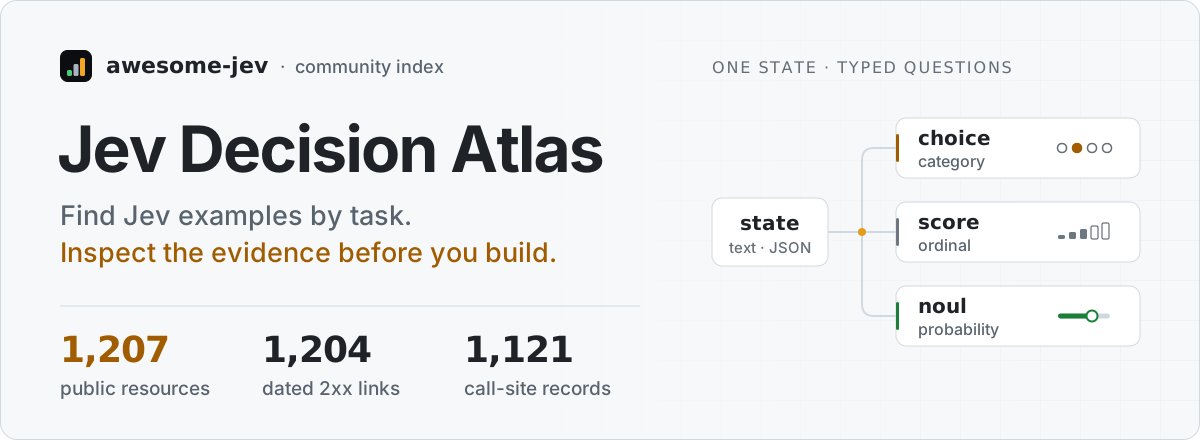


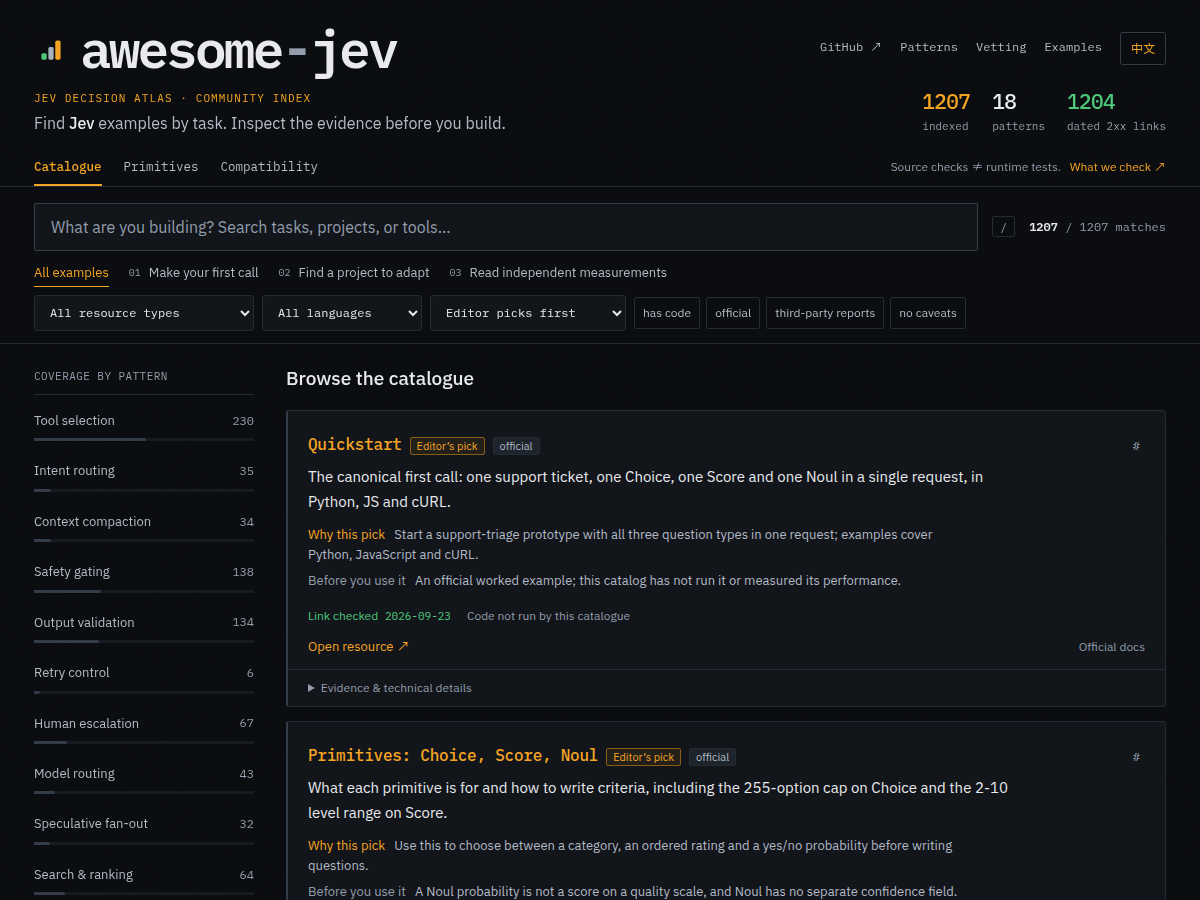


 Тщательно составленный указатель из 1207 публичных ресурсов для Jev — модели принятия решений System One от TypeSafe AI, — организованный по решению, которое иллюстрирует каждый ресурс. Это независимый каталог, а не сам продукт и не SDK.