




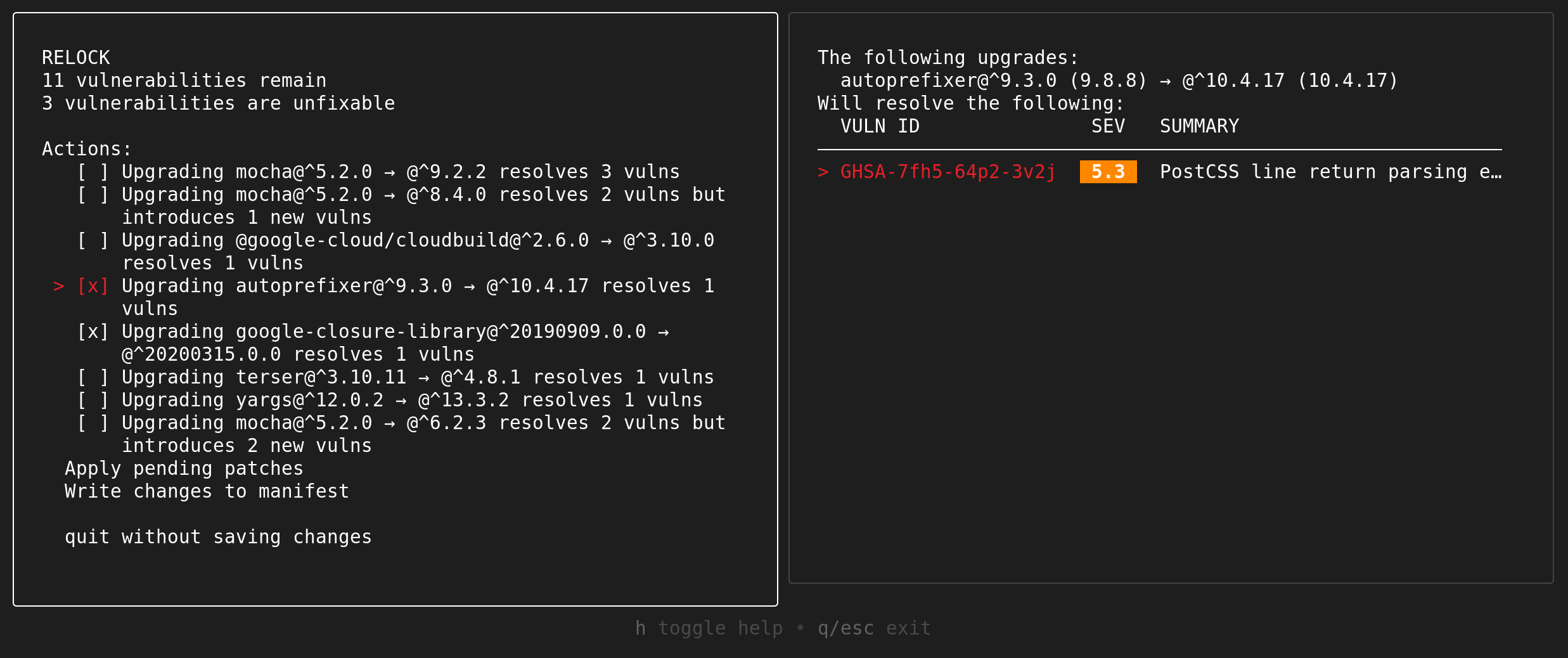
11.2K ·GitHub
What is this?
 OSV-Scanner is Google's open-source command-line vulnerability scanner: it checks your project's dependencies against OSV.dev, an open vulnerability database, and reports which known vulnerabilities affect you.
OSV-Scanner is Google's open-source command-line vulnerability scanner: it checks your project's dependencies against OSV.dev, an open vulnerability database, and reports which known vulnerabilities affect you.Is it a library I add to my codebase, or a separate tool I run?It is a standalone CLI tool written in Go, not a library you import — you point it at a project directory or container image and it reports findings. Internally it uses the OSV-Scalibr library to detect dependencies.
It is a standalone CLI tool written in Go, not a library you import — you point it at a project directory or container image and it reports findings. Internally it uses the OSV-Scalibr library to detect dependencies.Do I need anything else installed for it to scan my project?No, just the scanner binary — it reads your existing package files like package.json, go.mod and pom.xml. It covers 11+ language ecosystems and 19+ lockfile types: npm, pip, yarn, maven, go modules, cargo, gem, composer, nuget and more, plus Linux OS packages.
No, just the scanner binary — it reads your existing package files like package.json, go.mod and pom.xml. It covers 11+ language ecosystems and 19+ lockfile types: npm, pip, yarn, maven, go modules, cargo, gem, composer, nuget and more, plus Linux OS packages.Will it flag vulnerabilities my code never actually uses?Possibly — to cut that noise, OSV-Scanner offers optional call analysis that checks whether a vulnerable function is really used in your project, resulting in fewer false positives and more actionable alerts.
Possibly — to cut that noise, OSV-Scanner offers optional call analysis that checks whether a vulnerable function is really used in your project, resulting in fewer false positives and more actionable alerts.Can I use it without internet access?Yes. In offline mode it scans your project against a local OSV database: after the initial database download no network connection is required, and the database can also be downloaded manually.
Yes. In offline mode it scans your project against a local OSV database: after the initial database download no network connection is required, and the database can also be downloaded manually.What does it send over the network when I scan?It queries the OSV.dev API, sending package names, versions, ecosystems and file hashes, plus the deps.dev API for supplementary package info — no source code is transmitted. Run it with --offline to disable network requests entirely.
It queries the OSV.dev API, sending package names, versions, ecosystems and file hashes, plus the deps.dev API for supplementary package info — no source code is transmitted. Run it with --offline to disable network requests entirely.Can it scan Docker images, not just source lockfiles?Yes — it does layer-aware container scanning, finding vulnerable OS packages in Alpine, Debian and Ubuntu base images, plus Go, Java, Node and Python language dependencies inside the image.
Yes — it does layer-aware container scanning, finding vulnerable OS packages in Alpine, Debian and Ubuntu base images, plus Go, Java, Node and Python language dependencies inside the image.How good is the vulnerability data it relies on?OSV.dev aggregates advisories from open, authoritative sources like GitHub Security Advisories, the RustSec Advisory Database and Ubuntu security notices. Anyone can suggest improvements, and the machine-readable OSV format maps affected versions precisely onto your package list.
OSV.dev aggregates advisories from open, authoritative sources like GitHub Security Advisories, the RustSec Advisory Database and Ubuntu security notices. Anyone can suggest improvements, and the machine-readable OSV format maps affected versions precisely onto your package list.Can it also check the licenses of my dependencies?Yes — a license scanning mode uses deps.dev data, either as a summary or checked against your own allowlist of licenses in SPDX format.
Yes — a license scanning mode uses deps.dev data, either as a summary or checked against your own allowlist of licenses in SPDX format.Which topics is it in?dependencies, supply-chain-security, scanner, security-audit, devsecops, vulnerability-scanner, vulnerability, containers, google, security-tools, offline, go
dependencies, supply-chain-security, scanner, security-audit, devsecops, vulnerability-scanner, vulnerability, containers, google, security-tools, offline, go