DeepSeek-R1
1. Introduction
We introduce our first-generation reasoning models, DeepSeek-R1-Zero and DeepSeek-R1.
DeepSeek-R1-Zero, a model trained via large-scale reinforcement learning (RL) without supervised fine-tuning (SFT) as a preliminary step, demonstrated remarkable performance on reasoning.
With RL, DeepSeek-R1-Zero naturally emerged with numerous powerful and interesting reasoning behaviors.
However, DeepSeek-R1-Zero encounters challenges such as endless repetition, poor readability, and language mixing. To address these issues and further enhance reasoning performance,
we introduce DeepSeek-R1, which incorporates cold-start data before RL.
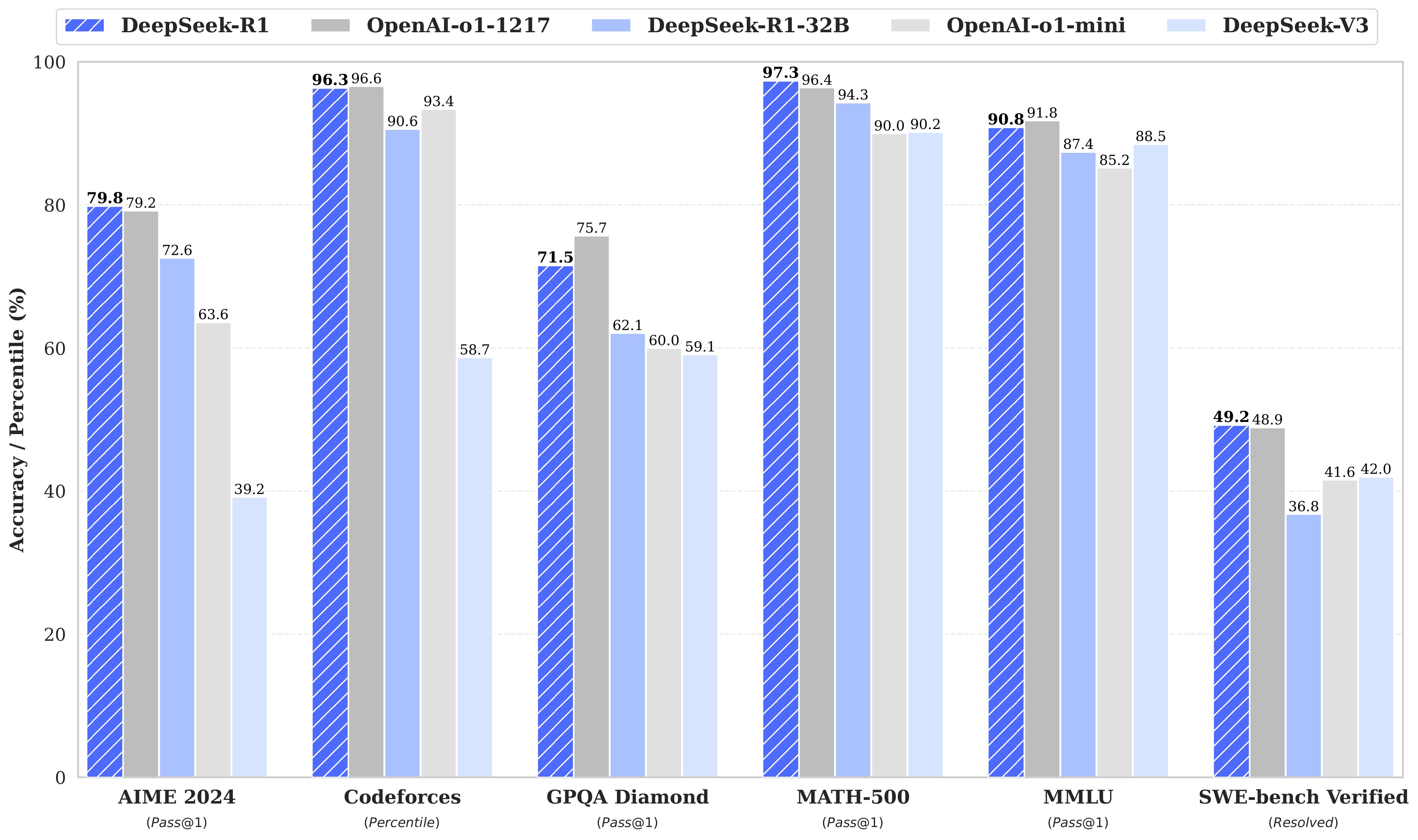
DeepSeek-R1 achieves performance comparable to OpenAI-o1 across math, code, and reasoning tasks.
To support the research community, we have open-sourced DeepSeek-R1-Zero, DeepSeek-R1, and six dense models distilled from DeepSeek-R1 based on Llama and Qwen. DeepSeek-R1-Distill-Qwen-32B outperforms OpenAI-o1-mini across various benchmarks, achieving new state-of-the-art results for dense models.
NOTE: Before running DeepSeek-R1 series models locally, we kindly recommend reviewing the Usage Recommendation section.
2. Model Summary
Post-Training: Large-Scale Reinforcement Learning on the Base Model
We directly apply reinforcement learning (RL) to the base model without relying on supervised fine-tuning (SFT) as a preliminary step. This approach allows the model to explore chain-of-thought (CoT) for solving complex problems, resulting in the development of DeepSeek-R1-Zero. DeepSeek-R1-Zero demonstrates capabilities such as self-verification, reflection, and generating long CoTs, marking a significant milestone for the research community. Notably, it is the first open research to validate that reasoning capabilities of LLMs can be incentivized purely through RL, without the need for SFT. This breakthrough paves the way for future advancements in this area.
We introduce our pipeline to develop DeepSeek-R1. The pipeline incorporates two RL stages aimed at discovering improved reasoning patterns and aligning with human preferences, as well as two SFT stages that serve as the seed for the model's reasoning and non-reasoning capabilities.
We believe the pipeline will benefit the industry by creating better models.
Distillation: Smaller Models Can Be Powerful Too
- We demonstrate that the reasoning patterns of larger models can be distilled into smaller models, resulting in better performance compared to the reasoning patterns discovered through RL on small models. The open source DeepSeek-R1, as well as its API, will benefit the research community to distill better smaller models in the future.
- Using the reasoning data generated by DeepSeek-R1, we fine-tuned several dense models that are widely used in the research community. The evaluation results demonstrate that the distilled smaller dense models perform exceptionally well on benchmarks. We open-source distilled 1.5B, 7B, 8B, 14B, 32B, and 70B checkpoints based on Qwen2.5 and Llama3 series to the community.
3. Model Downloads
DeepSeek-R1 Models
| Model |
#Total Params |
#Activated Params |
Context Length |
Download |
| DeepSeek-R1-Zero |
671B |
37B |
128K |
🤗 HuggingFace |
| DeepSeek-R1 |
671B |
37B |
128K |
🤗 HuggingFace |
DeepSeek-R1-Zero & DeepSeek-R1 are trained based on DeepSeek-V3-Base.
For more details regarding the model architecture, please refer to DeepSeek-V3 repository.
DeepSeek-R1-Distill Models
DeepSeek-R1-Distill models are fine-tuned based on open-source models, using samples generated by DeepSeek-R1.
We slightly change their configs and tokenizers. Please use our setting to run these models.
4. Evaluation Results
DeepSeek-R1-Evaluation
For all our models, the maximum generation length is set to 32,768 tokens. For benchmarks requiring sampling, we use a temperature of $0.6$, a top-p value of $0.95$, and generate 64 responses per query to estimate pass@1.
| Category |
Benchmark (Metric) |
Claude-3.5-Sonnet-1022 |
GPT-4o 0513 |
DeepSeek V3 |
OpenAI o1-mini |
OpenAI o1-1217 |
DeepSeek R1 |
|
Architecture |
- |
- |
MoE |
- |
- |
MoE |
|
# Activated Params |
- |
- |
37B |
- |
- |
37B |
|
# Total Params |
- |
- |
671B |
- |
- |
671B |
| English |
MMLU (Pass@1) |
88.3 |
87.2 |
88.5 |
85.2 |
91.8 |
90.8 |
|
MMLU-Redux (EM) |
88.9 |
88.0 |
89.1 |
86.7 |
- |
92.9 |
|
MMLU-Pro (EM) |
78.0 |
72.6 |
75.9 |
80.3 |
- |
84.0 |
|
DROP (3-shot F1) |
88.3 |
83.7 |
91.6 |
83.9 |
90.2 |
92.2 |
|
IF-Eval (Prompt Strict) |
86.5 |
84.3 |
86.1 |
84.8 |
- |
83.3 |
|
GPQA-Diamond (Pass@1) |
65.0 |
49.9 |
59.1 |
60.0 |
75.7 |
71.5 |
|
SimpleQA (Correct) |
28.4 |
38.2 |
24.9 |
7.0 |
47.0 |
30.1 |
|
FRAMES (Acc.) |
72.5 |
80.5 |
73.3 |
76.9 |
- |
82.5 |
|
AlpacaEval2.0 (LC-winrate) |
52.0 |
51.1 |
70.0 |
57.8 |
- |
87.6 |
|
ArenaHard (GPT-4-1106) |
85.2 |
80.4 |
85.5 |
92.0 |
- |
92.3 |
| Code |
LiveCodeBench (Pass@1-COT) |
33.8 |
34.2 |
- |
53.8 |
63.4 |
65.9 |
|
Codeforces (Percentile) |
20.3 |
23.6 |
58.7 |
93.4 |
96.6 |
96.3 |
|
Codeforces (Rating) |
717 |
759 |
1134 |
1820 |
2061 |
2029 |
|
SWE Verified (Resolved) |
50.8 |
38.8 |
42.0 |
41.6 |
48.9 |
49.2 |
|
Aider-Polyglot (Acc.) |
45.3 |
16.0 |
49.6 |
32.9 |
61.7 |
53.3 |
| Math |
AIME 2024 (Pass@1) |
16.0 |
9.3 |
39.2 |
63.6 |
79.2 |
79.8 |
|
MATH-500 (Pass@1) |
78.3 |
74.6 |
90.2 |
90.0 |
96.4 |
97.3 |
|
CNMO 2024 (Pass@1) |
13.1 |
10.8 |
43.2 |
67.6 |
- |
78.8 |
| Chinese |
CLUEWSC (EM) |
85.4 |
87.9 |
90.9 |
89.9 |
- |
92.8 |
|
C-Eval (EM) |
76.7 |
76.0 |
86.5 |
68.9 |
- |
91.8 |
|
C-SimpleQA (Correct) |
55.4 |
58.7 |
68.0 |
40.3 |
- |
63.7 |
Distilled Model Evaluation
| Model |
AIME 2024 pass@1 |
AIME 2024 cons@64 |
MATH-500 pass@1 |
GPQA Diamond pass@1 |
LiveCodeBench pass@1 |
CodeForces rating |
| GPT-4o-0513 |
9.3 |
13.4 |
74.6 |
49.9 |
32.9 |
759 |
| Claude-3.5-Sonnet-1022 |
16.0 |
26.7 |
78.3 |
65.0 |
38.9 |
717 |
| o1-mini |
63.6 |
80.0 |
90.0 |
60.0 |
53.8 |
1820 |
| QwQ-32B-Preview |
44.0 |
60.0 |
90.6 |
54.5 |
41.9 |
1316 |
| DeepSeek-R1-Distill-Qwen-1.5B |
28.9 |
52.7 |
83.9 |
33.8 |
16.9 |
954 |
| DeepSeek-R1-Distill-Qwen-7B |
55.5 |
83.3 |
92.8 |
49.1 |
37.6 |
1189 |
| DeepSeek-R1-Distill-Qwen-14B |
69.7 |
80.0 |
93.9 |
59.1 |
53.1 |
1481 |
| DeepSeek-R1-Distill-Qwen-32B |
72.6 |
83.3 |
94.3 |
62.1 |
57.2 |
1691 |
| DeepSeek-R1-Distill-Llama-8B |
50.4 |
80.0 |
89.1 |
49.0 |
39.6 |
1205 |
| DeepSeek-R1-Distill-Llama-70B |
70.0 |
86.7 |
94.5 |
65.2 |
57.5 |
1633 |
You can chat with DeepSeek-R1 on DeepSeek's official website: chat.deepseek.com, and switch on the button "DeepThink"
We also provide OpenAI-Compatible API at DeepSeek Platform: platform.deepseek.com
6. How to Run Locally
DeepSeek-R1 Models
Please visit DeepSeek-V3 repo for more information about running DeepSeek-R1 locally.
NOTE: Hugging Face's Transformers has not been directly supported yet.
DeepSeek-R1-Distill Models
DeepSeek-R1-Distill models can be utilized in the same manner as Qwen or Llama models.
For instance, you can easily start a service using vLLM:
vllm serve deepseek-ai/DeepSeek-R1-Distill-Qwen-32B --tensor-parallel-size 2 --max-model-len 32768 --enforce-eager
You can also easily start a service using SGLang
python3 -m sglang.launch_server --model deepseek-ai/DeepSeek-R1-Distill-Qwen-32B --trust-remote-code --tp 2
Usage Recommendations
We recommend adhering to the following configurations when utilizing the DeepSeek-R1 series models, including benchmarking, to achieve the expected performance:
- Set the temperature within the range of 0.5-0.7 (0.6 is recommended) to prevent endless repetitions or incoherent outputs.
- Avoid adding a system prompt; all instructions should be contained within the user prompt.
- For mathematical problems, it is advisable to include a directive in your prompt such as: "Please reason step by step, and put your final answer within \boxed{}."
- When evaluating model performance, it is recommended to conduct multiple tests and average the results.
Additionally, we have observed that the DeepSeek-R1 series models tend to bypass thinking pattern (i.e., outputting "<think>\n\n</think>") when responding to certain queries, which can adversely affect the model's performance.
To ensure that the model engages in thorough reasoning, we recommend enforcing the model to initiate its response with "<think>\n" at the beginning of every output.
Official Prompts
In the official DeepSeek web/app, we don't use system prompts but design two specific prompts for file upload and web search for better user experience. In addition, the temperature in web/app is 0.6.
For file upload, please follow the template to create prompts, where {file_name}, {file_content} and {question} are arguments.
file_template = \
"""[file name]: {file_name}
[file content begin]
{file_content}
[file content end]
{question}"""
For Web Search, {search_results}, {cur_date}, and {question} are arguments.
For Chinese query, we use the prompt:
search_answer_zh_template = \
'''# 以下内容是基于用户发送的消息的搜索结果:
{search_results}
在我给你的搜索结果中,每个结果都是[webpage X begin]...[webpage X end]格式的,X代表每篇文章的数字索引。请在适当的情况下在句子末尾引用上下文。请按照引用编号[citation:X]的格式在答案中对应部分引用上下文。如果一句话源自多个上下文,请列出所有相关的引用编号,例如[citation:3][citation:5],切记不要将引用集中在最后返回引用编号,而是在答案对应部分列出。
在回答时,请注意以下几点:
- 今天是{cur_date}。
- 并非搜索结果的所有内容都与用户的问题密切相关,你需要结合问题,对搜索结果进行甄别、筛选。
- 对于列举类的问题(如列举所有航班信息),尽量将答案控制在10个要点以内,并告诉用户可以查看搜索来源、获得完整信息。优先提供信息完整、最相关的列举项;如非必要,不要主动告诉用户搜索结果未提供的内容。
- 对于创作类的问题(如写论文),请务必在正文的段落中引用对应的参考编号,例如[citation:3][citation:5],不能只在文章末尾引用。你需要解读并概括用户的题目要求,选择合适的格式,充分利用搜索结果并抽取重要信息,生成符合用户要求、极具思想深度、富有创造力与专业性的答案。你的创作篇幅需要尽可能延长,对于每一个要点的论述要推测用户的意图,给出尽可能多角度的回答要点,且务必信息量大、论述详尽。
- 如果回答很长,请尽量结构化、分段落总结。如果需要分点作答,尽量控制在5个点以内,并合并相关的内容。
- 对于客观类的问答,如果问题的答案非常简短,可以适当补充一到两句相关信息,以丰富内容。
- 你需要根据用户要求和回答内容选择合适、美观的回答格式,确保可读性强。
- 你的回答应该综合多个相关网页来回答,不能重复引用一个网页。
- 除非用户要求,否则你回答的语言需要和用户提问的语言保持一致。

# 用户消息为:
{question}'''
For English query, we use the prompt:
search_answer_en_template = \
'''# The following contents are the search results related to the user's message:
{search_results}
In the search results I provide to you, each result is formatted as [webpage X begin]...[webpage X end], where X represents the numerical index of each article. Please cite the context at the end of the relevant sentence when appropriate. Use the citation format [citation:X] in the corresponding part of your answer. If a sentence is derived from multiple contexts, list all relevant citation numbers, such as [citation:3][citation:5]. Be sure not to cluster all citations at the end; instead, include them in the corresponding parts of the answer.
When responding, please keep the following points in mind:
- Today is {cur_date}.
- Not all content in the search results is closely related to the user's question. You need to evaluate and filter the search results based on the question.
- For listing-type questions (e.g., listing all flight information), try to limit the answer to 10 key points and inform the user that they can refer to the search sources for complete information. Prioritize providing the most complete and relevant items in the list. Avoid mentioning content not provided in the search results unless necessary.
- For creative tasks (e.g., writing an essay), ensure that references are cited within the body of the text, such as [citation:3][citation:5], rather than only at the end of the text. You need to interpret and summarize the user's requirements, choose an appropriate format, fully utilize the search results, extract key information, and generate an answer that is insightful, creative, and professional. Extend the length of your response as much as possible, addressing each point in detail and from multiple perspectives, ensuring the content is rich and thorough.
- If the response is lengthy, structure it well and summarize it in paragraphs. If a point-by-point format is needed, try to limit it to 5 points and merge related content.
- For objective Q&A, if the answer is very brief, you may add one or two related sentences to enrich the content.
- Choose an appropriate and visually appealing format for your response based on the user's requirements and the content of the answer, ensuring strong readability.
- Your answer should synthesize information from multiple relevant webpages and avoid repeatedly citing the same webpage.
- Unless the user requests otherwise, your response should be in the same language as the user's question.

# The user's message is:
{question}'''
7. License
This code repository and the model weights are licensed under the MIT License.
DeepSeek-R1 series support commercial use, allow for any modifications and derivative works, including, but not limited to, distillation for training other LLMs. Please note that:
- DeepSeek-R1-Distill-Qwen-1.5B, DeepSeek-R1-Distill-Qwen-7B, DeepSeek-R1-Distill-Qwen-14B and DeepSeek-R1-Distill-Qwen-32B are derived from Qwen-2.5 series, which are originally licensed under Apache 2.0 License, and now finetuned with 800k samples curated with DeepSeek-R1.
- DeepSeek-R1-Distill-Llama-8B is derived from Llama3.1-8B-Base and is originally licensed under [Llama3.1 license](https://huggingface.co/meta-llama/Lla


 DeepSeek-R1 是 DeepSeek 推出的一系列开源推理大语言模型,通过大规模强化学习训练,在数学、代码和通用推理任务上的表现可与 OpenAI 的 o1 相媲美。