English | 中文
Hears your tone. Speaks with one.
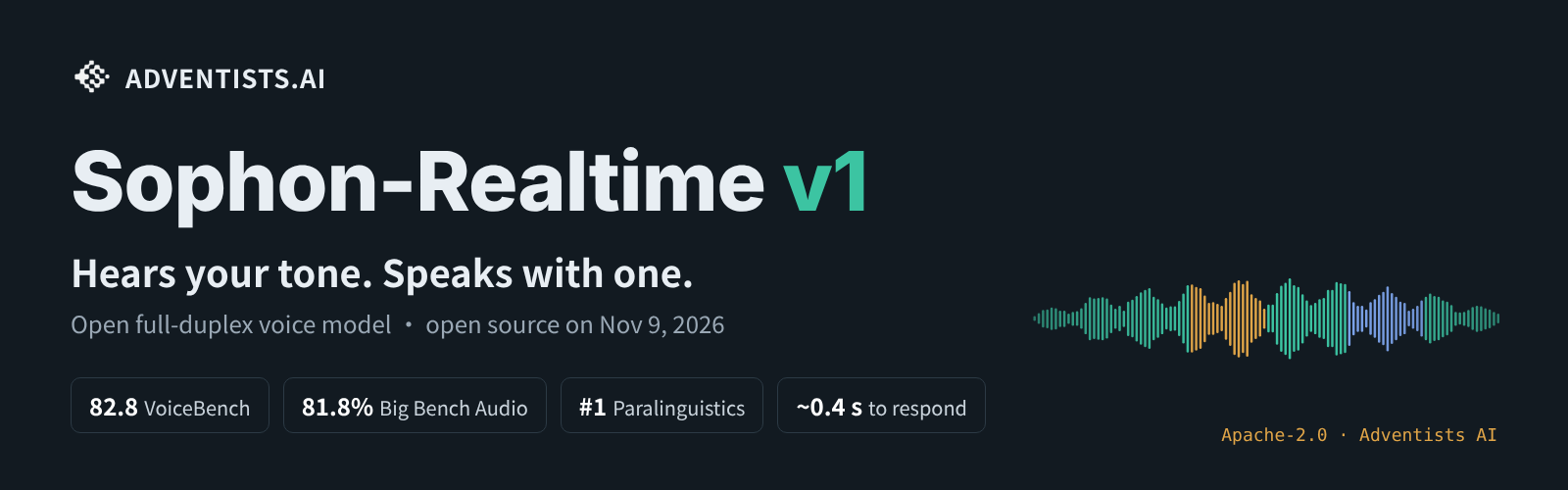
Sophon-Realtime v1 is an open full-duplex voice model family: it listens while you talk, hears how you say things, and answers with a voice that laughs, sighs and breathes when the moment calls for it.






Demo
Real conversations with Sophon-Realtime, recorded as they happened: no edits, no speed-up. Turn the sound on.
https://github.com/user-attachments/assets/4d6c74f5-3bbf-4dc2-8b11-f90ff85de4a2
Chinese demo
https://github.com/user-attachments/assets/1d9442ef-84b0-45a3-acd4-2d05a9562397
Highlights
- VoiceBench 82.8 and Big Bench Audio 81.8%: the strongest brain among open full-duplex models. #1 among open full-duplex models on both; level with GPT-4o-mini-Audio on VoiceBench. All three builds share this brain.
- Paralinguistic understanding 48.6, #1 overall: it hears your tone. Ahead of Gemini 3.8 Flash (46.9) and Qwen3-Omni (44.6) on LISTEN, StressTest and MSPB. It hears emotion, emphasis, sarcasm, laughter and sighs straight from your voice. Its ears are DuplexJev, our open speech-decision model.
- NVV-SuperBench 0.86 (Chinese) and 0.80 (English) with the Tag build: it speaks with tone. The model decides from the conversation when to laugh, sigh, breathe or clear its throat, and the voice performs it instead of reading the tag aloud.
- Speaks your language: Chinese, English and five European languages, with more on the way. Italian, German, Spanish, French and Portuguese work out of the box, Japanese and Russian run on Flash, and Korean is next. See Languages.
- Fast: first audio in about 0.25 s with E2E and 0.31 s with Flash. It listens the whole time you talk and drafts its reply as you go. When you cut in, it stops and answers your new question.
- Full-Duplex-Bench v3 tool calling: Pass@1 48%, ahead of Grok (43%), with a 100% response rate: it gets work done. Live mode lets it work together with a larger backend model, and it is compatible with the OpenAI GPT-Live interface format. Every reply comes with an auditable transcript.
- One 80 GB GPU for every build, one command. Tag and Flash are served by vLLM-Omni; up to 16 (Tag, E2E) or 40 (Flash) concurrent users per GPU. Apache-2.0 code and weights, free for commercial use.
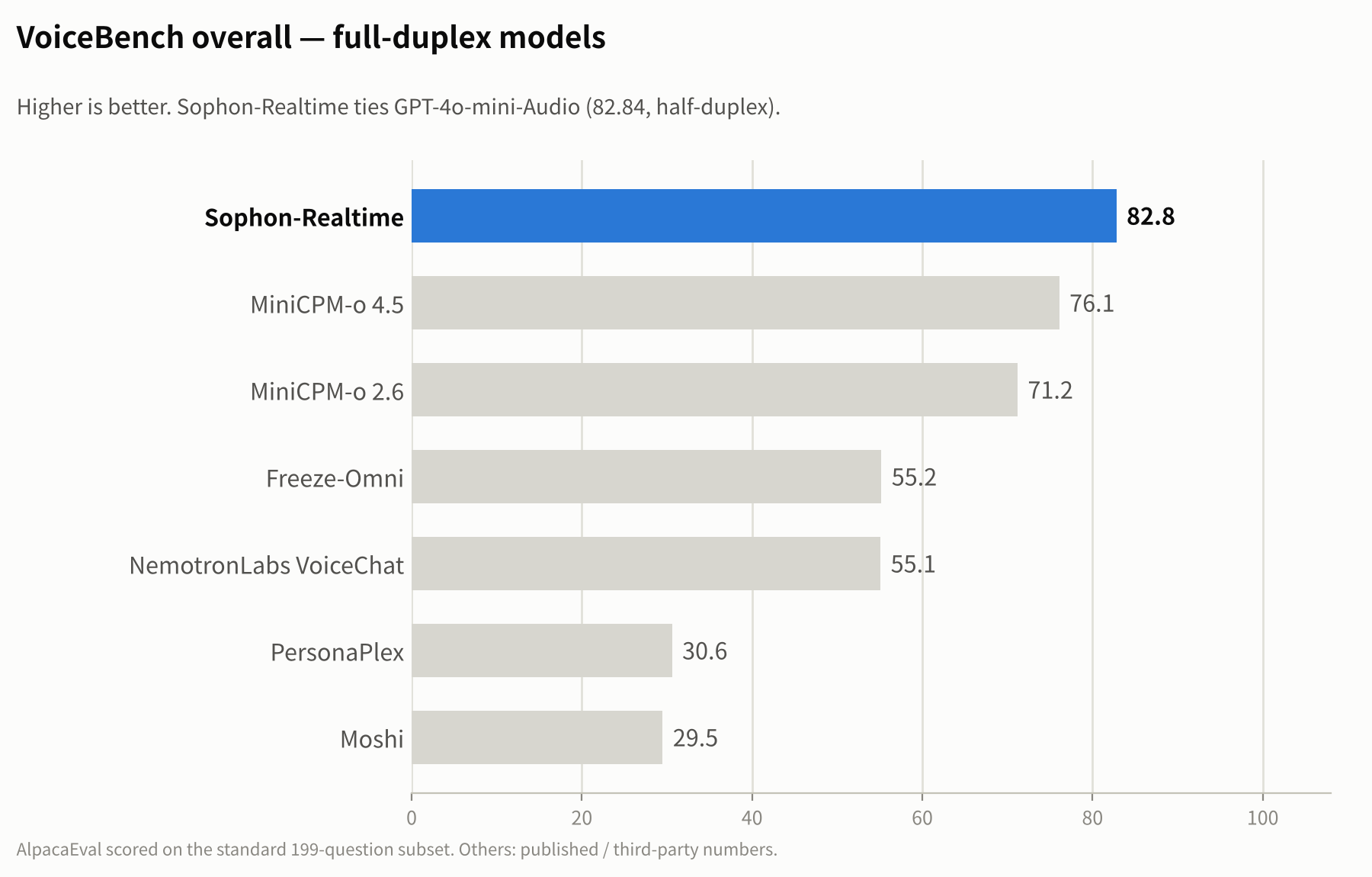
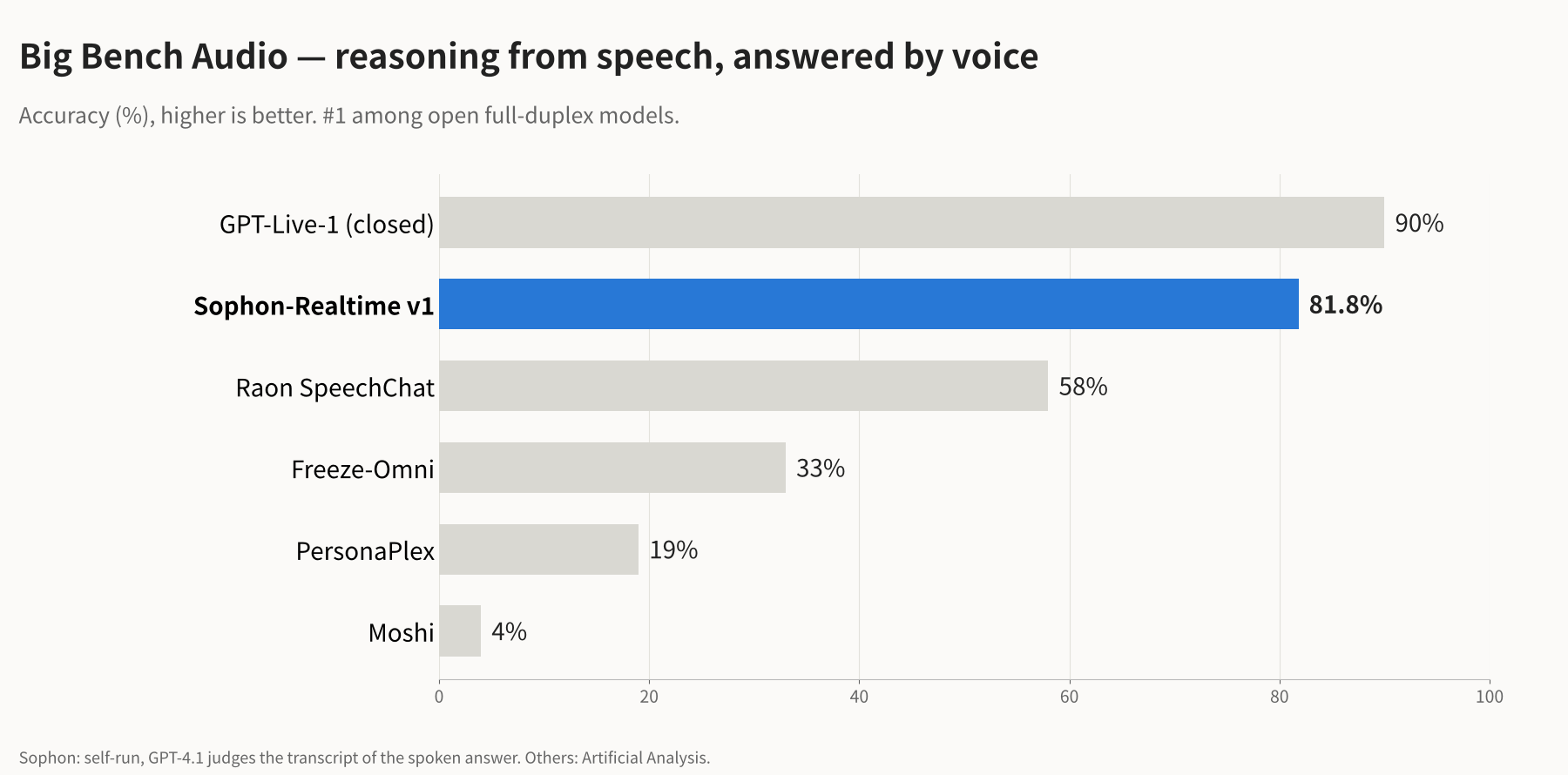
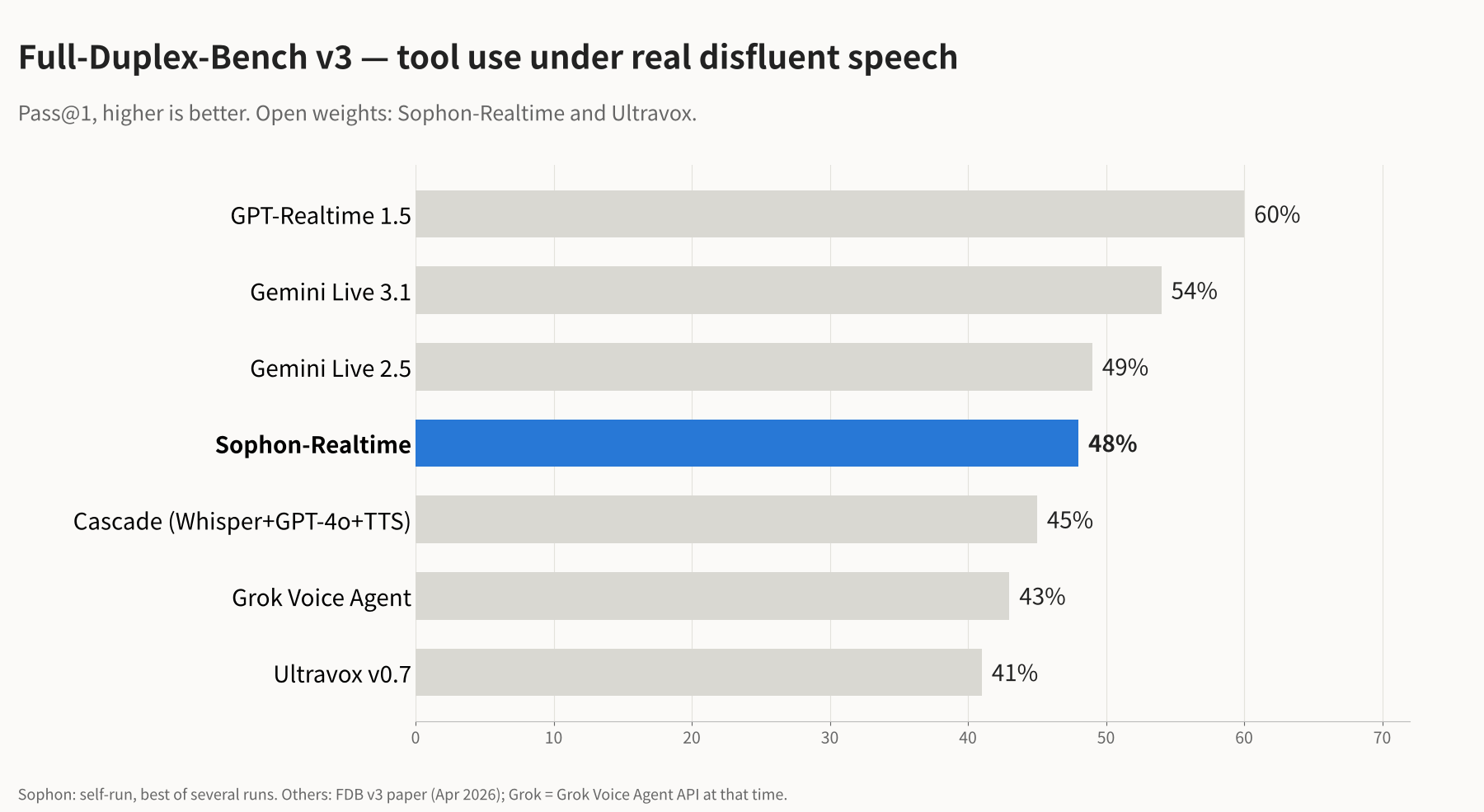
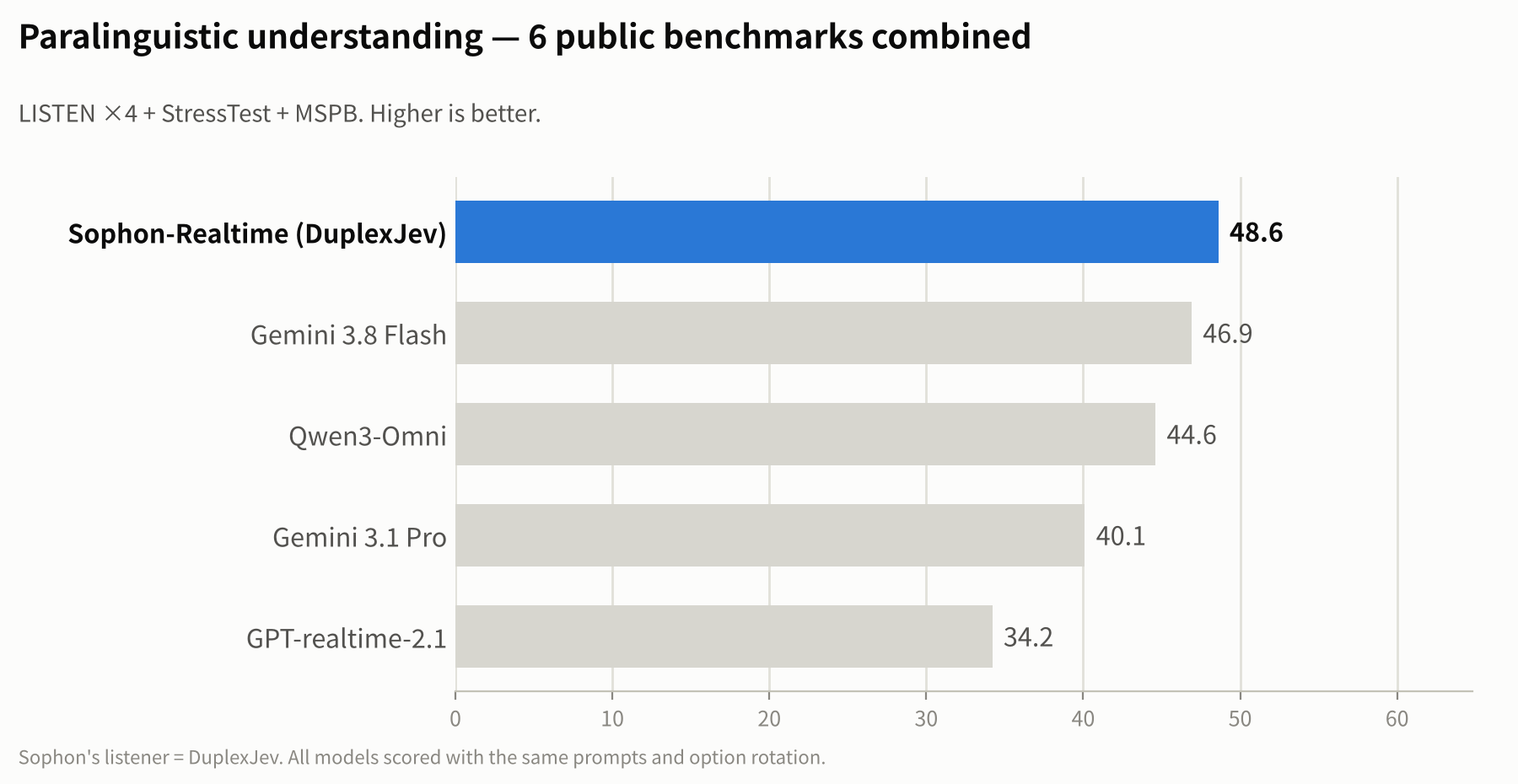
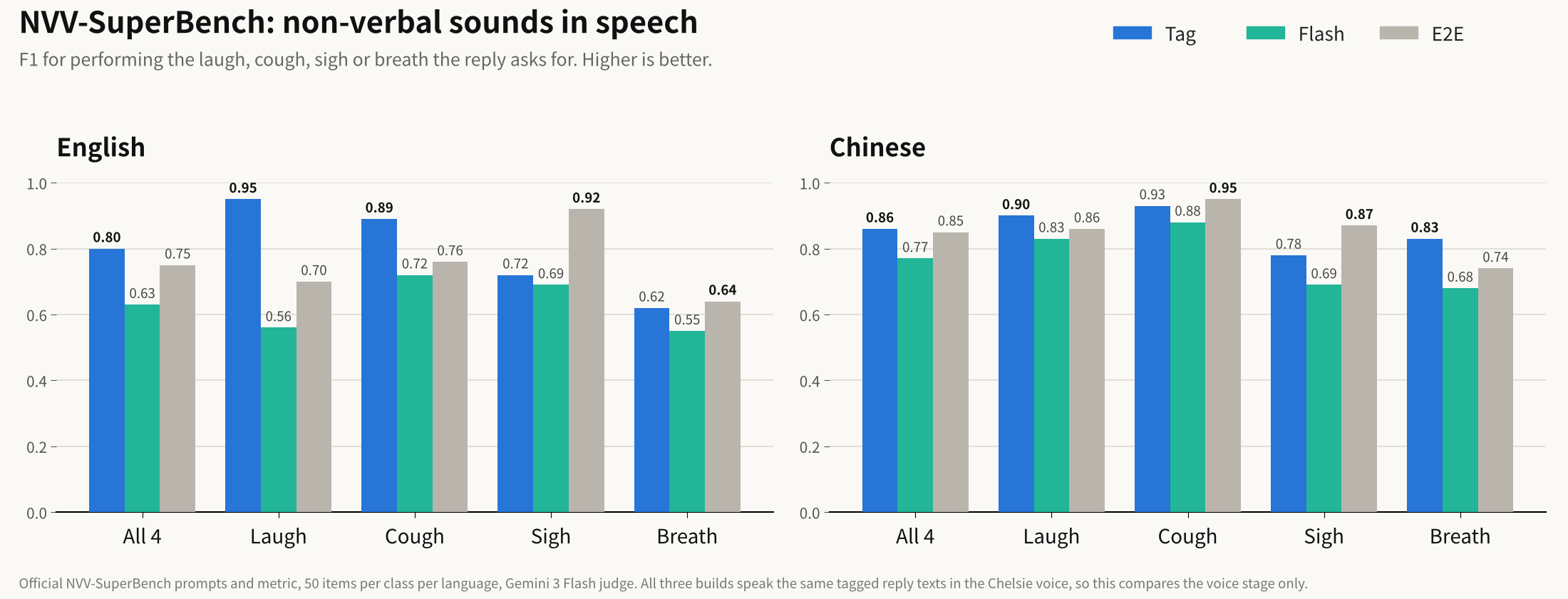
Self-run unless noted. VoiceBench: official evaluators with a gpt-4o-mini judge; AlpacaEval on the standard 199-question subset. Big Bench Audio: GPT-4.1 judges the transcript of the spoken answer; other models from Artificial Analysis. Full-Duplex-Bench v3: best of several runs; other systems from the FDB v3 paper (Apr 2026). Paralinguistic understanding: same prompts and option rotation for every model. NVV-SuperBench: official prompts and metric, 50 items per class per language, Gemini 3 Flash judge; the three builds speak the same tagged reply texts in the Chelsie voice. Latency and concurrency: one H100 80 GB, users arriving within 10 s.
News
- 2026-11-16 · v1.4: Sophon-Realtime 4B — Tag, Flash and E2E with a 4B brain, on one consumer GPU (Flash 24 GB; Tag and E2E 32 GB). Full-duplex turn-taking and sound tags carry over (Full-Duplex-Bench v1.0: Tag 94.3, E2E 92.3, Flash 87.7); much less knowledge than 32B (VoiceBench 62.4). Details · Tag · Flash · E2E
- 2026-11-14 · Try it without a GPU: hosted API, OpenAI Realtime-compatible, with all three builds; sign up and get 3 hours of free voice chat. Console · API docs
- 2026-11-13 · Sophon-Realtime on Mac: Flash-4bit runs locally on Apple silicon (MLX, 36 GB+ recommended), full duplex with turn-taking, barge-in and echo cancellation; it starts speaking about 1 s after you stop. mac/ · weights
- 2026-11-13 · v1.2: long replies are spoken to the end in Tag, Flash and E2E, however long they are; plus Flash-4bit for one 32 GB GPU. Release notes · Flash-4bit
- 2026-11-11 · v1.1: zero-shot voice cloning in Tag and Flash: a few seconds of audio and it talks to you in that voice, in real time. Watch the demo
- 2026-11-11 · E2E becomes a full build on one GPU, with first audio in about 0.25 s; it can also be served by vLLM-Omni like Tag and Flash. Details
- 2026-11-09 · Try it online on ModelScope Studio, and Live mode (OpenAI GPT-Live compatible: hands lookups to your own backend while it keeps talking) is open source. Live mode
- 2026-11-08 · v1.0: first open-source release of the Tag, Flash and E2E builds.
Every release, including fixes: CHANGELOG · GitHub Releases
Three builds, one brain
All three builds share the same brain: one 32B model that listens to your voice, decides when you have finished, and writes the reply. They differ only in how the reply becomes sound.
|
Tag (recommended) |
Flash |
E2E |
| How it speaks |
The brain writes the reply with sound tags ([laughter], [sigh], <strong>…</strong> …); an expressive speech model performs them |
Same tagged reply, spoken by a lighter, faster speech model (one forward pass per 80 ms frame) |
No speech-token model: a compact talker (about 350M parameters) reads the tagged reply as it is written and generates continuous voice vectors directly; a decoder turns them into sound |
| Best for |
Expressive voice: companions, characters, demos |
Speed and scale: customer service, in-car, many users per GPU |
Expressive voice with the fastest first audio; our own engine, easy to modify |
| Non-verbal sounds (NVV-SuperBench, en / zh) |
0.80 / 0.86 |
0.63 / 0.77 |
0.75 / 0.85 |
| First audio, one user |
~0.6 s |
0.31 s |
~0.25 s |
| Users per 80 GB GPU (recommended) |
16 |
40 |
16 |
| Zero-shot voice cloning |
yes, from a 3–10 s clip (how) |
yes, from a 3–10 s clip (how) |
yes, from a 5–12 s clip (how) |
| GPUs |
1 × 80 GB |
1 × 80 GB |
1 × 80 GB |
| Serving |
vLLM-Omni, one command |
vLLM-Omni, one command |
own engine or vLLM-Omni, one command |
| Weights |
HF · ModelScope |
HF · ModelScope |
HF · ModelScope |
| Code |
tag/ |
flash/ |
own engine: docs/deploy.md · vLLM-Omni: e2e/ |
Which one? Start with Tag if you want the voice to act. Pick Flash if the number of users per GPU matters most. Pick E2E for the fastest first audio with a voice that still laughs and sighs. Tag and Flash share the same APIs, so you can switch later; E2E runs on its own engine or, since 1.1.4, on vLLM-Omni with the same APIs as Tag and Flash.
4B builds (new in 1.4)
The same three builds with a 4B brain (DuplexJev-4B-Para with a tag-writing adapter), for one consumer GPU. The speech stages and voices are the same as in the 32B builds; there is no image input.
|
Tag-4B |
Flash-4B |
E2E-4B |
| GPU |
one 32 GB (uses ~27 GB) |
one 24 GB (uses ~21 GB) |
one 32 GB (uses ~31 GB) |
| Full-Duplex-Bench v1.0 (4-task avg; 32B: 94.0) |
94.3 |
87.7 |
92.3 |
| First audio, one user (RTX PRO 6000) |
0.40 s |
0.21 s |
0.31 s |
| Install |
SIZE=4B bash install.sh |
bash install.sh + weights |
SIZE=4B bash install.sh |
| Weights |
HF · ModelScope |
HF · ModelScope |
HF · ModelScope |
The 4B brain keeps the conversation skills (turn-taking, back-channels, barge-in, sound tags at the same rate as the reference data) but knows and reasons much less: VoiceBench 62.4 (32B: 82.8), Big Bench Audio 44.3% (32B: 81.8%). Use it for local demos, companions and characters, and turn-taking research; use 32B or the hosted API when answers must be right. start.sh sees a 4B model and picks its config.
Languages
Talk to it in your own language. Sophon-Realtime listens and answers in the language you speak.
| Language |
Status |
| Chinese, English |
Fully supported |
| Italian, German, Spanish, French, Portuguese |
Ready for conversation: clear speech, 80–92% of basic questions answered correctly, multi-turn quality close to English |
| Japanese, Russian |
Available on the Flash build |
| Korean and more |
Coming soon |
Internal tests, November 2026: 15 languages × 20 spoken questions, plus multi-turn dialogues from Omnilingua-AudioMC in 8 languages (Portuguese not included). Japanese is a priority language for us, and upcoming releases will keep improving it.
How it works
- Listens continuously. At each pause, the same model decides in a single token whether you've finished, are still talking, are back-channeling or are thinking.
- Drafts early, speaks on time. A reply is drafted from your first pause and released the moment the model decides it's its turn. If you keep talking, the draft is dropped before you hear it.
- Writes how to say it, not just what. The brain marks where to laugh, sigh, breathe, cough or stress a word. Tag and Flash perform these marks; they are never read aloud.
- Barge-in. When you interrupt, it stops and keeps only the part you actually heard in the conversation history.
Quick start
No GPU? Use the hosted API: sign up at api.adventists.ai/console and get 3 hours of free voice chat (counted on Flash). It speaks the OpenAI Realtime protocol at wss://api.adventists.ai/sophon/v1/realtime (HTTP: https://api.adventists.ai/sophon/v1); set model to sophon-realtime-tag, sophon-realtime-flash or sophon-realtime-e2e. A complete Python example is in the API docs.
Quickest (Tag build, one 80 GB GPU):
pip install "sophon-realtime[trt]"   # Python 3.12, Linux, CUDA 13; installs vLLM-Omni, the Tag plugin and TensorRT
sophon-realtime serve           # downloads Sophon-Realtime-32B-Tag (~42 GB) on first run, then serves on port 8000
Keep the [trt]. Without TensorRT the voice runs in plain PyTorch and is about 3× slower under load (16 users: first audio ~2.4 s
instead of ~0.75 s, with 1–1.5 s of stutter). sophon-realtime serve now warns at start-up when TensorRT is missing.
Or use the one-command scripts, which set up an isolated environment:
Tag (one 80 GB GPU):
git clone https://github.com/adventists-ai/sophon-realtime && cd sophon-realtime/tag
bash install.sh                 # venv + vLLM-Omni + plugin, downloads the weights (~45 GB)
GPU=0 PORT=8000 bash start.sh
python client_example.py --wav my_question.wav --lang en
Flash (one 80 GB GPU):
cd sophon-realtime/flash
bash install.sh
modelscope download --model AdventistsAI/Sophon-Realtime-32B-Flash --local_dir ./model   # or: hf download adventists-ai/Sophon-Realtime-32B-Flash --local-dir ./model
GPU=0 PORT=8000 bash start.sh
python client_example.py --wav my_question.wav --lang en --voice chelsie
Both serve ws://HOST:PORT/v1/realtime (full duplex, OpenAI-Realtime-style) and POST /v1/chat/completions (audio in, text + audio out). Details: tag/README.md · flash/README.md.
Mac (Apple silicon, 36 GB+ unified memory recommended; runs locally with MLX):
cd sophon-realtime && bash mac/install.sh   # environment + Sophon-Realtime-32B-Flash-4bit-MLX (~24 GB)
~/sophon-mac/sophon --lang en               # talk through your microphone
Details: mac/README.md.
Optional: Live mode (OpenAI GPT-Live compatible, see live/), next to a running engine:
cd sophon-realtime/live && BUILD=tag PORT=8000 LIVE_PORT=8780 bash start_live.sh # GPT-Live clients: ws://HOST:8780/v1/live/sessions
Live mode (OpenAI GPT-Live compatible)
live/ is a gateway that speaks the OpenAI GPT-Live protocol in front of a Tag or Flash engine: GPT-Live clients switch by changing the URL and key. Sophon keeps the voice and hands lookups and actions to your backend through delegation, then speaks the result. Optionally, a larger model can run the back office.
Zero-shot voice cloning (new in v1.1)
Give Sophon a few seconds of someone's voice and it talks to you in that voice, in real time. No fine-tuning, no restart, one GPU. Works in the Tag and Flash builds, and in E2E since 1.3.0.
https://github.com/user-attachments/assets/7f0627b0-fae4-4633-b412-88cb24942ab8
pip install -U "sophon-realtime[trt]"
sophon-realtime download --source modelscope   # or Hugging Face (default)
cp alice.wav model/voices/                      # 3-10 s, one speaker
sophon-realtime serve                           # then set "voice": "alice"
New, replaced and deleted voices take effect on the next request. Barge-in, backchannels and laughs still work in a cloned voice, and a voice cloned from one language can speak another. Everything stays on your server (details). The video also shows Live mode: Sophon hands lookups (weather, news) to your own backend, keeps talking, then says the answer.
Please only clone your own voice or voices you have permission to use. Do not use it to impersonate anyone or to deceive.
Chinese-subtitled version
https://github.com/user-attachments/assets/74bd6096-b6fc-4433-a1d7-d3e967107193
E2E
The E2E build has no speech-token model in the middle. A compact talker (about 350M parameters) reads the brain's tagged reply while it is still being written and generates a stream of continuous voice vectors, about 6.5 frames per second; a 2-step decoder and a vocoder turn them into 24 kHz audio. Laughs, coughs, sighs, breaths and stressed words are produced by the talker itself, as part of the same stream. Everything runs on one 80 GB GPU with our own engine: docs/deploy.md. Weights: HF · ModelScope.
Measured from a fresh install on one H100: first audio for one user in about 0.25 s; 16 users arriving within 10 s get first audio in 0.44 s (median) / 0.56 s (P90) with no reply falling behind playback. NVV-SuperBench: 0.75 (English) / 0.85 (Chinese). Full table in docs/deploy.md. This build speaks Chinese and English with one built-in voice; for voice cloning or more languages use Tag or Flash.
E2E can be served in two ways, with the same weights and the same voice: by our own engine (docs/deploy.md, the numbers above), or as one vLLM-Omni model like Tag and Flash (e2e/: /v1/realtime and /v1/chat/completions; first audio about 0.35 s for one user and 0.58–0.65 s (median) for 16). Both are measured on an H100. The E2E voice stages run about 2× slower on an RTX PRO 6000 (about 4–8 users per GPU); on such cards use Tag or Flash if you need more users per GPU.
Fine-tuning
Adapt the brain (persona, tone, domain knowledge, tool use) with LoRA in ms-swift on one 80 GB GPU. The voice, expressive sound tags and turn-taking are kept. See finetune/.
From the same team
- DuplexJev: one forward pass of a speech LLM answers every decision a voice agent needs (turn end, interruption, emotion, stress), in 92 ms.
License
Apache-2.0 for code and weights. See each build's NOTICE for third-party components.
Sophon series · by Adventists AI

 Открытое семейство моделей полнодуплексного голосового общения: модель слушает, пока вы говорите, распознаёт ваш тон и отвечает голосом, который умеет смеяться, вздыхать и дышать.