









What is this?
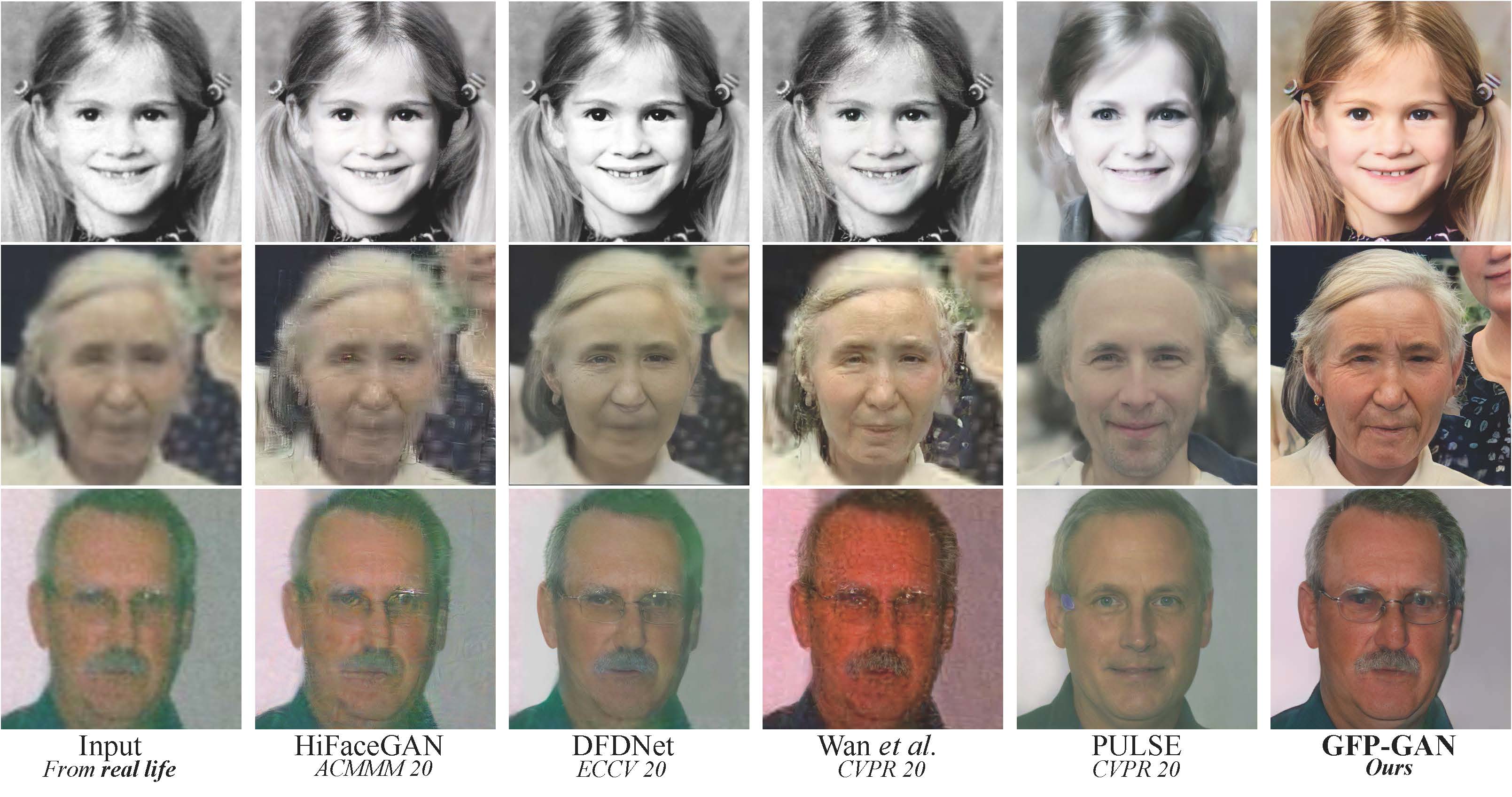
 GFPGAN is a practical algorithm for real-world blind face restoration: it rebuilds degraded or low-quality faces in photos using rich priors from a pretrained face GAN like StyleGAN2.
GFPGAN is a practical algorithm for real-world blind face restoration: it rebuilds degraded or low-quality faces in photos using rich priors from a pretrained face GAN like StyleGAN2.Is GFPGAN an app I open, or a Python tool I run myself?It is a Python package you run yourself — install it with pip and call it from a script or the command line. If you only want to try it, there are hosted Colab and Gradio web demos.
It is a Python package you run yourself — install it with pip and call it from a script or the command line. If you only want to try it, there are hosted Colab and Gradio web demos.How do I restore my first photo with it?Install Python >= 3.7 with PyTorch >= 1.7, clone the repo and install the dependent packages, then download a pretrained model such as GFPGANv1.3.pth and run the inference script.
Install Python >= 3.7 with PyTorch >= 1.7, clone the repo and install the dependent packages, then download a pretrained model such as GFPGANv1.3.pth and run the inference script.Which model version should I pick?Start with the newest V1.4 or the popular V1.3: results are natural and handle very low-quality inputs, but are not very sharp and slightly shift identity. V1.2 is sharper yet some outputs look unnatural.
Start with the newest V1.4 or the popular V1.3: results are natural and handle very low-quality inputs, but are not very sharp and slightly shift identity. V1.2 is sharper yet some outputs look unnatural.Is this for developers, or can anyone fix their old photos?Mainly developers and researchers comfortable with Python and PyTorch, but non-coders can restore photos too through the Colab and Hugging Face Gradio demos right in a browser.
Mainly developers and researchers comfortable with Python and PyTorch, but non-coders can restore photos too through the Colab and Hugging Face Gradio demos right in a browser.Do I need an NVIDIA GPU to run it?An NVIDIA GPU with CUDA is optional. The clean version of GFPGAN needs no customized CUDA extensions, so it runs without a GPU; only the original paper model (V1) requires them — see PaperModel.md.
An NVIDIA GPU with CUDA is optional. The clean version of GFPGAN needs no customized CUDA extensions, so it runs without a GPU; only the original paper model (V1) requires them — see PaperModel.md.Does GFPGAN restore only faces or the whole photo?Faces are its core strength; background and other non-face regions can be enhanced too, using Real-ESRGAN, the same authors' general image restoration model.
Faces are its core strength; background and other non-face regions can be enhanced too, using Real-ESRGAN, the same authors' general image restoration model.Can I train GFPGAN on my own data?Yes, the training codes used in the paper are included. The README advises that more high-quality faces improve quality, and offers a simple config that needs no face component landmarks.
Yes, the training codes used in the paper are included. The README advises that more high-quality faces improve quality, and offers a simple config that needs no face component landmarks.Does it work on anime images or videos?Not directly — GFPGAN targets real-world photos. For anime images and videos, the authors point to the tiny models added to their Real-ESRGAN project.
Not directly — GFPGAN targets real-world photos. For anime images and videos, the authors point to the tiny models added to their Real-ESRGAN project.What are similar projects?CodeFormer, lama, latent-diffusion, stylegan, neural-enhance, Real-ESRGAN, InstantID, ControlNet
CodeFormer, lama, latent-diffusion, stylegan, neural-enhance, Real-ESRGAN, InstantID, ControlNetWhich topics is it in?esrgan, face-restoration, face-swap, image-restoration, colab, pip, apache, gan, super-resolution, gradio, pretrained-models, training
esrgan, face-restoration, face-swap, image-restoration, colab, pip, apache, gan, super-resolution, gradio, pretrained-models, training