













What is this?
 Spark-TTS is a text-to-speech system that uses a large language model (built on Qwen2.5) to generate highly natural, accurate speech, including zero-shot voice cloning.
Spark-TTS is a text-to-speech system that uses a large language model (built on Qwen2.5) to generate highly natural, accurate speech, including zero-shot voice cloning.Is this a ready-made app or code I run myself?It's PyTorch inference code you run yourself, either via CLI scripts or a bundled Gradio-style Web UI (webui.py), not a packaged application.
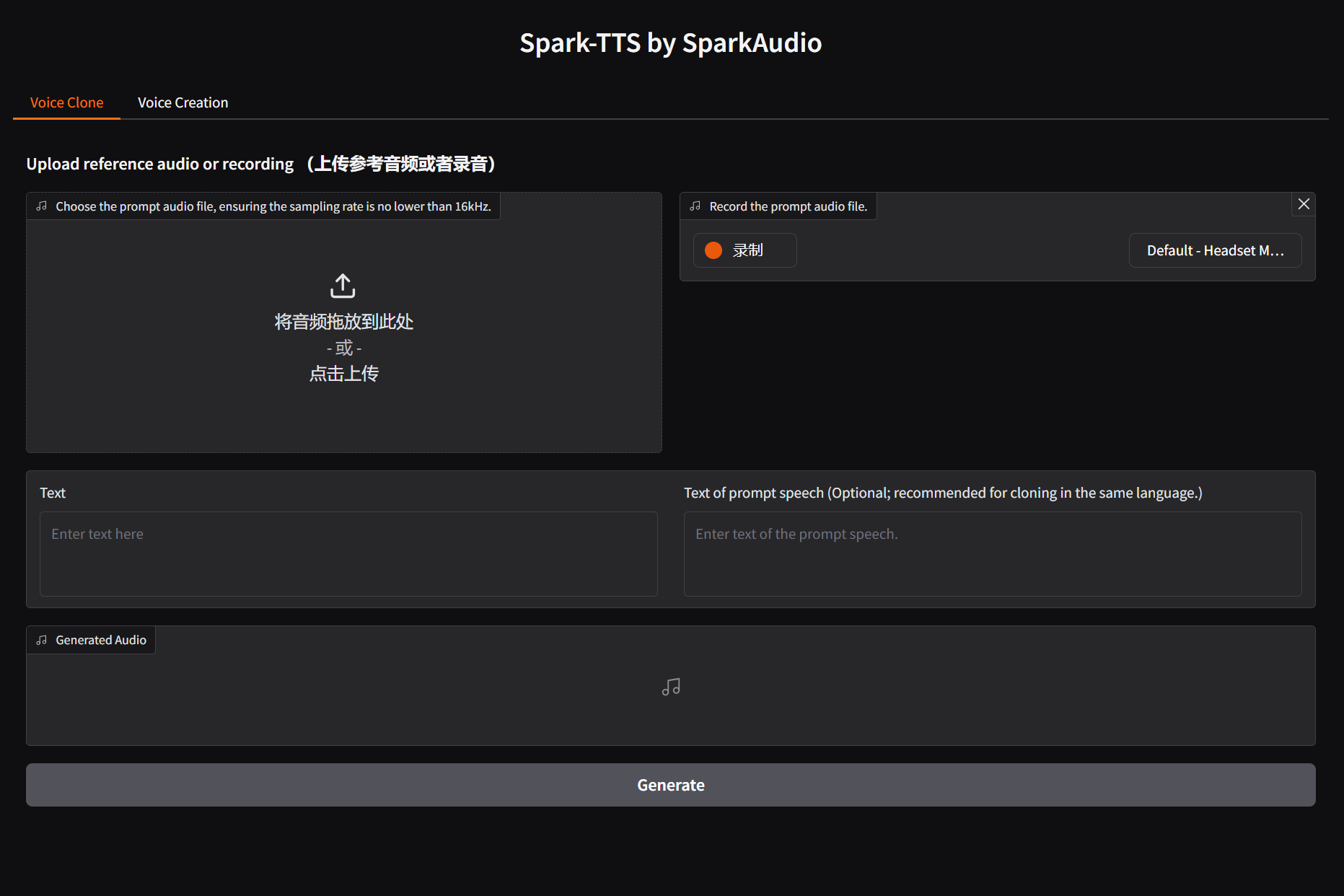
It's PyTorch inference code you run yourself, either via CLI scripts or a bundled Gradio-style Web UI (webui.py), not a packaged application.How do I get it running?Clone the repo, create a Conda environment, download the model (via python or git clone), then run the demo CLI or start the Web UI with 'python webui.py --device 0'.
Clone the repo, create a Conda environment, download the model (via python or git clone), then run the demo CLI or start the Web UI with 'python webui.py --device 0'.What do I need installed before trying it?You need Conda to set up the Python environment, plus the downloaded Spark-TTS model weights; a GPU is implied by the Nvidia Triton benchmarks for serving.
You need Conda to set up the Python environment, plus the downloaded Spark-TTS model weights; a GPU is implied by the Nvidia Triton benchmarks for serving.Is the training code available too?No, only inference code is released so far; the training code and the VoxBox training dataset are still on the to-do list, not yet published.
No, only inference code is released so far; the training code and the VoxBox training dataset are still on the to-do list, not yet published.Does it only run on Linux?The main instructions target Linux, but there's a separate community-contributed Windows Installation Guide for getting it running on Windows too.
The main instructions target Linux, but there's a separate community-contributed Windows Installation Guide for getting it running on Windows too.Is there a usage disclaimer I should know about?Yes, the authors explicitly warn against using it for unauthorized voice cloning, impersonation, fraud, or deepfakes, and take no liability for misuse.
Yes, the authors explicitly warn against using it for unauthorized voice cloning, impersonation, fraud, or deepfakes, and take no liability for misuse.Can it speak more than one language?Yes, it has bilingual support for Chinese and English and can do zero-shot cross-lingual and code-switching voice cloning, meaning it can switch languages mid-speech while keeping the same cloned voice.
Yes, it has bilingual support for Chinese and English and can do zero-shot cross-lingual and code-switching voice cloning, meaning it can switch languages mid-speech while keeping the same cloned voice.Can I create a synthetic voice without a reference recording?Yes, the Web UI's Voice Creation mode lets you build a virtual speaker by adjusting parameters like gender, pitch, and speaking rate instead of cloning an existing voice.
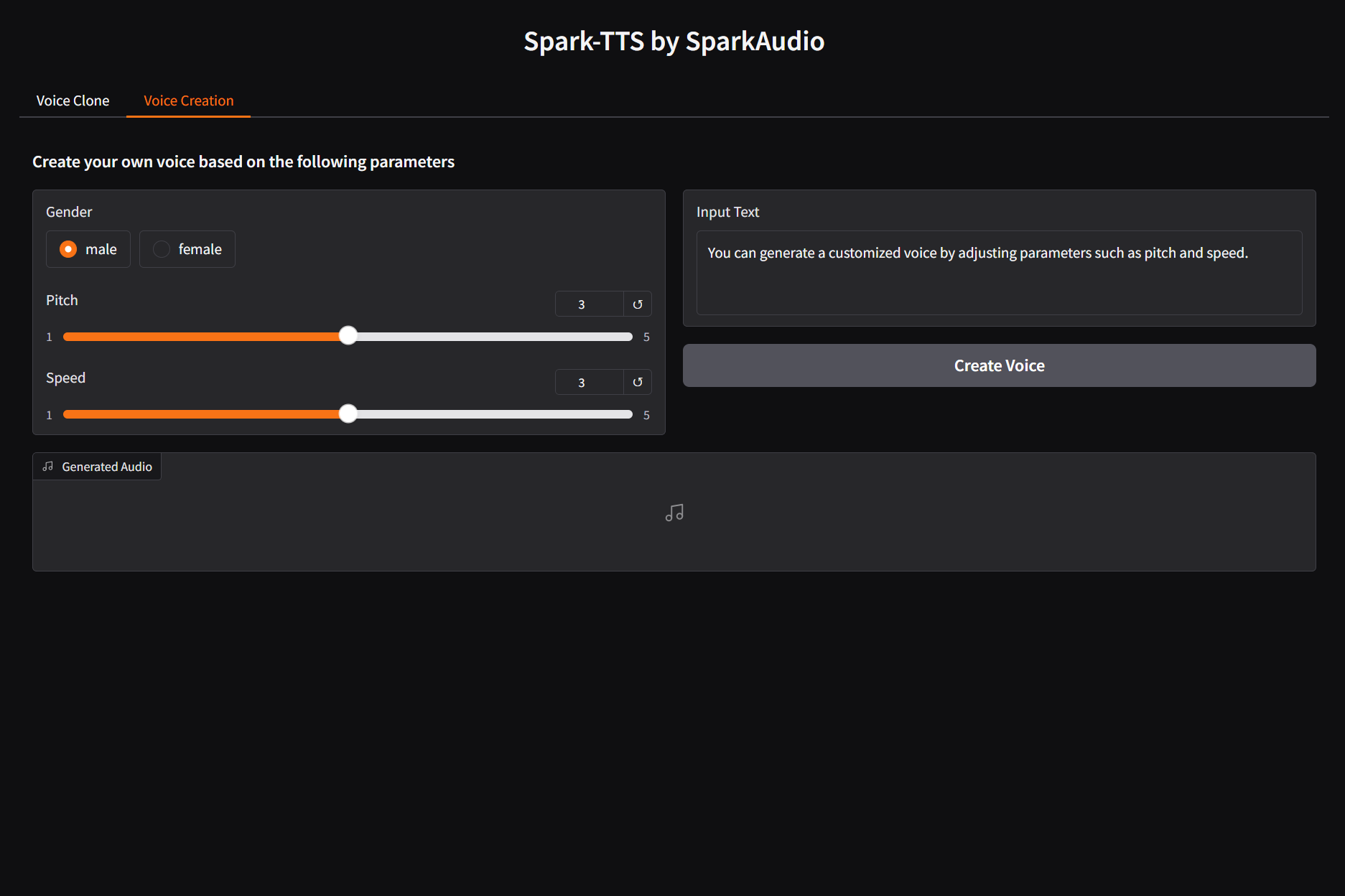
Yes, the Web UI's Voice Creation mode lets you build a virtual speaker by adjusting parameters like gender, pitch, and speaking rate instead of cloning an existing voice.How fast is it for production serving?Benchmarks on a single Nvidia L20 GPU using Triton and TensorRT-LLM show average latencies around 876ms-1.6s depending on concurrency, with an RTF as low as 0.07.
Benchmarks on a single Nvidia L20 GPU using Triton and TensorRT-LLM show average latencies around 876ms-1.6s depending on concurrency, with an RTF as low as 0.07.Why skip flow-matching models like other TTS systems?Spark-TTS is built entirely on Qwen2.5 and reconstructs audio directly from LLM-predicted codes, removing the need for a separate acoustic feature generation model and simplifying the pipeline.
Spark-TTS is built entirely on Qwen2.5 and reconstructs audio directly from LLM-predicted codes, removing the need for a separate acoustic feature generation model and simplifying the pipeline.What are similar projects?breeze-tts, VoxCPM, fish-speech, OmniVoice, Index-Translate, Speech, MOSS-TTS, MOSS-TTS-Nano
breeze-tts, VoxCPM, fish-speech, OmniVoice, Index-Translate, Speech, MOSS-TTS, MOSS-TTS-NanoWhich topics is it in?triton, bilingual, voice-cloning, speech-synthesis, tts, text-to-speech, multilingual, inference, nvidia, command-line-tool, research, gpu
triton, bilingual, voice-cloning, speech-synthesis, tts, text-to-speech, multilingual, inference, nvidia, command-line-tool, research, gpu