Что это такое?
 Это TRM (Tiny Recursive Model), код к статье «Less is More: Recursive Reasoning with Tiny Networks»: крошечная сеть на 7 млн параметров, которая набирает 45% на ARC-AGI-1 и 8% на ARC-AGI-2 за счёт рекурсивного рассуждения.
Это модель, которую можно скачать, или код, который нужно обучать самому?Это исследовательский код из статьи: вы сами готовите датасеты и обучаете маленькую сеть с нуля. В README описаны только обучающие эксперименты — готовых предобученных чекпойнтов нет.
Это исследовательский код из статьи: вы сами готовите датасеты и обучаете маленькую сеть с нуля. В README описаны только обучающие эксперименты — готовых предобученных чекпойнтов нет.Как это запустить?Установите Python 3.10 с CUDA 12.6.0 (точные зафиксированные версии перечислены в specificrequirements.txt, если возникнут проблемы с версиями), выполните шаг подготовки датасета, затем запустите скрипт обучения для своего эксперимента. Установка занимает несколько минут.
Установите Python 3.10 с CUDA 12.6.0 (точные зафиксированные версии перечислены в specificrequirements.txt, если возникнут проблемы с версиями), выполните шаг подготовки датасета, затем запустите скрипт обучения для своего эксперимента. Установка занимает несколько минут.Репозиторий до сих пор активно поддерживается?Нет. Он заархивирован и открыт только для чтения: авторы закрыли его после волны автоматически сгенерированного спама в issues, который превысил их возможности по поддержке, так что исправлений и ответов на новые issues ждать не стоит.
Нет. Он заархивирован и открыт только для чтения: авторы закрыли его после волны автоматически сгенерированного спама в issues, который превысил их возможности по поддержке, так что исправлений и ответов на новые issues ждать не стоит.Какое железо нужно, чтобы воспроизвести результаты?Самый маленький запуск (Sudoku-Extreme) помещается на одну видеокарту с достаточным объёмом памяти — меньше 20 часов на одной L40S 48 ГБ. ARC-AGI-1/2 предполагают 4 GPU H-100 примерно на 3 дня каждый; Maze-Hard обучается на 4 L40S или на одной с уменьшенным размером батча.
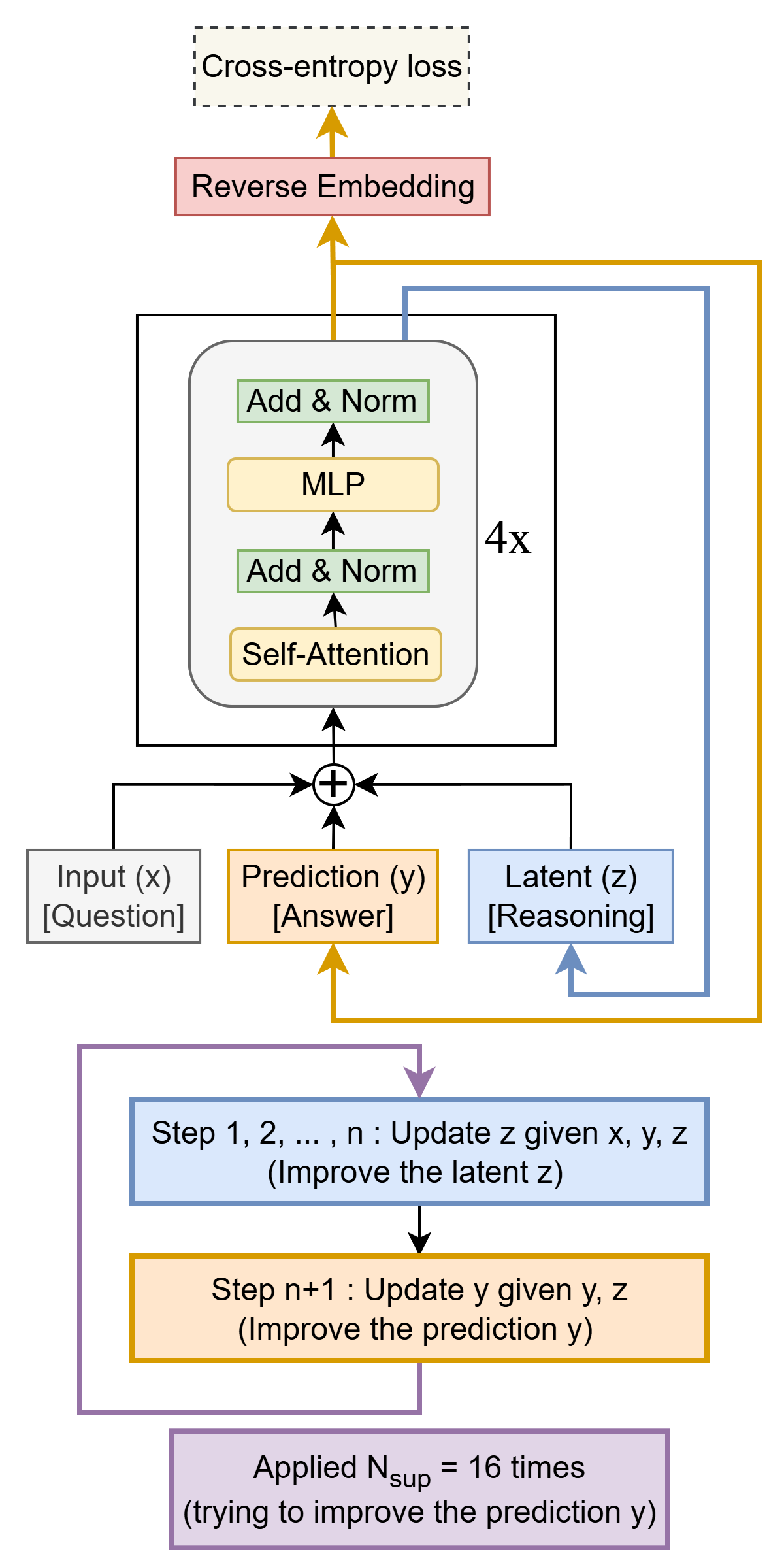
Самый маленький запуск (Sudoku-Extreme) помещается на одну видеокарту с достаточным объёмом памяти — меньше 20 часов на одной L40S 48 ГБ. ARC-AGI-1/2 предполагают 4 GPU H-100 примерно на 3 дня каждый; Maze-Hard обучается на 4 L40S или на одной с уменьшенным размером батча.Как сеть на 7 млн параметров вообще способна рассуждать?Она рекурсивно улучшает свой ответ за несколько шагов (до K): на каждом шаге она несколько раз обновляет скрытое «размышление» z с учётом вопроса, текущего ответа и z, а затем заново формулирует ответ на их основе. Так крошечная сеть дёшево исправляет собственные ошибки и при этом меньше переобучается.
Она рекурсивно улучшает свой ответ за несколько шагов (до K): на каждом шаге она несколько раз обновляет скрытое «размышление» z с учётом вопроса, текущего ответа и z, а затем заново формулирует ответ на их основе. Так крошечная сеть дёшево исправляет собственные ошибки и при этом меньше переобучается.Почему автор сделал это, а не просто взял HRM?TRM — это упрощение Hierarchical Reasoning Model: автор счёл HRM излишне сложным и слишком опирающимся на биологические доводы о человеческом мозге, поэтому рекурсивное рассуждение было сведено к своей сути — без теоремы о неподвижной точке и без иерархии.
TRM — это упрощение Hierarchical Reasoning Model: автор счёл HRM излишне сложным и слишком опирающимся на биологические доводы о человеческом мозге, поэтому рекурсивное рассуждение было сведено к своей сути — без теоремы о неподвижной точке и без иерархии.В чём главная идея статьи?В том, что «меньше значит больше»: полагаться на огромные foundation-модели, обученные за миллионы долларов, — это ловушка. Крошечная модель, предобученная с нуля, которая рекурсивно обращается к самой себе и постепенно уточняет свои ответы, может решать сложные задачи без колоссальных затрат.
В том, что «меньше значит больше»: полагаться на огромные foundation-модели, обученные за миллионы долларов, — это ловушка. Крошечная модель, предобученная с нуля, которая рекурсивно обращается к самой себе и постепенно уточняет свои ответы, может решать сложные задачи без колоссальных затрат.Какие результаты воспроизводят прилагаемые эксперименты?Sudoku-Extreme достигает точности около 75% (+-2%) менее чем за 20 часов на одной L40S. Maze-Hard обучается менее чем за 24 часа на 4 GPU L40S, а запуски ARC-AGI-1 и ARC-AGI-2 занимают примерно по 3 дня на 4 GPU H-100.
Sudoku-Extreme достигает точности около 75% (+-2%) менее чем за 20 часов на одной L40S. Maze-Hard обучается менее чем за 24 часа на 4 GPU L40S, а запуски ARC-AGI-1 и ARC-AGI-2 занимают примерно по 3 дня на 4 GPU H-100.What are similar projects?HRM, arc-task-gen, stylegan, MSA, jeeves, StartLux-Decision, bdh, ZDTaichu5.0-9B
HRM, arc-task-gen, stylegan, MSA, jeeves, StartLux-Decision, bdh, ZDTaichu5.0-9BWhich topics is it in?reasoning, paper, training, neural-network, nvidia, cuda, benchmark, deep-learning, research, gpu, machine-learning, ai
reasoning, paper, training, neural-network, nvidia, cuda, benchmark, deep-learning, research, gpu, machine-learning, ai