What is this?
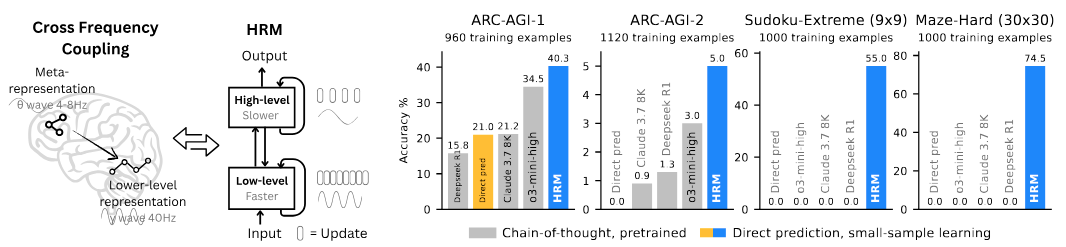
 The official release of the Hierarchical Reasoning Model (HRM): a brain-inspired recurrent architecture that reaches significant computational depth with only 27 million parameters, trained on ~1000 examples without pretraining or chain-of-thought data.
The official release of the Hierarchical Reasoning Model (HRM): a brain-inspired recurrent architecture that reaches significant computational depth with only 27 million parameters, trained on ~1000 examples without pretraining or chain-of-thought data.Is it a ready-made trained model, or code I have to train myself?Both. The repo is the architecture plus a full training pipeline, and the authors also ship trained checkpoints for ARC-AGI-2, 9x9 Extreme Sudoku and 30x30 Hard Maze that you can evaluate without training.
Both. The repo is the architecture plus a full training pipeline, and the authors also ship trained checkpoints for ARC-AGI-2, 9x9 Extreme Sudoku and 30x30 Hard Maze that you can evaluate without training.How do I get it running?Install PyTorch with CUDA first, because the repo builds CUDA extensions; then add FlashAttention (version 3 for Hopper GPUs, version 2 for Ampere or older), install the Python dependencies and log in to Weights & Biases for tracking.
Install PyTorch with CUDA first, because the repo builds CUDA extensions; then add FlashAttention (version 3 for Hopper GPUs, version 2 for Ampere or older), install the Python dependencies and log in to Weights & Biases for tracking.How long does training take, and are there any gotchas?From 1k-sample datasets, Sudoku Extreme trains in ~10 minutes on the reference 8-GPU setup, the 30x30 maze in about an hour and ARC in about 24 hours. Expect roughly ±2 accuracy-point variance on small samples, and use early stopping on Sudoku-Extreme, where late-stage overfitting can destabilize training and Q-learning.
From 1k-sample datasets, Sudoku Extreme trains in ~10 minutes on the reference 8-GPU setup, the 30x30 maze in about an hour and ARC in about 24 hours. Expect roughly ±2 accuracy-point variance on small samples, and use early stopping on Sudoku-Extreme, where late-stage overfitting can destabilize training and Q-learning.What kind of hardware do I need to train it?An NVIDIA GPU is required — the whole stack is PyTorch, CUDA extensions and FlashAttention. The Sudoku demo trains in about 10 hours on an RTX 4070 laptop GPU, while the full-scale experiments assume an 8-GPU setup.
An NVIDIA GPU is required — the whole stack is PyTorch, CUDA extensions and FlashAttention. The Sudoku demo trains in about 10 hours on an RTX 4070 laptop GPU, while the full-scale experiments assume an 8-GPU setup.How is this different from how large language models reason?It skips chain-of-thought text entirely: HRM executes sequential reasoning in a single forward pass through two interdependent recurrent modules — a slow high-level module for abstract planning and a fast low-level one for detailed computation — with no explicit supervision of intermediate steps.
It skips chain-of-thought text entirely: HRM executes sequential reasoning in a single forward pass through two interdependent recurrent modules — a slow high-level module for abstract planning and a fast low-level one for detailed computation — with no explicit supervision of intermediate steps.What tasks can it actually solve, and how well?Three puzzle-style tasks out of the box: 9x9 Extreme Sudoku, 30x30 Hard mazes and the Abstraction and Reasoning Corpus (ARC), where it outperforms much larger models with far longer context windows — nearly perfect on the Sudoku and maze tasks.
Three puzzle-style tasks out of the box: 9x9 Extreme Sudoku, 30x30 Hard mazes and the Abstraction and Reasoning Corpus (ARC), where it outperforms much larger models with far longer context windows — nearly perfect on the Sudoku and maze tasks.How do I check how good a trained model is?Run the evaluation script and read eval/exactaccuracy in Weights & Biases; for ARC there are extra steps, and you finalize and inspect results in the provided arceval.ipynb notebook.
Run the evaluation script and read eval/exactaccuracy in Weights & Biases; for ARC there are extra steps, and you finalize and inspect results in the provided arceval.ipynb notebook.Can I look at the training puzzles myself?Yes — generate a dataset, open puzzlevisualizer.html in your browser and upload the folder from data/ to explore the puzzles visually.
Yes — generate a dataset, open puzzlevisualizer.html in your browser and upload the folder from data/ to explore the puzzles visually.What are similar projects?Attention-Residuals, jeeves, mamba, minimind, verl, MSA, EvoVLM, StartLux-Decision
Attention-Residuals, jeeves, mamba, minimind, verl, MSA, EvoVLM, StartLux-DecisionWhich topics is it in?wandb, flash-attention, attention, jupyter, reasoning, gpu-acceleration, reinforcement-learning, neural-network, large-language-models, artificial-intelligence, nvidia, cuda
wandb, flash-attention, attention, jupyter, reasoning, gpu-acceleration, reinforcement-learning, neural-network, large-language-models, artificial-intelligence, nvidia, cuda