When LLMs Forget What They Believe: Characterizing State Integrity Collapse in Long-Horizon Dialogues
Yancheng Zhu · Yifan Yuan†
School of Artificial Intelligence, Shenzhen University
†Corresponding author
EMNLP 2026 (Main Conference)





English · 简体中文
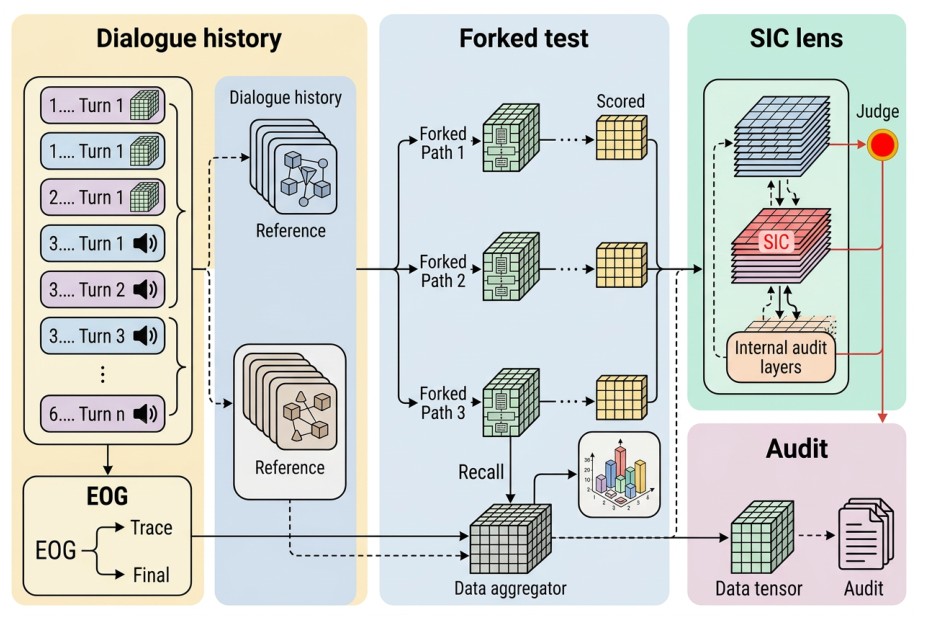
StateTrack-Bench evaluation protocol: a persistent constraint is planted in the dialogue, probed at increasing depths, and every failure is re-examined with a forked recall test.
TL;DR: An assistant can repeat a user's rule and still stop obeying it. We call this recall–compliance dissociation State Integrity Collapse (SIC): the model keeps the constraint in memory but no longer applies it to later turns — unlike ordinary forgetting, longer context or memory retrieval does not fix it. StateTrack-Bench plants one persistent constraint (numerical, format, role/persona, factual-memory or logical-rule) in a conversation, checks compliance at increasing dialogue depths, and uses a forked recall audit to separate forgetting from remembering-without-complying. Across seven provider-pinned models, 88.6% of failures are behavioral drift rather than forgetting, and Structured State Anchoring (SSA) recovers up to 24.4 points.
🔍 StateTrack-Bench
- Persistent constraints of five types — numerical, format, role/persona, factual-memory and logical-rule — are stated early in a dialogue and must govern every later answer.
- Depth probes check strict joint retention (immediate task + persistent constraint) at turns 3, 5, 7, 10 and 12, and in extended evaluations up to 50 turns.
- Forked recall audit. For every non-retained answer, a recall probe is replayed on a copy of the dialogue prefix: if the model can still state the constraint, the failure is an integrity failure (SIC+), otherwise ordinary forgetting (SIC−).
- Structured State Anchoring (SSA). A training-free mitigation: an
[ACTIVE_STATE] block is prepended at each turn, constraints are rewritten as verifiable predicates, and outputs are checked with up to two retries.
🚀 Reproduce the Paper Offline
All reported tables are reconstructed from the cached outputs with the Python standard library — no API key, no network:
git clone https://github.com/MUSE-AI-Lab/StateTrack.git
cd StateTrack
python tools/reproduce_reported_metrics.py      # retention table, dynamic-state, depth-50, two-constraint and checker audits
python scripts/sgd_ecological_pilot/reproduce_pilot_metrics.py   # SGD dialogue pilot
python -m unittest discover -s tests -v         # consistency checks over the stored results
python tools/verify_checksums.py                # integrity of every released file
python verify_package.py                        # exact package membership
The expected output of the first command is stored in reproduced_metrics.txt.
The primary retention curves are now recomputed from 175 scenario-level cached records in results/core/all_results.json, then checked against the published aggregate cache. The released core and augmented scenario banks, original runner sources, and full generation/replay instructions are documented in REPRODUCIBILITY.md.
Run the Core and Augmented Benchmarks
Both scenario banks are public: 25 core scenarios and 50 augmented scenarios, across five constraint categories. The runner retains the original 12-turn schedule, probe depths [3, 5, 7, 10, 12], filler messages, and regex checkers. These commands require only Python 3.10+:
# Inspect all scenarios and planned probe counts without credentials or API calls.
python scripts/run_benchmark.py --suite core --dry-run --output outputs/core-plan
python scripts/run_benchmark.py --suite augmented --dry-run --output outputs/augmented-plan

# Recompute metrics from scenario-level records, not aggregate tables.
python scripts/run_benchmark.py --suite core --replay results/core/all_results.json --output outputs/core-replay
python scripts/run_benchmark.py --suite augmented --replay results/augmented/all_results.json --output outputs/augmented-replay

# Generate fresh model outputs after configuring OPENAI_API_KEY.
python scripts/run_benchmark.py --suite core --model YOUR_MODEL_ID --output outputs/new-core
python scripts/run_benchmark.py --suite augmented --model YOUR_MODEL_ID --output outputs/new-augmented
Use --resume with the same arguments and output directory to skip completed dialogues. --state-type, --scenario-index, --limit, and --concurrency support smaller runs. OPENAI_BASE_URL or --base-url selects an explicitly configured compatible provider; the default is the official OpenAI API. Fresh runs save full dialogues, probe labels, a versioned scenario manifest, and reconstructed metrics under ignored outputs/ directories. Historical cached records contain probe previews and labels rather than complete dialogues; replay reproduces their original scoring, while fresh generation produces new evidence.
📊 Main Results
|
Strict joint retention (%) — mean over five constraint types and five depths (Table 3)
| Model |
Overall |
Turn 3 |
Turn 12 |
| DeepSeek-v4-Flash |
100.0 |
100.0 |
100.0 |
| GPT-5.4-mini |
98.4 |
96.0 |
100.0 |
| DeepSeek-v4-Pro |
96.0 |
92.0 |
96.0 |
| Qwen3.6-Plus |
95.2 |
92.0 |
96.0 |
| GPT-5.4 |
94.4 |
100.0 |
96.0 |
| Claude-Sonnet-4-6 |
90.4 |
92.0 |
88.0 |
| Gemini-3.1-Pro |
62.4 |
64.0 |
54.0 |
|
Structured State Anchoring — retention (%) at depth 12 (Table 14)
| Model |
Baseline |
+ SSA |
Δ |
| GPT-5.4 |
96.0 |
99.2 |
+3.2 |
| Claude-Sonnet-4-6 |
88.0 |
96.0 |
+8.0 |
| Gemini-3.1-Pro |
54.0 |
78.4 |
+24.4 |
| Qwen3.6-Plus |
96.0 |
98.4 |
+2.4 |
|
The forked recall audit attributes 88.6% of the observed failures to behavioral drift (84.4% when the most brittle model is excluded). Model snapshot identifiers are listed in metadata/snapshot_manifest.csv.
📦 Released Artifacts
| Folder |
Content |
results/core/ |
aggregate retention cache behind Tables 2 and 3 (7 models × 5 depths) |
results/rebuttal/ |
70-output audit (task success, constraint compliance, recall, SIC+ / SIC−), 105-output update / revocation experiment, 216-probe symbolic-depth analysis, 34-output two-constraint analysis, execution audit for the depth-50 results |
results/checker_calibration/ |
two independently worded temperature-0 model-assisted checker passes over the 70 audit rows, disagreement adjudication and agreement report |
results/ecological_pilot/ |
pilot on human-authored Schema-Guided Dialogue conversations: 30 cases × 7 models with behavior and recall responses (details) |
🧪 Re-running the Experiments
Re-running model generation needs your own provider credentials. Copy the template and fill in OpenAI-compatible endpoints and keys (never commit this file):
cp experiment_config.example.json experiment_config.json
python scripts/paper1_state_collapse/run_rebuttal_experiments.py
python scripts/paper1_state_collapse/run_symbolic_depth_audit.py
python scripts/paper1_state_collapse/run_multiconstraint_audit.py
python scripts/paper1_state_collapse/run_model_assisted_checker_audit.py --max-workers 16
Hosted model endpoints change over time, so fresh runs can differ from the cached outputs.
📁 Repository Structure
results/                     # cached outputs and summaries (see above)
scripts/
├── common/                  # OpenAI-compatible LLM caller and JSON judge
├── paper1_state_collapse/   # runners of the follow-up audits and checker calibration
└── sgd_ecological_pilot/    # SGD pilot prompts, summary and reproduction
tools/                       # offline metric reproduction and checksum verification
tests/                       # consistency tests over the stored results
metadata/                    # model snapshot identifiers
assets/                      # figures
📝 Citation
@inproceedings{zhu2026statetrack,
  title     = {When {LLMs} Forget What They Believe: Characterizing State Integrity Collapse in Long-Horizon Dialogues},
  author    = {Zhu, Yancheng and Yuan, Yifan},
  booktitle = {Proceedings of the 2026 Conference on Empirical Methods in Natural Language Processing (EMNLP)},
  year      = {2026},
  eprint    = {2610.31314},
  archivePrefix = {arXiv}
}
📄 License
Code is released under the MIT License; the authored benchmark scenarios and derived metadata under CC BY 4.0. Cached model outputs remain subject to the respective providers' terms, and the Schema-Guided Dialogue source data is not redistributed.

 StateTrack 是一篇 EMNLP 2026 论文的可复现代码库。该论文研究的问题是:大语言模型为什么还能复述用户在对话前面给出的规则,却不再遵守它。代码库包含 StateTrack-Bench 评测协议、缓存的实验结果,以及一种名为结构化状态锚定(SSA)的缓解方法。