Droid ASC: R8 Compiler Optimization as a DeCompiler Primitive
https://blackhat.com/europe/arsenal/schedule/index.html#droid-asc-r8-compiler-optimization-as-a-decompiler-primitive-54834
When decompiling massive Android APKs, the standard procedure is to wait. We wait for tools to eat gigabytes of RAM, fully inflate the artifacts, and spend tens of minutes building heavy global indexes and cross references... All of this is just to guarantee fast code searches later, but here is the contradiction. A compiled artifact is already highly structured, modern decompilers never utilize this, they waste massive amounts of time and memory reconstructing a bloated database of code relationships over already structured data. This engineering approach defies common sense. When I can directly extract any code relationship from the APK in milliseconds, does this preprocessing still hold any value?
Instead of forcing decompilers into heavy preprocessing, we choose to query the compiled artifact directly as a database. We built a stateless, zero-overhead engine that extracts and searches code on demand in milliseconds. In this briefing, we will explore the underlying engineering required to bypass traditional bottlenecks. We will demonstrate how to abandon full inflate by probing directly within the Deflate bitstream, building dense Huffman lookup tables to extract core metadata without touching irrelevant data blocks. Furthermore, we will explain optimization details of the R8 compiler, especially how deterministic constant relocation and instruction deduplication leave behind highly concentrated physical layouts, we weaponize this compiler behavior to execute lightning-fast cross DEX code searches. To map these raw bytecode offsets back to methods, we engineered an O(1) instruction locating primitive, achieving constant-time method resolution without building heavy mapping tables. Finally, upon hitting a target, Droid ASC extracts only the specific bytecodes and its dependencies, dynamically reconstructing a minimal and self consistent DEX entirely in memory for instant decompilation.
We will demonstrate this architecture live against a 352MB commercial APK. Droid ASC executes global cross reference searches in 1.79 seconds and decompiles target classes in 177 milliseconds using only 141MB of RAM. By treating the artifact as a read only database and operating with zero preprocessing, we return the decompiler to its core essence. It is no longer a bloated indexing tool, but a lightning fast, on demand decompilation engine that fundamentally redefines how we analyze compiled code.
Benchmark
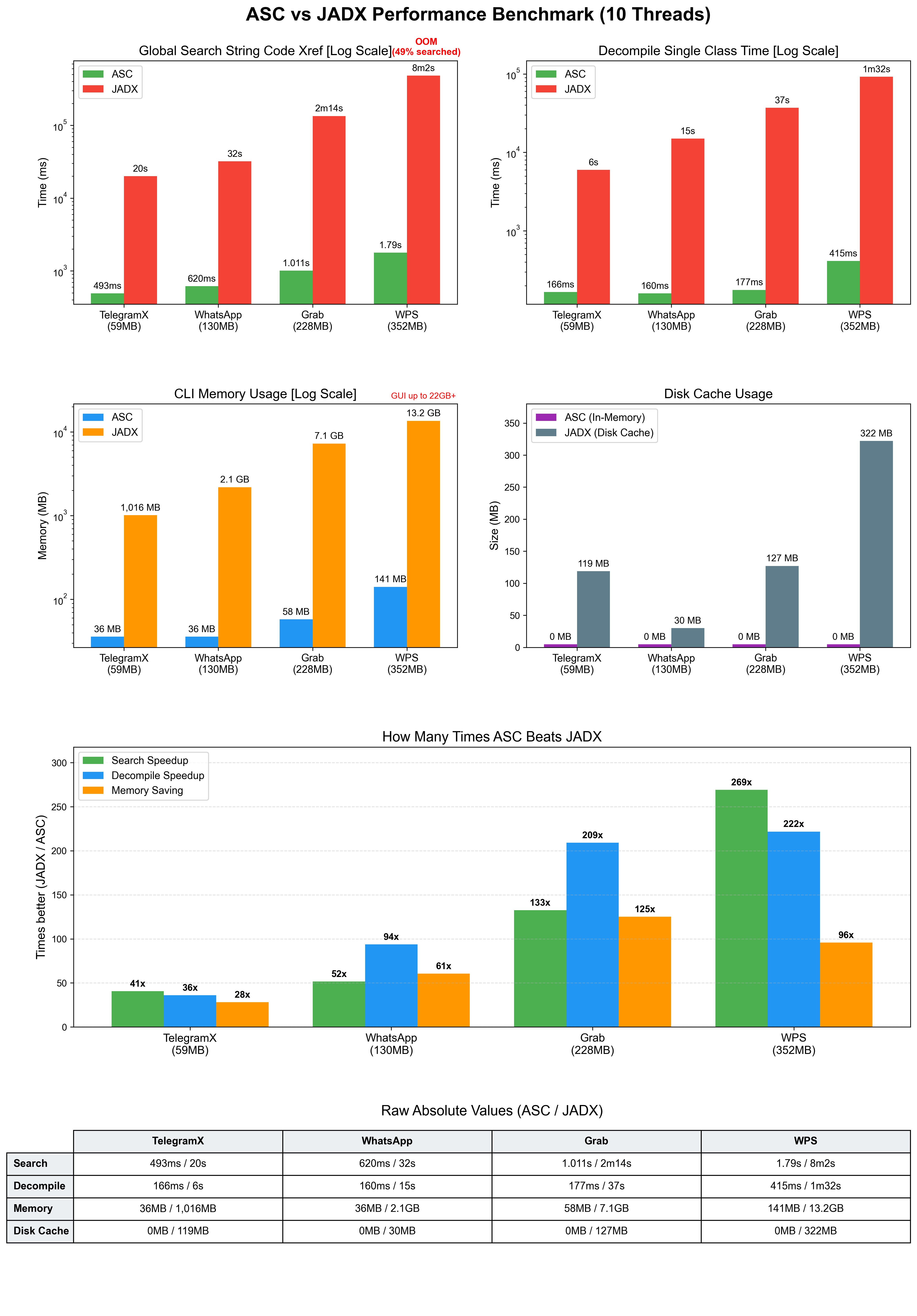
https://github.com/user-attachments/assets/4c4a6813-8561-490c-a573-ef113da861b6
Install
# from PyPI
pip install droidasc

# or from source
pip install .
After installation, the droidasc CLI command is available globally:
usage: droidasc [-h] {getclass,listclass,getmanifest,findrefs} ...

ASC tooling entry.

positional arguments:
  {getclass,listclass,getmanifest,findrefs}
    getclass            Locate the target class in APK, extract one DEX in memory, then decompile.
    listclass           List classes defined across all DEX entries in APK.
    getmanifest         Decode AndroidManifest.xml from APK and print it as XML.
    findrefs            Find code references for string/type/method/field across all DEX entries in APK.

options:
  -h, --help            show this help message and exit

examples:
  droidasc app.apk --gui
  droidasc getclass app.apk Lcom/poc/Main; -o Main.java
  droidasc getclass app.apk com.poc.Main --threads 16
  droidasc listclass app.apk -o classes.txt
  droidasc listclass app.apk --prefix com.poc
  droidasc getmanifest app.apk -o AndroidManifest.xml
  droidasc findrefs app.apk string token -o string_refs.txt
  droidasc findrefs app.apk type com.poc.Main
  droidasc findrefs app.apk method onCreate --class com.poc.Main
  droidasc findrefs app.apk method notify --class MainActivity --fuzzy-class -o method_refs.txt
  droidasc findrefs app.apk field apiKey -o field_refs.txt
listclass prints Dalvik class descriptors in APK/DEX definition order, one per
line. With -o, output is written to the selected file instead of stdout.
--prefix com.poc filters by Lcom/poc; an already normalized prefix such as
Lcom/poc is kept unchanged.
You can also use python main.py as before — it delegates to the same entry point.

 Droid ASC 是一个速度极快、轻量级的 Android 反编译工具,专为 AI 智能体和移动端研究人员打造:它不对 APK 预先建立索引,而是按需在毫秒级时间内提取并反编译代码。