What is this?
 Droid ASC is a super FAST, lightweight Android decompiler built for AI agents and mobile researchers: instead of pre-indexing an APK, it extracts and decompiles code on demand in milliseconds.
Droid ASC is a super FAST, lightweight Android decompiler built for AI agents and mobile researchers: instead of pre-indexing an APK, it extracts and decompiles code on demand in milliseconds.Why would I use this instead of a regular Android decompiler?Classic decompilers fully inflate the APK and spend minutes and gigabytes of RAM building global indexes just to enable fast searches later. ASC does zero preprocessing: it queries the compiled artifact directly as a read-only database.
Classic decompilers fully inflate the APK and spend minutes and gigabytes of RAM building global indexes just to enable fast searches later. ASC does zero preprocessing: it queries the compiled artifact directly as a read-only database.Is it a command-line tool, and how do I get it running?Yes, it is a CLI: after installation the 'droidasc' command is available globally. The README gives no step-by-step install commands, but 'python main.py' from the repo delegates to the same entry point.
Yes, it is a CLI: after installation the 'droidasc' command is available globally. The README gives no step-by-step install commands, but 'python main.py' from the repo delegates to the same entry point.Does its speed depend on how the APK was compiled?Its fast cross-DEX search is built on R8 compiler behavior: deterministic constant relocation and instruction deduplication leave behind a highly concentrated physical layout that the engine exploits. The README does not discuss APKs compiled differently.
Its fast cross-DEX search is built on R8 compiler behavior: deterministic constant relocation and instruction deduplication leave behind a highly concentrated physical layout that the engine exploits. The README does not discuss APKs compiled differently.How does it read an APK without fully unpacking it?It abandons full inflate and probes directly inside the Deflate bitstream, using dense Huffman lookup tables to pull out core metadata without touching irrelevant data blocks.
It abandons full inflate and probes directly inside the Deflate bitstream, using dense Huffman lookup tables to pull out core metadata without touching irrelevant data blocks.How does it find and decompile a target class so fast?An O(1) instruction locating primitive maps raw bytecode offsets back to methods in constant time, without building mapping tables. It then extracts only the needed bytecodes and dependencies, rebuilding a minimal self-consistent DEX entirely in memory for instant decompilation.
An O(1) instruction locating primitive maps raw bytecode offsets back to methods in constant time, without building mapping tables. It then extracts only the needed bytecodes and dependencies, rebuilding a minimal self-consistent DEX entirely in memory for instant decompilation.Why is it designed for agents and not just human researchers?The stateless, zero-overhead design fits automated pipelines: every query returns in milliseconds with no long preprocessing to babysit, so an agent can probe an APK on demand instead of waiting minutes per full scan.
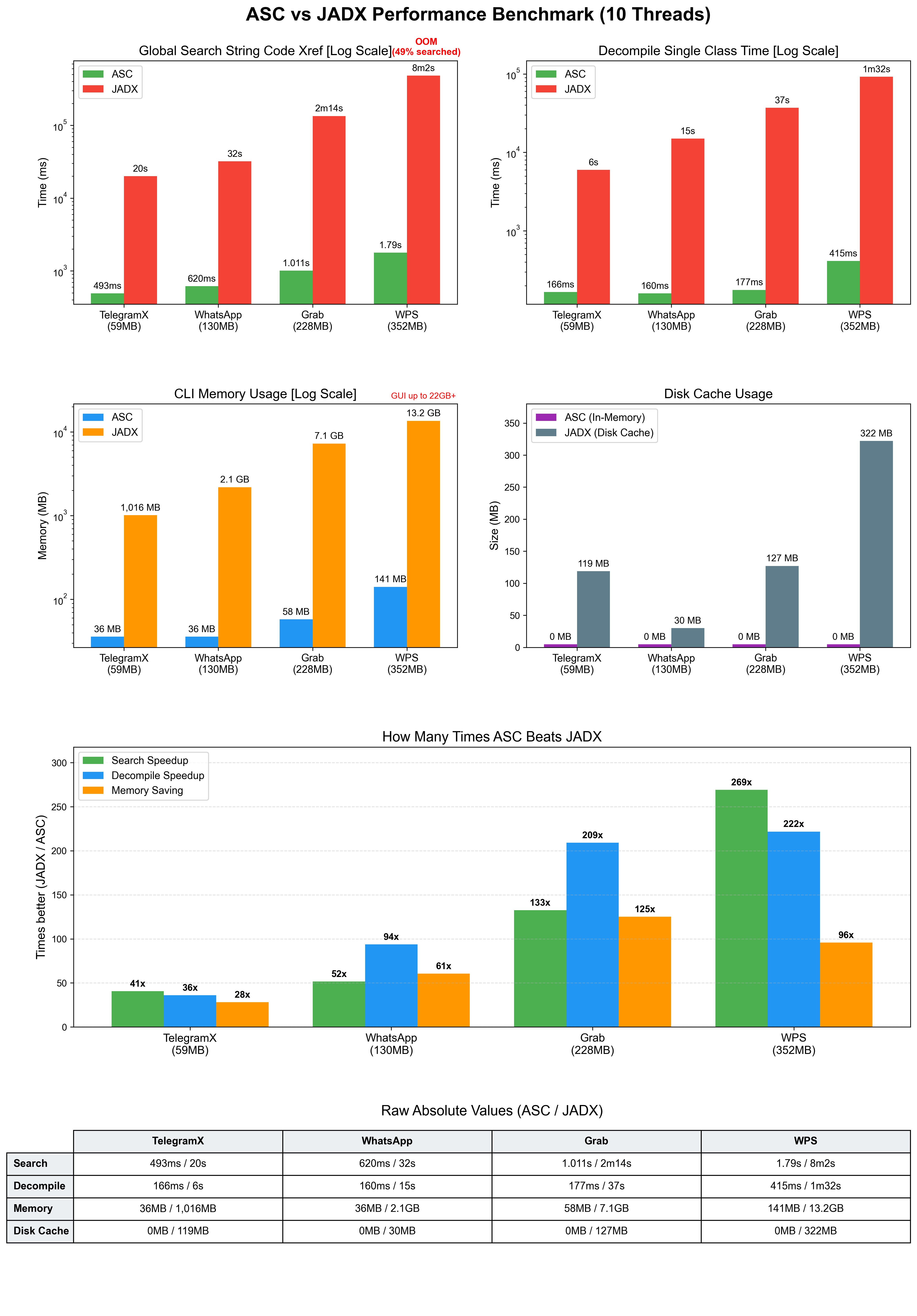
The stateless, zero-overhead design fits automated pipelines: every query returns in milliseconds with no long preprocessing to babysit, so an agent can probe an APK on demand instead of waiting minutes per full scan.Does the whole APK ever get loaded into memory?No. By design it touches only the blocks it needs: metadata is read straight from the compressed stream, and only the target bytecode plus its dependencies is reconstructed in memory, which is why a 352MB APK analysis fit in 141MB of RAM.
No. By design it touches only the blocks it needs: metadata is read straight from the compressed stream, and only the target bytecode plus its dependencies is reconstructed in memory, which is why a 352MB APK analysis fit in 141MB of RAM.What are similar projects?jadx, rea, Apktool, Seep-Reverse-Lab, dex2jar, GhidraMCP, bytecode-viewer, ghidra
jadx, rea, Apktool, Seep-Reverse-Lab, dex2jar, GhidraMCP, bytecode-viewer, ghidraWhich topics is it in?dex, decompilation, decompiler, apk, binary-analysis, static-analysis, reverse-engineering, security-tools, agentic-ai, java, mobile, performance
dex, decompilation, decompiler, apk, binary-analysis, static-analysis, reverse-engineering, security-tools, agentic-ai, java, mobile, performance