Recursive Experiential–Working Memory Evolution for Long-Horizon Agent Harnesses
National University of Singapore · Stanford University · University of Oxford · Princeton University
💡 Introduction
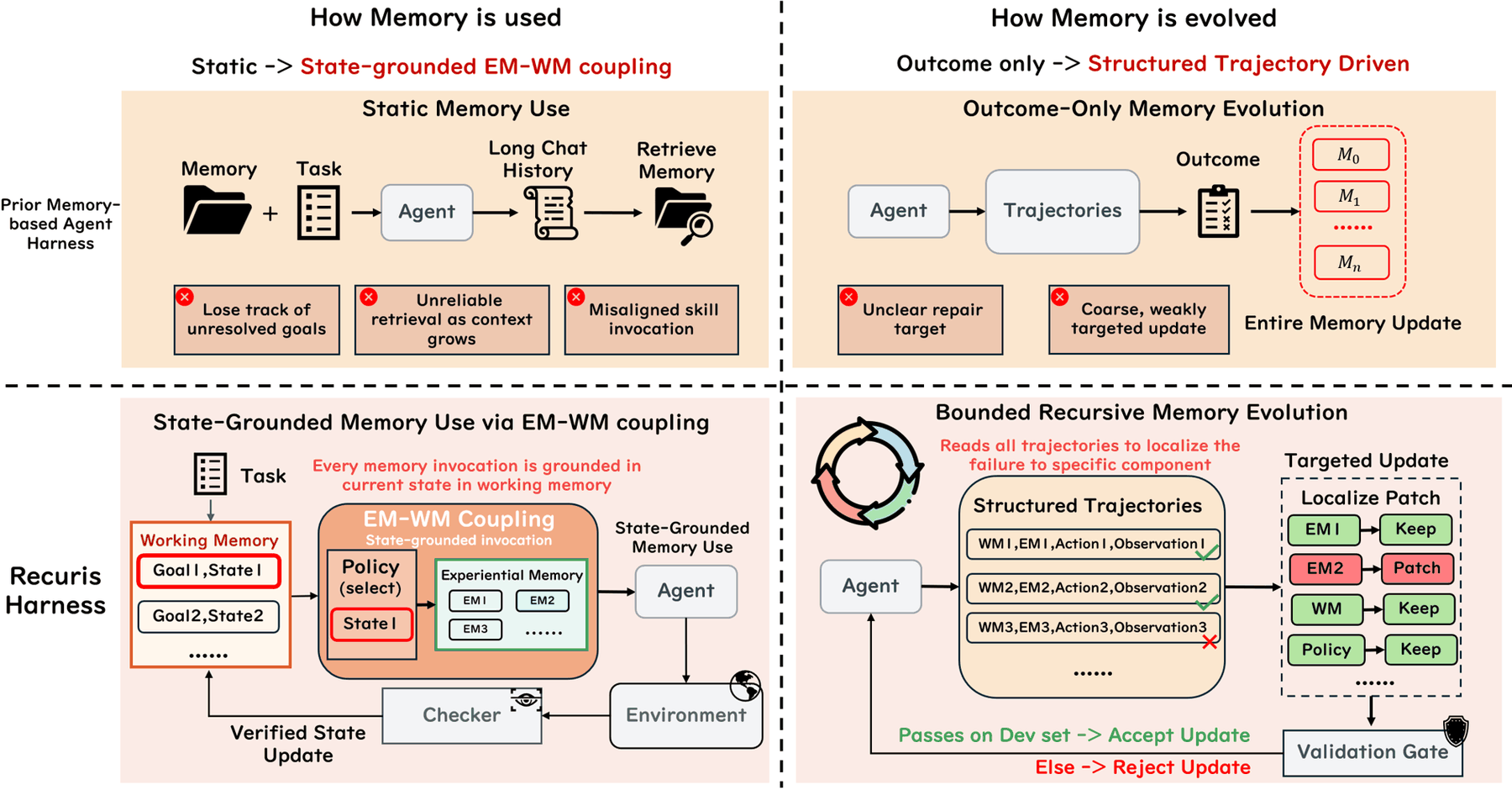
Recuris is a recursive self-improvement framework that improves a
long-horizon agent by evolving its memory instead of its weights or its
prompt. A frozen agent is paired with a Skill MemoryM = (E, W, ρ, C).
A meta-agent reads structured execution traces, locates each failure in one
component of that memory, and patches only that component. A deterministic
validation gate then decides, on paired held-out evidence, whether the patch
survives. Recuris has the following key features:
State-grounded memory use. Working memory drives skill invocation, so
retrieval is conditioned on verified task state rather than on a chat history
that grows until the state is buried.
Targeted memory evolution. Structured trajectories (w_t, E_t, a_t, o_t)
locate a failure in a specific component, instead of nudging a monolithic
prompt from outcomes alone.
Bounded by a validation gate. Candidates are admitted by paired held-out
arithmetic and nothing else. No model votes on its own patch.
Training-free and model-agnostic. The downstream agent stays frozen, and a
memory evolved on one model transfers to others unchanged.
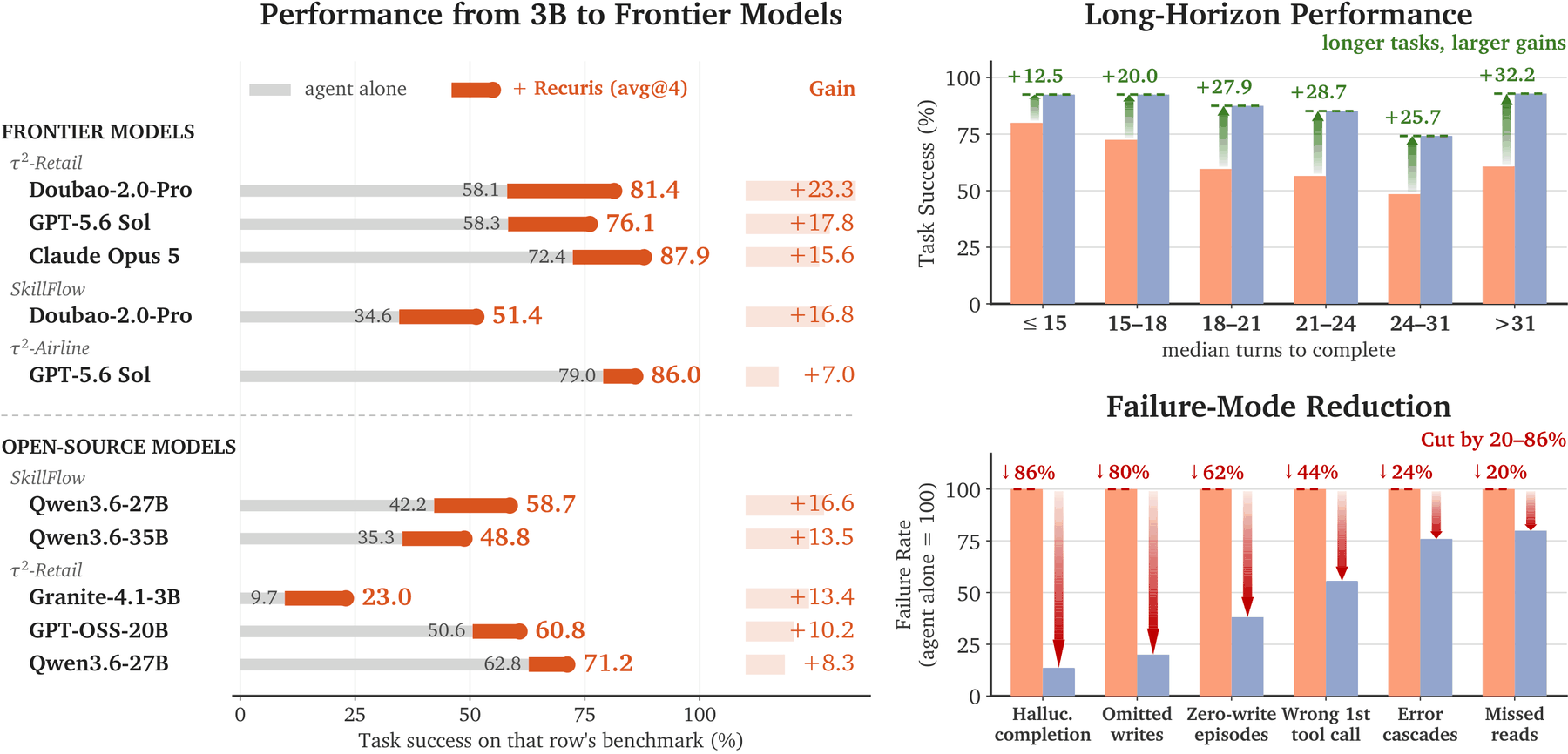
Overall, Recuris achieves higher task success, larger gains on longer
horizons, and substantially fewer long-horizon failures, on both frontier
and open-source agents.
🔔 News
[2026-08] 🎉 Initial release: evaluation and evolution code, the evolved
Skill Memory packages, and the frozen evaluation splits.
📊 Results
Task success (avg@4, %), each model run with the benchmark's own reference
agent alone and with that same agent plus Recuris. Bold marks the better of
each pair, the subscript is Δ, † marks a paired task-clustered bootstrap 95% CI
excluding zero, and n/a means the model was not run on that benchmark.
Model
Cross-task evolution
Within-task adaptation
τ²-Retail
τ²-Airline
SkillFlow
Terminal-Bench 2.1
Open-source models
Granite-4.1-3B
9.7
34.3
0.3
0.6
+ Recuris
23.0+13.4†
39.8+5.5
0.0 −0.3
3.1+2.5
Qwen3.5-4B
68.0
75.3
6.0
10.1
+ Recuris
68.3+0.3
79.0+3.8
7.1+1.1
13.0+2.9
Qwen3.5-9B
77.6
75.5
15.1
17.4
+ Recuris
79.6+2.0
78.4+2.9
18.4+3.4
20.5+3.1
GPT-OSS-20B
50.6
54.8
7.8
3.9
+ Recuris
60.8+10.2†
59.3+4.5†
10.4+2.6†
6.7+2.8
Qwen3.6-27B
62.8
79.0
42.2
38.8
+ Recuris
71.2+8.3†
80.0+1.0
58.7+16.6†
42.1+3.3
Qwen3.6-35B
78.2
80.3
35.3
33.1
+ Recuris
78.5+0.3
81.5+1.3
48.8+13.5†
36.4+3.3
Frontier models
Gemini 3.7 Flash
73.5
86.5
n/a
79.8
+ Recuris
78.3+4.8
85.0 −1.5
n/a
82.4+2.6
GPT-5.6 Sol
58.3
79.0
n/a
83.2
+ Recuris
76.1+17.8†
86.0+7.0†
n/a
86.4+3.2
Claude Opus 5
72.4
89.5
n/a
84.6
+ Recuris
87.9+15.6†
90.5+1.0
n/a
88.4+3.8
Doubao-2.0-Pro (deployment)
58.1
75.5
34.6
46.1
+ Recuris
81.4+23.3†
80.5+5.0
51.4+16.8†
48.9+2.9
Recuris improves task success in 35 of the 37 completed model and benchmark
pairs, from a 3B open-source agent up to the strongest frontier models. The
largest gains reach +23.3 on τ²-Retail and +16.8 on SkillFlow. Gains
grow with the interaction horizon, reaching +32.2 on the longest tasks, and
common long-horizon failure modes drop by up to 80%.
🛠️ Getting Started
This repository provides the code for running Recuris on τ²-Bench, SkillFlow and
Terminal-Bench 2.1, the Skill Memory packages produced by the evolution loop,
and the frozen evaluation splits.
📦 Install Packages
Python 3.12 and git. SkillFlow and Terminal-Bench 2.1 also need Docker
with the Compose V2 plugin (docker compose version must work; harbor
shells out to it for every task).
git clone https://github.com/Gen-Verse/Recuris.git recuris
cd recuris

uv sync --extra all          # or: pip install -e ".[all]"
⚙️ Setup Environment Variables
Put your endpoint in a .env file at the repository root, or export it:
OPENAI_API_KEY=...
OPENAI_BASE_URL=...
Any OpenAI-compatible endpoint works. This is needed even when the agent itself
is an open-source model, because τ²-Bench scores every episode with an LLM user
simulator and an LLM assertion judge, and both stay pinned to a reference model.
🚀 Quick Start
Each benchmark is run twice, once with a Skill Memory loaded and once without.
The two runs differ only in the flags shown below. Both are needed, because the
number that matters is the difference between them.
Install tau2 after uv sync, not before: uv sync resolves the environment to
exactly what pyproject.toml declares, so running it again removes anything
added with uv pip install.
Serve an open-source model locally. τ²-Bench drives the agent through tool
calls, so the two tool-calling flags are required, not optional: without them
vLLM rejects every request and every episode ends ungraded.
--domain is retail or airline. For airline, use
--skill-memory tau2_airline.
--agent-llm-args must be identical in both runs. It is validated rather
than merged, so an unknown key raises an error instead of being dropped
silently.
Switching models means changing $MODEL and $ARGS. Nothing else changes.
Some servers need extras, for example
"extra_body":{"chat_template_kwargs":{"enable_thinking":false}} for Qwen.
🔹 SkillFlow
Set up the benchmark and build the task images once:
Generate the configs for both runs, then execute them:
export MODEL=openai/qwen3.6-27b
export BASE=http://127.0.0.1:8000/v1

recuris skillflow render-configs --arm bare \
    --model "$MODEL" --base-url "$BASE" --out configs/skillflow/generated
recuris skillflow render-configs --arm skill --routing default \
    --model "$MODEL" --base-url "$BASE" \
    --skill-memory skillflow --out configs/skillflow/generated

for cfg in configs/skillflow/generated/bare_*.yaml;  do harbor run -c "$cfg" --yes; done
for cfg in configs/skillflow/generated/skill_*.yaml; do harbor run -c "$cfg" --yes; done

recuris skillflow score --bare jobs/bare --skill jobs/skill
Notes:
Run the jobs one at a time. Concurrent harbor jobs exhaust the Docker IPv4
address pool, and the resulting failure looks like something else entirely.
Configs are generated rather than committed, so the two runs cannot drift
apart and no credential is ever written to disk.
--routing default is model-agnostic and is the right choice for new
work. --routing frozen_insample reproduces our reported numbers and applies
six per-family overrides that were chosen in-sample.
On this benchmark a task may be attempted several times in a row, and it stops
as soon as one attempt succeeds. --rounds sets how many attempts each task
gets. There are three configurations:
Configuration
What the agent carries
After a failed attempt
bare
nothing, the stock agent
nothing changes, the next attempt starts over
m0
a fixed Skill Memory, the seed package
nothing changes, the next attempt gets the same package
tta
the same package, as a per-task copy
the meta-agent reads the failed trajectory and writes a new card into that copy, which the next attempt carries
# smoke test: one task, one attempt
recuris tta run --taskset splits/tb21/tta_taskset_v3.json \
    --run-id smoke --arm m0 --limit 1 --rounds 1

# all three configurations, four attempts each
for cfg in bare m0 tta; do
    recuris tta run --taskset splits/tb21/tta_taskset_v3.json \
        --run-id demo --arm "$cfg" --rounds 4 --concurrency 3
done
Notes:
Give all three configurations the same --rounds. Comparing tta at four
attempts against bare at one mostly measures the extra attempts rather than
adaptation.
m0 against bare isolates the value of having a Skill Memory at all. tta
against m0 isolates the value of updating it between attempts, since both
carry a package and both get the same number of attempts.
At four attempts, that second comparison is worth +2.3 points, 60.9%
against 58.6%, which is not significant at this sample size. We report it
that way rather than as a headline number.
🔹 Evolving a Skill Memory
This is the recursive loop. A meta-agent, the upstream model, reads failed
trajectories from the agent being improved, the downstream model. It patches
one component of the memory, and a gate admits the patch only on paired held-out
evidence.
npm install -g @anthropic-ai/claude-code
RECURIS_META_MODEL=...        # the upstream meta-agent's model
RECURIS_META_BASE_URL=...
RECURIS_META_API_KEY=...
--meta-model is the upstream meta-agent and --worker-model is the
downstream agent being improved. Both default to Doubao.
--base neutral starts from a deterministic seed package, so no
hand-written domain profile enters the loop.
Start with qualify and then a single round. Each round writes a full record:
the evidence the session was given, the plan it produced, the gate arithmetic,
and the ledger entry. A round that admits nothing is a valid outcome.
Evolving a package for a specific model beats reusing one evolved elsewhere.
On GPT-OSS-20B a rebuilt package gained +10.2, while the general-purpose
package transferred negatively.
📖 Citation
@article{yu2026recuris,
  title   = {Recursive Experiential--Working Memory Evolution for Long-Horizon Agent Harnesses},
  author  = {Yu, Zhaochen and Wu, Yingcheng and Yin, Zhenfei and Chen, Kaiyuan and Zhao, Zhe and Wang, Mengdi and Yan, Shuicheng and Yang, Ling},
  journal = {arXiv preprint arXiv:2608.24876},
  year    = {2026}
}







 Recuris 是一个递归自我改进框架,通过演化记忆而不是权重或提示词来增强长程 LLM 代理。它把一个冻结的代理与结构化的 Skill Memory 配对,由元代理根据执行轨迹对其进行修补,只保留通过验证门槛的改动。