UniVR: SFT & RL Training Framework for Emu3.5 Series Unified Models
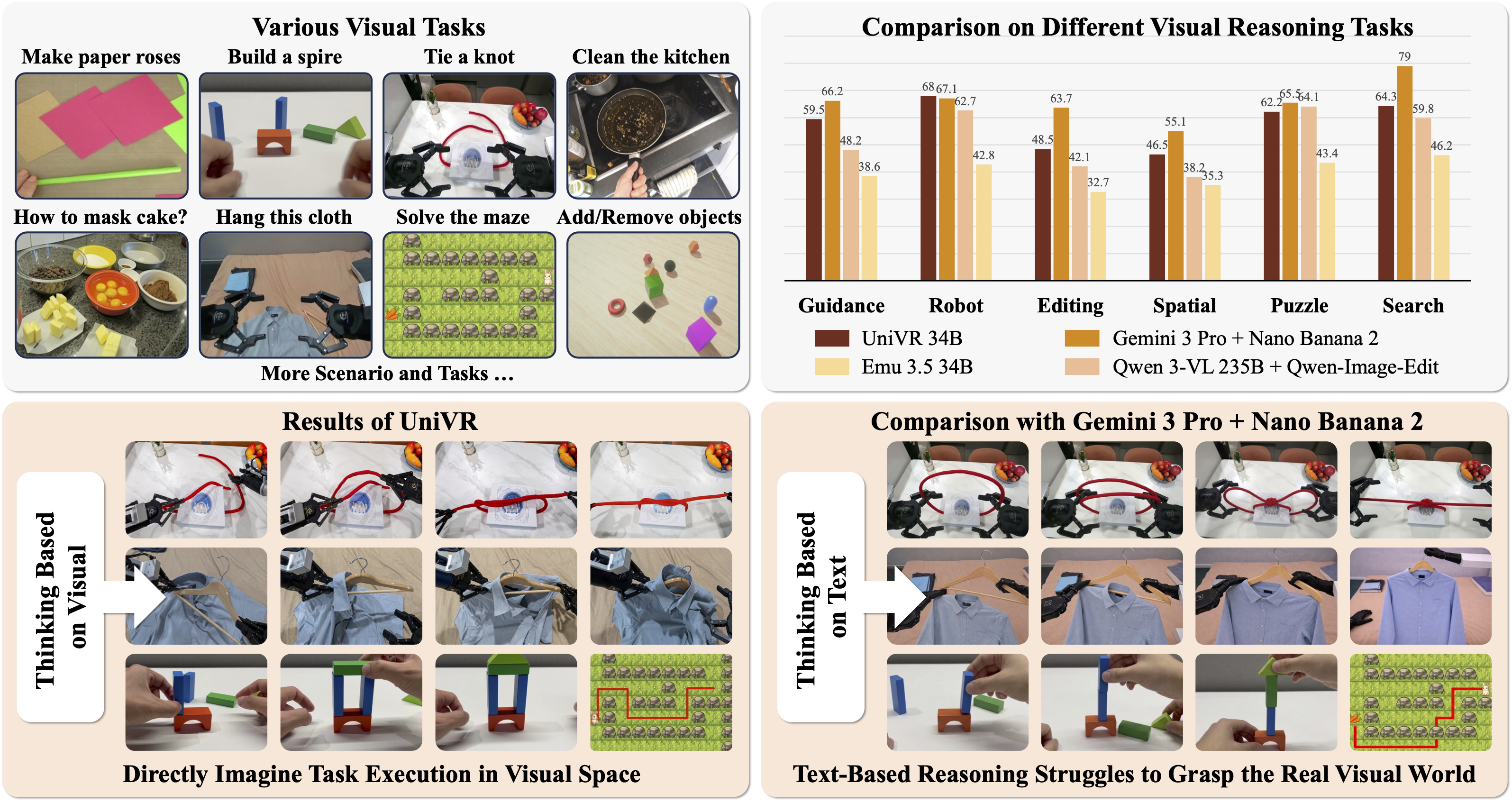
What is This?
UniVR is an end-to-end SFT and Reinforcement Learning (GRPO) training framework specifically built for Emu3.5 series unified generative models. It is designed to be easily adapted for your own tasks — you only need to swap in your own data loader and RL reward function.
Key framework features:
- SFT (
UniVR_SFT): Multi-node distributed supervised fine-tuning of Emu3.5, supporting both LoRA and full-parameter training via DeepSpeed ZeRO-3.
- RL (
UniVR_RL): GRPO-based reinforcement learning built on the verl framework with a custom HybridEngine for efficient rollout and training.
- Emu3.5 vLLM support: Custom vLLM source patches enabling fast no-CFG parallel inference for Emu3.5 during RL rollout, achieving ~2× throughput over standard CFG mode. LoRA support for Emu3.5 in vLLM is also included.
- Bring your own task: Replace the data loader (SFT) and the reward function (RL) to train on any visual task using Emu3.5 as the backbone.
Customizing for Your Own Task
Step 1 — Replace the Data Loader (SFT)
The SFT stage reads training samples in a unified format: [query image, textual instruction, visual reasoning trajectory]. To use your own data, implement a custom PyTorch Dataset that returns samples in this format and plug it into UniVR_SFT/train.py.
No changes to the training loop, DeepSpeed config, or model code are needed.
Step 2 — Replace the Reward Function (RL)
The RL stage calls a reward server via HTTP to score rollout trajectories. To use your own reward:
- Implement your reward logic as an HTTP server (see
UniVR_RL/verl/ for the existing VLM-based reward server reference).
- Set
VLLM_PATH in UniVR_RL/examples/emu3_grpo_lora.sh to point to your reward server endpoint.
- Optionally adjust
worker.rollout.enable_image_decode_for_reward in examples/config_emu3.yaml depending on whether your reward consumes raw image tokens or decoded pixel images.
The GRPO training loop, rollout engine, and Emu3.5 vLLM backend remain unchanged.
Research Context (UniVR)
This framework was developed for UniVR, a system that learns complex visual reasoning, fine-grained physical dynamics, and long-term planning from pure visual demonstrations — without relying on dense image-text pairs or task-specific heuristics.
UniVR uses VR-GRPO, a reinforcement learning paradigm combining:
- Format reward ($R_{\text{format}}$): enforces structural constraints (uniform resolution, correct step count).
- Global reward ($R_g$): a VLM evaluator (Qwen3-VL-30B) assesses overall task completion via pairwise comparison.
- Step-focal reward ($R_s$): identifies the most uncertain sub-steps via CLIP-feature variance across rollout trajectories and applies fine-grained VLM evaluation on those critical windows.
- Combined reward: $R_{\text{reason}} = R_g - \lambda |R_g - R_s|$
Training and evaluation use VR-X, a benchmark of 1.5M raw samples from 16 diverse sources spanning manipulation, spatial puzzles, and physical reasoning.
Architecture
UniVR adopts Emu3.5 (34B) as its backbone — a unified generative model that tokenizes images and text into a shared discrete vocabulary via a VQ-VAE-style encoder. The model autoregressively generates visual reasoning traces (future frames) given an image sequence and instruction, with no intermediate text chain.
Training is a two-stage pipeline:
| Stage |
Module |
Data |
Description |
| 1. Cold Initialization |
UniVR_SFT |
310k VR-X samples |
SFT to instill visual reasoning priors |
| 2. Reinforcement Learning |
UniVR_RL |
3k curated samples |
VR-GRPO with composite reward |
Repository Structure
UniVR/
├── install.sh            # One-shot environment setup for both subprojects
├── UniVR_SFT/            # Supervised Fine-Tuning (cold initialization)
│   ├── train.py          # ← Replace dataset here for your task
│   ├── inference.py
│   ├── scripts/
│   │   ├── train_sft_lora.sh
│   │   ├── train_sft_full.sh
│   │   └── inference.sh
│   ├── configs/          # Inference configs
│   └── src/
│       ├── patch/        # vLLM source patches for Emu3.5 (no-CFG + LoRA)
│       └── tokenizer_emu3_ibq/
└── UniVR_RL/             # Reinforcement Learning (VR-GRPO)
    ├── examples/
    │   ├── emu3_grpo_lora.sh  # ← Set your reward server endpoint here
    │   └── config_emu3.yaml
    ├── verl/             # Modified verl framework with Emu3.5 HybridEngine
    └── src/
Installation
bash install.sh
Installs all dependencies (torch==2.8.0, transformers==4.57.3, vllm==0.11.0, flash-attn==2.8.3, deepspeed), applies the vLLM source patches for Emu3.5, and installs the verl-based RL framework.
See UniVR_SFT/README.md and UniVR_RL/README.md for detailed usage of each subproject.
Quick Start
SFT (LoRA, 2 nodes × 8 GPUs)
# Edit scripts/train_sft_lora.sh to set MODEL_PATH, TOKENIZER_PATH, OUTPUT_DIR
cd UniVR_SFT
bash scripts/train_sft_lora.sh
SFT (Full parameter, 4 nodes × 8 GPUs)
bash scripts/train_sft_full.sh
RL (VR-GRPO)
# Edit examples/emu3_grpo_lora.sh to set MODEL_PATH, TOKENIZER_PATH, VQ_MODEL_PATH, VLLM_PATH
cd UniVR_RL
bash examples/emu3_grpo_lora.sh

 UniVR 是专为 Emu3.5 系列统一生成模型打造的端到端 SFT 和强化学习(GRPO)训练框架,让你通过换入自己的数据加载器和奖励函数来训练视觉推理任务。