




What is this?
 This is 'Data Engineering Zoomcamp', a free 9-week course that teaches the fundamentals of data engineering by building an end-to-end data pipeline from scratch.
This is 'Data Engineering Zoomcamp', a free 9-week course that teaches the fundamentals of data engineering by building an end-to-end data pipeline from scratch.Is this a video course, a reading list, or hands-on project work?It combines pre-recorded video lectures with structured modules, hands-on workshops, and a final project, not just reading material.
It combines pre-recorded video lectures with structured modules, hands-on workshops, and a final project, not just reading material.How do I start the course?For self-paced learning, follow the materials on GitHub, join the Slack channel for questions, and do the self-checked homework; for the live cohort you register via a sign-up link, with the next one starting January 2027.
For self-paced learning, follow the materials on GitHub, join the Slack channel for questions, and do the self-checked homework; for the live cohort you register via a sign-up link, with the next one starting January 2027.What do I need to know before starting?You need basic coding experience and familiarity with SQL; Python experience is helpful but not required, and no prior data engineering background is needed.
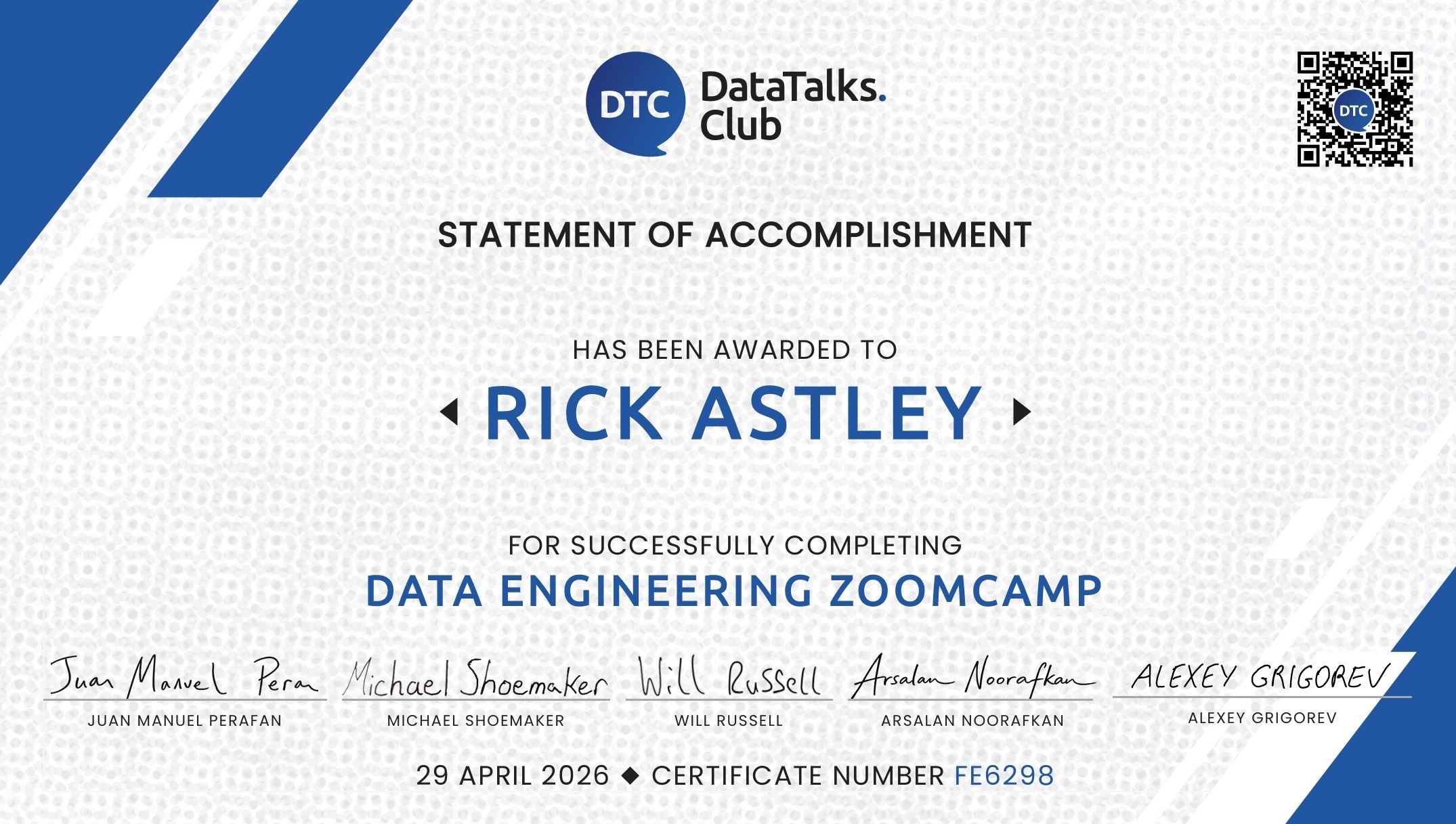
You need basic coding experience and familiarity with SQL; Python experience is helpful but not required, and no prior data engineering background is needed.Do I get a certificate if I take it self-paced?No. Certificates are only awarded to learners who complete the final project and peer review during a live cohort; self-paced homework exists but isn't scored and has no leaderboard, peer review, or certificate.
No. Certificates are only awarded to learners who complete the final project and peer review during a live cohort; self-paced homework exists but isn't scored and has no leaderboard, peer review, or certificate.Who should take this course?It's aimed at developers, analysts, and data scientists who want to learn to build data pipelines and work with the modern data engineering stack, with no prior data engineering experience required.
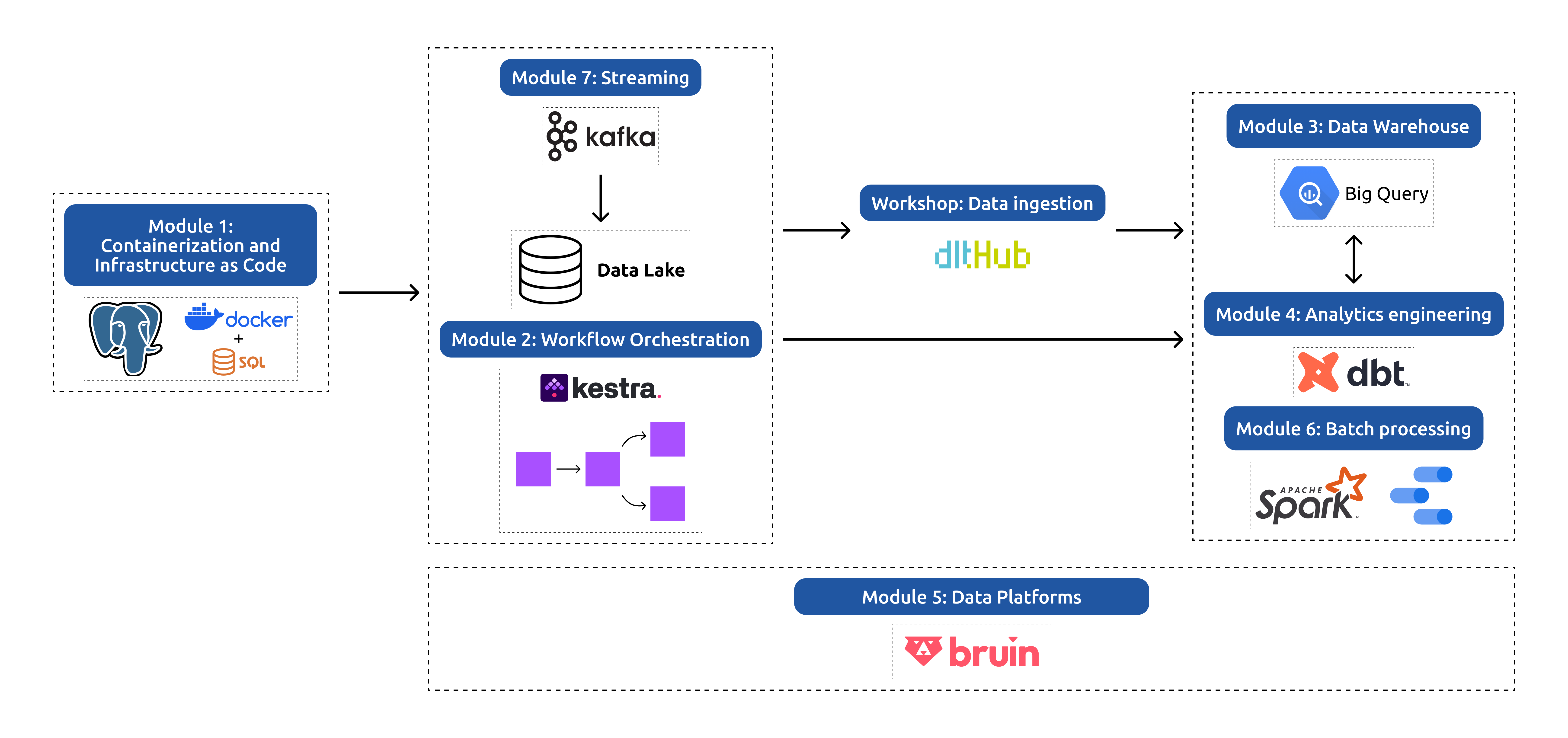
It's aimed at developers, analysts, and data scientists who want to learn to build data pipelines and work with the modern data engineering stack, with no prior data engineering experience required.What tools and topics does the syllabus cover?Modules cover Docker and Terraform for infrastructure, workflow orchestration with Kestra, BigQuery data warehousing, analytics engineering with dbt, batch processing with Apache Spark, and streaming with Kafka.
Modules cover Docker and Terraform for infrastructure, workflow orchestration with Kestra, BigQuery data warehousing, analytics engineering with dbt, batch processing with Apache Spark, and streaming with Kafka.Who teaches the course?It's taught by DataTalksClub instructors including Alexey Grigorev, Michael Shoemaker, Will Russell, Anna Geller, Juan Manuel Perafan, and Arsalan Noorafkan.
It's taught by DataTalksClub instructors including Alexey Grigorev, Michael Shoemaker, Will Russell, Anna Geller, Juan Manuel Perafan, and Arsalan Noorafkan.What does the final project involve?The final project applies everything learned in a real-world scenario, building an end-to-end data pipeline, and includes a peer review and feedback process.
The final project applies everything learned in a real-world scenario, building an end-to-end data pipeline, and includes a peer review and feedback process.Does the course use real cloud infrastructure?Yes, it uses Google Cloud Platform (BigQuery) alongside Docker, Terraform, Spark, Kafka, and dbt to mirror an industry-standard data stack.
Yes, it uses Google Cloud Platform (BigQuery) alongside Docker, Terraform, Spark, Kafka, and dbt to mirror an industry-standard data stack.What are similar projects?full-stack-data-engineering, data-engineer-handbook, airflow, dolphinscheduler, BigData-Notes, flink-learning, Cookbook, mlops-zoomcamp
full-stack-data-engineering, data-engineer-handbook, airflow, dolphinscheduler, BigData-Notes, flink-learning, Cookbook, mlops-zoomcampWhich topics is it in?data-pipelines, certificate, spark, gcp, terraform, kafka, data-engineering, course, jupyter notebook, workflow, sql, orchestration
data-pipelines, certificate, spark, gcp, terraform, kafka, data-engineering, course, jupyter notebook, workflow, sql, orchestration