Graph Engineering in the Era of LLM Agents: From Individual Intelligence to System Intelligence
A curated collection of research papers, benchmarks, and open-source projects on Graph Engineering in the era of LLM Agents. This repository accompanies the survey Graph Engineering in the Era of LLM Agents: From Individual Intelligence to System Intelligence and will be continuously updated.
Graph Engineering studies how explicit, dynamic, and evolving graph structures can organize tasks, coordinate heterogeneous agents, maintain runtime state, and support system evolution. The collection follows the survey's progression from Model Intelligence, through Individual Intelligence, to System Intelligence.
🤗 Contributions are welcome. If you find a missing resource or a relevant new work, please open an issue or submit a pull request.
📃 Please cite our paper if you find this survey or repository helpful.
@article{feng2026graph,
  title={Graph Engineering in the Era of LLM Agents: From Individual Intelligence to System Intelligence},
  author={Feng, Yuyuan and Xiang, Zhishang and Yang, Chaobin and Ma, Qichao and Chen, Zerui and Zhang, Yujing and Huang, Ke and Wu, Chuanjie and Liu, Zhaoxu and Wang, Yili and others},
  journal={arXiv preprint arXiv:2608.21156},
  year={2026}
}
🎉 News
Overview
Graph Engineering provides a structured path from standalone model capability to coordinated system-level intelligence:
- Model Intelligence builds and adapts foundation-model capabilities through parameterized training, prompt engineering, and context engineering.
- Individual Intelligence equips a single agent with tools, memory, skills, runtime orchestration, and persistent interaction loops.
- System Intelligence organizes tasks, agents, runtime state, and system evolution through explicit graph structures, with ontology engineering providing a shared semantic layer.
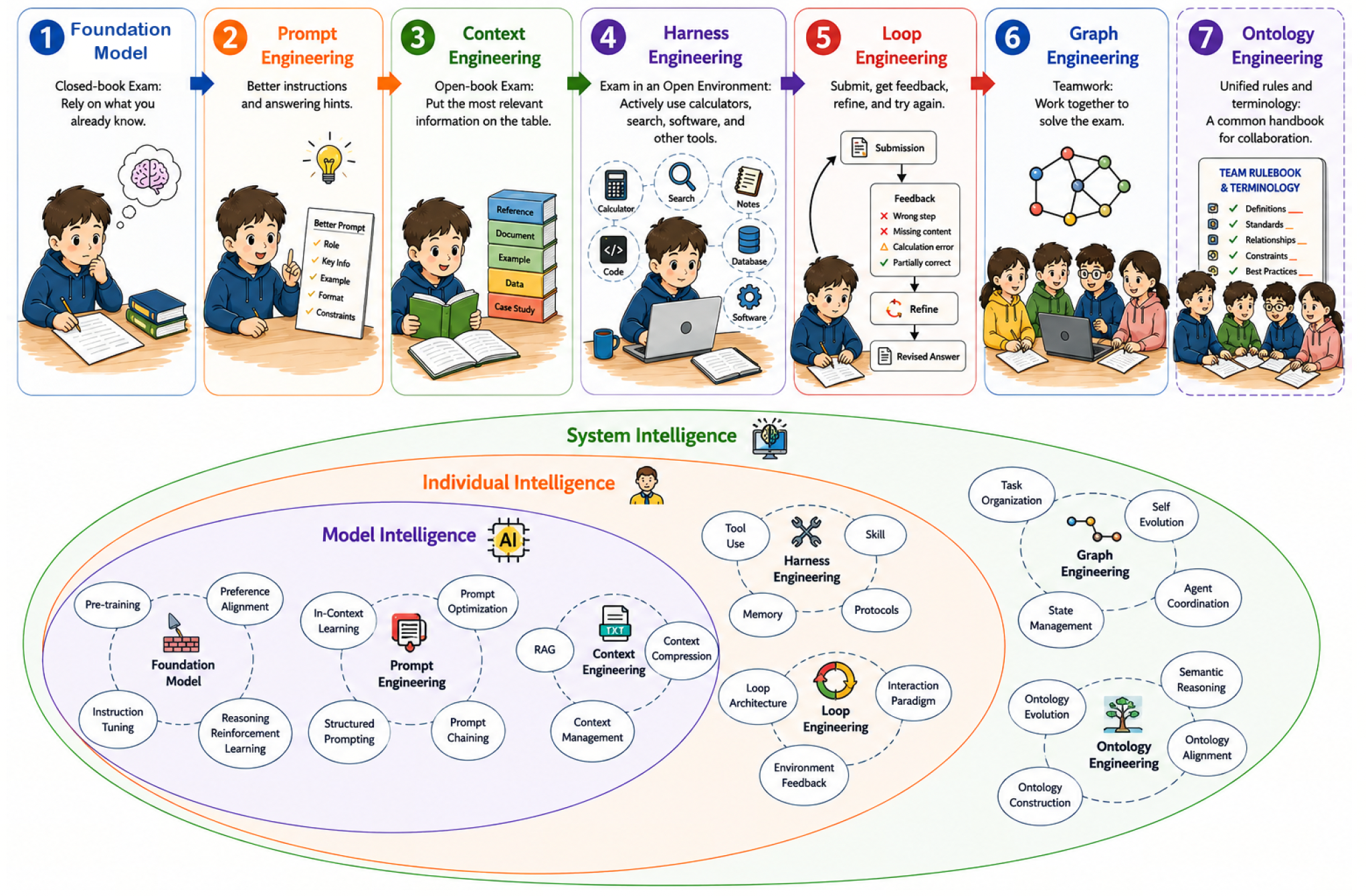
The evolution of engineering paradigms from Foundation Models to Graph and Ontology Engineering.
Table of Contents
- (arXiv 2024) Graph Retrieval-Augmented Generation: A Survey [Paper]
- (arXiv 2026) Agent Harness Engineering: A Survey [Paper]
- (TechRxiv 2026) A Systematic Survey of Self-Evolving Agents: From Model-Centric to Environment-Driven Co-Evolution [Paper] [Google Scholar]
- (arXiv 2025) Graphs Meet AI Agents: Taxonomy, Progress, and Future Opportunities [Paper]
- (arXiv 2025) Graph-Augmented Large Language Model Agents: Current Progress and Future Prospects [Paper]
- (arXiv 2026) Integrating Graphs, Large Language Models, and Agents: Reasoning and Retrieval [Paper]
- (arXiv 2024) Understanding the Planning of LLM Agents: A Survey [Paper]
- (Paper 2025) A Survey on Agent Workflow—Status and Future [Paper]
- (arXiv 2026) From Agent Loops to Structured Graphs: A Scheduler-Theoretic Framework for LLM Agent Execution [Paper]
- (Vicinagearth 2024) A Survey on LLM-Based Multi-Agent Systems: Workflow, Infrastructure, and Challenges [Paper]
- (Frontiers of Computer Science 2026) Beyond Self-Talk: A Communication-Centric Survey of LLM-Based Multi-Agent Systems [Paper]
- (arXiv 2026) Graph-Based Agent Memory: Taxonomy, Techniques, and Applications [Paper]
- (TMLR 2026) A Survey of Self-Evolving Agents: What, When, How, and Where to Evolve on the Path to Artificial Super Intelligence [Paper]
- (OpenReview Archive 2026) Self-Improving Agents in the Era of Experience: A Survey of Self- to Meta-Evolution [Paper]
- (arXiv 2025) Multi-Agent Collaboration Mechanisms: A Survey of LLMs [Paper]
- (arXiv 2026) Beyond Individual Intelligence: Surveying Collaboration, Failure Attribution, and Self-Evolution in LLM-based Multi-Agent Systems [Paper]
📜 Research Papers
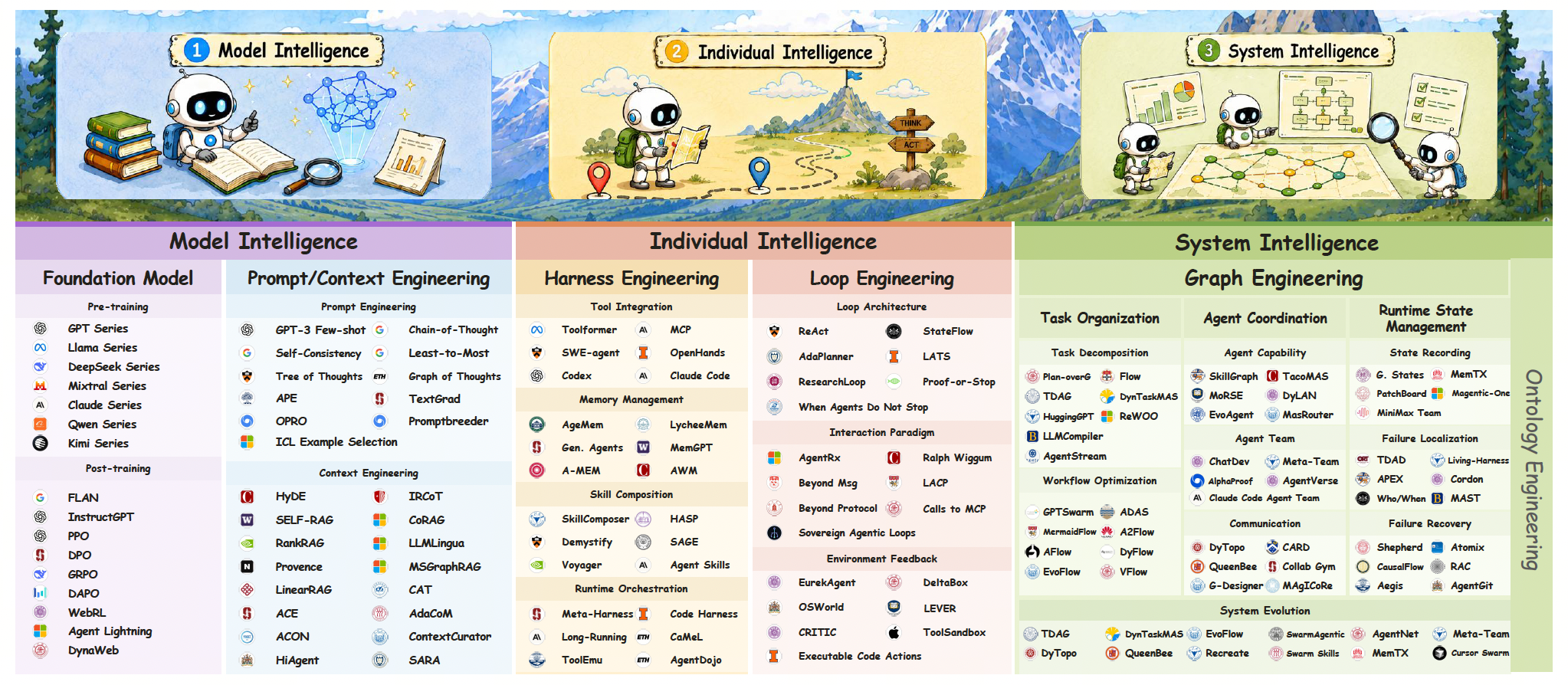
A comprehensive taxonomy spanning Model, Individual, and System Intelligence.
Model Intelligence
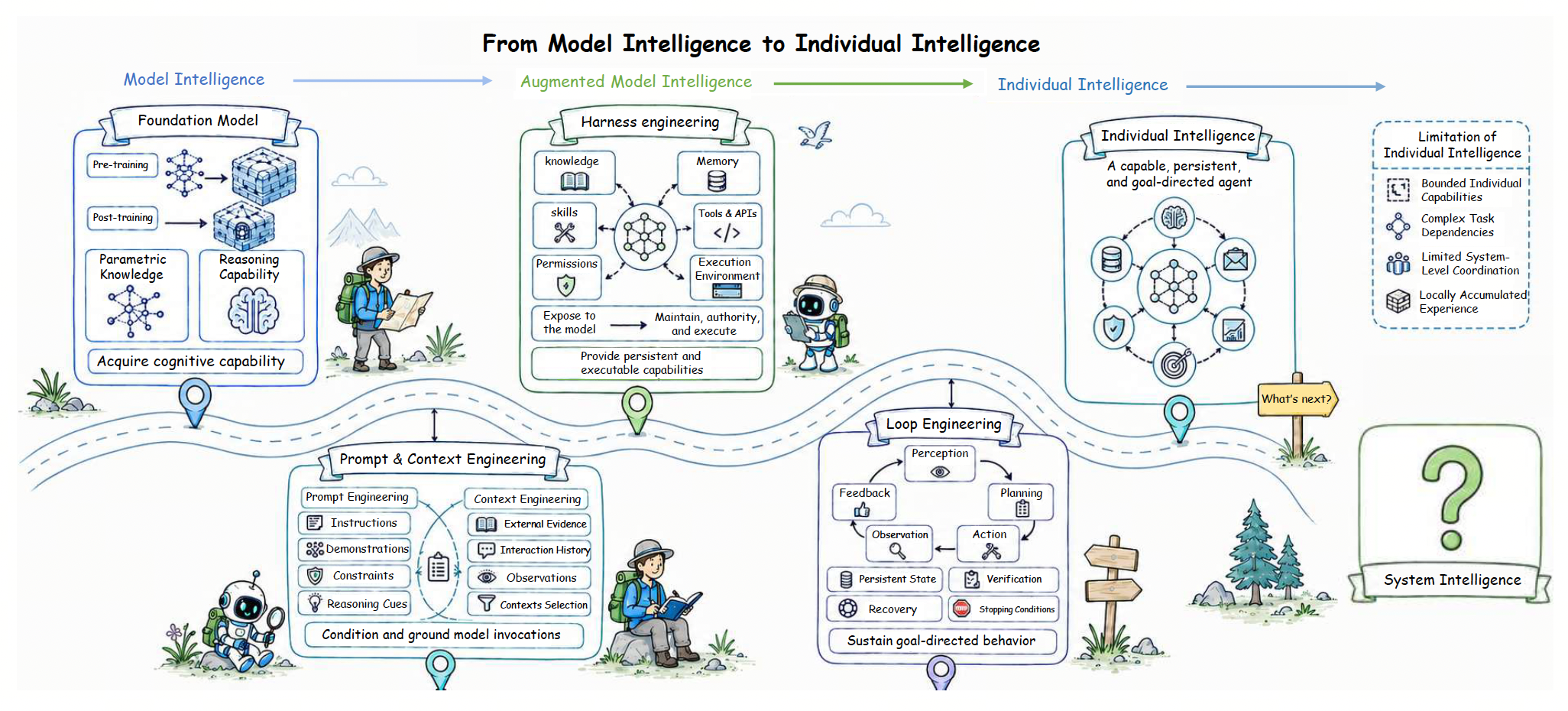
From Model Intelligence to Individual Intelligence through Prompt, Context, Harness, and Loop Engineering.
Pre-Training
- (NeurIPS 2020) GPT-3 — Language Models are Few-Shot Learners [Paper]
- (arXiv 2021) Gopher — Scaling Language Models: Methods, Analysis & Insights from Training Gopher [Paper]
- (JMLR 2023) PaLM — PaLM: Scaling Language Modeling with Pathways [Paper]
- (arXiv 2023) LLaMA — LLaMA: Open and Efficient Foundation Language Models [Paper]
- (arXiv 2020) Scaling Laws — Scaling Laws for Neural Language Models [Paper]
- (NeurIPS 2022) Chinchilla — Training Compute-Optimal Large Language Models [Paper]
- (JMLR 2022) Switch Transformer — Switch Transformers: Scaling to Trillion Parameter Models with Simple and Efficient Sparsity [Paper]
- (arXiv 2024) Mixtral — Mixtral of Experts [Paper]
- (Paper 2024) DeepSeekMoE — DeepSeekMoE: Towards Ultimate Expert Specialization in Mixture-of-Experts Language Models [Paper]
- (arXiv 2024) Llama 3 — The Llama 3 Herd of Models [Paper]
- (arXiv 2024) DeepSeek-V3 — DeepSeek-V3 Technical Report [Paper]
- (Paper 2022) Deduplication — Deduplicating Training Data Makes Language Models Better [Paper]
- (NeurIPS 2024) FineWeb — The FineWeb Datasets: Decanting the Web for the Finest Text Data at Scale [Paper]
- (NeurIPS 2024) DataComp-LM — DataComp-LM: In Search of the Next Generation of Training Sets for Language Models [Paper]
- (arXiv 2024) Qwen2.5 — Qwen2.5 Technical Report [Paper]
- (arXiv 2025) Qwen3 — Qwen3 Technical Report [Paper]
- (arXiv 2025) Kimi K2 — Kimi K2: Open Agentic Intelligence [Paper]
Post-Training
(ICLR 2022) FLAN — Finetuned Language Models Are Zero-Shot Learners [Paper]
(ICLR 2022) T0 — Multitask Prompted Training Enables Zero-Shot Task Generalization [Paper]
(NeurIPS 2022) InstructGPT — Training Language Models to Follow Instructions with Human Feedback [Paper]
(ICML 2023) Flan Collection — The Flan Collection: Designing Data and Methods for Effective Instruction Tuning [Paper]
(arXiv 2022) Constitutional AI — Constitutional AI: Harmlessness from AI Feedback [Paper]
(arXiv 2023) RLAIF — RLAIF vs. RLHF: Scaling Reinforcement Learning from Human Feedback with AI Feedback [Paper]
(NeurIPS 2023) DPO — Direct Preference Optimization: Your Language Model is Secretly a Reward Model [Paper]
(arXiv 2024) Tulu 3 — Tulu 3: Pushing Frontiers in Open Language Model Post-Training [Paper]
(arXiv 2024) DeepSeekMath — DeepSeekMath: Pushing the Limits of Mathematical Reasoning in Open Language Models [Paper]
(Nature 2025) DeepSeek-R1 — DeepSeek-R1 Incentivizes Reasoning in LLMs through Reinforcement Learning [Paper]
(arXiv 2025) DAPO — DAPO: An Open-Source LLM Reinforcement Learning System at Scale [Paper]
(ICLR 2025) WebRL — WebRL: Training LLM Web Agents via Self-Evolving Online Curriculum Reinforcement Learning [Paper]
(arXiv 2025) Search-R1 — Search-R1: Training LLMs to Reason and Leverage Search Engines with Reinforcement Learning [Paper]
(arXiv 2025) ReTool — ReTool: Reinforcement Learning for Strategic Tool Use in LLMs [Paper]
(arXiv 2025) ToolRL — ToolRL: Reward is All Tool Learning Needs [Paper]
(arXiv 2025) RAGEN — RAGEN: Understanding Self-Evolution in LLM Agents via Multi-Turn Reinforcement Learning [Paper]
(arXiv 2025) Agent-R1 — Agent-R1: Training Powerful LLM Agents with End-to-End Reinforcement Learning [Paper]
(arXiv 2025) Agent Lightning — Agent Lightning: Train ANY AI Agents with Reinforcement Learning [Paper]
(arXiv 2026) DynaWeb — DynaWeb: Model-Based Reinforcement Learning of Web Agents [Paper]
(arXiv 2026) HAT — Training Agents to Evolve with Their Harness: TaoLive Digital Avatar Agent Technical Report [Paper]
Prompt Engineering
- (arXiv 2021) Prompt Programming — Prompt Programming for Large Language Models: Beyond the Few-Shot Paradigm [Paper]
- (Paper 2022) Demonstrations — Rethinking the Role of Demonstrations: What Makes In-Context Learning Work? [Paper]
- (Paper 2022) In-Context Examples — What Makes Good In-Context Examples for GPT-3? [Paper]
- (NeurIPS 2022) Chain-of-Thought — Chain-of-Thought Prompting Elicits Reasoning in Large Language Models [Paper]
- (ICLR 2023) Self-Consistency — Self-Consistency Improves Chain of Thought Reasoning in Language Models [Paper]
- (ICLR 2023) Least-to-Most — Least-to-Most Prompting Enables Complex Reasoning in Large Language Models [Paper]
- (NeurIPS 2023) Tree of Thoughts — Tree of Thoughts: Deliberate Problem Solving with Large Language Models [Paper]
- (NeurIPS 2023) Self-Refine — Self-Refine: Iterative Refinement with Self-Feedback [Paper]
- (AAAI 2024) Graph of Thoughts — Graph of Thoughts: Solving Elaborate Problems with Large Language Models [Paper]
- (Paper 2020) AutoPrompt — AutoPrompt: Eliciting Knowledge from Language Models with Automatically Generated Prompts [Paper]
- (ICLR 2023) APE — Large Language Models Are Human-Level Prompt Engineers [Paper]
- (ICLR 2024) OPRO — Large Language Models as Optimizers [Paper]
- (ICLR 2024) Promptbreeder — Promptbreeder: Self-Referential Self-Improvement via Prompt Evolution [Paper]
- (arXiv 2024) TextGrad — TextGrad: Automatic ``Differentiation'' via Text [Paper]
Context Engineering
- (Paper 2020) DPR — Dense Passage Retrieval for Open-Domain Question Answering [Paper]
- (NeurIPS 2020) RAG — Retrieval-Augmented Generation for Knowledge-Intensive NLP Tasks [Paper]
- (Paper 2021) FiD — Leveraging Passage Retrieval with Generative Models for Open Domain Question Answering [Paper]
- (Paper 2023) HyDE — Precise Zero-Shot Dense Retrieval without Relevance Labels [Paper]
- (Paper 2023) IRCoT — Interleaving Retrieval with Chain-of-Thought Reasoning for Knowledge-Intensive Multi-Step Questions [Paper]
- (ICLR 2024) Self-RAG — Self-RAG: Learning to Retrieve, Generate, and Critique through Self-Reflection [Paper]
- (NeurIPS 2025) CoRAG — Chain-of-Retrieval Augmented Generation [Paper]
- (NeurIPS 2024) RankRAG — RankRAG: Unifying Context Ranking with Retrieval-Augmented Generation in LLMs [Paper]
- (Paper 2023) LLMLingua — LLMLingua: Compressing Prompts for Accelerated Inference of Large Language Models [Paper]
- (ICLR 2024) RECOMP — RECOMP: Imp



 Отобранная коллекция исследовательских статей, бенчмарков и open-source проектов, сопровождающая обзор по Graph Engineering для LLM-агентов и покрывающая развитие от Model Intelligence через Individual Intelligence к System Intelligence.