




What is this?
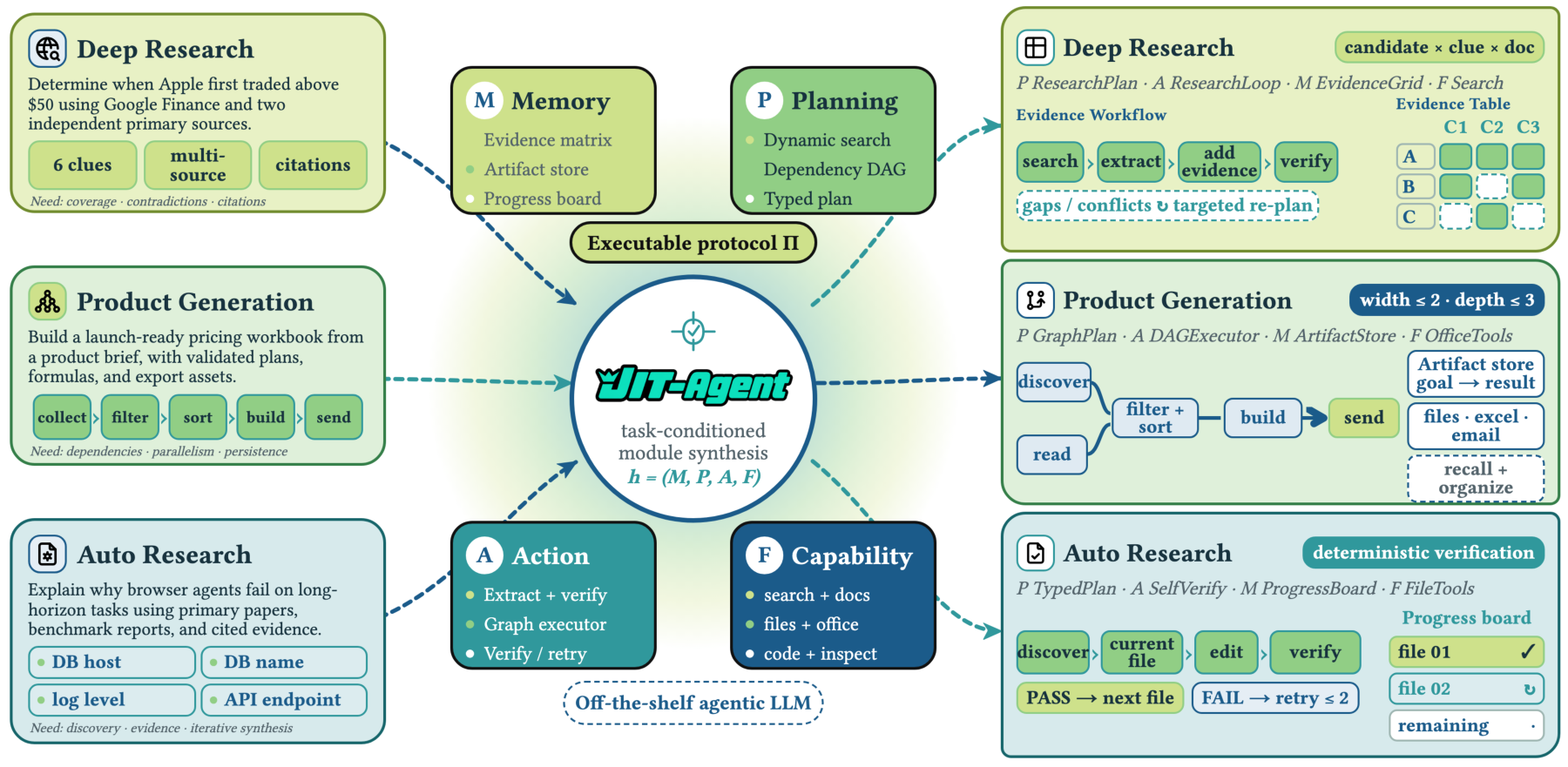
 JIT-Agent is a compact meta-agent that writes a task-specific agent harness on the fly instead of relying on one precompiled general-purpose scaffold, wrapping any off-the-shelf agentic LLM in what the authors call 'Model-as-a-Harness'.
JIT-Agent is a compact meta-agent that writes a task-specific agent harness on the fly instead of relying on one precompiled general-purpose scaffold, wrapping any off-the-shelf agentic LLM in what the authors call 'Model-as-a-Harness'.Is this a ready-made agent or something that builds agents for me?It is a meta-agent framework: given a task spec, protocol, and tool/skill registry, it composes an executable harness out of memory, planning, action, and capability modules, then that harness runs a separate execution LLM.
It is a meta-agent framework: given a task spec, protocol, and tool/skill registry, it composes an executable harness out of memory, planning, action, and capability modules, then that harness runs a separate execution LLM.How do I get it running?Clone the repo, set up a Python 3.11 environment (or run pip install -r requirements.txt in an existing one), then configure execution/judge/meta model credentials in .env before launching scripts.runseedharness or scripts.runjit.
Clone the repo, set up a Python 3.11 environment (or run pip install -r requirements.txt in an existing one), then configure execution/judge/meta model credentials in .env before launching scripts.runseedharness or scripts.runjit.Do I need to host my own meta model, or can I use a hosted API?Either works: point METAMODEL at a hosted OpenAI-compatible API, or serve the JIT-27B checkpoint yourself with vLLM/SGLang since the pipeline only talks HTTP to it; you also need separate keys for the execution and judge models, plus optional SERPERAPIKEY/JINAAPIKEY for web tools.
Either works: point METAMODEL at a hosted OpenAI-compatible API, or serve the JIT-27B checkpoint yourself with vLLM/SGLang since the pipeline only talks HTTP to it; you also need separate keys for the execution and judge models, plus optional SERPERAPIKEY/JINAAPIKEY for web tools.Can I run it without ever calling a meta model?Yes — scripts.runseedharness executes one of the eleven hand-written HarnessFactory designs directly, with no meta model call or candidate selection involved, making it the simplest entry point.
Yes — scripts.runseedharness executes one of the eleven hand-written HarnessFactory designs directly, with no meta model call or candidate selection involved, making it the simplest entry point.What is HarnessFactory?It is the shared interface plus a library of eleven hand-written harness designs that JIT-Agent instantiates, samples from as references, or runs directly in fixed-harness mode.
It is the shared interface plus a library of eleven hand-written harness designs that JIT-Agent instantiates, samples from as references, or runs directly in fixed-harness mode.What are the four modules every generated harness is built from?Memory, planning, action, and capability orchestration — every harness is factored into these shared interfaces so generation emits structured code rather than free-form agent programs.
Memory, planning, action, and capability orchestration — every harness is factored into these shared interfaces so generation emits structured code rather than free-form agent programs.Why generate a custom harness instead of using one fixed scaffold?A single general-purpose scaffold does not transfer well across different task structures, so JIT-Agent treats harness design itself as a trainable, transferable axis of agent intelligence, separate from scaling the base model.
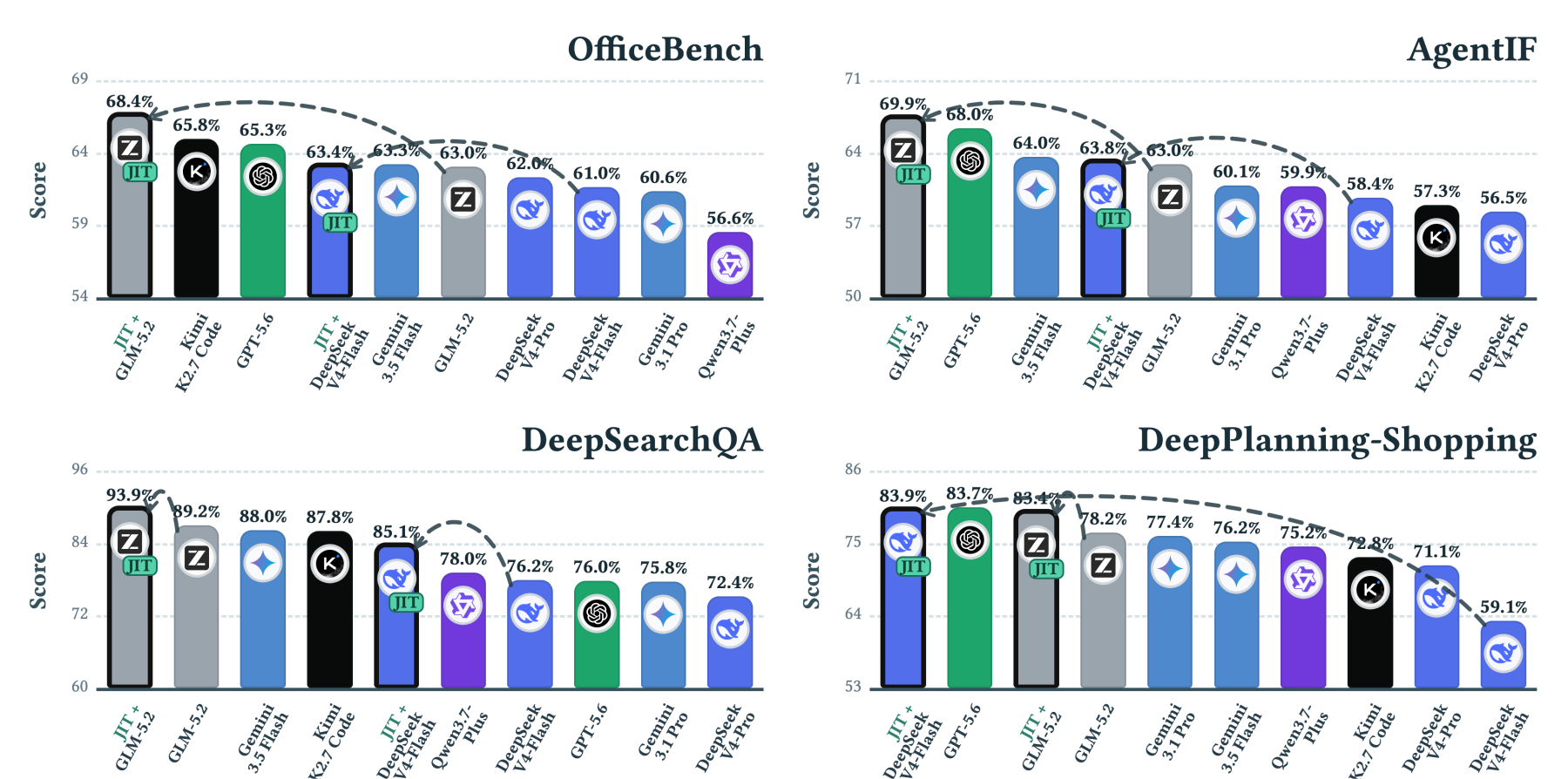
A single general-purpose scaffold does not transfer well across different task structures, so JIT-Agent treats harness design itself as a trainable, transferable axis of agent intelligence, separate from scaling the base model.Which benchmarks can I evaluate against?xbench, deepsearchqa, agentif, officebench, odyssey, shopping, and travel, each with its own adapter, config, and evaluator under the benchmark/ directory.
xbench, deepsearchqa, agentif, officebench, odyssey, shopping, and travel, each with its own adapter, config, and evaluator under the benchmark/ directory.What are similar projects?Agentlas-OS, Proteus, Agent-S, SystemOneHarness, Raven, hive, Recuris, ai-agents-the-definitive-guide
Agentlas-OS, Proteus, Agent-S, SystemOneHarness, Raven, hive, Recuris, ai-agents-the-definitive-guideWhich topics is it in?planning, evaluation-framework, harness-engineering, llm-agents, agent-framework, autonomous-agents, evaluation, agent-memory, memory, agent-orchestration, agentic-ai, benchmark
planning, evaluation-framework, harness-engineering, llm-agents, agent-framework, autonomous-agents, evaluation, agent-memory, memory, agent-orchestration, agentic-ai, benchmark