














What is this?
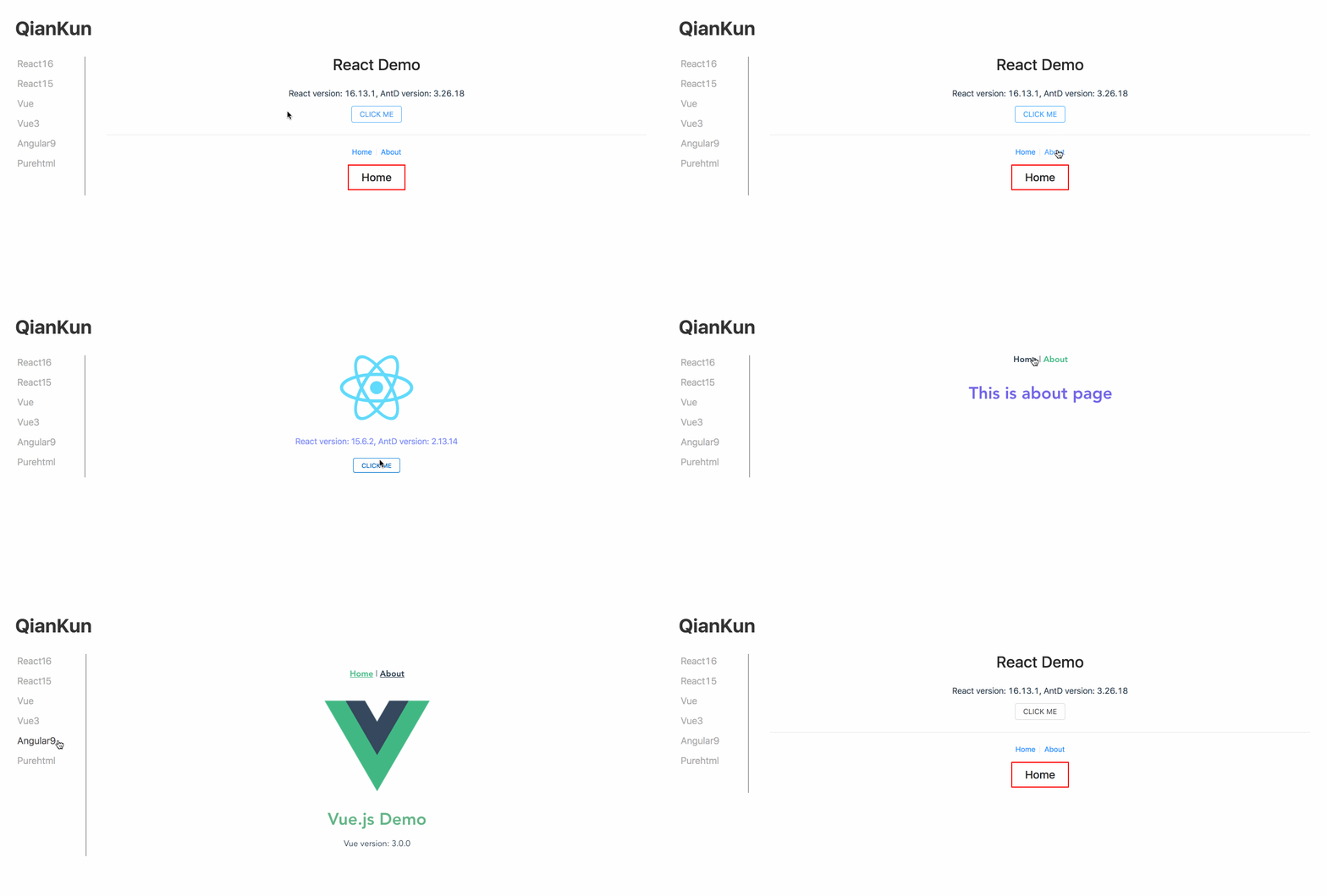
 Qiankun is a JavaScript framework for building micro-frontend applications, letting independently built and deployed apps (React, Vue, or anything else) run together inside one host page.
Qiankun is a JavaScript framework for building micro-frontend applications, letting independently built and deployed apps (React, Vue, or anything else) run together inside one host page.Is this a standalone app, or a framework I add to my own project?It is a framework/library you add to an existing host application; you load separately-built micro apps into a container element and keep a handle to control their lifecycle. It does not run on its own.
It is a framework/library you add to an existing host application; you load separately-built micro apps into a container element and keep a handle to control their lifecycle. It does not run on its own.How do I add qiankun to a project?Install the npm package (use the @rc tag for the in-development v3, or the plain tag for 2.x), then call loadMicroApp to mount a micro app, or use registerMicroApps plus start for route-driven orchestration. There is also an agent skill that can scaffold a correctly wired host or micro app for you.
Install the npm package (use the @rc tag for the in-development v3, or the plain tag for 2.x), then call loadMicroApp to mount a micro app, or use registerMicroApps plus start for route-driven orchestration. There is also an agent skill that can scaffold a correctly wired host or micro app for you.Does my micro app need a specific bundler?Qiankun ships bundler plugins for webpack 4/5 and Vite that mark the entry script and fix the output library format, which a micro app needs to be loadable; the micro app itself only has to export three lifecycle hooks (bootstrap, mount, unmount).
Qiankun ships bundler plugins for webpack 4/5 and Vite that mark the entry script and fix the output library format, which a micro app needs to be loadable; the micro app itself only has to export three lifecycle hooks (bootstrap, mount, unmount).Is qiankun 3.0 ready to use right now?No — v3 is under active development and only ships under the npm rc tag, while the latest tag still points to the older 2.x line (whose docs live separately on v2.qiankun.umijs.org).
No — v3 is under active development and only ships under the npm rc tag, while the latest tag still points to the older 2.x line (whose docs live separately on v2.qiankun.umijs.org).Can I use qiankun with frameworks besides React and Vue?The core loader and sandbox are framework-agnostic since a micro app just needs to export three lifecycle hooks; qiankun specifically ships ready-made UI binding components for React and Vue.
The core loader and sandbox are framework-agnostic since a micro app just needs to export three lifecycle hooks; qiankun specifically ships ready-made UI binding components for React and Vue.What is the JS sandbox actually isolating?Each micro app runs behind a Proxy-membrane view of window and document, so its globals, timers and listeners stay inside the app and are automatically cleaned up on unmount, instead of leaking into the host page or other micro apps.
Each micro app runs behind a Proxy-membrane view of window and document, so its globals, timers and listeners stay inside the app and are automatically cleaned up on unmount, instead of leaking into the host page or other micro apps.Why build qiankun instead of just using single-spa?Qiankun was born internally to solve problems single-spa left open — asset distribution, runtime sandboxing, style isolation and prefetching — and packages that extra tooling into an open-sourced solution built on top of single-spa.
Qiankun was born internally to solve problems single-spa left open — asset distribution, runtime sandboxing, style isolation and prefetching — and packages that extra tooling into an open-sourced solution built on top of single-spa.How does style isolation work without a Shadow DOM?Qiankun offers opt-in runtime CSS scoping built on the native CSS @scope at-rule, covering external stylesheets too, so you avoid rewriting your CSS or paying the performance cost of Shadow DOM.
Qiankun offers opt-in runtime CSS scoping built on the native CSS @scope at-rule, covering external stylesheets too, so you avoid rewriting your CSS or paying the performance cost of Shadow DOM.Can I use the sandbox without the rest of the micro-frontend framework?Yes — the @qiankunjs/sandbox package is published standalone and can contain any third-party script even without qiankun's broader orchestration layer.
Yes — the @qiankunjs/sandbox package is published standalone and can contain any third-party script even without qiankun's broader orchestration layer.What are similar projects?ice, angular-webpack-starter, bit, webpack, todomvc, single-spa, mitosis, rspack
ice, angular-webpack-starter, bit, webpack, todomvc, single-spa, mitosis, rspackWhich topics is it in?module-bundler, esm, webpack, web-framework, microservices, monorepo, sandbox, vite, vue, css, plugin, framework
module-bundler, esm, webpack, web-framework, microservices, monorepo, sandbox, vite, vue, css, plugin, framework