Hierarchical Reasoning Model
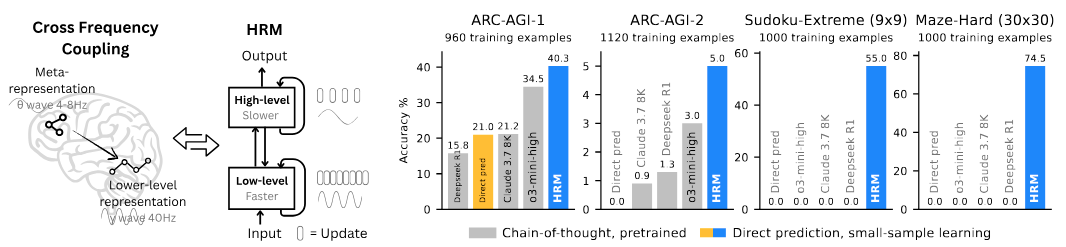
Reasoning, the process of devising and executing complex goal-oriented action sequences, remains a critical challenge in AI.
Current large language models (LLMs) primarily employ Chain-of-Thought (CoT) techniques, which suffer from brittle task decomposition, extensive data requirements, and high latency. Inspired by the hierarchical and multi-timescale processing in the human brain, we propose the Hierarchical Reasoning Model (HRM), a novel recurrent architecture that attains significant computational depth while maintaining both training stability and efficiency.
HRM executes sequential reasoning tasks in a single forward pass without explicit supervision of the intermediate process, through two interdependent recurrent modules: a high-level module responsible for slow, abstract planning, and a low-level module handling rapid, detailed computations. With only 27 million parameters, HRM achieves exceptional performance on complex reasoning tasks using only 1000 training samples. The model operates without pre-training or CoT data, yet achieves nearly perfect performance on challenging tasks including complex Sudoku puzzles and optimal path finding in large mazes.
Furthermore, HRM outperforms much larger models with significantly longer context windows on the Abstraction and Reasoning Corpus (ARC), a key benchmark for measuring artificial general intelligence capabilities.
These results underscore HRM’s potential as a transformative advancement toward universal computation and general-purpose reasoning systems.
Read Our Paper: https://arxiv.org/abs/2506.21734
Join Our Discord Community: https://discord.gg/sapient
Quick Start Guide 🚀
Prerequisites ⚙️
Ensure PyTorch and CUDA are installed. The repo needs CUDA extensions to be built. If not present, run the following commands:
# Install CUDA 12.6
CUDA_URL=https://developer.download.nvidia.com/compute/cuda/12.6.3/local_installers/cuda_12.6.3_560.35.05_linux.run

wget -q --show-progress --progress=bar:force:noscroll -O cuda_installer.run $CUDA_URL
sudo sh cuda_installer.run --silent --toolkit --override

export CUDA_HOME=/usr/local/cuda-12.6

# Install PyTorch with CUDA 12.6
PYTORCH_INDEX_URL=https://download.pytorch.org/whl/cu126

pip3 install torch torchvision torchaudio --index-url $PYTORCH_INDEX_URL

# Additional packages for building extensions
pip3 install packaging ninja wheel setuptools setuptools-scm
Then install FlashAttention. For Hopper GPUs, install FlashAttention 3
git clone [email protected]:Dao-AILab/flash-attention.git
cd flash-attention/hopper
python setup.py install
For Ampere or earlier GPUs, install FlashAttention 2
pip3 install flash-attn
Install Python Dependencies 🐍
pip install -r requirements.txt
W&B Integration 📈
This project uses Weights & Biases for experiment tracking and metric visualization. Ensure you're logged in:
wandb login
Run Experiments
Quick Demo: Sudoku Solver 💻🗲
Train a master-level Sudoku AI capable of solving extremely difficult puzzles on a modern laptop GPU. 🧩
# Download and build Sudoku dataset
python dataset/build_sudoku_dataset.py --output-dir data/sudoku-extreme-1k-aug-1000  --subsample-size 1000 --num-aug 1000

# Start training (single GPU, smaller batch size)
OMP_NUM_THREADS=8 python pretrain.py data_path=data/sudoku-extreme-1k-aug-1000 epochs=20000 eval_interval=2000 global_batch_size=384 lr=7e-5 puzzle_emb_lr=7e-5 weight_decay=1.0 puzzle_emb_weight_decay=1.0
Runtime: ~10 hours on a RTX 4070 laptop GPU
Trained Checkpoints 🚧
To use the checkpoints, see Evaluation section below.
Full-scale Experiments 🔵
Experiments below assume an 8-GPU setup.
Dataset Preparation
# Initialize submodules
git submodule update --init --recursive

# ARC-1
python dataset/build_arc_dataset.py  # ARC offical + ConceptARC, 960 examples
# ARC-2
python dataset/build_arc_dataset.py --dataset-dirs dataset/raw-data/ARC-AGI-2/data --output-dir data/arc-2-aug-1000  # ARC-2 official, 1120 examples

# Sudoku-Extreme
python dataset/build_sudoku_dataset.py  # Full version
python dataset/build_sudoku_dataset.py --output-dir data/sudoku-extreme-1k-aug-1000  --subsample-size 1000 --num-aug 1000  # 1000 examples

# Maze
python dataset/build_maze_dataset.py  # 1000 examples
Dataset Visualization
Explore the puzzles visually:
- Open
puzzle_visualizer.html in your browser.
- Upload the generated dataset folder located in
data/....
Launch experiments
Small-sample (1K)
ARC-1:
OMP_NUM_THREADS=8 torchrun --nproc-per-node 8 pretrain.py
Runtime: ~24 hours
ARC-2:
OMP_NUM_THREADS=8 torchrun --nproc-per-node 8 pretrain.py data_path=data/arc-2-aug-1000
Runtime: ~24 hours (checkpoint after 8 hours is often sufficient)
Sudoku Extreme (1k):
OMP_NUM_THREADS=8 torchrun --nproc-per-node 8 pretrain.py data_path=data/sudoku-extreme-1k-aug-1000 epochs=20000 eval_interval=2000 lr=1e-4 puzzle_emb_lr=1e-4 weight_decay=1.0 puzzle_emb_weight_decay=1.0
Runtime: ~10 minutes
Maze 30x30 Hard (1k):
OMP_NUM_THREADS=8 torchrun --nproc-per-node 8 pretrain.py data_path=data/maze-30x30-hard-1k epochs=20000 eval_interval=2000 lr=1e-4 puzzle_emb_lr=1e-4 weight_decay=1.0 puzzle_emb_weight_decay=1.0
Runtime: ~1 hour
Full Sudoku-Hard
OMP_NUM_THREADS=8 torchrun --nproc-per-node 8 pretrain.py data_path=data/sudoku-hard-full epochs=100 eval_interval=10 lr_min_ratio=0.1 global_batch_size=2304 lr=3e-4 puzzle_emb_lr=3e-4 weight_decay=0.1 puzzle_emb_weight_decay=0.1 arch.loss.loss_type=softmax_cross_entropy arch.L_cycles=8 arch.halt_max_steps=8 arch.pos_encodings=learned
Runtime: ~2 hours
Evaluation
Evaluate your trained models:
- Check
eval/exact_accuracy in W&B.
- For ARC-AGI, follow these additional steps:
OMP_NUM_THREADS=8 torchrun --nproc-per-node 8 evaluate.py checkpoint=<CHECKPOINT_PATH>
- Then use the provided
arc_eval.ipynb notebook to finalize and inspect your results.
Notes
- Small-sample learning typically exhibits accuracy variance of around ±2 points.
- For Sudoku-Extreme (1,000-example dataset), late-stage overfitting may cause numerical instability during training and Q-learning. It is advisable to use early stopping once the training accuracy approaches 100%.
Citation 📜
@misc{wang2025hierarchicalreasoningmodel,
      title={Hierarchical Reasoning Model},
      author={Guan Wang and Jin Li and Yuhao Sun and Xing Chen and Changling Liu and Yue Wu and Meng Lu and Sen Song and Yasin Abbasi Yadkori},
      year={2025},
      eprint={2506.21734},
      archivePrefix={arXiv},
      primaryClass={cs.AI},
      url={https://arxiv.org/abs/2506.21734},
}

 分层推理模型(HRM)的官方发布版本:一种受大脑启发的循环神经网络架构,仅用 2700 万参数就能达到很深的计算层次,只用约 1000 个样本训练,不需要预训练,也不需要思维链数据。