Noise: Speedrun for pretraining without backpropagation
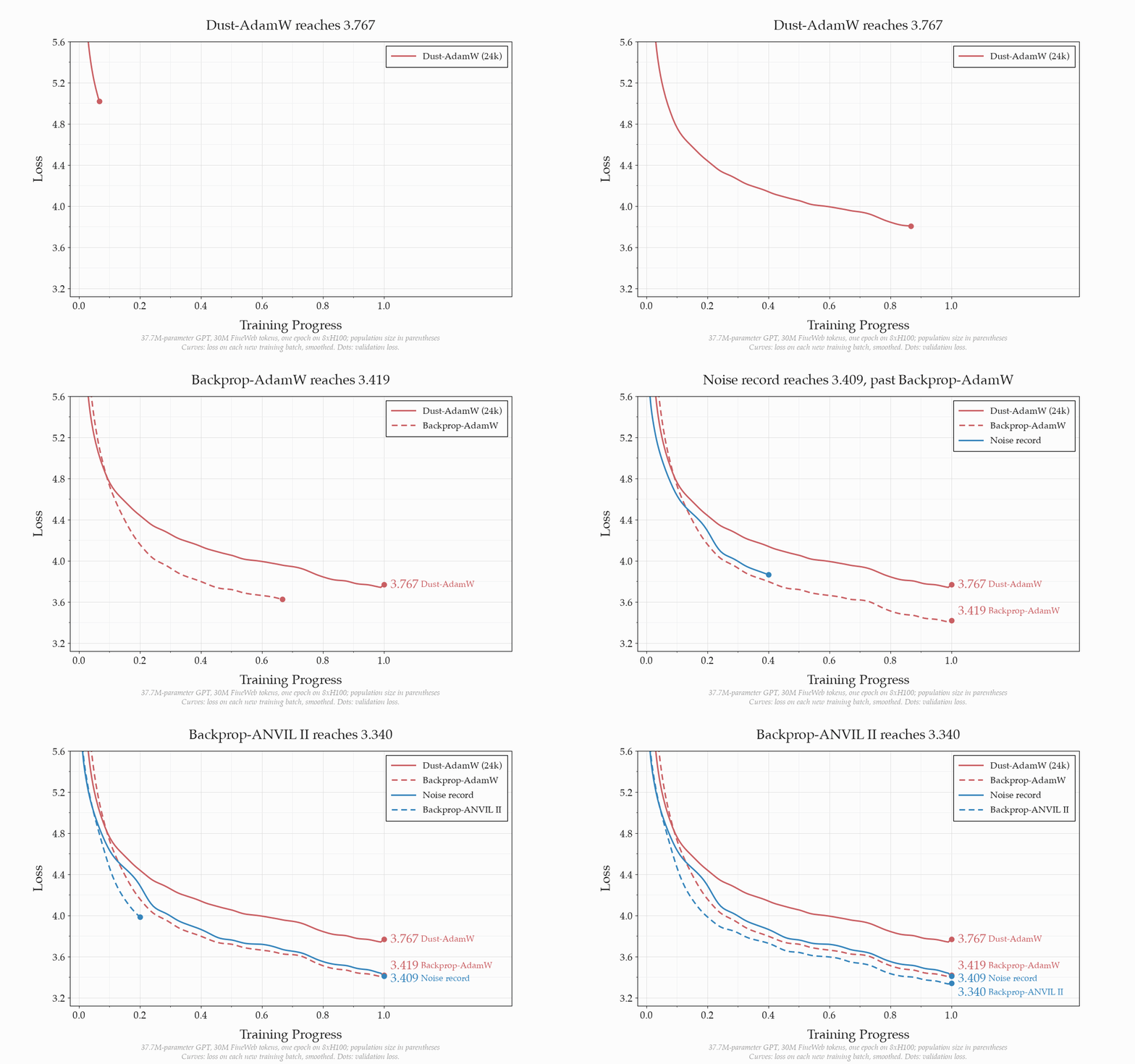
Noise is a pretraining speedrun for learning algorithms that never run a backward pass. We think replacing
backprop with a much better credit assignment algorithm is inevitable. Deep learning's architectures,
optimizers and hardware have co-evolved with backprop, but as compute grows, the
bitter lesson suggests that more general,
brute-force learning algorithms based on search will win. Dust is a big step
forward: it rivals backprop under SGD and is 1,000 to 10,000x more efficient than EGGROLL, the state-of-the-art
weight-space ES, but still trails backprop under Adam. These methods have also had a small fraction of the
research that went into backprop. We made Noise to close the gap: better estimators, and optimizers co-designed
for them instead of for backprop gradients.
The model, the data and the score are fixed: the 37.7M-parameter transformer of Dust, a 30M-token FineWeb
training set, and the cross-entropy on Dust's validation set. What changes is the learning algorithm, which may
only run the model forward; track 3 also frees the architecture. Until October 22, 2026, the training set was
Dust's 10M tokens; those tracks and records are archived in archive/10M/.
Tracks
The 10M-token tracks are archived in archive/10M/ and no longer accept submissions.
- Validation loss. The lowest validation loss after one epoch on one 8xH100 node, with no time limit.
- Speedrun. The shortest training time on one 8xH100 node to reach validation loss 3.5.
- Open architecture. Track 1 with the architecture free: the model is
train/arch/model.py, which entries may change.
Rules
- No backpropagation. No autograd (reverse or forward mode) and no hand-written backward pass. Learning
signal comes from evaluating the model forward: every error signal is measured against a loss by running the
model forward, and may then take at most one step through a nonlinear part of the model. Steps through
linear maps don't count, and a signal that has taken a step can't take another, so credit can't be chained
back through the network block by block. Entries are judged by the spirit of this rule: a method should
still apply to networks with non-differentiable parts.
- Fixed model (tracks 1 and 2). Final weights must load into
utils/model.py with a
strict state-dict match. How training computes the same function, and how it initializes it, is free. On
track 3 the model is train/arch/model.py instead, a copy of utils/model.py that
entries change in place; it must keep the interface utils/eval.py uses (GPT(GPTConfig()), init_weights()
and the summed loss from forward).
- Fixed data. Train only on
data/train.pt (30M tokens: 14,648 sequences of 2,048 predictions), for at most one
epoch: each training sequence feeds at most one update. Batch size and order are free.
- Score.
utils/eval.py on the final weights (on track 3 with --model train/arch/model.py): mean next-token cross-entropy over the 1,114,112 predictions of data/val.pt. No
checkpoint selection on validation loss.
- Timing (speedrun track; reported on the other). From the start of the first update to the end of the
last, excluding any validation. An untimed warmup on random tokens may compile kernels, as long as training
then starts from a fresh state (the baselines rebuild everything from the seed). Runs use seed 0.
Setup
Requires Linux, an NVIDIA GPU with bfloat16 support and uv.
uv sync
uv run utils/prepare_data.py
utils/prepare_data.py streams FineWeb sample-10BT, tokenizes it with the fixed BPE-4096 tokenizer in
tokenizer/, and writes data/train.pt and data/val.pt. val.pt is the
Dust repo's; train.pt is Dust's ~20.5M-token training pool followed by the
documents after its validation and test documents, so its first 4,880 sequences are Dust's train_10M.pt. Both
are checked against pinned hashes.
Running the records
uv run torchrun --standalone --nproc_per_node=8 train/val/run.py         # track 1
uv run torchrun --standalone --nproc_per_node=8 train/speedrun/run.py    # track 2
uv run torchrun --standalone --nproc_per_node=8 train/arch/run.py        # track 3
uv run torchrun --standalone --nproc_per_node=8 train/val/dust.py        # Dust w/ Adam
Each run writes config.json, metrics.jsonl, final.pt and result.json (validation loss and training time)
to logs/. uv run utils/eval.py logs/val/final.pt rescores a checkpoint.
Records
Track 1: validation loss (30M)
| # |
Val loss |
Description |
Time |
Script |
Contributors |
| 1 |
3.767 |
Dust w/ Adam, 24k population, lr cooldown |
5 h 17 min |
Script |
- |
| 2 |
3.409 |
10M record #14: Boost → Cut with own queries, exact values, future-token probes and an end merge |
1 h 43 min |
Script |
@JaydenTeoh, @spicylemonade, @hoo0681, @Lazarus-931, @CharlesDDDD, @NotDesigned |
| 3 |
3.338 |
A forward readout of cross-token credit along each token's path; a fixed Boost, lower ANVIL II weight decay |
56 min |
Script |
@CharlesDDDD |
| 4 |
3.300 |
#3 with two-hop credit through next-token twins and a transit decode; head transplants, self-distillation, a planted previous-token head, a linear decay |
43 min |
Script |
@CharlesDDDD |
Track 2: speedrun to 3.5 (30M)
| # |
Val loss |
Description |
Time |
Script |
Contributors |
| 1 |
3.409 |
10M record #14: Boost → Cut with own queries, exact values, future-token probes and an end merge |
1 h 43 min |
Script |
@JaydenTeoh, @spicylemonade, @hoo0681, @Lazarus-931, @CharlesDDDD, @NotDesigned |
| 2 |
3.499 |
The identity path first, then Cut-lite at 8 rows per update with faster chain reruns |
8 min 20 s |
Script |
@RobertTLange |
| 3 |
3.494 |
A shorter identity phase, then Cut with paired MLP roots and a difficulty-balanced row order |
2 min 3 s |
Script |
@conglu1997 |
| 4 |
3.498 |
#3's identity phase, then Cut with two single roots, fused Gluon chain kernels and overlapped bf16 collectives |
22.9 s |
Script |
@RobertTLange |
| 5 |
3.496 |
#4 with root 4 on importance-drawn tokens (root 6 as its control), root 6 along its routed span, 16 rows per update in the second half, overhead in CUDA graphs, a fixed end merge, word-mix row pruning, warp-specialized attention kernels |
15.9 s |
Script |
@CharlesDDDD |
| 6 |
3.497 |
#4 with 16-row Cut updates from 10% of Cut, root 4 on every 2nd update early, per-head q/k polar, an in-run per-part end merge on held-out rows, tensor-core and Gluon credit kernels |
14.2 s |
Script |
@RobertTLange |
Track 3: open architecture (30M)
New track where any architecture is allowed!
| # |
Val loss |
Description |
Time |
Script |
Contributors |
| 1 |
3.767 |
Dust w/ Adam, 24k population, lr cooldown |
5 h 17 min |
Script |
- |
| 2 |
3.409 |
10M record #14: Boost → Cut with own queries, exact values, future-token probes and an end merge |
1 h 43 min |
Script |
@JaydenTeoh, @spicylemonade, @hoo0681, @Lazarus-931, @CharlesDDDD, @NotDesigned |
| 3 |
3.378 |
A quarter-turn previous-token tap in the embedding; exact future-token probes |
3 h 50 min |
Script |
@dylantirandaz |
| 4 |
3.358 |
6 blocks with hashed n-gram tables; future and input-key probes by moments |
27 min |
Script |
@Euraba |
| 5 |
3.211 |
12 × 1024 GPT with hashed n-gram value embeddings; Cut-lite with input-key probes |
2 h 57 min |
Script |
@RobertTLange |
What backprop gets
The same model, data and epoch trained with backprop, scored the same way (seed 0, a few learning rates each):
| Optimizer |
Val loss |
| Adam w/ lr cooldown |
3.419 |
| ANVIL II on the block matrices and Adam elsewhere |
3.340 |
The goal is to beat backprop by a large margin.
Submitting
Open a PR that changes its track's training script in place, train/val/run.py,
train/speedrun/run.py or train/arch/run.py (with
train/arch/model.py on track 3), with the run's log (config.json, metrics.jsonl and result.json from logs/) in the log/ folder next to it. A record must beat the current one
in its track under the rules above; the training script is the record.
Citation
@misc{noise_2026,
  title  = {Noise: Speedrun for pretraining without backpropagation},
  author = {G{\"u}lbahar, Serdar and Mandal, Bishwas and Vegesna, Akshay and Dahal, Samip},
  year   = {2026},
  url    = {https://github.com/qlabs-eng/noise}
}
Core contributors: Serdar Gülbahar and Bishwas Mandal.
License
Released under the MIT License.

 Noise 是一个基准测试与速通挑战,用于在完全不运行反向传播的情况下预训练 Transformer,检验其他信用分配算法能否匹敌或超越反向传播。