230 ·GitHub
A training framework that elicits proactive reflection in tool-using LLM agents: noticing noisy tool feedback and user corrections, and recovering from them.
The project's README from github.com/RUC-NLPIR/Agent-Reflex. As one markdown file: README.md.
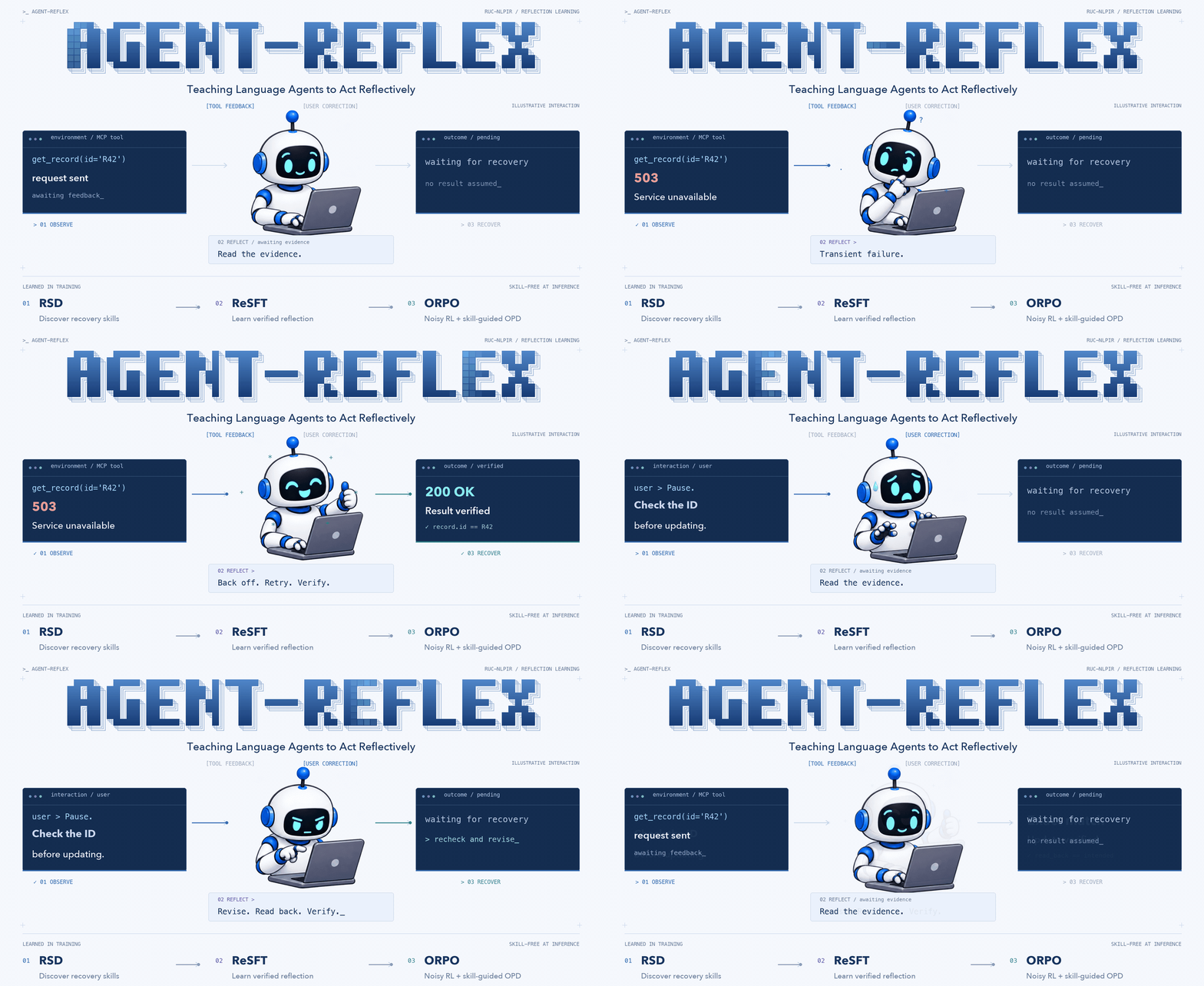
 Agent-Reflex: Teaching Language Agents to Act Reflectively







A training framework that elicits proactive reflection in tool-using LLM agents: noticing noisy tool feedback and user corrections, and recovering from them.
Demo · Overview · Framework · Results · Installation · Data · Quick Start · Citation
https://github.com/user-attachments/assets/281af1d3-843e-4496-b232-58fee951cefd
🎥 Download the 1080p video (60 seconds) · 💻 original task interactive replay (open locally in a browser)
Agents are trained in idealized environments but deployed into noisy ones. Two gaps follow:
Figure 1 (a, b) · The two gaps. Idealized interaction (a) vs. real-world interaction with user corrections and noisy feedback (b).
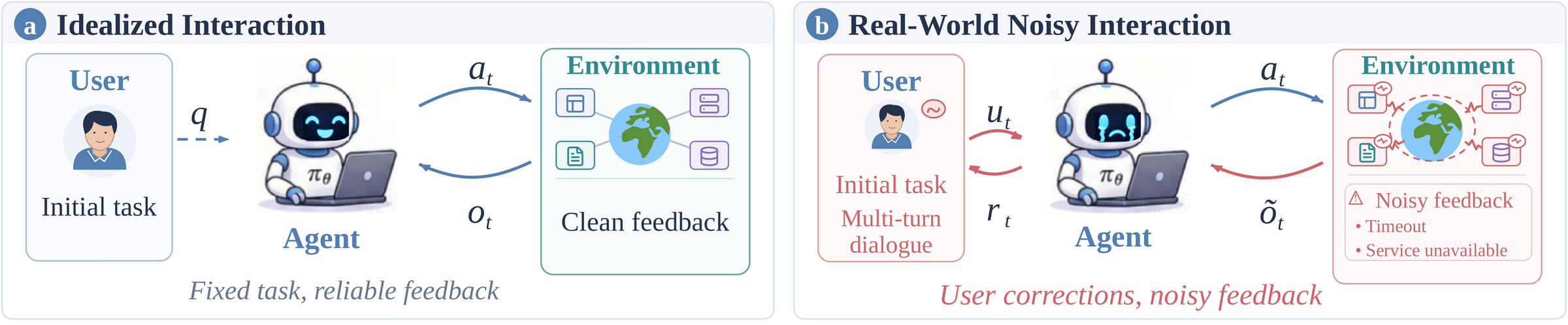
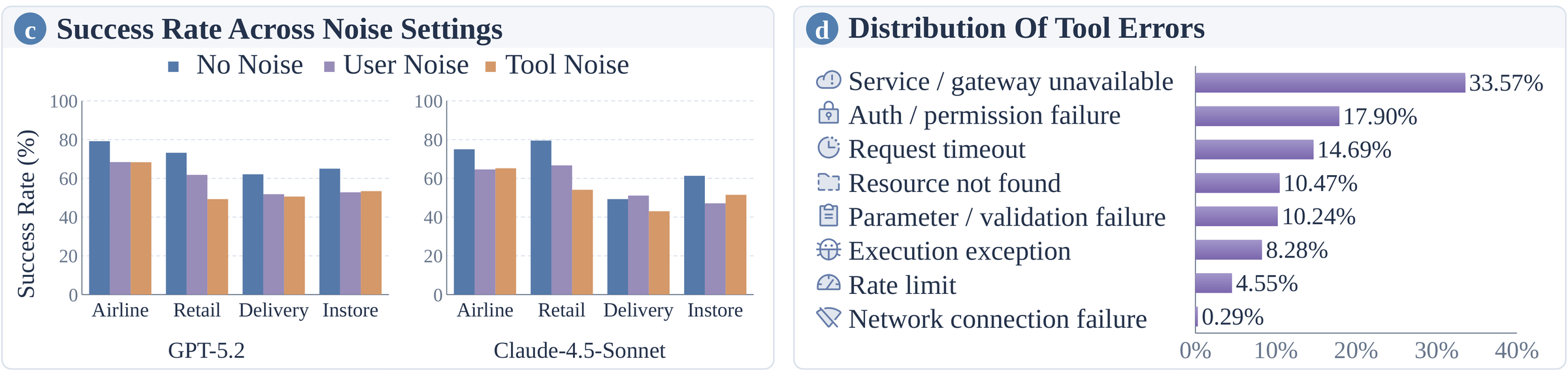
Figure 1 (c, d) · The cost of noise. Strong agents lose success rate under user or tool noise (c); tool errors fall into eight recurring families (d).
Agent-Reflex treats reflection as a learnable meta-skill: it mines skills from failures in noisy environments, distills them into supervised data and reinforces them with noisy agentic RL. On Qwen3-8B it improves six agent benchmarks and stays robust under noise.
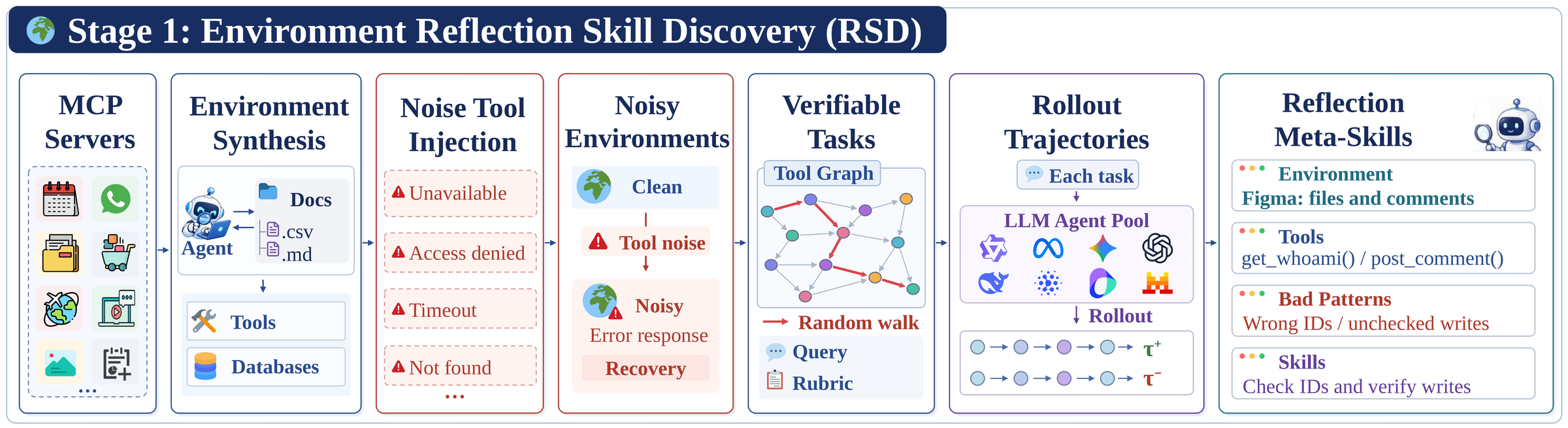
Build failure-aware executable environments by perturbing tool returns with real-world failure families, and mine verifier-matched success / failure pairs into an offline library of 1,170 reflection meta-skills over 557 environments. Environment synthesis and the environment infrastructure follow Agent-World.
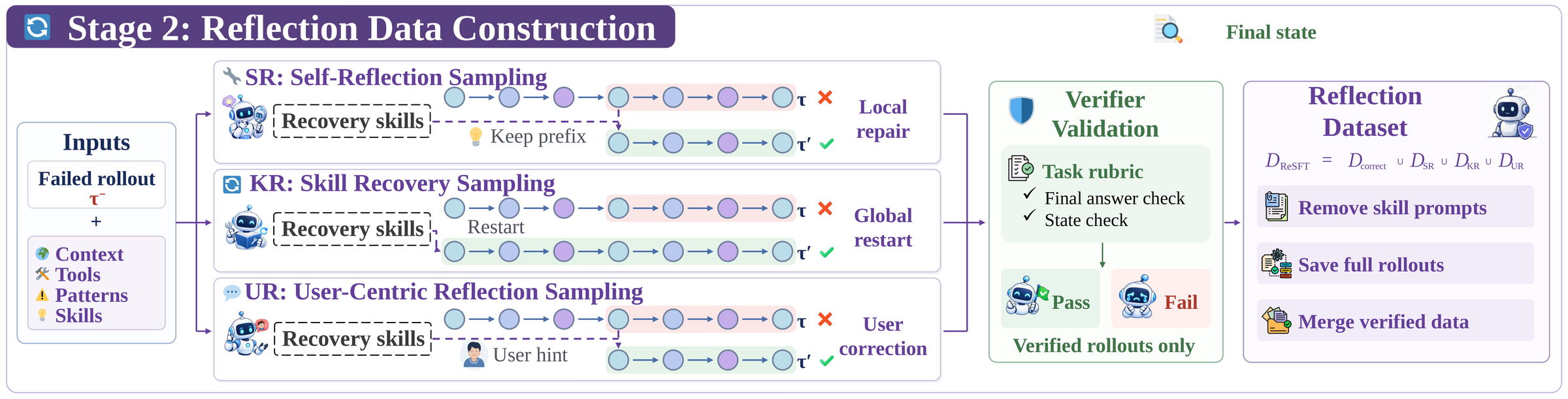
Convert each skill into verifier-validated self-reflection (SR), skill recovery (KR) and user-correction (UR) data, with skill prompts stripped, and internalize them by supervised fine-tuning.
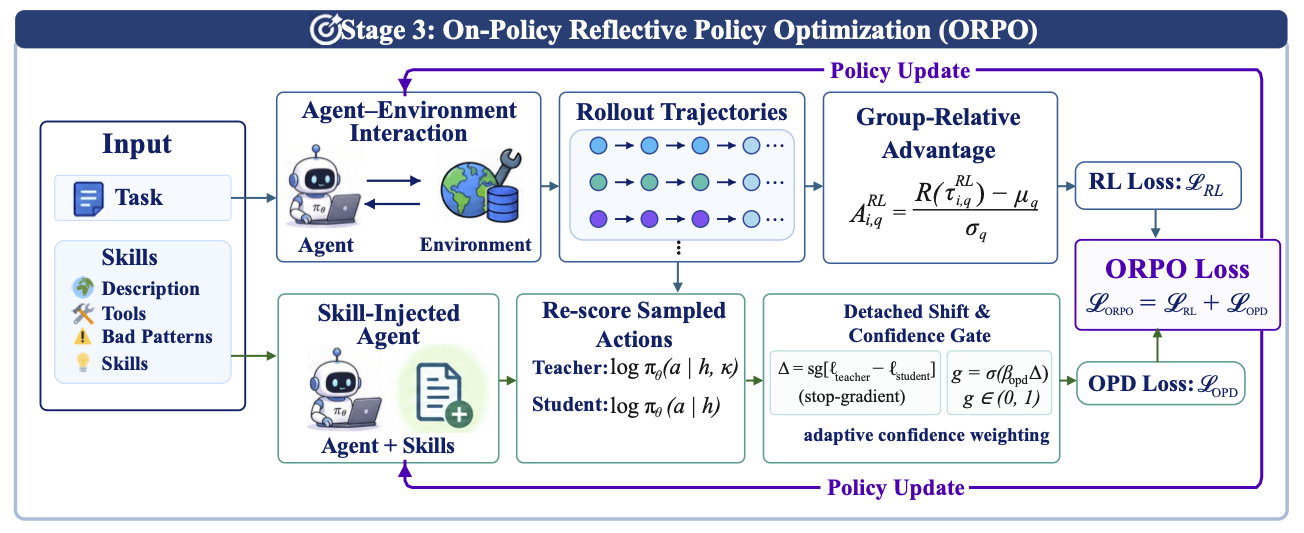
Combine Noisy Agent RL with same-token, skill-guided on-policy distillation (OPD) to provide dense reflection supervision. Skills are used only in training; the deployed agent is skill-free.
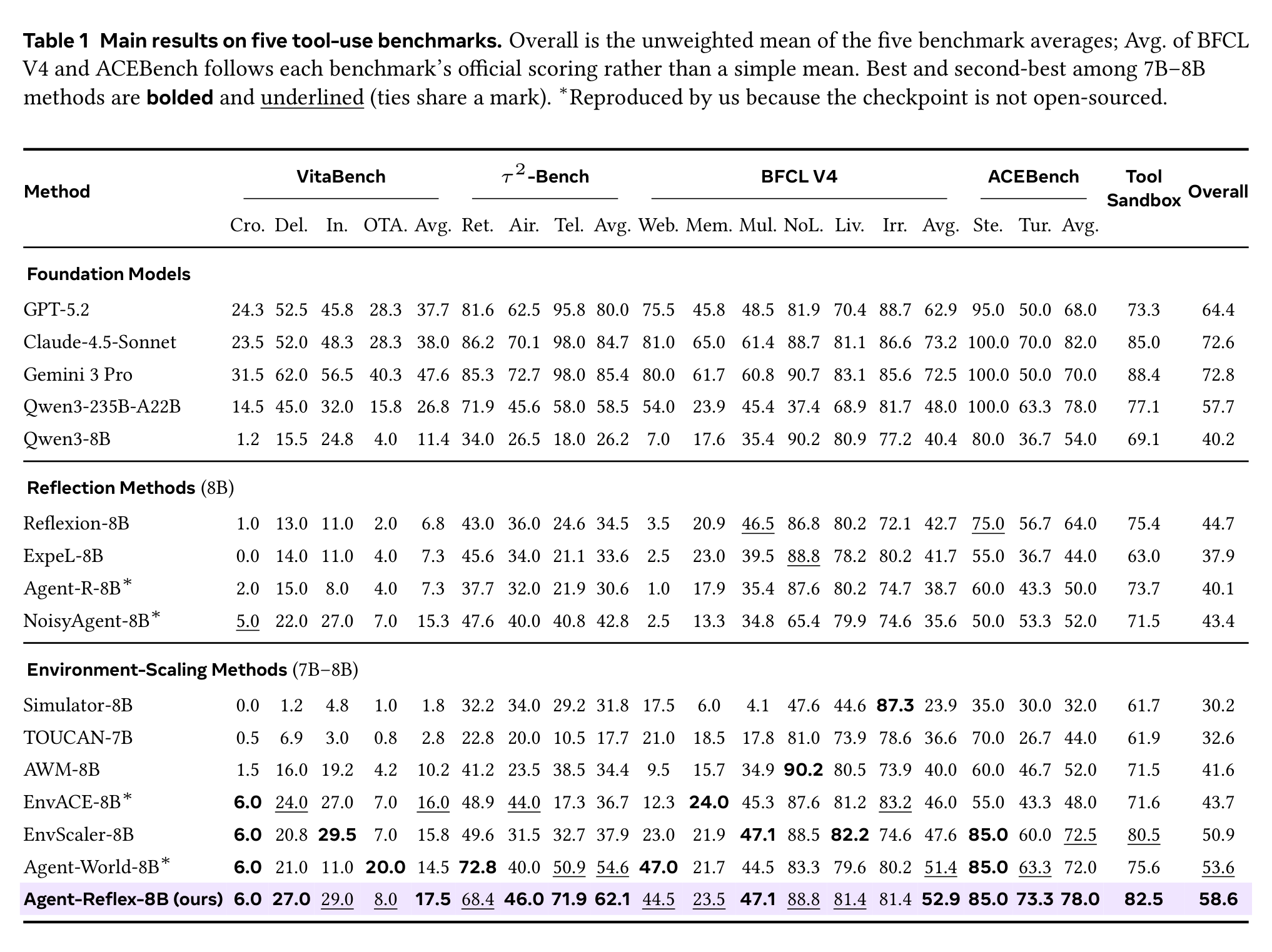
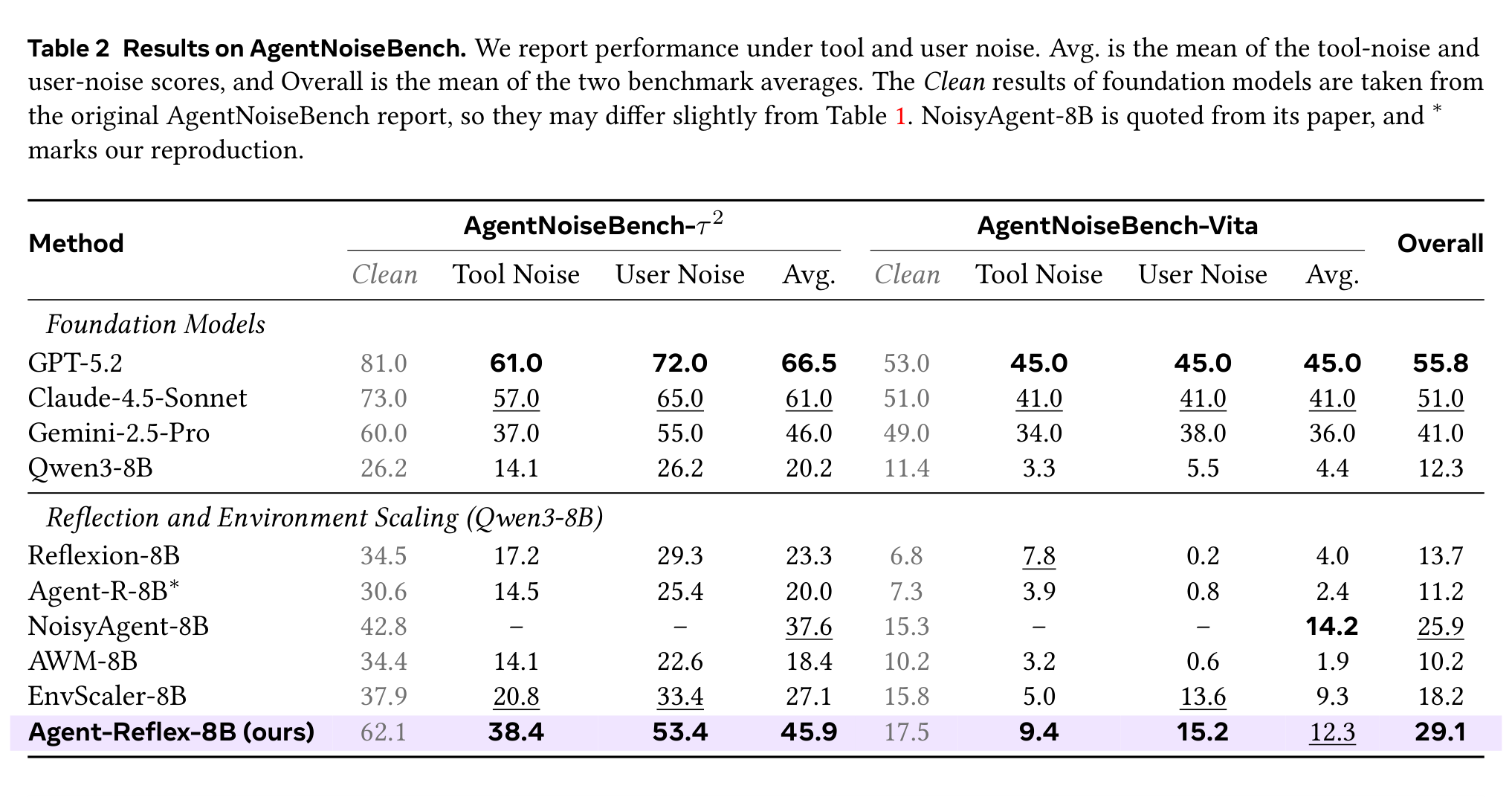
We evaluate on six agent benchmarks under each benchmark's official metric:
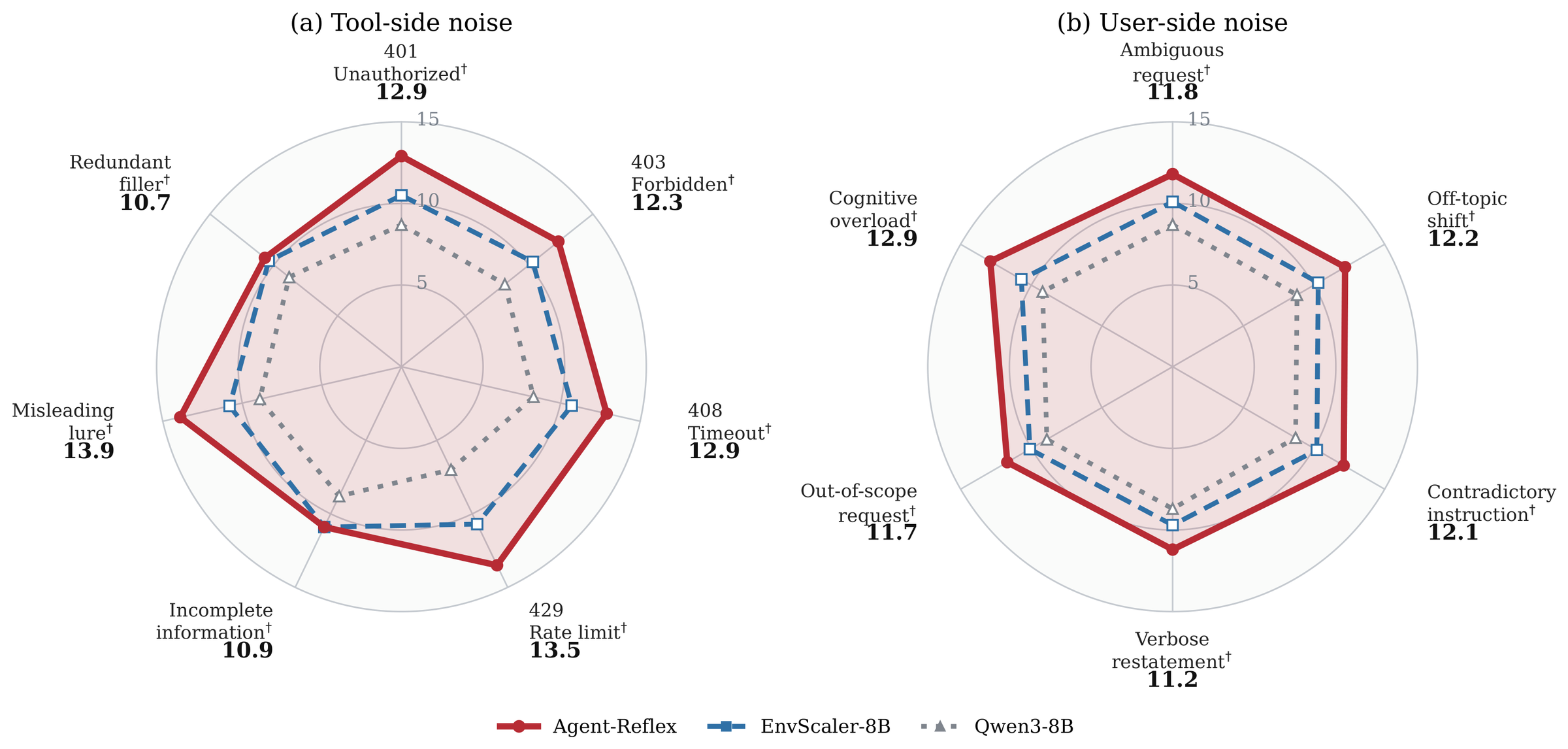
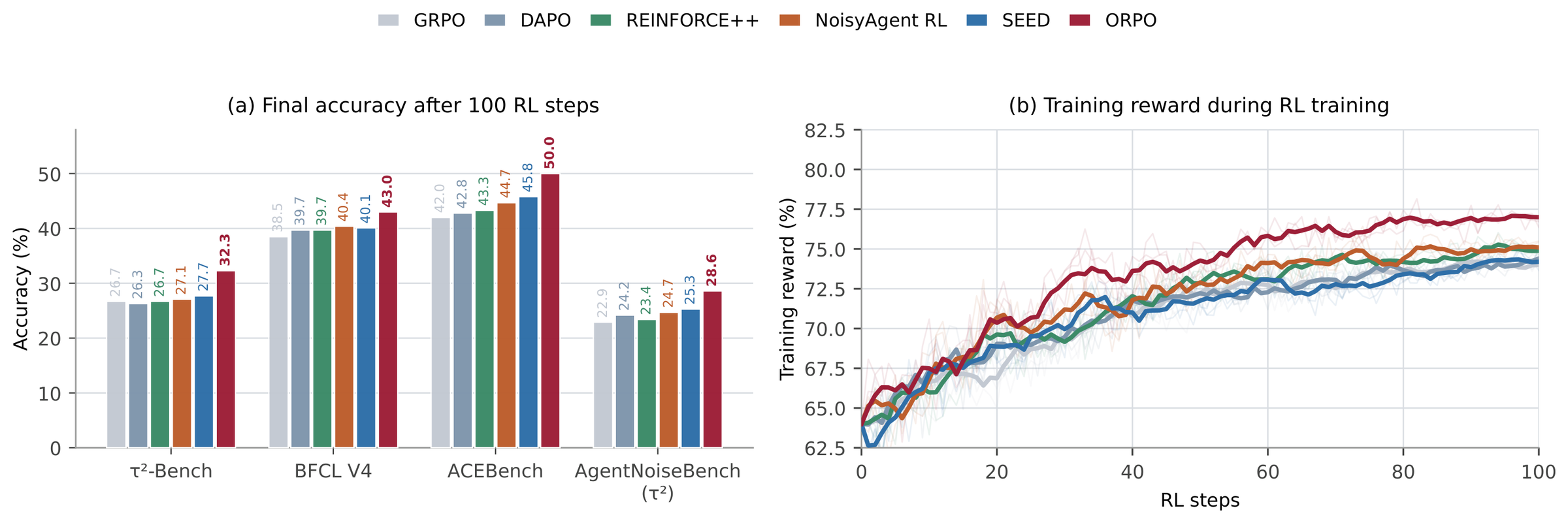
On Qwen3-8B, Agent-Reflex reaches 58.6 Overall on the five long-horizon tool-use benchmarks (+18.4 over the backbone, +7.7 over EnvScaler-8B) and 29.1 on AgentNoiseBench, the best among all 8B methods:
| Method | VitaBench | τ²-Bench | BFCL V4 | ACEBench | ToolSandbox | Overall | AgentNoiseBench |
|---|---|---|---|---|---|---|---|
| Qwen3-8B | 11.4 | 26.2 | 40.4 | 54.0 | 69.1 | 40.2 | 12.3 |
| Reflexion | 6.8 | 34.5 | 42.7 | 64.0 | 75.4 | 44.7 | 13.7 |
| EnvScaler-8B | 15.8 | 37.9 | 47.6 | 72.5 | 80.5 | 50.9 | 18.2 |
| Agent-World-8B | 14.5 | 54.6 | 51.4 | 72.0 | 75.6 | 53.6 | – |
| Agent-Reflex | 17.5 | 62.1 | 52.9 | 78.0 | 82.5 | 58.6 | 29.1 |
Each part has its own environment, built by one script with uv (pip install uv) from a pinned requirements.txt:
| Part | Python | Core packages | Setup |
|---|---|---|---|
| ReSFT | 3.12 | torch 2.6.0 (cu124), transformers 5.8, DeepSpeed 0.19, flash-attn 2.7.4, Liger 0.8 | bash LLaMA-Factory/setup_env.sh |
| ORPO | 3.10 | torch 2.7.1 (cu128), verl 0.5, SGLang 0.4.10.post2, transformers 4.54.1, Ray 2.57, flash-attn 2.8.3 | bash ORPO/setup_env.sh |
| Model serving | 3.12 | vLLM 0.27.1 | bash evaluation/shared/setup_vllm.sh |
| Benchmarks | 3.10 / 3.12 | one venv per benchmark; upstream code cloned at pinned commits | bash evaluation/<Bench>/setup.sh |
HTTP_PROXY / HTTPS_PROXY first.Training needs no API keys. Evaluation reads them from evaluation/.env (git-ignored):
cp evaluation/.env.example evaluation/.env
# then edit evaluation/.env:
BOYUE_API_KEY=sk-xxxxxxxx
BOYUE_API_BASE_URL=http://35.220.164.252:3888/v1   # outside CN/HK: https://api.boyuerichdata.opensphereai.com/v1
SERPER_API_KEY=xxxxxxxx
BOYUE_API_KEY: the user simulator (gpt-4.1) and judge (claude-sonnet-4-6) for every benchmark except BFCL. Register at Boyue API (docs), open the API令牌 (API tokens) page and create a token in the auto group; the key starts with sk-.[!NOTE] By default our evaluation calls these models through Boyue, a third-party OpenAI-compatible API service. Any OpenAI-compatible endpoint works: to use the official OpenAI / Anthropic APIs or your own gateway, point the base URL and key in
evaluation/.env(and the client setup in each benchmark'srun.sh/ config) to your provider. A coding agent can make this change in a few minutes.
SERPER_API_KEY: BFCL V4 web search only, from serper.dev.Agent-Reflex/
├── RSD/ 🪞 Stage 1 · the reflection meta-skill library (1,170 skills)
├── LLaMA-Factory/ 📘 Stage 2 · ReSFT recipe and launch scripts
├── ORPO/ 🎯 Stage 3 · verl-based ORPO: noisy rollouts + skill-guided OPD
├── evaluation/ 📊 τ²-Bench, BFCL V4, ACEBench, VitaBench, AgentNoiseBench, ToolSandbox
└── assets/ 🖼️ figures used in this README; demo/ holds the demo video and replay page
| Folder | What you get | Start here |
|---|---|---|
RSD/ |
557 MCP-anchored environments with tools, bad patterns and 1,170 reflection meta-skills, in English and Chinese | README |
LLaMA-Factory/ |
ReSFT on Qwen3-8B: full fine-tuning, ZeRO-3, 3 epochs, 5,127 steps | README · reproduce |
ORPO/ |
ORPO from the ReSFT checkpoint on 1 × 8 GPUs | README · reproduce |
evaluation/ |
one folder per benchmark, official settings, vLLM serving | README · reproduce |
| Resource | Size | Download | Put it at |
|---|---|---|---|
| Agent-Reflex-8B (Qwen3-8B, ReSFT + ORPO) | 16 GB | 🤗 HuggingFace | any path, pass as MODEL_PATH |
| ReSFT data, 54,663 trajectories | 2.6 GB | 🤗 HuggingFace | LLaMA-Factory/data/agent_reflex_resft/train/ |
| ORPO tasks, 2,550 with skills | 152 MB | 🤗 HuggingFace | ORPO/data/ |
| RSD skill library, 1,170 skills (English / Chinese) | 22 MB | this repo | RSD/environment_skills.jsonl · RSD/environment_skills_zh.jsonl |
| Evaluation data | 115 MB | this repo | evaluation/<Bench>/data/ |
pip install -U huggingface_hub
hf download dongguanting/Agent-Reflex-SFT-54K --repo-type dataset --include "train/*" \
  --local-dir LLaMA-Factory/data/agent_reflex_resft
hf download dongguanting/Agent-Reflex-RL-2K train_envscaler_2550_with_skills.jsonl \
  --repo-type dataset --local-dir ORPO/data
hf download dongguanting/Agent-Reflex-8B --local-dir /path/to/Agent-Reflex-8B
cd LLaMA-Factory
NNODES=2 NODE_RANK=<0|1> MASTER_ADDR=<node0> MODEL_PATH=/path/to/Qwen3-8B \
  bash scripts/run_resft_qwen3_8b.sh
Start from the ReSFT model checkpoint:
cd ORPO
python scripts/prepare_init_checkpoint.py /path/to/resft_checkpoint --apply
MODEL_PATH=/path/to/resft_checkpoint bash scripts/run_orpo_qwen3_8b.sh
Full task sets under the official settings (fill in evaluation/.env first):
cd evaluation
MODEL_PATH=/path/to/Agent-Reflex-8B RUN_NAME=agent-reflex bash run_all.sh
run_all.sh serves the model with vLLM and runs all six benchmarks; set BENCHES="Tau2 BFCL-v4" to run a subset. Per-benchmark details are in evaluation/README.md.
Agent-Reflex builds on verl, LLaMA-Factory, EnvScaler, Agent-World, tau2-bench, BFCL, VitaBench, ToolSandbox and AgentNoiseBench. Thanks to their authors.
Agent-Reflex code and the RSD skill library are released under the MIT License. Vendored components keep their own licenses:
| Component | License |
|---|---|
ORPO/ (verl), LLaMA-Factory/ |
Apache-2.0 |
evaluation/BFCL-v4/ (BFCL data, from gorilla) |
Apache-2.0 |
evaluation/Tau2/data/, evaluation/AgentNoiseBench/repo/tau2-bench-main/ (tau2-bench) |
MIT |
evaluation/VitaBench/data/, evaluation/AgentNoiseBench/repo/vitabench/ (VitaBench) |
MIT |
evaluation/ACEBench/interact_with_env/ (EnvScaler, tau-bench) |
MIT |
ToolSandbox is cloned from apple/ToolSandbox at setup time and is not redistributed here. The AgentNoiseBench noise injection and data follow AgentNoiseBench; please refer to its authors for terms of use.
@misc{dong2026agentreflex,
  title={Agent-Reflex: Teaching Language Agents to Act Reflectively},
  author={Guanting Dong and Xinyu Yang and Jiajie Jin and Yuyang Hu and Xiaoshuai Song and Yifei Chen and Xiaoxi Li and Jiejun Tan and Yutao Zhu and Tat-Seng Chua and Ji-Rong Wen and Zhicheng Dou},
  year={2026},
  eprint={2610.17953},
  archivePrefix={arXiv},
  primaryClass={cs.CL},
  url={https://arxiv.org/abs/2610.17953},
}
A training framework that elicits proactive reflection in tool-using LLM agents: noticing noisy tool feedback and user corrections, and recovering from them.