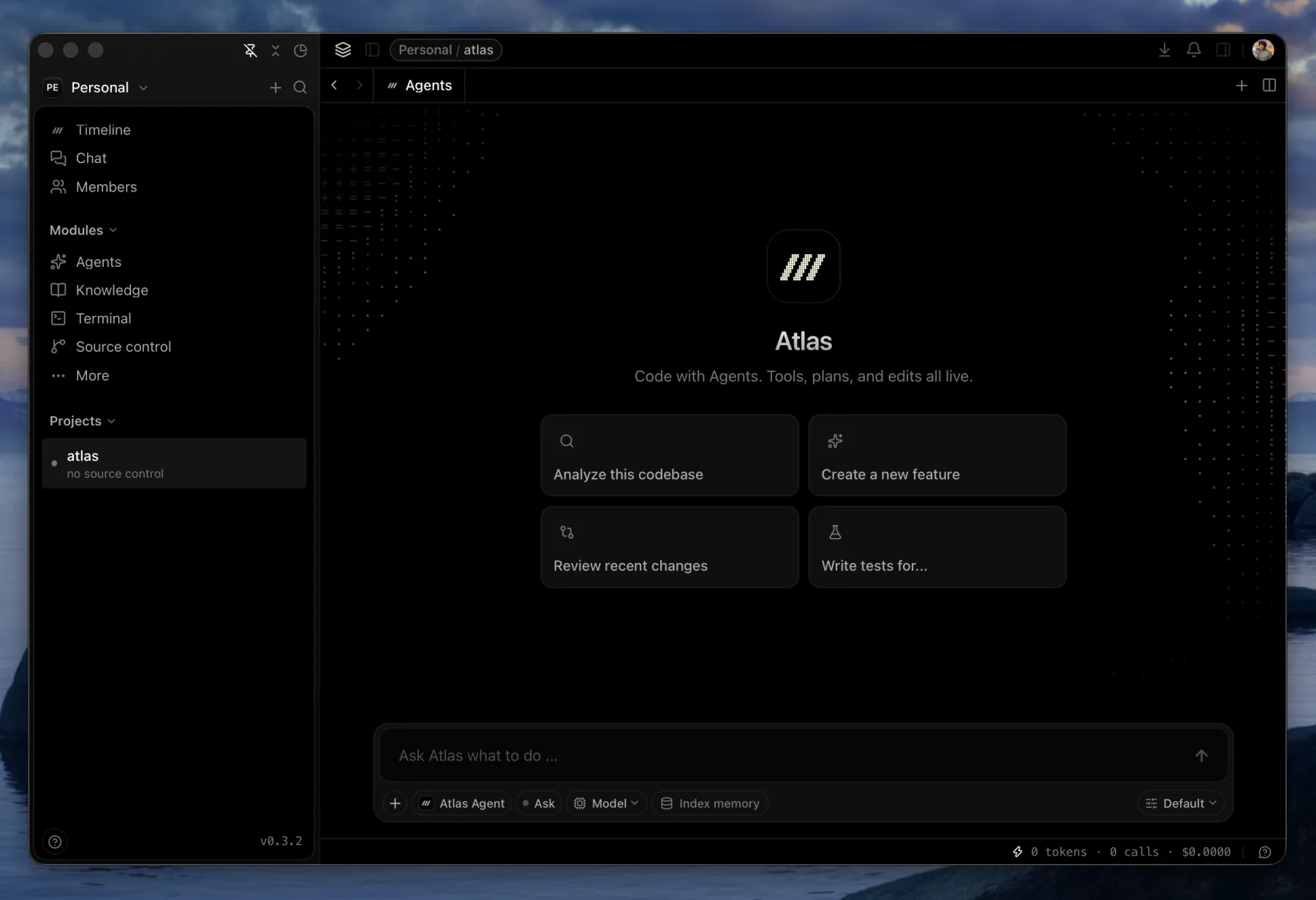
Atlas is source control for coding agents. Every agent run produces checkpoints: commits are linked back to the session that made it alongside the prompts, tool calls, and reasoning. You see which agent did exactly what and why.
Run Claude Code, Codex, Atlas's own agent, or anything from the ACP registry side by side against the same codebase, with shared memory so switching agents mid-task doesn't mean starting over.
- Every commit, explained. A checkpoint links a commit back to the session that produced it: prompts, tool calls, and file changes kept together, queryable months later.
- Run any agent, side by side. Claude Code, Codex, Atlas's own agent, and the wider ACP registry, all in the same window, against the same codebase. Switching agents mid-task doesn't mean starting over.
- One memory, every agent. A decision Claude Code made shows up in Codex's next prompt. Plans, file changes, failures, and architecture notes are shared automatically, matched on-device against what you're asking about.
- Your notes are agent context. Markdown in
.atlas/knowledge/, plus the CLAUDE.md and AGENTS.md you already wrote, feed every agent in the project.
@ anything into a prompt. Files, folders, symbols, branches, commits, notes, papers, and past sessions resolve locally before the prompt is sent.- Local by default. Code, notes, and sessions stay on your machine. Sign in and create an organisation when you want to sync across a team.
Download
Grab the latest build from tryatlas.cc or the releases page — a .dmg for macOS (Apple Silicon or Intel), an .msi for Windows.
[!NOTE]
macOS 13+ and Windows 10+ (x64) are the supported platforms. Linux builds from the same Tauri codebase but is untested — see Build from source.
Why Atlas
Agents now write a large share of the code and keep none of the reasoning behind it. The prompt that produced a change, the tool calls it made, the approach it tried first and abandoned — all of it lives in a scrollback buffer until the buffer scrolls.
What survives is a commit message, written by a model, summarising a diff. Months later that is the only record of why the code looks the way it does.
Three problems follow, and every editor designed before agents has all three:
- Agents start from zero every session. The context you established yesterday is gone, and rebuilding it is your job, every time.
- Switching agents loses the thread. Claude Code cannot read Codex's history, and Codex cannot read Claude Code's. Changing agent mid-task means starting the explanation over.
- Context lives in ten places. The knowledge base,
CLAUDE.md, AGENTS.md, and each agent's own memory files. Nothing reads all of them at once.
Two commitments shape how Atlas answers them:
- Nothing is locked in. Notes are markdown, canvases are JSON, sessions are JSONL, and the editor is a file on disk. Close Atlas and pick up in vim. The one exception is the checkpoint record (which agent session produced which commit), which is SQLite in the project's gitignored
.atlas/, because it is queried, not read.
- Built for agents from the ground up. The agent runtime, shared memory, and session history are the foundation the rest of the app is built on.
Checkpoints
A checkpoint is what a commit doesn't tell you on its own: which session produced it, what the agent was asked, the tool calls it made, and the reasoning behind the change, kept together instead of lost the moment the terminal scrolls.
Atlas records every agent session locally in .atlas/sessions.db, with secrets scrubbed before anything touches disk. When you commit (from any tool, even with Atlas closed), the commit is linked back to the session that produced it as a checkpoint, and links survive rebases and amends.
You don't have to read the raw transcript to get the context back: select a checkpoint and chat with it directly, and it answers from what actually happened in that session. Local mode works fully offline with no account.
How it works
Atlas runs your agents as they are, and enriches what they see.
Claude Code and Codex run as external subprocesses over ACP, the most-used, most-tested path. Atlas Agent, the native agent, runs in-process on a hard fork of the Codex engine (see CONTEXT.md and ADR-0004).
Beyond those, Atlas can spawn any agent in the ACP registry (Cursor, OpenCode, Kilo Code, and more), pulling in each one's official binary automatically. All of them go through the same send path, so everything below applies whichever one you pick.
[!NOTE]
QA on the long tail of registry agents is ongoing.
Before your message reaches the agent, Atlas assembles context around it:
| Injected |
Where it comes from |
When |
@ mentions |
Resolved locally in Rust before the prompt is sent. Notes, skills, papers, and past sessions are inlined; files and folders resolve to a path |
Every turn |
| Shared agent memory |
Active plan, decisions, file changes, failures, and architecture notes, written by any agent |
Every turn |
| Semantic matches |
Your message is embedded on-device and matched against the project's memory index |
Every turn |
| Session handoff |
A curated fact pack plus the tail of your last session in this project, including one from a different agent |
First message |
| What you already wrote |
Knowledge notes, CLAUDE.md, AGENTS.md, Claude Code's memory files, and Codex's history, folded into one index |
Continuously |
- One path, no per-agent special-casing. Run your existing Claude Code or Codex subscription through Atlas and the session gets more context, with no change to how you work.
- Claude Code's memory is visible to Codex, and the reverse. Neither agent can read the other's history on its own.
- Folders resolve to a pointer, not a paste.
@-ing a 5000-line file sends a path the agent reads on demand, so one mention doesn't occupy the context window for the rest of the session.
- Embedding runs on your machine. Retrieval never leaves the device.
Features
Agents
| Capability |
Description |
Link |
| Multi-agent sessions |
Claude Code, Codex, and Atlas's native agent, selectable per session and running in parallel across tabs. Sessions are independent of tabs, so switching never drops a run in flight |
Chat & Sessions |
| Shared agent memory |
On-device semantic index (local embeddings, HNSW search) that every agent reads from and writes to |
Memory |
| @ mentions |
Local resolution of files, folders, symbols, branches, commits, notes, skills, papers, and past sessions |
Chat & Sessions |
| Skills |
SKILL.md files scoped globally or per project, enabled per agent by symlinking into that agent's own skills directory |
Skills |
| Packs |
Install a GitHub repo of skills, subagents, commands, hooks, rules, and scripts, discovered through the skills.sh index |
Skills |
| Model chat |
Talk to a model directly in its own tab, with no agent loop around it |
Chat & Sessions |
| Organisations |
Sign in, create an organisation, and sync across devices and teammates |
Organisations |
Agent history
| Capability |
Description |
| Session capture |
Every session recorded to .atlas/sessions.db: prompts, messages, tool calls, the files each one touched, and the patches it applied |
| Checkpoints |
Each session linked to the commits it produced. Commits are observed rather than intercepted, so one made from a terminal, from another editor, or while Atlas was closed still finds its session |
| Survives history rewrites |
Links re-point through amend and rebase by patch-id reconciliation. When a squash makes the link genuinely ambiguous, it orphans instead of guessing |
| Transcript import |
Backfills your existing Claude Code history, so the record starts before you installed Atlas |
| Secrets scrubbed on write |
Redaction runs before anything is persisted, so the local store is never itself a disclosure risk |
| Capture health |
One signal per project, OK, Degraded, or Stopped, each with a reason and the next step |
| Mission control |
Dashboard for agent activity: usage over time, consumption breakdown, timelines, and a filterable log table |
Works with no account and no network.
The project
| Capability |
Description |
Link |
| Editor |
CodeMirror editing surface, with per-project editor state restored across restarts |
Editor |
| Git |
Real commit graph with lane assignment, stage/unstage/commit, branch operations, and file-level diffs |
Git & Diff |
| Terminal |
Block terminal where each command carries its own output, exit code, and duration, plus a full interactive surface for vim, htop, and friends |
Terminal |
| Knowledge base |
Plain markdown notes in .atlas/knowledge/, versioned next to the code, with backlinks, a link graph, and export to HTML or a standalone server binary |
Knowledge base |
| Research |
Search arXiv and Semantic Scholar, pull papers in, read them in-app, and @-mention them into a prompt |
Research |
| Browser |
Native WebKit webview in a tab, with real logins, cookies, and a reader mode |
Explorer |
| Spaces |
Spatial board for notes and their connections, persisted as JSON in the project |
Chat & Sessions |
| Split view |
Up to three resizable columns, each with its own tabs |
Editor |
| Activity log |
Every significant event in the project, filterable, with rows you can pin across restarts |
Timeline |
Build from source
To use the Claude Code agent, install the claude CLI and put it on your PATH. Atlas's native agent needs no external CLI.
Requires Bun and Rust (stable, via rustup), plus Xcode Command Line Tools on macOS or the MSVC build tools (Visual Studio Build Tools with the C++ workload) on Windows.
Linux system dependencies (GTK 3, WebKit2GTK 4.1, GLib headers)
- Debian / Ubuntu / Linux Mint:
sudo apt install -y libglib2.0-dev libgtk-3-dev libwebkit2gtk-4.1-dev
- Fedora / RHEL:
sudo dnf install glib2-devel gtk3-devel webkit2gtk4.1-devel
- Arch Linux / Manjaro:
sudo pacman -S glib2 gtk3 webkit2gtk-4.1
- openSUSE:
sudo zypper install glib2-devel gtk3-devel webkit2gtk3-devel
git clone https://github.com/pacifio/atlas
cd atlas
bun install
bun run dev:app
The first Rust compile takes a few minutes; after that it is seconds. Use bun run dev for frontend-only iteration, though anything calling invoke() needs dev:app.
Production builds:
bun run build:app       # macOS .app bundle
bun run build:app:dmg   # macOS .app + .dmg installer
bun run build:app:win   # Windows .msi installer
Contributing
See CONTRIBUTING.md. One thing catches people out:
- Feature work targets the current version branch, not
main. main only receives a finished version branch, and that merge is the release.
ARCHITECTURE.md covers how Atlas is built. SECURITY.md covers reporting vulnerabilities.
Local by default
- Your code, notes, and sessions stay on your machine. Nothing is uploaded to run an agent.
- Secrets are scrubbed before anything is written to disk. Not before upload, before persistence.
- Session capture is local-only by default. The Checkpoints record is written to
.atlas/sessions.db and stays there. No account required, and nothing sent anywhere until you explicitly opt in to sync.
- Accounts are opt-in. Sign in to create an organisation and sync across devices and teammates.
- Anonymous usage analytics are on by default. Coarse metadata, never code or prompts. What's collected, and how to turn it off.
Contributors
License
Apache License 2.0. See LICENSE.







 Atlas — это система контроля версий, созданная для кодинг-агентов: она записывает каждую сессию агента как контрольную точку, связывающую коммит с промптами, вызовами инструментов и рассуждениями, которые его породили, и позволяет запускать Claude Code, Codex, собственный встроенный агент или любого агента из реестра ACP бок о бок с общей памятью.