Noctalia
Noctalia is a native Wayland desktop shell for people who want a polished, configurable Linux desktop without stitching
together a separate bar, launcher, notification daemon, lock screen, wallpaper tool, and settings UI.
It provides the shell layer around your compositor: bars, widgets, dock, launcher, control center, notifications,
wallpaper, lock screen, session actions, clipboard history, OSDs, tray integration, and desktop widgets. The project is
built directly on Wayland and OpenGL ES with no Qt or GTK dependency, so the UI, rendering, configuration, and IPC model
are designed as one cohesive shell instead of a collection of unrelated panels and scripts.




Why Noctalia?
Most Wayland setups leave the desktop shell to a stack of small tools: one bar, another launcher, another notification
daemon, a lock screen, a wallpaper daemon, scripts for session actions, and separate config formats for each piece. That
can be flexible, but it also makes a complete desktop feel fragile and hard to keep visually consistent.
Noctalia solves that by providing one configurable shell layer that owns the common desktop surfaces and services while
still fitting into compositor-driven Wayland workflows. It is meant for users who want the control of a custom desktop
environment with fewer moving parts and a consistent UI.
To understand the values and philosophy guiding the project, read our ethos.
What It Includes
- Multi-monitor bars with configurable widgets, taskbar, workspaces, system tray, media, network, battery, brightness,
weather, clipboard, and custom script-backed widgets.
- Dock, launcher, control center, notification toasts/history, wallpaper picker, OSD overlays, lock screen, session
panel, and desktop widgets.
- TOML configuration with hot reload, GUI-managed overrides, theme/palette support, template application, and IPC for
runtime control.
- Direct Wayland integration for layer-shell, session lock, idle behavior, clipboard, foreign toplevels, workspaces,
fractional scaling, and compositor-specific workspace backends where needed.
Wayland Compositor Support
Noctalia supports Wayland compositors that provide the layer-shell protocols it needs for shell surfaces. Workspace
integration works through compositor-native backends where needed, or through ext-workspace-v1 on compositors that
implement it.
Current compositor integrations include Niri, Hyprland, Sway, Scroll, Mango, Labwc, Triad, dwl, and other compatible
Wayland compositors. Other compositors may run Noctalia but can have reduced workspace, window, output, or
session-action integration depending on the protocols and IPC they expose.
Scope
Noctalia is a desktop shell, not a full desktop environment. It provides the visual and service layer around your
Wayland compositor: bars, panels, launcher, notifications, dock, lock screen, idle behavior, OSDs, theming, wallpapers,
desktop widgets, and multi-monitor shell surfaces.
Window management, tiling, compositor configuration such as monitor arrangement and positions, file management,
removable-drive mounting, printers management, and screen mirroring/casting belong to the compositor, dedicated desktop
applications, or system services.
Display/login greeter support lives in the separate Noctalia Greeter
project. Noctalia may integrate with those pieces when useful, but it does not replace them.
Core Noctalia is non-invasive: it does not manage your compositor settings or take over your dotfiles. Compositor-specific
controls can be provided as opt-in plugins rather than becoming core shell behavior.
The plugin system is available for user-installed extensions. Features that are useful to some users but not essential
to the core shell can live there: extra bar widgets, launcher providers, desktop widgets, panels, shortcuts, background
services, compositor-specific extras and controls, hardware-specific controls, and third-party service integrations.
Build from source
Source dependencies, distro-specific package commands, build modes, and install layouts live in
BUILDING.md.
Configuration
A ready-to-use starting config with all defaults is at example.toml. The full configuration reference
lives in the documentation site. The source MDX files are in
docs/user/; sync them to a local docs checkout with tools/sync-docs.sh.
Contributing
Developer notes, architecture overview, code style, project layout, and debugging commands live in
CONTRIBUTING.md.
Bug reports, fixes, documentation updates, themes, and configuration examples are welcome. For general help and design
discussion, join the community on Discord.
Credits
Thank you to the contributors and community
members who test Noctalia, report issues, share configurations, and help shape the project.
Donations
Donations are appreciated but completely optional.


License
MIT License. See LICENSE for details.
Packaging
Distro packaging notes (description, deps, install layout, Meson options) live in
PACKAGING.md.
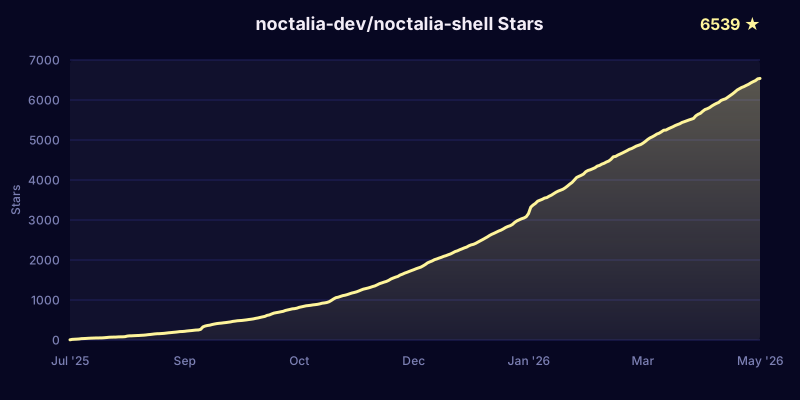
Star History

 Noctalia 是一个原生 Wayland 桌面 shell,把状态栏、启动器、Dock、控制中心、通知、壁纸选择器、锁屏、OSD、托盘和桌面小组件整合成一个连贯的整体,而不是各自独立的工具。