Posthorse
Fresh context. Same journey. (POST-horse)
Native, no-summary context windows for the fitchmultz/pi fork of Pi. A post-horse was swapped in at relay stations so the courier and the message could continue on fresh legs. Posthorse does the same for a model: fresh context, same work, complete recoverable transcript.
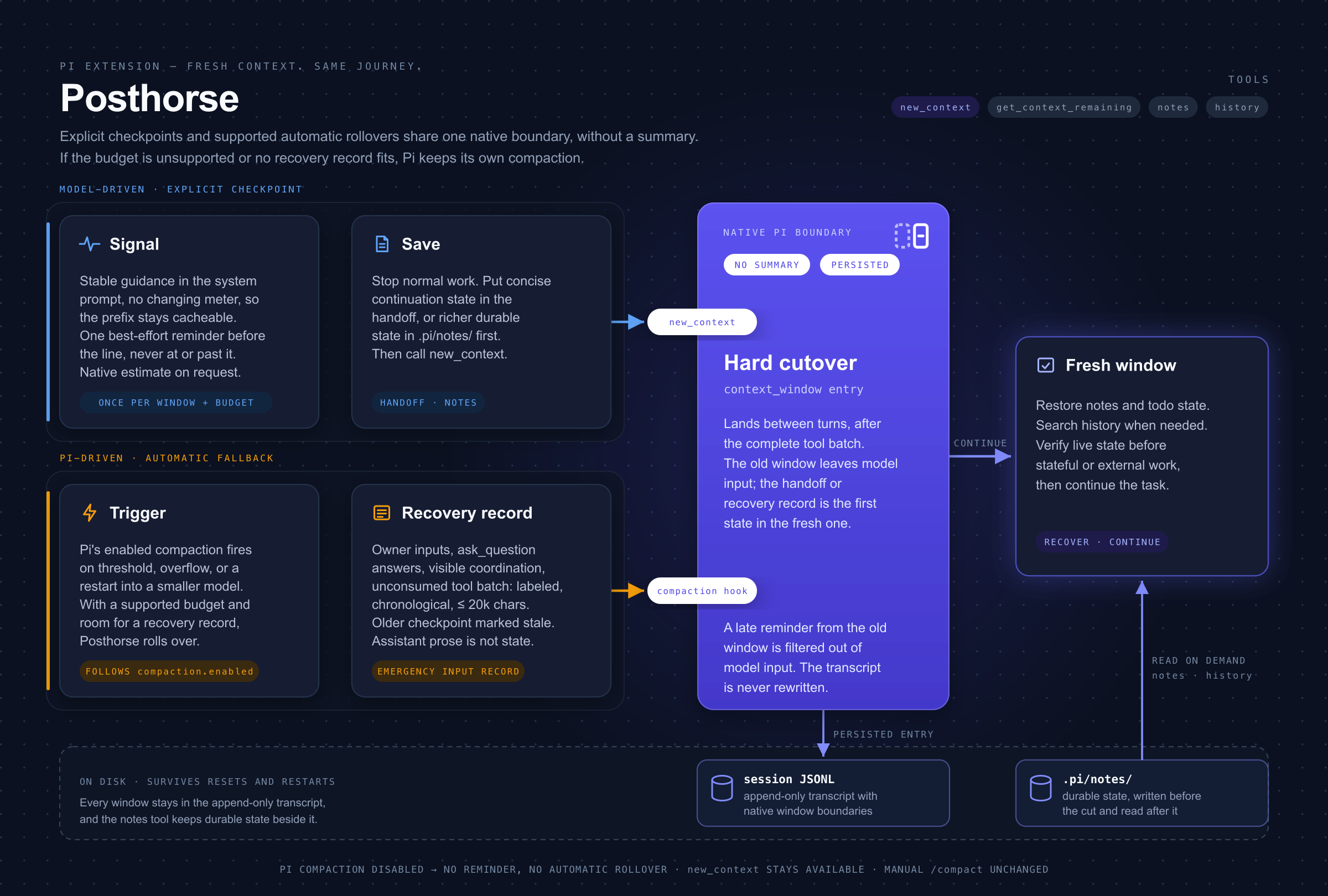
Pi owns the persisted boundary. Posthorse owns the policy: stable window guidance, one best-effort checkpoint reminder, new_context, get_context_remaining, durable notes, and window-aware history. A rollover removes the old window from active model context while the JSONL transcript stays append-only and complete.
An isolated Codex prototype tests local notes and recovery with Codex's native context reset. It is not ready for everyday use and is not included in the Pi package.
Requirements
- Node
>=22.19.0.
- The
fitchmultz/pi fork. The CI baseline is f9b06177e565f70cd243a785d088d1c491830dbd (Pi 0.85.0). Posthorse needs the fork's native context_window entries, its session_before_auto_compact hook, and ctx.getCompactionSettings().
- Official, unpatched Pi is unsupported. Posthorse reports a clear extension error at session start and cannot operate; Pi itself keeps running.
Install
Build the fork:
git clone https://github.com/fitchmultz/pi.git
cd pi
git checkout f9b06177e565f70cd243a785d088d1c491830dbd
npm install --ignore-scripts
npm run build
After updating the fork, run the install and build commands again, then restart Pi. pi --version reads the checkout's package metadata, so it does not prove that the updated source has been built.
Run it as node packages/coding-agent/dist/bundle/cli.js, or run npm link inside packages/coding-agent so that build becomes your pi command.
Then install Posthorse with that pi:
pi install git:github.com/fitchmultz/pi-posthorse        # from Git; add @<tag> to pin a release
pi install npm:pi-posthorse                             # from npm
pi -e git:github.com/fitchmultz/pi-posthorse              # try it for one run without installing
Update with pi update npm:pi-posthorse or pi update --extensions; move a pinned Git install with pi install git:github.com/fitchmultz/pi-posthorse@<new tag>. Uninstall with pi remove npm:pi-posthorse (or the Git source you installed). Removing the package leaves .pi/notes and Pi's session history in place.
Restart Pi after installing or updating Posthorse to load the new extension code.
Keep exactly one copy loaded. pi list shows every package source; if an older entry such as git:github.com/fitchmultz/pi-headroom.git or a local checkout is still listed, pi remove it before installing the npm package, otherwise two copies register the same tools and compete for the same rollover hook.
How it works
- Stable guidance. Window behavior is part of the system prompt. There is no per-request meter to churn the prompt.
- One best-effort checkpoint. While Pi compaction is enabled, one reminder may appear shortly before Pi's rollover line. A large turn, overflow, restart, or smaller model can reach rollover without it. Reminders are fingerprinted by window, context size, and reserve, so switching to a different context size gets a fresh reminder and stale ones are filtered from model input.
get_context_remaining. Reports the best available native estimate of tokens until Pi's automatic rollover line and until the model's hard limit. Pi's value is an estimate until the active model reports usage.new_context. Requests an atomic rollover after the complete tool batch succeeds. An optional handoff is persisted and becomes the first state of the fresh window. If a sibling tool in the same batch fails, Pi does not commit the boundary; the checkpoint reminder still applies.- Automatic rollover without summaries. With a supported context budget and room for a recovery record, Posthorse claims Pi's automatic threshold and overflow trigger through
session_before_auto_compact, before Pi resolves summarization credentials or prepares a summary. Oversized first turns and tool results can then roll over even without summarization credentials. Otherwise Pi's own compaction remains in control. Manual /compact is unchanged.
- Bounded recovery record. The automatic handoff keeps direct user inputs,
ask_question outcomes, visible coordination messages, and the trailing tool batch that no model has consumed yet (call arguments, bounded result text, and the entry ids to recover the rest). A clearly labeled, possibly stale older checkpoint comes last, after the current inputs and unseen results. Older assistant prose and consumed tool results are not treated as state. Newly submitted input stays separate and is saved after the boundary, not copied into the handoff.
notes and history. Notes live with the repository root, shared across linked worktrees. History searches normalized transcript text and returns stored images for a requested entry.
At turn end, Posthorse checks whether usage is in the reminder band before explicitly looking up the full branch. Context filtering skips its branch lookup when model input contains neither posthorse-reminder nor legacy headroom-reminder messages. History searches, reads, and recovery remain available with no new limits.
Automatic recovery is an emergency input record, not proof of progress. The fresh model is told to restore notes and todo state, inspect history when needed, and verify live state before taking stateful or external action.
Settings
Posthorse follows Pi's effective compaction settings, including Pi's decision about whether project settings are trusted. Disabling compaction.enabled disables reminders and automatic rollover; new_context stays available.
The model's context window minus compaction.reserveTokens must leave at least 10,000 usable tokens. Below that (for example an 8K or 16K model with the default 16,384 reserve) Posthorse reports an unsupported configuration in the guidance and in get_context_remaining, turns automatic behavior off for that model, and leaves Pi's own compaction in place. Lower the reserve or use a larger model. The checkpoint reminder band is the last 10% of usable context, capped at 32,000 tokens, so a large reserve cannot trigger a reminder immediately in a fresh window.
Explicit and automatic handoffs are capped at 20,000 characters and half the active model's fresh operational capacity after prompt/tool overhead and any pending input, whichever is smaller. Oversized explicit handoffs are rejected with an instruction to save fuller state in notes; automatic rollover stays with Pi when no safe recovery record fits. When usage is not known yet, notes and history pages use the same model-aware limit.
Only one automatic compaction or rollover policy extension should be enabled at a time. Pi keeps the last non-cancel result from multiple handlers of the same hook, so load order would otherwise decide which policy wins.
new_context({ handoff? })get_context_remaining()notes({ op, ... }): list, read (paged; offset continues), write (empty content clears), append (one atomic newline-terminated record), search (excerpts centered on the match)history({ op, ... }): search, read; results carry native window ids, reads return stored images with the first page and the next character offset when text remains
In the TUI, tools use Pi's native expandable cards. Collapsed cards show the operation and target, a short content preview, and counts or page ranges with the next offset when more remains. Expand with Pi's tool-output shortcut (Ctrl+O by default), or click the card's header or body in fullscreen mode. Expanded cards show the complete returned page and its metadata, not content the tool has not fetched yet. Writes and context requests also show the submitted content or handoff.
Committed context-window messages and checkpoint reminders are compact, expandable cards too. The new_context tool card describes a request; only the committed context-window message says a fresh window has started.
Read pages, including returned images, shrink to the context that is actually left. Before usage is known, they reserve prompt/tool overhead and leave half the rest free. Unsafe pages are refused with the offset preserved; call new_context and retry.
history search puts matching original content before recovery material: handoffs, compaction and branch summaries, checkpoint reminders, and notes, new_context, and history calls/results. Ordinary prose or another tool call in the same assistant entry keeps its priority when that content matches. Every entry remains searchable; history read returns the complete normalized entry, including any recovery content omitted from a search excerpt.
Within each group, current-branch matches are newest first. With all: true, Posthorse searches every session file in the active Pi session directory, newest-modified sessions first and newest entries within each session; this is not a global timestamp sort. The result limit applies after priority, so newer echoes cannot displace older original matches. Entries copied by a fork are reported once.
Notes live in .pi/notes/ at the repository root (the main checkout for a linked worktree, the current directory outside Git). Add the directory to .gitignore when the project should not track it.
Data and privacy
- Posthorse makes no network requests.
- Notes are plaintext files under
.pi/notes. They survive package removal and may be committed unless ignored.
history with all: true scans nested JSONL files in the active Pi session directory, including subagent sessions.- History can return user text, assistant text and thinking, tool arguments and results, handoffs, custom messages, and images. Direct shell entries Pi marked
excludeFromContext come back as a placeholder only.
- Returned history content enters the currently selected model and provider context.
- Removing Posthorse does not remove notes or Pi session history.
Compatibility
Reminders persisted by pi-headroom (headroom-reminder) are recognized alongside posthorse-reminder for deduplication, filtering, and recovery records. Notes, tool names, .pi/notes, and Pi's context_window entries are unchanged.
Develop
npm ci
npm test
npm run check
PI_FORK=../pi scripts/integration.sh   # loads the real extension into the fork's test harness (fork built)
npm run check type-checks the extension, renderers, and tests. Tests cover reminder policy, notes/history behavior, and real native card components, including width, expansion, and legacy results. The pinned Pi 0.85.0 SDK's unbundled entry imports an undeclared server package, so test-only resolution loads its shipped native bundle. Integration tests run inside the fork's harness and cover rollover and history recovery; use a disposable built fork checkout because the script briefly copies the test into its test directory. CI runs the unit tests on Node 22.19 and 24, npm audit, npm pack --dry-run, and the integration job against the pinned fork revision.

 Posthorse 是 Pi 编程智能体(具体是 fitchmultz/pi 这个 fork)的一个扩展,用于在不做摘要的情况下处理上下文窗口轮换:当会话接近上限时,它会以一次持久化的交接和完整可恢复的对话记录开启一个新窗口,而不是把历史压缩成摘要。