🐸Coqui.ai News
- 📣 ⓍTTSv2 is here with 16 languages and better performance across the board.
- 📣 ⓍTTS fine-tuning code is out. Check the example recipes.
- 📣 ⓍTTS can now stream with <200ms latency.
- 📣 ⓍTTS, our production TTS model that can speak 13 languages, is released Blog Post, Demo, Docs
- 📣 🐶Bark is now available for inference with unconstrained voice cloning. Docs
- 📣 You can use ~1100 Fairseq models with 🐸TTS.
- 📣 🐸TTS now supports 🐢Tortoise with faster inference. Docs
💬 Where to ask questions
Please use our dedicated channels for questions and discussion. Help is much more valuable if it's shared publicly so that more people can benefit from it.
🔗 Links and Resources
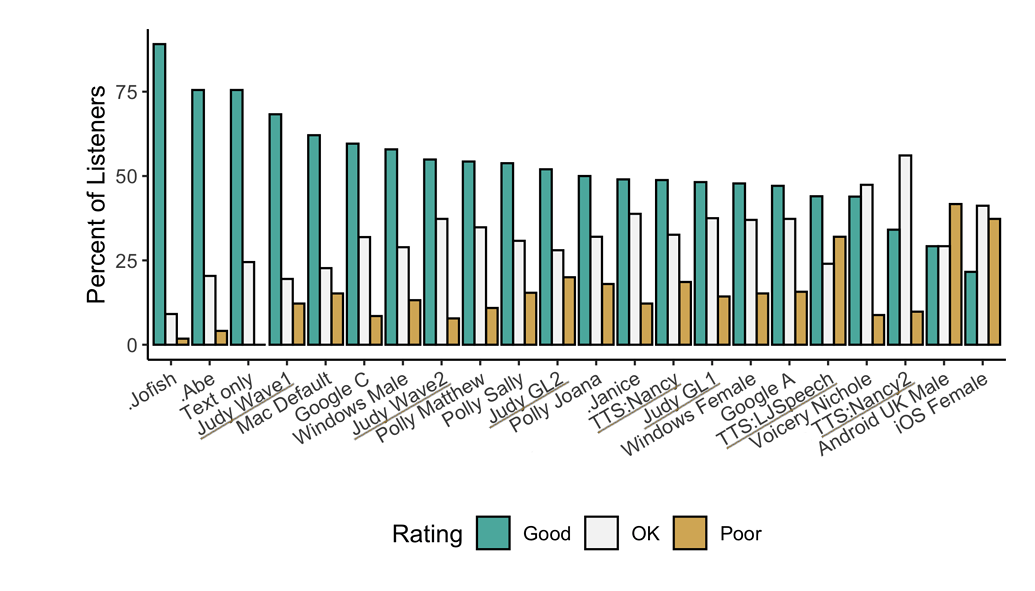
Underlined "TTS*" and "Judy*" are internal 🐸TTS models that are not released open-source. They are here to show the potential. Models prefixed with a dot (.Jofish .Abe and .Janice) are real human voices.
Features
- High-performance Deep Learning models for Text2Speech tasks.
- Text2Spec models (Tacotron, Tacotron2, Glow-TTS, SpeedySpeech).
- Speaker Encoder to compute speaker embeddings efficiently.
- Vocoder models (MelGAN, Multiband-MelGAN, GAN-TTS, ParallelWaveGAN, WaveGrad, WaveRNN)
- Fast and efficient model training.
- Detailed training logs on the terminal and Tensorboard.
- Support for Multi-speaker TTS.
- Efficient, flexible, lightweight but feature complete
Trainer API.
- Released and ready-to-use models.
- Tools to curate Text2Speech datasets under
dataset_analysis.
- Utilities to use and test your models.
- Modular (but not too much) code base enabling easy implementation of new ideas.
Model Implementations
Spectrogram models
End-to-End Models
Attention Methods
- Guided Attention: paper
- Forward Backward Decoding: paper
- Graves Attention: paper
- Double Decoder Consistency: blog
- Dynamic Convolutional Attention: paper
- Alignment Network: paper
Speaker Encoder
Vocoders
Voice Conversion
You can also help us implement more models.
Installation
🐸TTS is tested on Ubuntu 18.04 with python >= 3.9, < 3.12..
If you are only interested in synthesizing speech with the released 🐸TTS models, installing from PyPI is the easiest option.
pip install TTS
If you plan to code or train models, clone 🐸TTS and install it locally.
git clone https://github.com/coqui-ai/TTS
pip install -e .[all,dev,notebooks]  # Select the relevant extras
If you are on Ubuntu (Debian), you can also run following commands for installation.
$ make system-deps  # intended to be used on Ubuntu (Debian). Let us know if you have a different OS.
$ make install
If you are on Windows, 👑@GuyPaddock wrote installation instructions here.
Docker Image
You can also try TTS without install with the docker image.
Simply run the following command and you will be able to run TTS without installing it.
docker run --rm -it -p 5002:5002 --entrypoint /bin/bash ghcr.io/coqui-ai/tts-cpu
python3 TTS/server/server.py --list_models #To get the list of available models
python3 TTS/server/server.py --model_name tts_models/en/vctk/vits # To start a server
You can then enjoy the TTS server here
More details about the docker images (like GPU support) can be found here
Synthesizing speech by 🐸TTS
🐍 Python API
Running a multi-speaker and multi-lingual model
import torch
from TTS.api import TTS

# Get device
device = "cuda" if torch.cuda.is_available() else "cpu"

# List available 🐸TTS models
print(TTS().list_models())

# Init TTS
tts = TTS("tts_models/multilingual/multi-dataset/xtts_v2").to(device)

# Run TTS
# ❗ Since this model is multi-lingual voice cloning model, we must set the target speaker_wav and language
# Text to speech list of amplitude values as output
wav = tts.tts(text="Hello world!", speaker_wav="my/cloning/audio.wav", language="en")
# Text to speech to a file
tts.tts_to_file(text="Hello world!", speaker_wav="my/cloning/audio.wav", language="en", file_path="output.wav")
Running a single speaker model
# Init TTS with the target model name
tts = TTS(model_name="tts_models/de/thorsten/tacotron2-DDC", progress_bar=False).to(device)

# Run TTS
tts.tts_to_file(text="Ich bin eine Testnachricht.", file_path=OUTPUT_PATH)

# Example voice cloning with YourTTS in English, French and Portuguese
tts = TTS(model_name="tts_models/multilingual/multi-dataset/your_tts", progress_bar=False).to(device)
tts.tts_to_file("This is voice cloning.", speaker_wav="my/cloning/audio.wav", language="en", file_path="output.wav")
tts.tts_to_file("C'est le clonage de la voix.", speaker_wav="my/cloning/audio.wav", language="fr-fr", file_path="output.wav")
tts.tts_to_file("Isso é clonagem de voz.", speaker_wav="my/cloning/audio.wav", language="pt-br", file_path="output.wav")
Example voice conversion
Converting the voice in source_wav to the voice of target_wav
tts = TTS(model_name="voice_conversion_models/multilingual/vctk/freevc24", progress_bar=False).to("cuda")
tts.voice_conversion_to_file(source_wav="my/source.wav", target_wav="my/target.wav", file_path="output.wav")
Example voice cloning together with the voice conversion model.
This way, you can clone voices by using any model in 🐸TTS.
tts = TTS("tts_models/de/thorsten/tacotron2-DDC")
tts.tts_with_vc_to_file(
    "Wie sage ich auf Italienisch, dass ich dich liebe?",
    speaker_wav="target/speaker.wav",
    file_path="output.wav"
)
Example text to speech using Fairseq models in ~1100 languages 🤯.
For Fairseq models, use the following name format: tts_models/<lang-iso_code>/fairseq/vits.
You can find the language ISO codes here
and learn about the Fairseq models here.
# TTS with on the fly voice conversion
api = TTS("tts_models/deu/fairseq/vits")
api.tts_with_vc_to_file(
    "Wie sage ich auf Italienisch, dass ich dich liebe?",
    speaker_wav="target/speaker.wav",
    file_path="output.wav"
)
Command-line tts
Synthesize speech on command line.
You can either use your trained model or choose a model from the provided list.
If you don't specify any models, then it uses LJSpeech based English model.
Single Speaker Models
List provided models:
$ tts --list_models
Get model info (for both tts_models and vocoder_models):
Query by type/name:
The model_info_by_name uses the name as it from the --list_models.
$ tts --model_info_by_name "<model_type>/<language>/<dataset>/<model_name>"
For example:
$ tts --model_info_by_name tts_models/tr/common-voice/glow-tts
$ tts --model_info_by_name vocoder_models/en/ljspeech/hifigan_v2
Query by type/idx:
The model_query_idx uses the corresponding idx from --list_models.
$ tts --model_info_by_idx "<model_type>/<model_query_idx>"
For example:
$ tts --model_info_by_idx tts_models/3
Query info for model info by full name:
$ tts --model_info_by_name "<model_type>/<language>/<dataset>/<model_name>"
Run TTS with default models:
$ tts --text "Text for TTS" --out_path output/path/speech.wav
Run TTS and pipe out the generated TTS wav file data:
$ tts --text "Text for TTS" --pipe_out --out_path output/path/speech.wav | aplay
Run a TTS model with its default vocoder model:
$ tts --text "Text for TTS" --model_name "<model_type>/<language>/<dataset>/<model_name>" --out_path output/path/speech.wav
For example:
$ tts --text "Text for TTS" --model_name "tts_models/en/ljspeech/glow-tts" --out_path output/path/speech.wav
Run with specific TTS and vocoder models from the list:
$ tts --text "Text for TTS" --model_name "<model_type>/<language>/<dataset>/<model_name>" --vocoder_name "<model_type>/<language>/<dataset>/<model_name>" --out_path output/path/speech.wav
For example:
$ tts --text "Text for TTS" --model_name "tts_models/en/ljspeech/glow-tts" --vocoder_name "vocoder_models/en/ljspeech/univnet" --out_path output/path/speech.wav
Run your own TTS model (Using Griffin-Lim Vocoder):
$ tts --text "Text for TTS" --model_path path/to/model.pth --config_path path/to/config.json --out_path output/path/speech.wav
Run your own TTS and Vocoder models:
$ tts --text "Text for TTS" --model_path path/to/model.pth --config_path path/to/config.json --out_path output/path/speech.wav
    --vocoder_path path/to/vocoder.pth --vocoder_config_path path/to/vocoder_config.json
Multi-speaker Models
List the available speakers and choose a among them:
$ tts --model_name "<language>/<dataset>/<model_name>" --list_speaker_idxs
Run the multi-speaker TTS model with the target speaker ID:
$ tts --text "Text for TTS." --out_path output/path/speech.wav --model_name "<language>/<dataset>/<model_name>" --speaker_idx <speaker_id>
Run your own multi-speaker TTS model:
$ tts --text "Text for TTS" --out_path output/path/speech.wav --model_path path/to/model.pth --config_path path/to/config.json --speakers_file_path path/to/speaker.json --speaker_idx <speaker_id>
Voice Conversion Models
$ tts --out_path output/path/speech.wav --model_name "<language>/<dataset>/<model_name>" --source_wav <path/to/speaker/wav> --target_wav <path/to/reference/wav>
Directory Structure
|- notebooks/       (Jupyter Notebooks for model evaluation, parameter selection and data analysis.)
|- utils/           (common utilities.)
|- TTS
    |- bin/             (folder for all the executables.)
      |- train*.py                  (train your target model.)
      |- ...
    |- tts/             (text to speech models)
        |- layers/          (model layer definitions)
        |- models/          (model definitions)
        |- utils/           (model specific utilities.)
    |- speaker_encoder/ (Speaker Encoder models.)
        |- (same)
    |- vocoder/         (Vocoder models.)
        |- (same)


















 Coqui TTS 是一个用于文本转语音(Text-to-Speech)的深度学习工具包,提供 1100 多个预训练模型,并附带用于训练、微调和整理数据集的工具,以便打造新的声音。