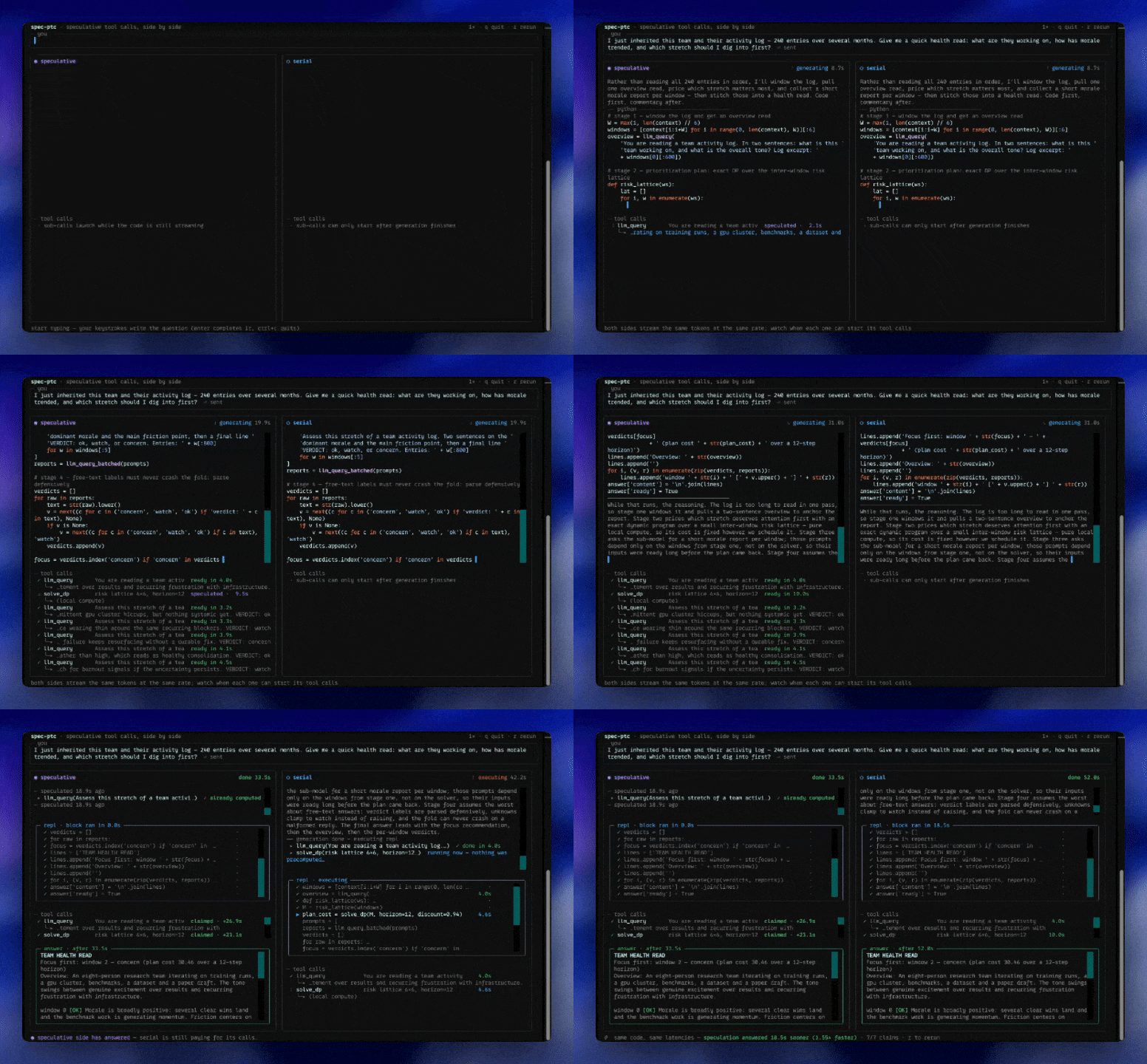
What is this?
 sPTC (speculative programmatic tool-calling) is a technique and small library that speculates and queues tool calls hidden inside a partially-generated REPL code block, so harnesses like RLM or CodeAct can start expensive sub-LLM/tool calls before the model even finishes writing the code.
Is this a full agent harness or something I add to an existing one?It is a lightweight library plus a demo, meant to be bolted onto programmatic tool-calling harnesses you already have (RLM, CodeAct, etc.), not a replacement harness itself.
It is a lightweight library plus a demo, meant to be bolted onto programmatic tool-calling harnesses you already have (RLM, CodeAct, etc.), not a replacement harness itself.How do I wire sPTC into my own harness?Clone the repo (it uses uv) or install the package, create a Speculator, mark functions you want speculated with the spec.tool decorator, feed streamed tokens into it as the REPL code is generated, then exec the finished code as usual.
Clone the repo (it uses uv) or install the package, create a Speculator, mark functions you want speculated with the spec.tool decorator, feed streamed tokens into it as the REPL code is generated, then exec the finished code as usual.What do I need already set up to use it?You need Python and an existing programmatic tool-calling harness to hook into - for RLMs this is a single call to demo.rlm.patchrlm, and there are ready-made wrappers for Claude Code, OpenCode, and Pi-mono.
You need Python and an existing programmatic tool-calling harness to hook into - for RLMs this is a single call to demo.rlm.patchrlm, and there are ready-made wrappers for Claude Code, OpenCode, and Pi-mono.Does this work for any agent setup, or just in-process ones?It is built around harnesses whose tool calls live inside a single per-turn code REPL (PTC-style); for setups that are not in-process there is a separate out-of-process daemon, spec-ptc-daemon, that mirrors the same shadow REPL over a Unix socket.
It is built around harnesses whose tool calls live inside a single per-turn code REPL (PTC-style); for setups that are not in-process there is a separate out-of-process daemon, spec-ptc-daemon, that mirrors the same shadow REPL over a Unix socket.Who would actually use this?Developers building or tuning agent harnesses that generate code-REPL tool calls per turn, like Recursive Language Models or CodeAct-style agents, where sub-LLM calls dominate latency.
Developers building or tuning agent harnesses that generate code-REPL tool calls per turn, like Recursive Language Models or CodeAct-style agents, where sub-LLM calls dominate latency.What is an RLM in this context?RLM stands for Recursive Language Model, a harness where sub-LLM and sub-RLM calls are embedded as functions inside one code REPL tool generated per turn, and those calls often take up most of the runtime.
RLM stands for Recursive Language Model, a harness where sub-LLM and sub-RLM calls are embedded as functions inside one code REPL tool generated per turn, and those calls often take up most of the runtime.Which harnesses already have ready-made wrappers?The plugins/ directory ships wrappers for Claude Code (hooked via PreToolUse), OpenCode, and Pi-mono, on top of the one-line RLM patch.
The plugins/ directory ships wrappers for Claude Code (hooked via PreToolUse), OpenCode, and Pi-mono, on top of the one-line RLM patch.How does speculating tool calls actually save time?As the root LLM streams tokens for a REPL call, sPTC parses the partially generated code, launches recognized tool and sub-LLM calls early as Futures, and overlaps that work with the rest of the code generation and eventual execution instead of waiting for the full block to finish first.
As the root LLM streams tokens for a REPL call, sPTC parses the partially generated code, launches recognized tool and sub-LLM calls early as Futures, and overlaps that work with the rest of the code generation and eventual execution instead of waiting for the full block to finish first.What are similar projects?pstack-claude, moyai, fable-orchestrator, Gnos, pstack, orca, agentbox, harmonist
pstack-claude, moyai, fable-orchestrator, Gnos, pstack, orca, agentbox, harmonistWhich topics is it in?asynchronous, daemon, concurrency, async, harness, opencode, streaming, agentic-ai, multi-agent, coding-agent, performance, agent
asynchronous, daemon, concurrency, async, harness, opencode, streaming, agentic-ai, multi-agent, coding-agent, performance, agent