What is this?
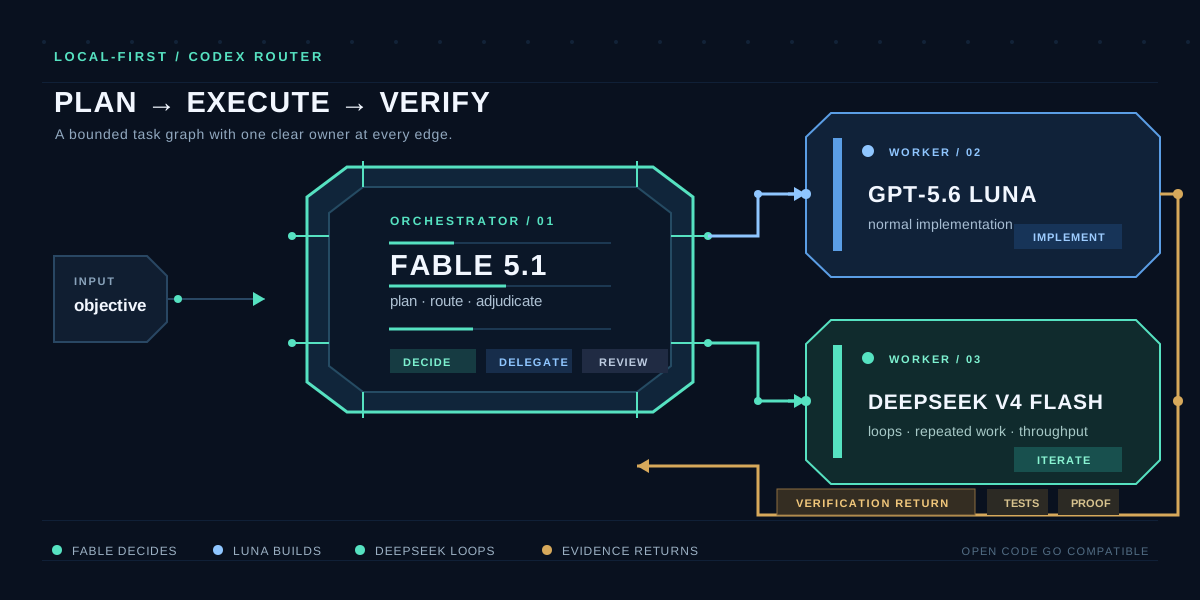
 Fable is a local-first routing skill for Codex that plans and adjudicates tasks, delegating bounded implementation work to OpenCode Go agents - GPT-5.6 Luna for normal work and DeepSeek V4 Flash for loops and high-throughput iteration.
Is this a standalone app or a skill for an existing tool?It is a Codex skill, not a separate app: three files under skill/fable/ get copied into Codex's skills folder, and Codex stays the runtime while Fable only plans and adjudicates without writing code.
It is a Codex skill, not a separate app: three files under skill/fable/ get copied into Codex's skills folder, and Codex stays the runtime while Fable only plans and adjudicates without writing code.What do I need set up before using Fable?You need Codex with the OpenCode Go agents (GPT-5.6 Luna and DeepSeek V4 Flash) configured in Codex Router, plus Claude Code's local fable alias, which askfable.sh invokes.
You need Codex with the OpenCode Go agents (GPT-5.6 Luna and DeepSeek V4 Flash) configured in Codex Router, plus Claude Code's local fable alias, which askfable.sh invokes.What happens if the required models aren't available?If neither GPT-5.6 Luna nor DeepSeek V4 Flash is callable through OpenCode Go, Fable reports a blocker instead of substituting another model, and you must restart Codex after changing provider or agent definitions.
If neither GPT-5.6 Luna nor DeepSeek V4 Flash is callable through OpenCode Go, Fable reports a blocker instead of substituting another model, and you must restart Codex after changing provider or agent definitions.Does Fable ever touch my credentials?No - the skill and its installer never read, create, or modify credentials, and any packet passed to it must contain only decisions and workspace facts.
No - the skill and its installer never read, create, or modify credentials, and any packet passed to it must contain only decisions and workspace facts.Why are there two different implementation models instead of one?GPT-5.6 Luna handles normal implementation while DeepSeek V4 Flash is reserved for loops, repeated iteration, and high-throughput work, so Fable can route each task to the model best suited for it.
GPT-5.6 Luna handles normal implementation while DeepSeek V4 Flash is reserved for loops, repeated iteration, and high-throughput work, so Fable can route each task to the model best suited for it.How do I run the tests?The repository's dependency-light test suite checks shell syntax, the copied source files, required routing strings, basic YAML structure, optional XML/SVG validation, a temporary-home dry run, an idempotent copy, and scans for credential-shaped strings, with no PyYAML or live Claude login needed.
The repository's dependency-light test suite checks shell syntax, the copied source files, required routing strings, basic YAML structure, optional XML/SVG validation, a temporary-home dry run, an idempotent copy, and scans for credential-shaped strings, with no PyYAML or live Claude login needed.How does Fable decide when a task needs another decision?Codex validates the graph Fable returns, starts ready workers in parallel, collects their evidence, verifies the result, and only calls back into Fable to adjudicate when the task needs another decision.
Codex validates the graph Fable returns, starts ready workers in parallel, collects their evidence, verifies the result, and only calls back into Fable to adjudicate when the task needs another decision.What are similar projects?pstack-claude, council-of-high-intelligence, ordewell, agents, ruflo, foreman, pstack, autoprompt-skill
pstack-claude, council-of-high-intelligence, ordewell, agents, ruflo, foreman, pstack, autoprompt-skillWhich topics is it in?bash, agent-skill, gpt, harness, opencode, orchestration, agent-orchestration, cli-tool, skill, shell, deepseek, agentic-ai
bash, agent-skill, gpt, harness, opencode, orchestration, agent-orchestration, cli-tool, skill, shell, deepseek, agentic-ai