



WeVisOne-VL README

README проекта с github.com/Tencent/WeVisOne-VL. Одним файлом markdown: README.md.

WeChat Vision

WeVisOne-VL

Unified Visual Perception from Objects to Pixels

Project Page Paper WeVisOne-VL-2B WeVisOne-VL-4B 2B Demo 4B Demo License

English | 简体中文

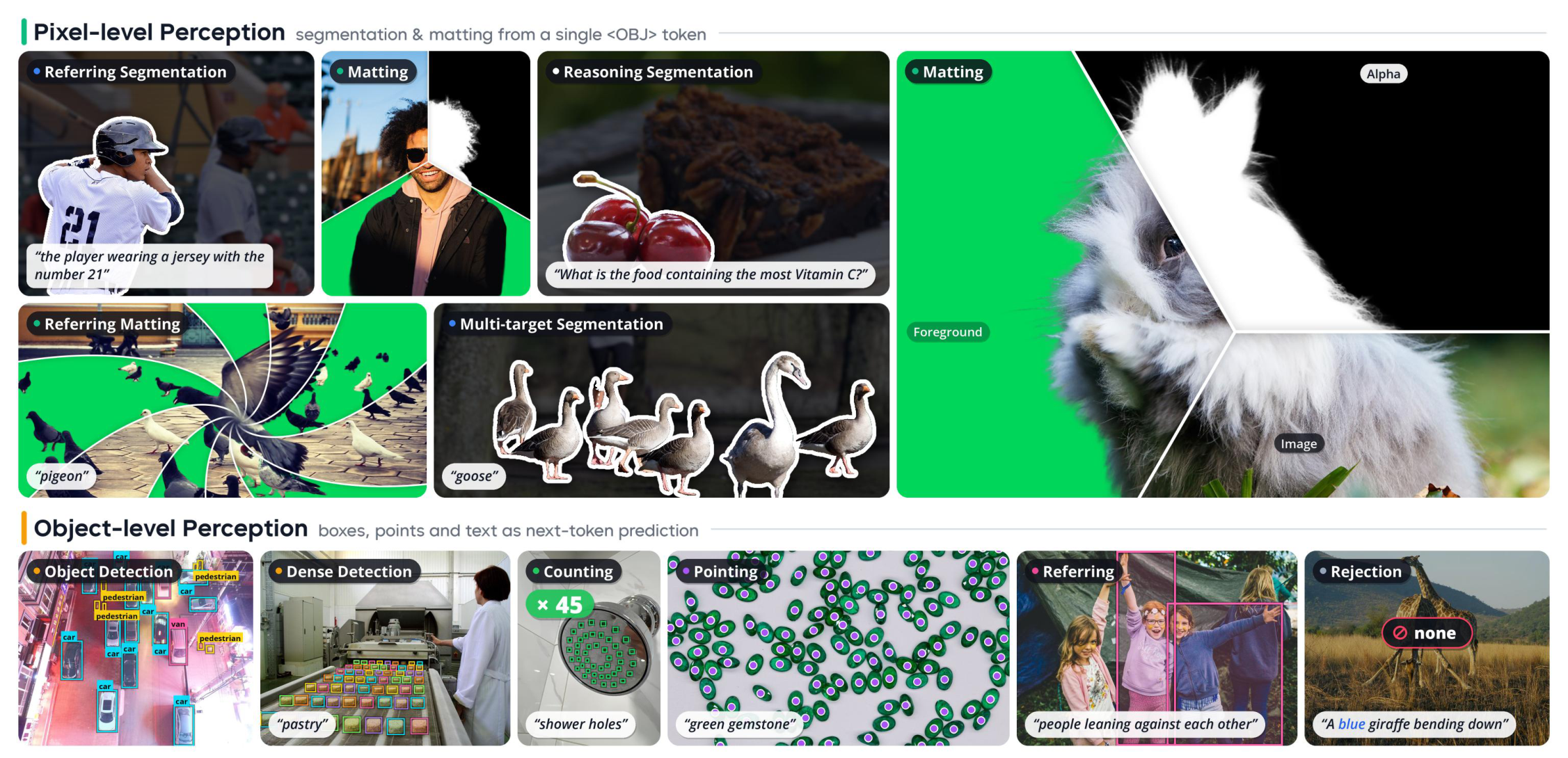
WeVisOne-VL (WeChat Vision All-in-One) is a vision-language foundation model that unifies object-level perception (object detection, referring localization, counting, pointing, and OCR) and pixel-level perception (referring segmentation and promptable alpha matting) through structured next-token prediction and a lightweight 9.6M-parameter pixel decoder—enabling localization at any user-specified granularity from points and boxes to binary masks and continuous alpha mattes, while reliably rejecting absent-target queries.

Overview of WeVisOne-VL

✨ Highlights

📢 News

📝 TODO

🏆 Performance at a Glance

Headline numbers for WeVisOne-VL-4B against the strongest open baseline in each benchmark (Qwen3-VL / Qwen3.5 up to 9B, Rex-Omni, LocateAnything, and task-specific segmentation / matting models).

Task Benchmark Metric Best Baseline WeVisOne-VL-4B
📦 Detection LVIS F1 Mean ↑ 50.7 55.3
📦 Dense Detection Dense200 F1 Mean ↑ 58.7 71.3
💬 Referring RefCOCOg test F1 Mean ↑ 77.6 81.8
🚫 Rejection WeRef-Bench Rej. Rate ↑ 73.0 96.4
🔢 Counting PixMo-Count test Acc ↑ 82.8 89.6
📍 Pointing PointBench Acc ↑ 69.9 71.9
🔤 OCR TotalText F1 Mean ↑ 43.3 52.0
🎭 Referring Seg. ReasonSeg val gIoU ↑ 65.0 71.2
✂️ Box Matting P3M-500-NP MAD ↓ 15.4 7.3
✂️ Text Matting WeRefMat (Referring) MAD ↓ 22.4 9.8

📊 Full Benchmark Results (click each task to expand)

F1 for detection, referring and OCR is averaged over IoU thresholds 0.5:0.95 ("Mean"). Greedy decoding, ≤ 1,960 visual tokens per image.

Object Detection (F1 Mean)
Method COCO LVIS Dense200 VisDrone
GroundingDINO-T 56.6 38.8 33.1 38.5
Qwen3-VL-8B 47.8 42.9 13.8 29.5
Qwen3.5-9B 49.5 43.7 18.0 31.3
Rex-Omni-3B 52.9 46.9 58.3 35.8
LocateAnything-3B 54.7 50.7 58.7 39.9
WeVisOne-VL-2B 55.2 53.3 61.4 40.4
WeVisOne-VL-4B 57.1 55.3 71.3 44.7
Referring Object Detection (F1 Mean / Rejection Rate %)
Method RefCOCOg test RefCOCOg Rej WeRef Mean WeRef Rej HumanRef Ref-L4
Qwen3-VL-8B 74.9 22.5 36.7 18.3 71.6 72.4
Qwen3.5-9B 74.6 15.2 50.7 70.7 77.8 72.0
Rex-Omni-3B 74.3 0.5 50.3 43.3 79.9 65.2
LocateAnything-3B 77.6 0.6 51.7 73.0 78.7 74.3
WeVisOne-VL-2B 78.2 50.2 73.2 92.9 77.4 75.1
WeVisOne-VL-4B 81.8 67.4 78.7 96.4 80.7 78.1
Object Counting (Exact-match Accuracy %)
Method CountQA PixMo-Count test CLOC test KubriCount testB MixCount test
Qwen3.5-9B 41.6 80.4 22.4 19.1 7.0
Rex-Omni-3B 37.6 71.9 22.3 18.8 11.4
LocateAnything-3B 52.4 82.8 23.9 22.4 15.2
WeVisOne-VL-2B 47.9 88.1 26.9 32.4 32.2
WeVisOne-VL-4B 57.1 89.6 28.3 40.1 40.4
Object Pointing
Method PointBench PixMo-Points COCO LVIS Dense200 VisDrone
Qwen3-VL-8B 62.5 72.2 77.5 67.7 42.2 46.4
Rex-Omni-3B 69.9 72.9 80.5 70.8 82.5 58.9
LocateAnything-3B 56.9 68.6 83.9 76.6 87.6 60.4
WeVisOne-VL-2B 62.9 73.2 85.8 78.9 83.2 62.4
WeVisOne-VL-4B 71.9 74.7 85.4 79.5 87.0 64.4
OCR — Text Grounding & Recognition (F1 Mean)
Method HierText ICDAR2015 TotalText SROIE
PP-OCRv5 (specialist) 30.5 25.6 25.7 58.6
Qwen3-VL-8B 25.7 27.1 35.4 43.3
Rex-Omni-3B 28.0 28.1 40.6 44.8
LocateAnything-3B 29.4 24.1 43.3 40.3
WeVisOne-VL-2B 30.5 42.6 42.5 62.1
WeVisOne-VL-4B 39.0 47.8 52.0 68.1
Referring Segmentation (cIoU; ReasonSeg uses gIoU)
Method RefCOCO testA RefCOCO+ testA RefCOCOg test ReasonSeg val Ref-ZOM cIoU Ref-ZOM Rej
LISA-13B (ft) 78.8 70.2 70.5 65.0 - -
GSVA-7B 78.9 69.6 73.3 50.5 66.6 41.9
UniPixel-7B 83.0 80.1 77.1 60.5 62.9 0.3
Youtu-VL-4B 82.0 79.6 76.6 - 61.0 1.3
WeVisOne-VL-2B 82.9 79.0 74.9 60.9 73.4 62.4
WeVisOne-VL-4B 84.5 81.1 77.8 71.2 72.2 86.0
Promptable Matting (MAD ×10³ ↓)
Method P3M-500-NP (Box) AM-2K (Box) PPM-100 (Box) WeRefMat (Category) WeRefMat (Referring)
Matte Anything 24.4 13.2 10.5 - -
SAM2-Matting (SAM3) 15.4 12.1 10.8 70.8 51.9
Qwen3.5-9B + SAM2-Matting - - - 77.8 22.4
WeVisOne-VL-2B 6.6 5.7 5.3 17.7 15.8
WeVisOne-VL-4B 7.3 5.0 6.1 16.4 9.8

See the technical report for all splits and metrics, and evaluation/README.md to reproduce the public benchmarks.

🏗️ How It Works

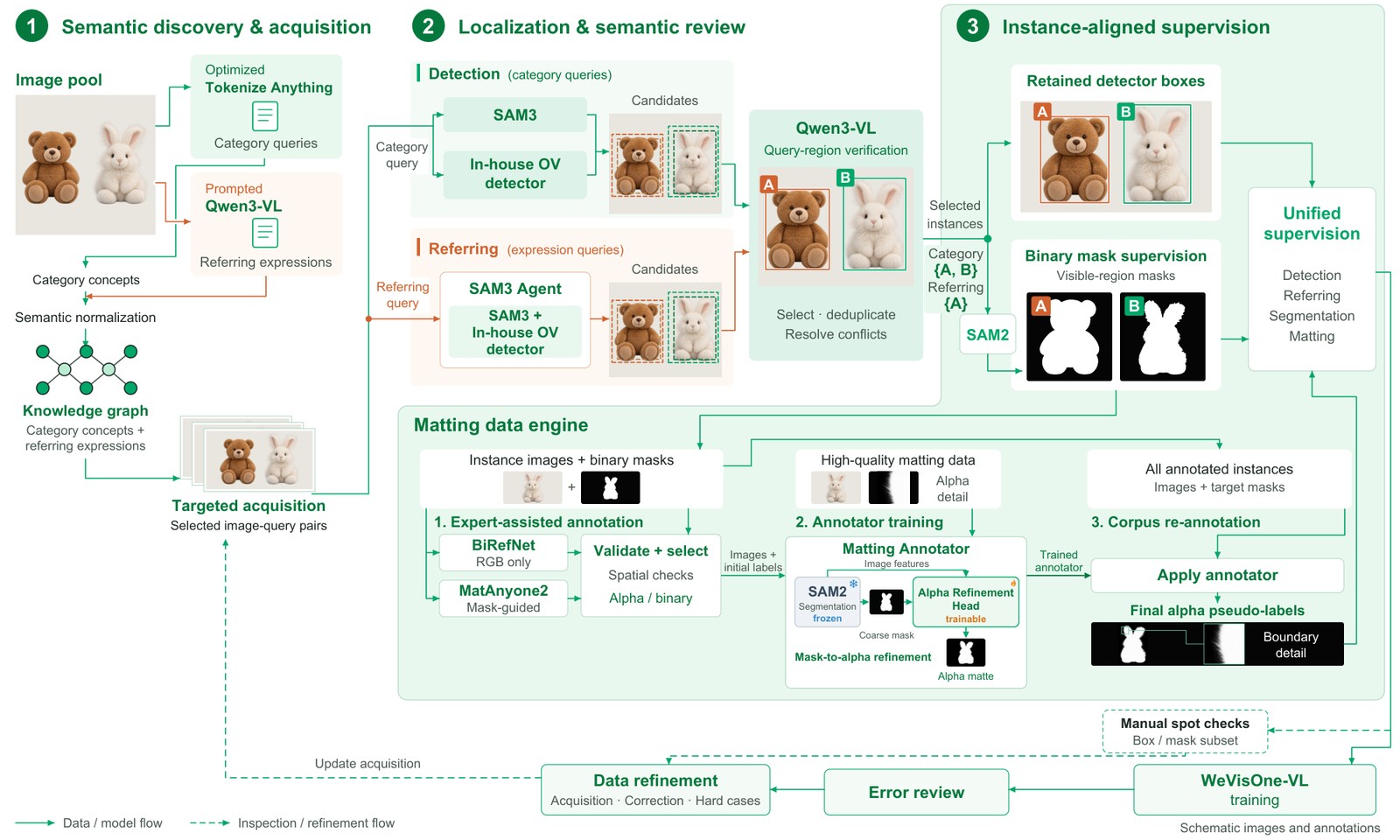
1. Data Engine. A knowledge-graph-driven engine discovers concepts, localizes them with complementary experts verified by a VLM, and extends the verified boxes to masks and alpha mattes. Over 100M images are annotated this way.

Data engine

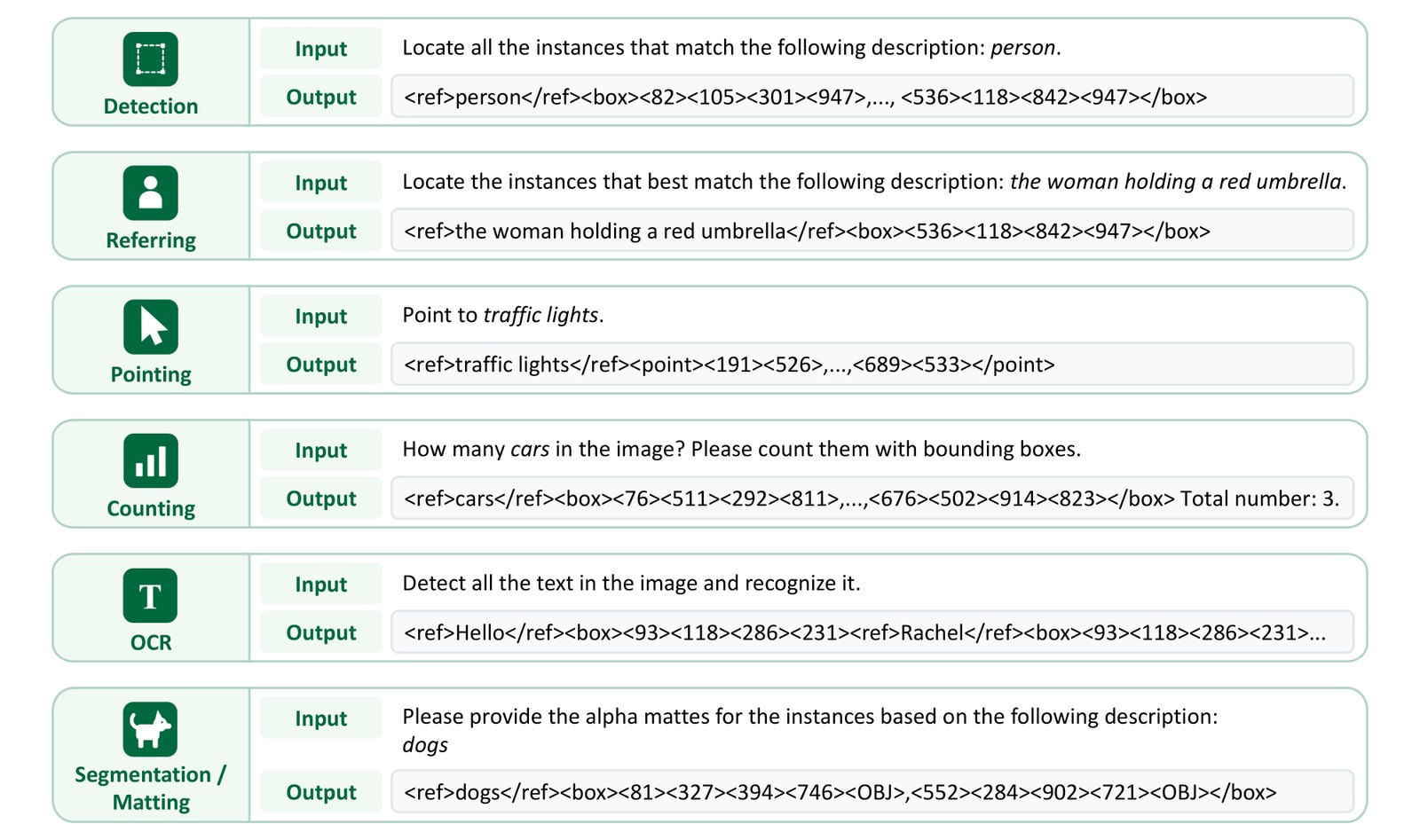
2. Unified Task Formulation. Every task is written as structured text, with coordinate tokens <0> … <1000> for boxes and points, None for absent targets, and an <OBJ> token after each box for pixel-level outputs.

Unified task formulation

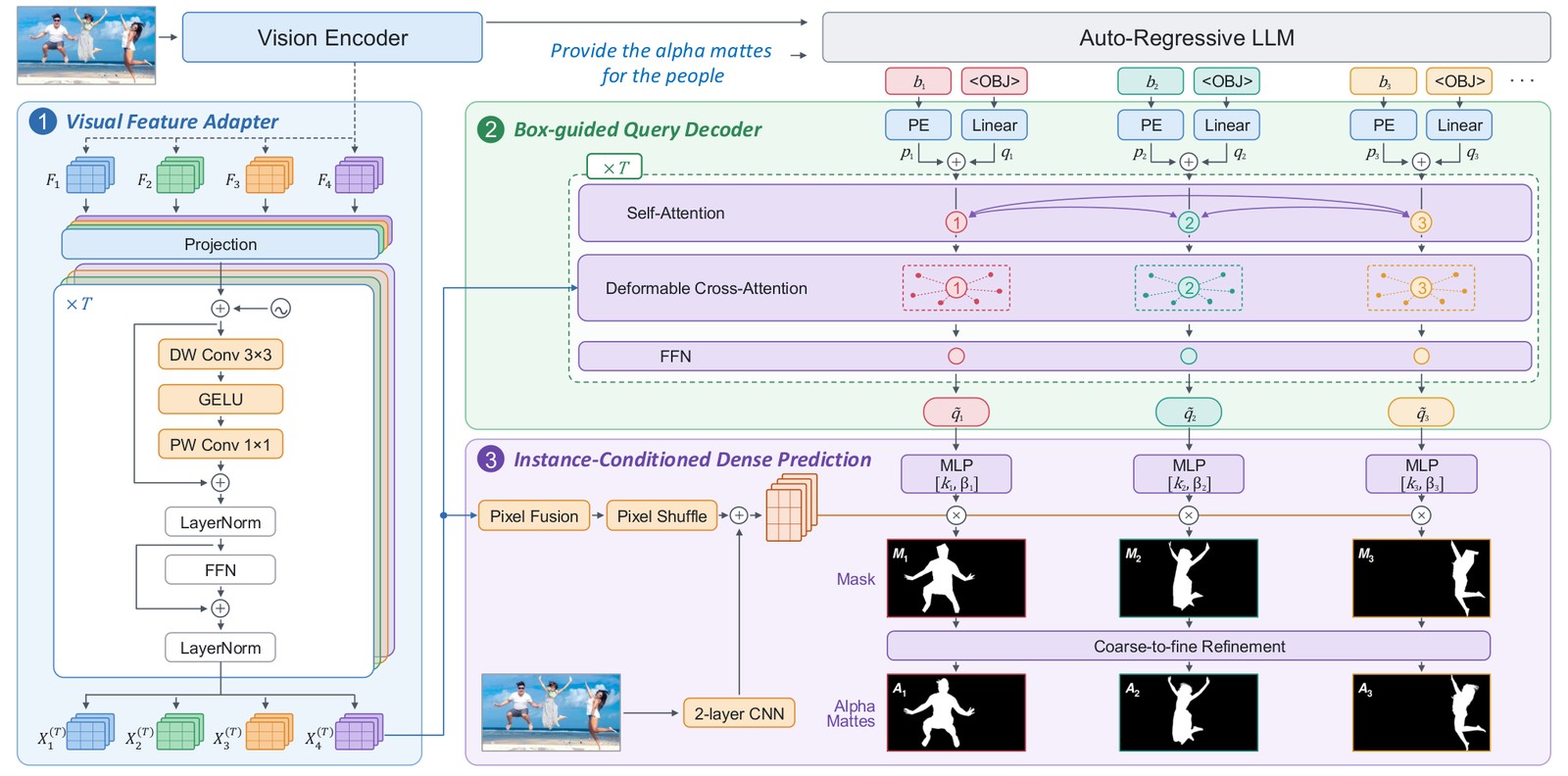
3. Model Architecture. A 9.6M-parameter pixel decoder combines the hidden state of each <OBJ> token, its predicted box and multi-level Qwen3-VL ViT features to predict a full-resolution mask or alpha matte.

Pixel decoder architecture

🚀 Quick Start

Installation

git clone https://github.com/Tencent/WeVisOne-VL.git && cd WeVisOne-VL
conda create -n wevisone-vl python=3.10 -y && conda activate wevisone-vl
pip install -r requirements.txt && pip install -v -e .

Inference

from PIL import Image
from wevisone_vl import WeVisOneVL
from wevisone_vl.visualization import save_result

model = WeVisOneVL("tencent/WeVisOne-VL-4B", backend="transformers")  # or backend="vllm"
# model = WeVisOneVL("tencent/WeVisOne-VL-2B", backend="transformers")  # Use 2B instead

# Object-level: open-vocabulary detection
image = Image.open("demo/examples/images/livingroom.jpg").convert("RGB")
result = model.predict(image, task="detection", query=["sofa", "pillow", "coffee table", "lamp"])
save_result("outputs/detection", image, result)

# Pixel-level: promptable alpha matting
image = Image.open("demo/examples/images/seabreeze.jpg").convert("RGB")
result = model.predict(image, task="matting", query="person")
save_result("outputs/matting", image, result)

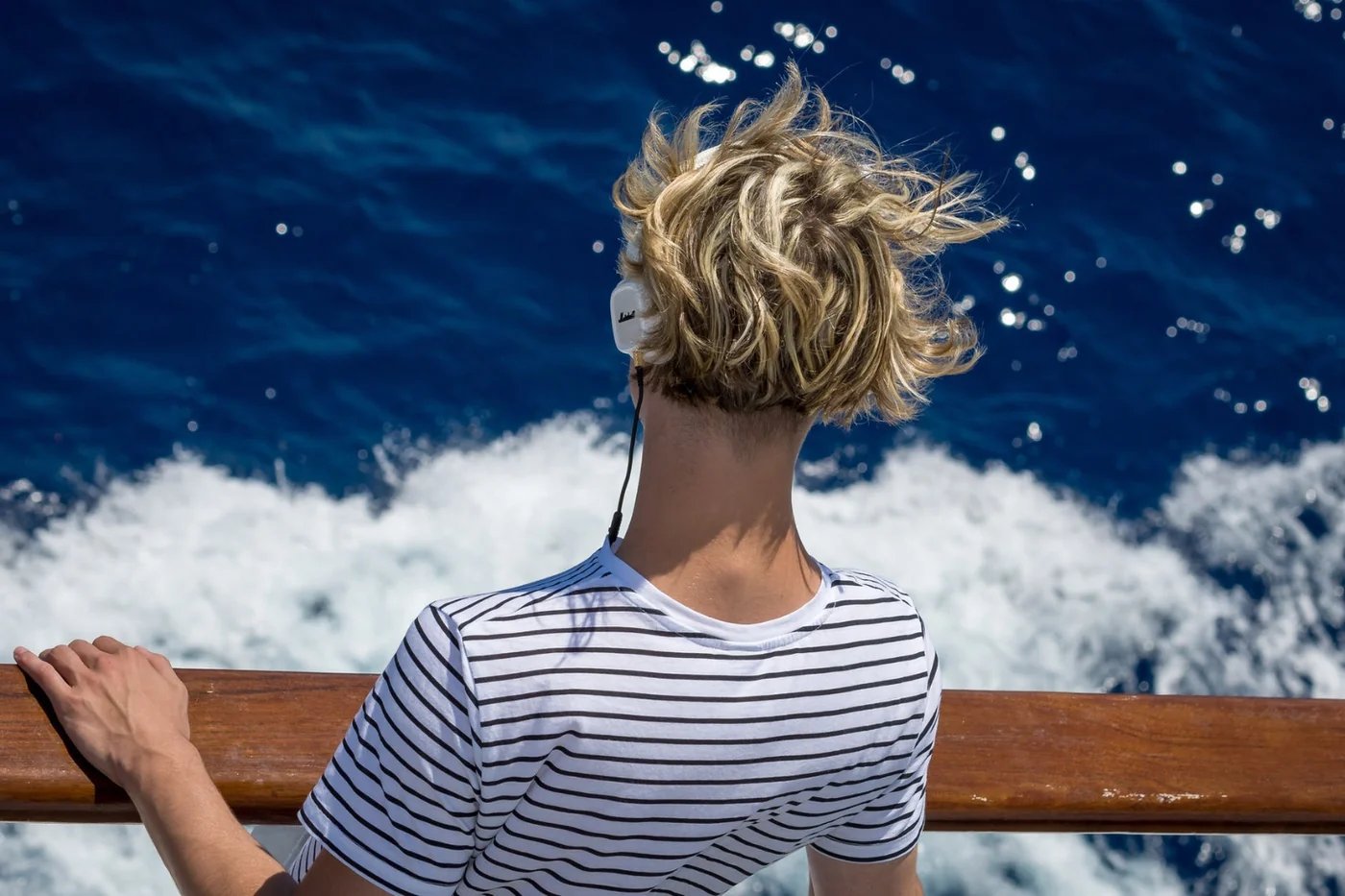
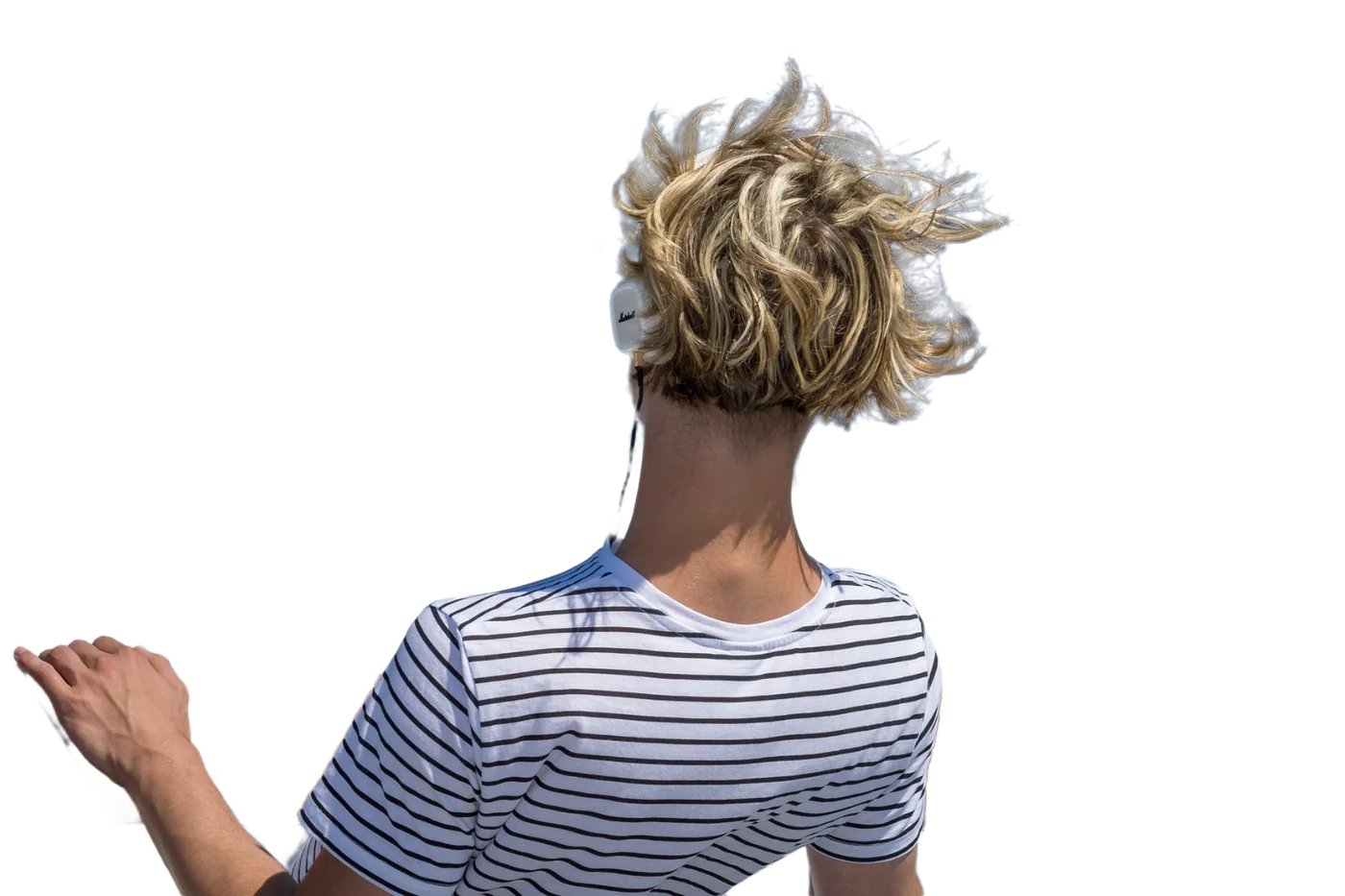
Input · query="person"

Predicted alpha matte

Cutout

Supported Tasks

task query Output
📦 detection category list boxes
💬 referring referring expression boxes or None
📍 point category / expression points
🔢 count_box / count_point category / expression boxes / points + count
🔤 ocr / ocr_grounding – / text to find text + boxes
🎭 segmentation category / expression boxes + binary masks
✂️ matting category / expression boxes + alpha mattes

[!TIP] device ("auto", "cuda:0", "npu:0", "cpu"), dtype, min_pixels / max_pixels, and the usual decoding arguments (max_new_tokens, temperature, ...) are also available. The Cookbooks walk through each task in detail.

📓 Cookbooks

Tutorial Covers
📦 Object-level pipeline Detection, Referring, Counting, Pointing
🔤 OCR pipeline OCR, Text Grounding
🎭 Pixel-level pipeline Segmentation, Matting

🎮 Gradio Demo

Try the hosted demo: 2B / 4B

Launch the demo locally:

CUDA_VISIBLE_DEVICES=0 python demo/app.py --model tencent/WeVisOne-VL-4B
# Or use 2B:
# CUDA_VISIBLE_DEVICES=0 python demo/app.py --model tencent/WeVisOne-VL-2B
More launch options
# vLLM backend on a custom port, with a public share link
CUDA_VISIBLE_DEVICES=0 python demo/app.py \
    --model tencent/WeVisOne-VL-4B --backend vllm \
    --server-name 0.0.0.0 --server-port 8080 --share

📊 Evaluation

See evaluation/README.md.

🖼️ Representative Visualizations

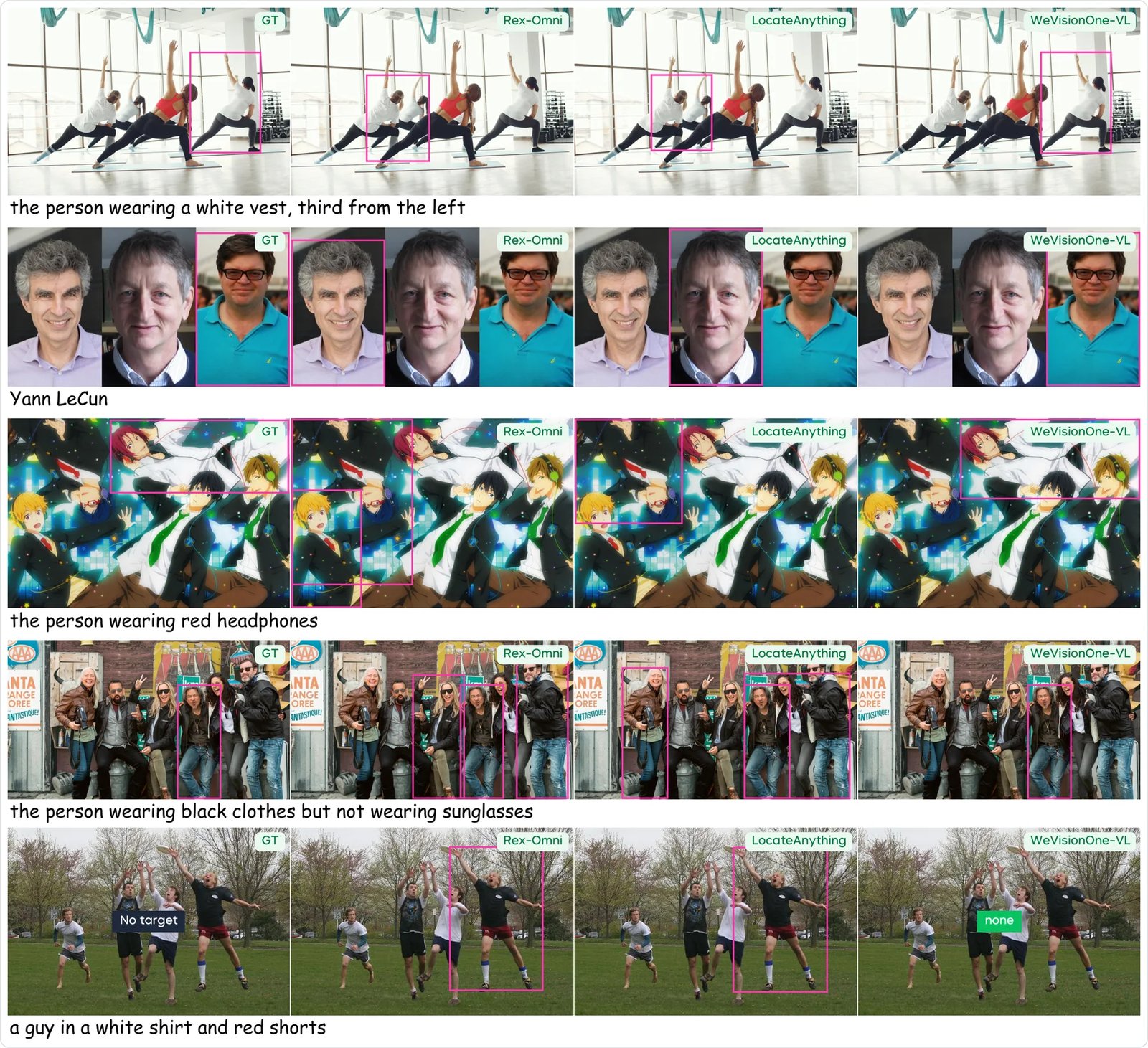
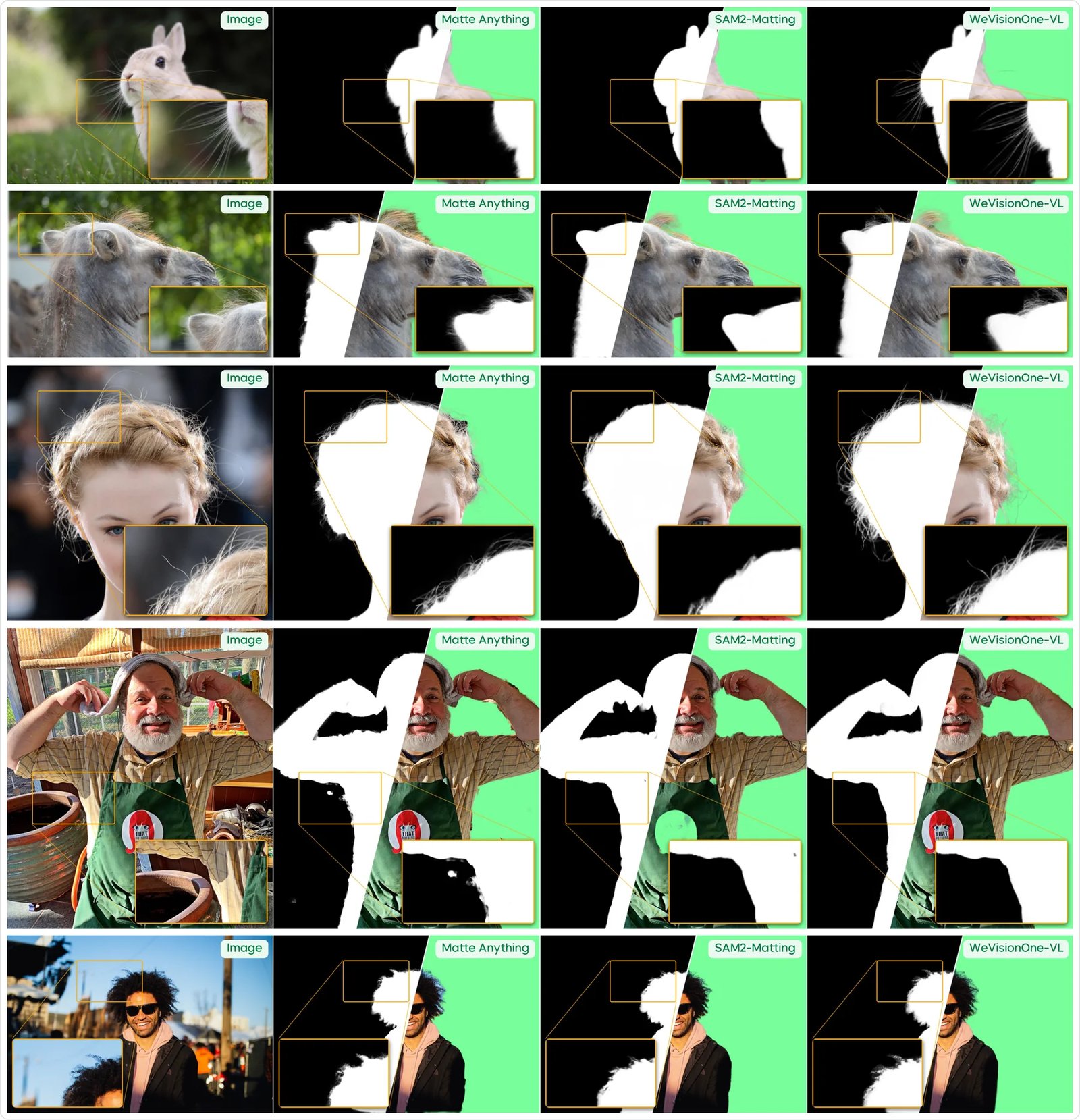
Side-by-side comparisons with strong baselines. Click a task to expand or collapse it.

Referring Detection — locating the objects described by a natural-language expression
Referring detection comparison
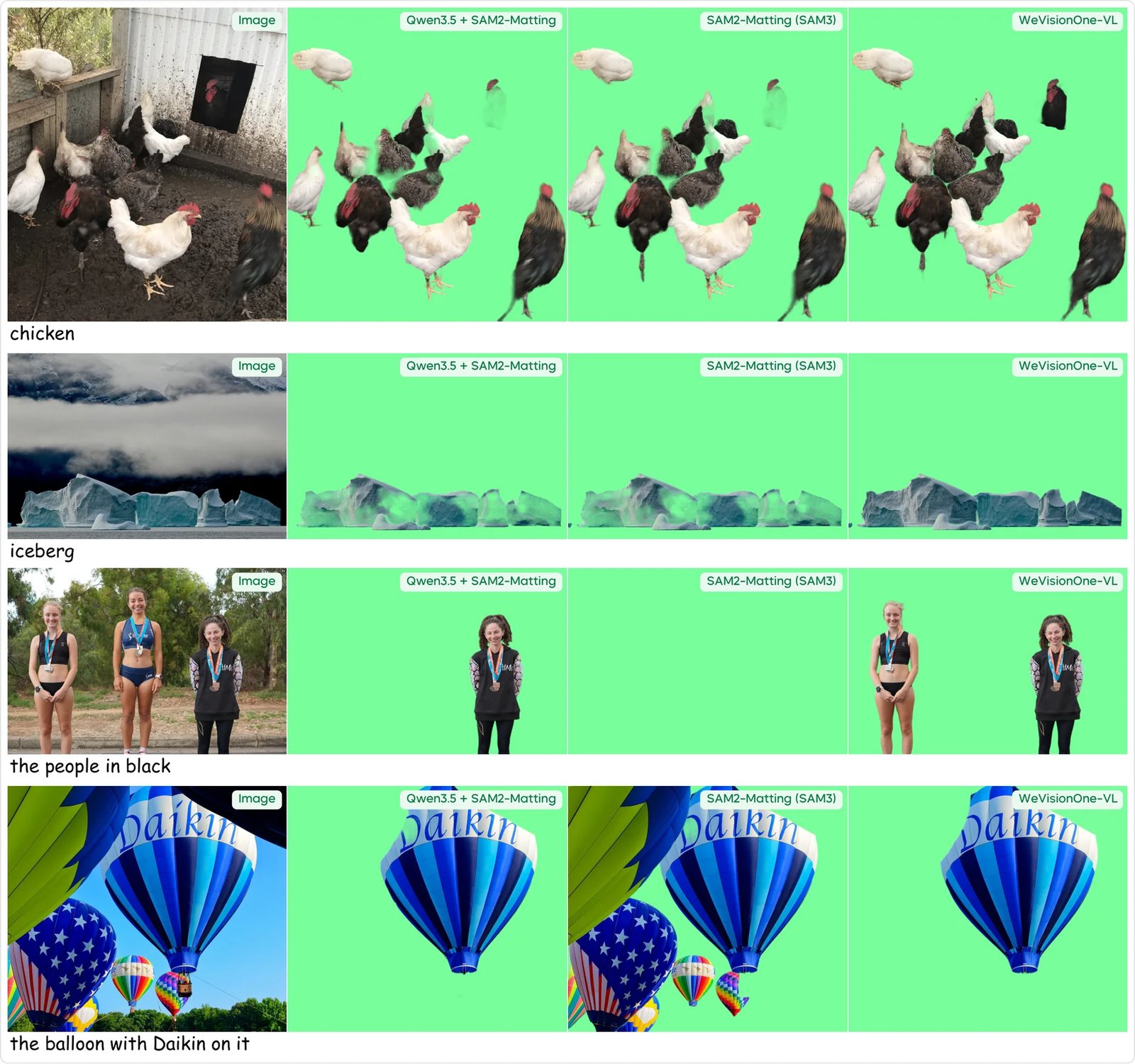
Box-prompted Matting — predicting the alpha matte of the target inside a given box
Box-prompted matting comparison
Text-prompted Matting — predicting the alpha matte of the target specified by a category name or referring expression
Text-prompted matting comparison
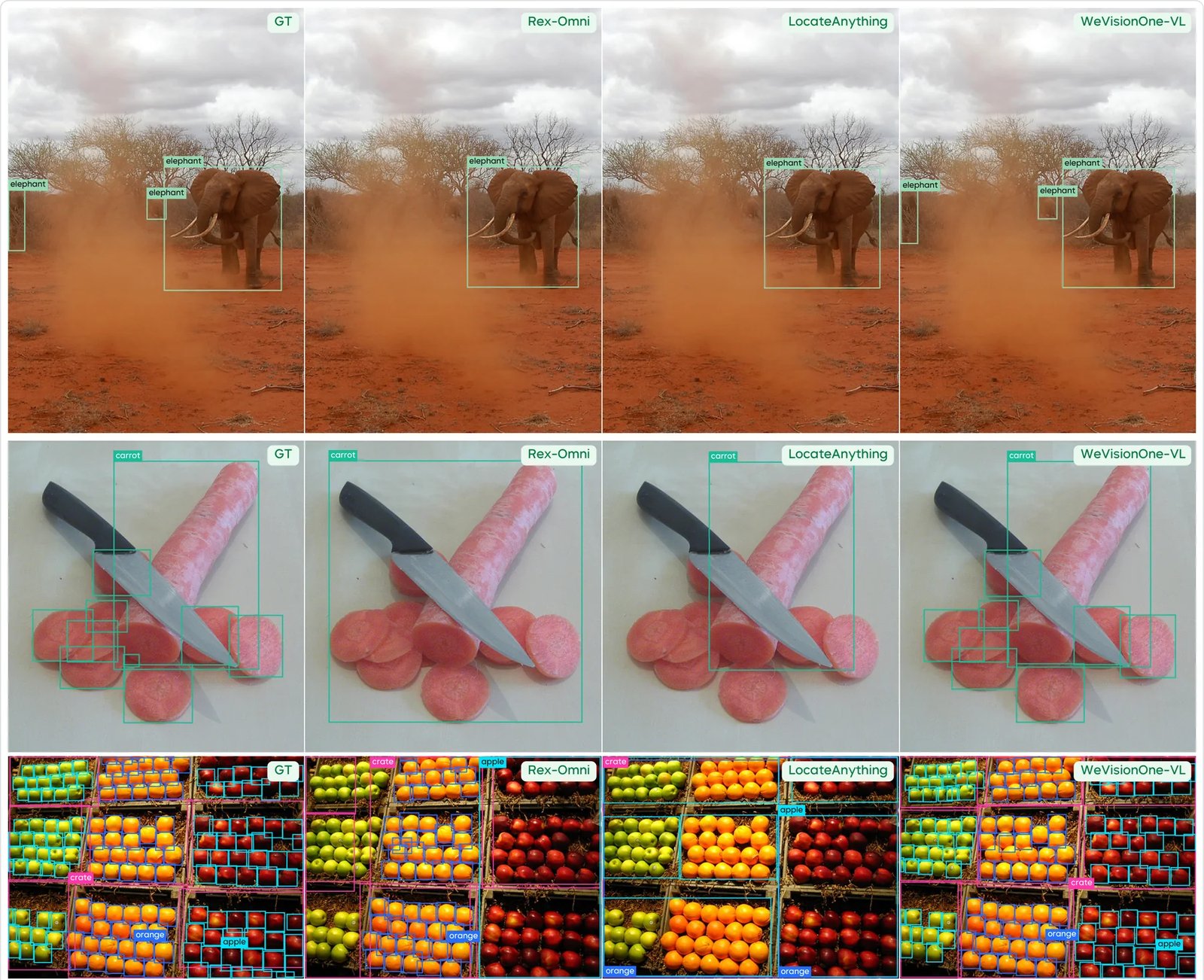
Object Detection — locating all instances of the given categories with boxes
Object detection comparison
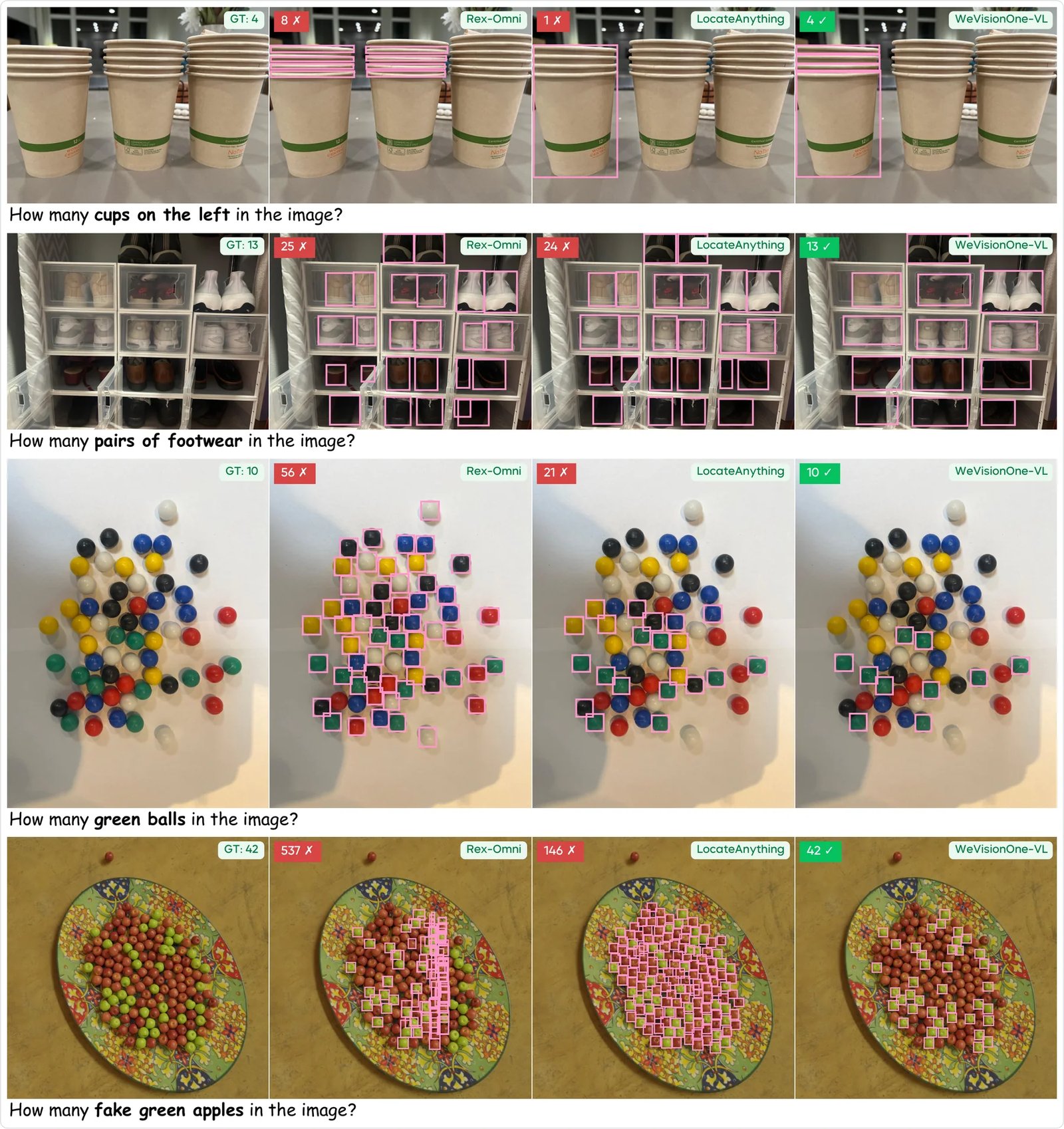
Object Counting — counting the instances that match a category or expression
Object counting comparison
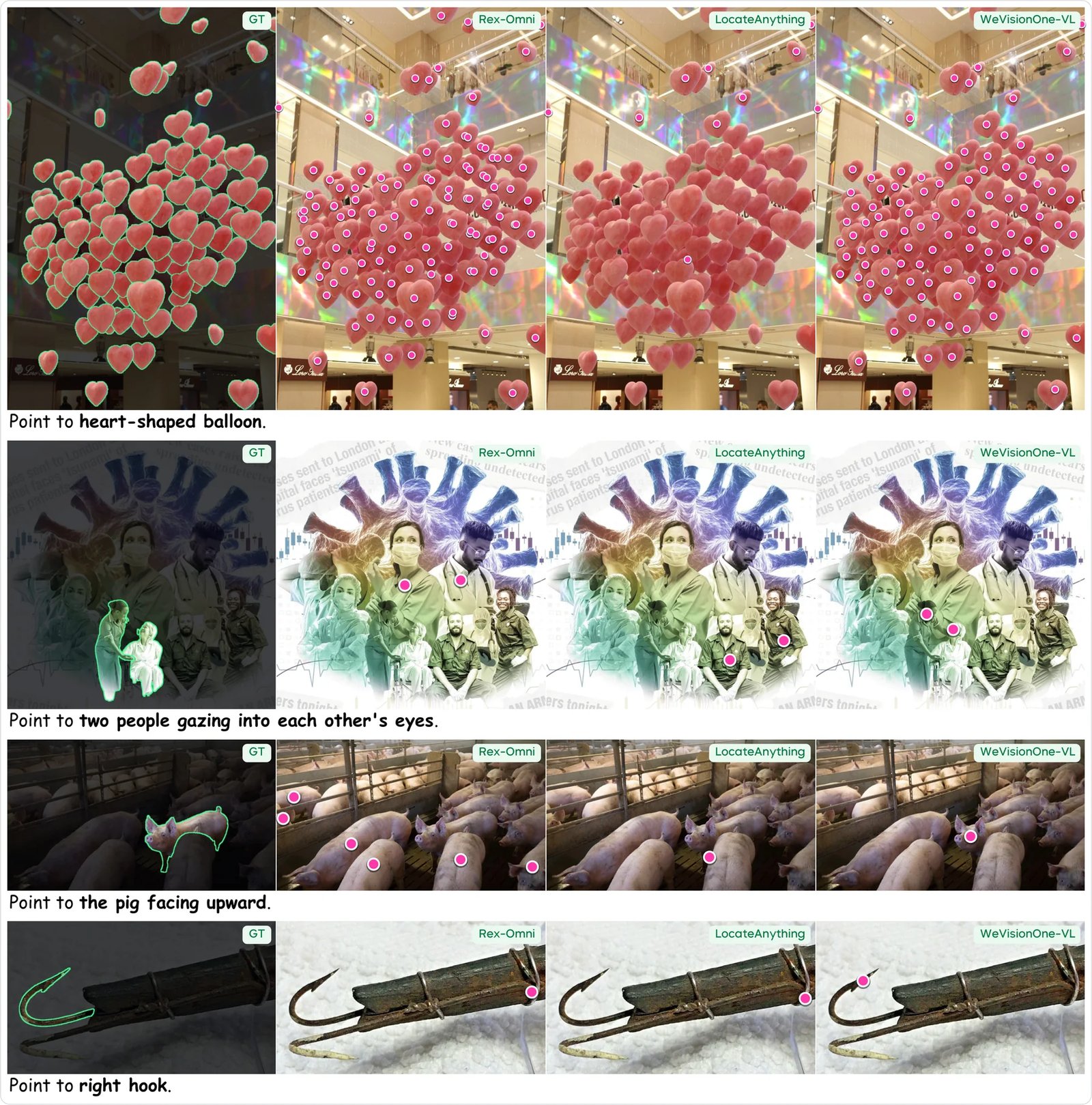
Object Pointing — marking each queried object with a point
Object pointing comparison
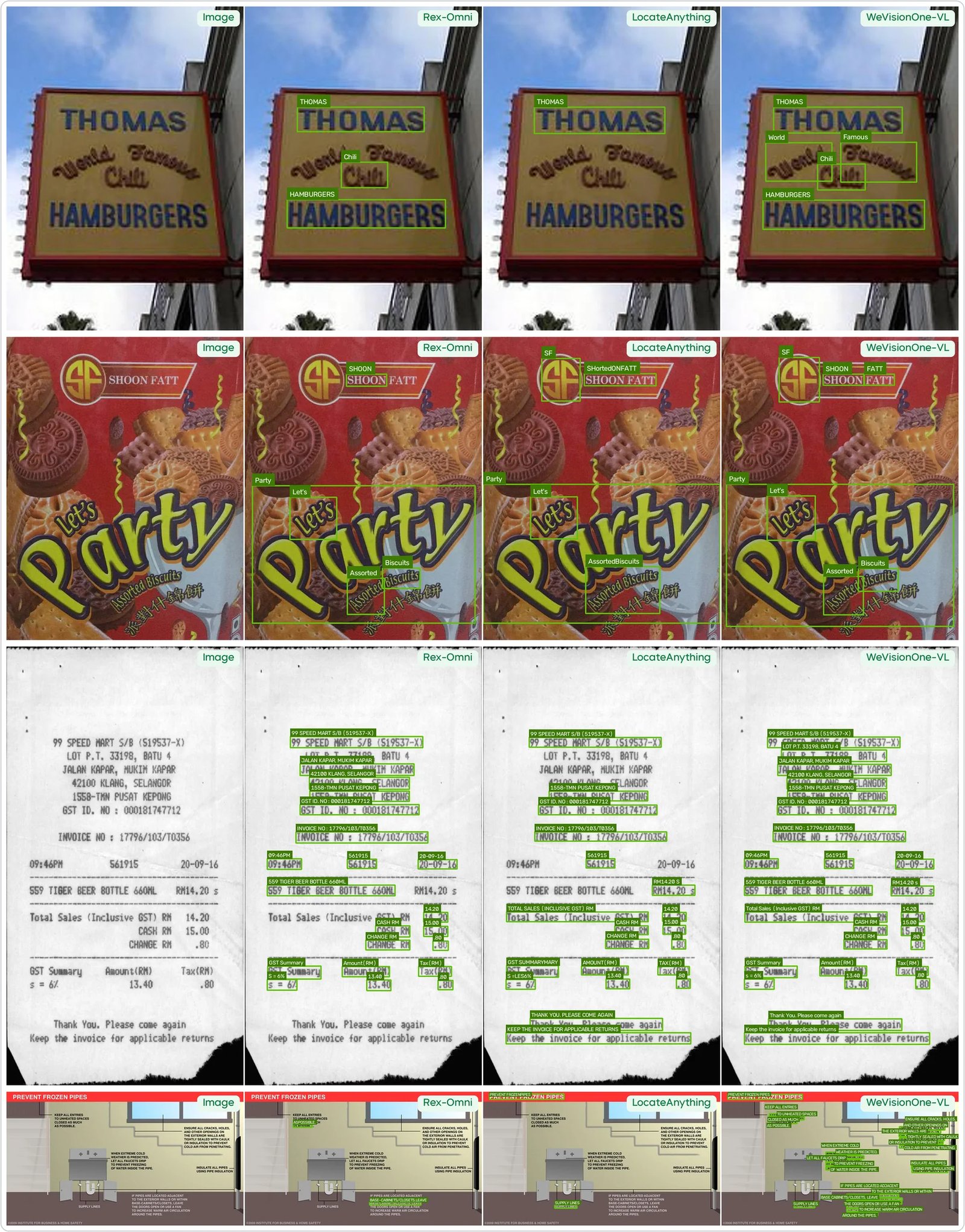
OCR — locating and recognizing text in the image
OCR comparison
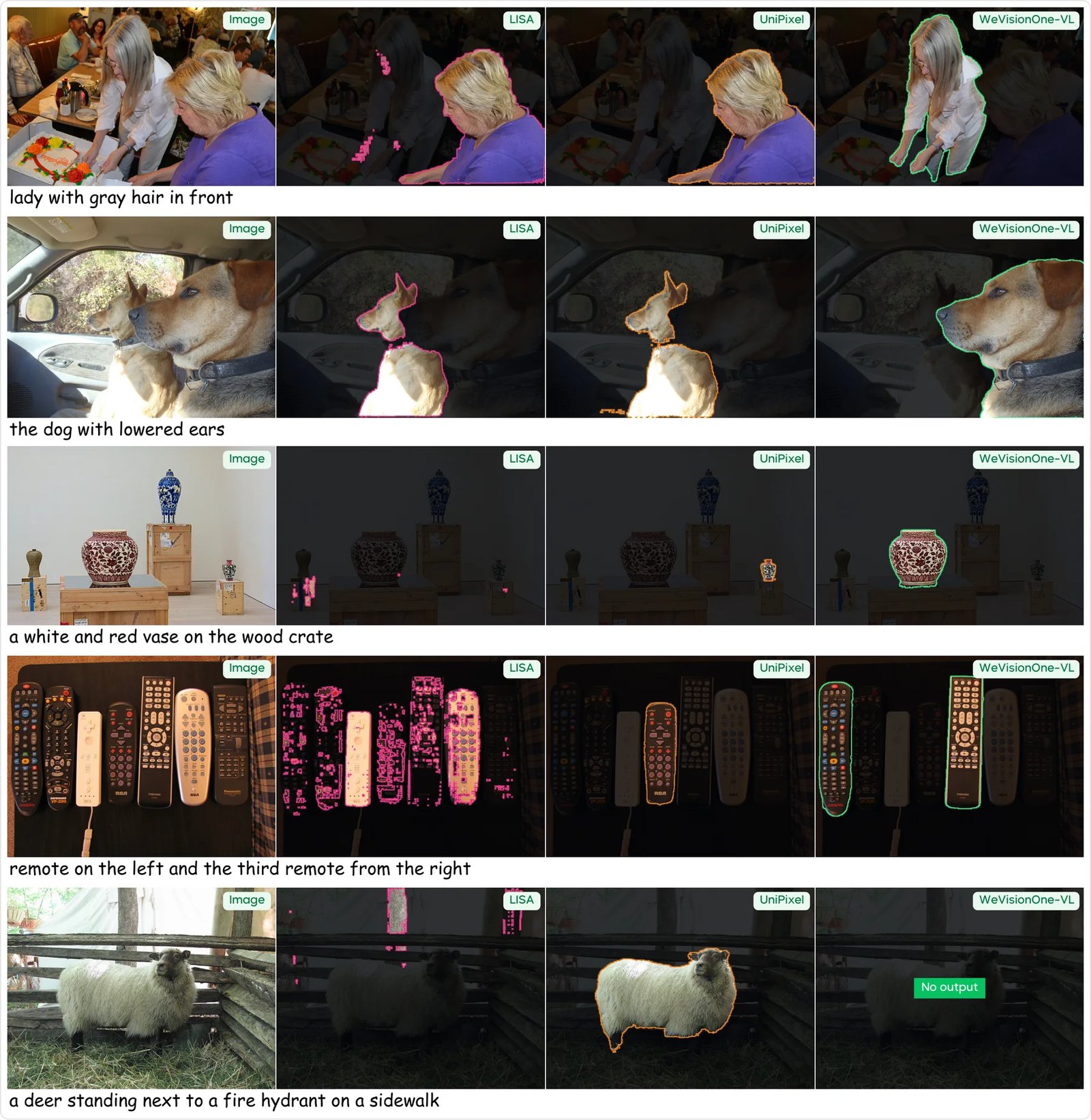
Referring Segmentation — segmenting the objects described by a natural-language expression
Referring segmentation comparison

📜 License

Tencent-authored code in this repository is released under the Apache License 2.0. Third-party components keep their original licenses; please check the corresponding source files.

📖 Citation

If WeVisOne-VL is helpful to your work, please consider giving us a ⭐ and citing:

@article{liang2026wevisone,
  title={WeVisOne-VL: Unified Visual Perception from Objects to Pixels},
  author={Liang, Tianming and Pan, Junyi and Li, Yuxi and Fu, Canmiao and Huang, Zhipeng and Sun, Chong and Li, Chen and Lyu, Jing},
  journal={arXiv preprint arXiv:2610.31329},
  year={2026}
}

WeVisOne-VL (Tencent/WeVisOne-VL)

Ищем в базе…

Что это такое?WeVisOne-VL — визуально-языковая модель от команды WeChat Vision Team компании Tencent. В одной модели объединены задачи на уровне объектов (детекция, поиск объекта по текстовому описанию, подсчёт, указание на объект, OCR) и задачи на уровне пикселей (сегментация, альфа-маттинг).
Это модель, которую я скачиваю, или сервис, к которому я обращаюсь?Веса скачиваете сами: модели 2B и 4B лежат на Hugging Face, а запускаете их через пакет inference. В README упоминается размещённое демо на Gradio, но размещённого API нет.
Как это запустить?Сначала попробуйте размещённое демо на Gradio для 2B или 4B — ничего устанавливать не нужно. Чтобы использовать модель в своём коде, установите пакет inference и следуйте Quick Start, а затем Cookbook, где подробно разобрана каждая задача.
Что нужно перед запуском?Веса модели с Hugging Face (2B или 4B) и пакет inference. Cookbook — это блокноты Jupyter, поэтому для них понадобится Jupyter. В README не указаны фиксированные версии.
Уже можно дообучать модель?Из этого репозитория — пока нет. Код для дообучения в списке TODO ещё не отмечен как выполненный, поэтому можно использовать только выпущенные веса 2B и 4B в исходном виде.
Можно запустить на CPU или нужен CUDA?Параметр device принимает значения 'auto', 'cuda:0', 'npu:0' или 'cpu', так что работа на CPU поддерживается. В README не указан объём видеопамяти, поэтому перед выбором железа посмотрите карточку модели.
Модель выдумывает объекты, которых нет на картинке?Нет, это заложено в её работу. Для отсутствующих целей она возвращает None вместо выдумки, а 4B показывает долю отказов 96,4 на WeRef-Bench.
Нужен ли SAM, чтобы получить маски и альфа-маттинг?Нет. Пиксельный декодер на 9,6 млн параметров сразу выдаёт маски и альфа-маттинг в полном разрешении, поэтому SAM не нужен.
Как 4B справляется с плотной детекцией?На детекции Dense200 она получает F1 71,3, тогда как лучший базовый вариант в главной таблице README — 58,7.
Что такое Mask2Alpha?Инструмент для аннотирования альфа-маттинга с открытым исходным кодом, доступный в ветке mask2alpha. Он превращает бинарные маски в высококачественные альфа-маттинги. Использовался в WeVisOne-VL Data Engine.
Какие есть похожие проекты?damo-radar, Qwen-Drive-1.0, dinov3, VisionHOPE, LongCat-Next, OmniParser, sam2, segment-anything
Автор
Tencent
Размер
30.4 MB
Звёзды
1.2K
Обновлён
КоммитOct 25
Возраст
27 д
Коммиты · 90 дней
