



%20%7C%20Windows-lightgrey)



💬 Join our Slack community!
We'd love for you to be part of the LEANN community!
👉 Join LEANN Slack
If the invite link has expired or you have trouble joining, please open an issue and we'll help you get in!
The smallest vector index in the world. RAG Everything with LEANN!
LEANN is an innovative vector database that democratizes personal AI. Transform your laptop into a powerful RAG system that can index and search through millions of documents while using 97% less storage than traditional solutions without accuracy loss.
LEANN achieves this through graph-based selective recomputation with high-degree preserving pruning, computing embeddings on-demand instead of storing them all. Illustration Fig → | Paper →
Ready to RAG Everything? Transform your laptop into a personal AI assistant that can semantic search your file system, emails, browser history, chat history (WeChat, iMessage), agent memory (ChatGPT, Claude), live data (Slack, Twitter), codebase*, or external knowledge bases (i.e., 60M documents) - all on your laptop, with zero cloud costs and complete privacy.
* Claude Code only supports basic grep-style keyword search. LEANN is a drop-in semantic search MCP service fully compatible with Claude Code, unlocking intelligent retrieval without changing your workflow. 🔥 Check out the easy setup →
Why LEANN?
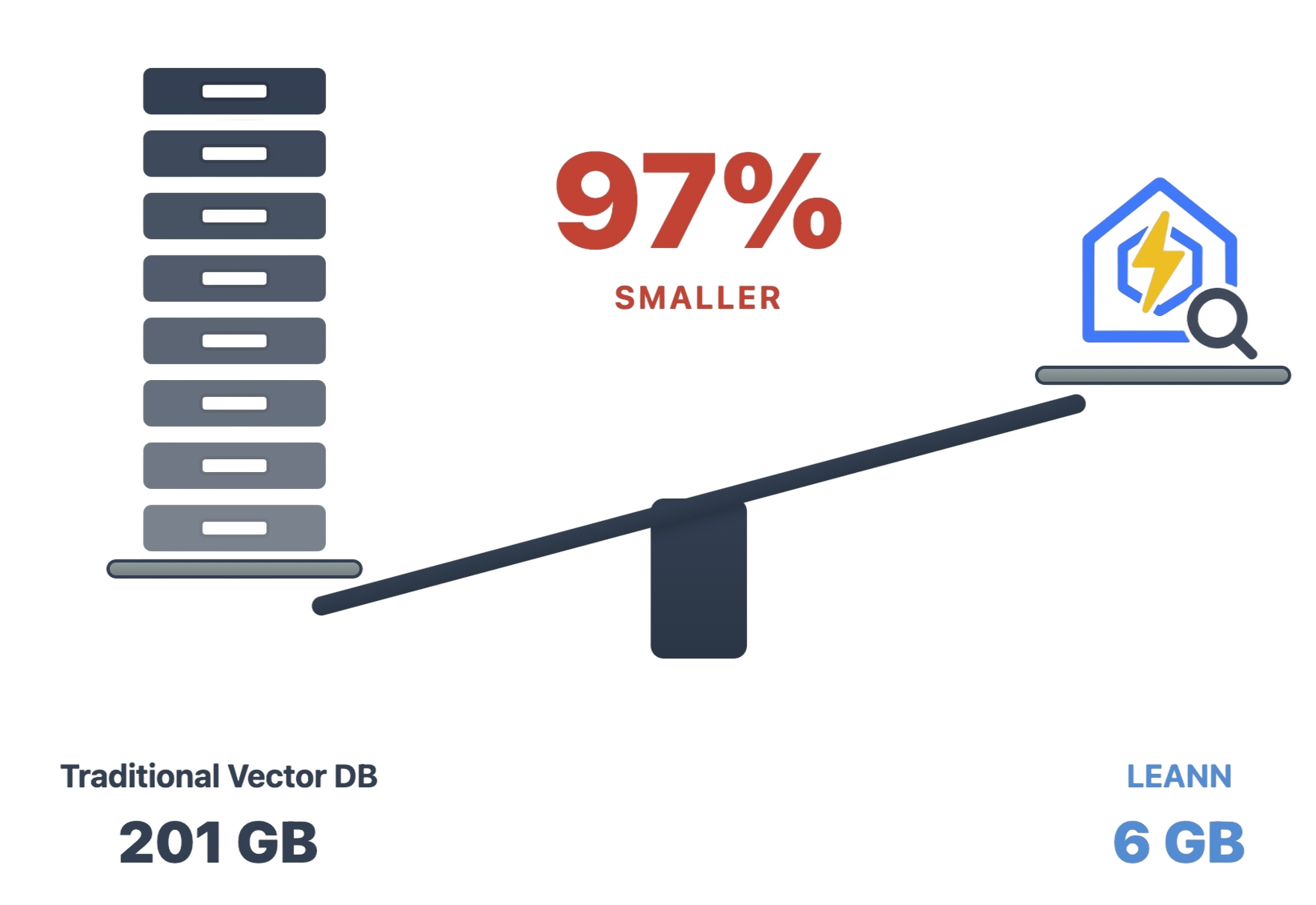
The numbers speak for themselves: Index 60 million text chunks in just 6GB instead of 201GB. From emails to browser history, everything fits on your laptop. See detailed benchmarks for different applications below ↓
🔒 Privacy: Your data never leaves your laptop. No OpenAI, no cloud, no "terms of service".
🪶 Lightweight: Graph-based recomputation eliminates heavy embedding storage, while smart graph pruning and CSR format minimize graph storage overhead. Always less storage, less memory usage!
📦 Portable: Transfer your entire knowledge base between devices (even with others) with minimal cost - your personal AI memory travels with you.
📈 Scalability: Handle messy personal data that would crash traditional vector DBs, easily managing your growing personalized data and agent generated memory!
✨ No Accuracy Loss: Maintain the same search quality as heavyweight solutions while using 97% less storage.
Making Your Coding Agent Smarter
We plugged LEANN into Claude Code and compared it with BM25 on 30 SWE-Bench Pro tasks from ContextBench, keeping the model, agent, tools, and 8,192-token retrieval budget fixed.
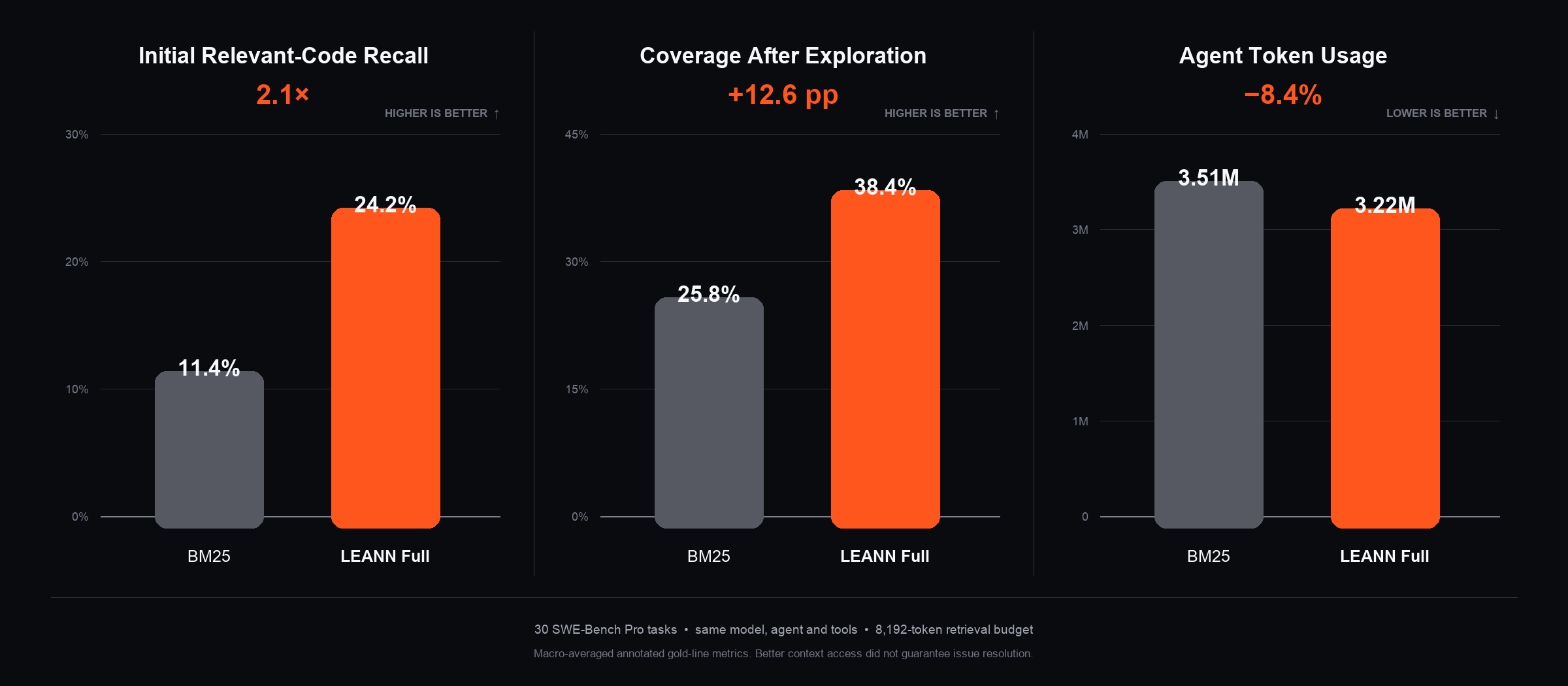
With LEANN, the agent achieved 2.1× the initial relevant-code recall (24.2% vs. 11.4%), reached 12.6 percentage points higher relevant-code coverage after exploration (38.4% vs. 25.8%), and used 8.4% fewer tokens (3.22M vs. 3.51M).
LEANN surfaces relevant code earlier, so coding agents can spend more of their context window reasoning about the right files instead of repeatedly scanning the repository. Reproduce the benchmark →
Note: Results are macro-averaged annotated gold-line metrics over 30 SWE-Bench Pro tasks. Better context access does not guarantee issue resolution.
Installation
📦 Prerequisites: Install uv
Install uv first if you don't have it. Typically, you can install it with:
curl -LsSf https://astral.sh/uv/install.sh | sh
🚀 Quick Install
Clone the repository to access all examples and try amazing applications,
git clone https://github.com/yichuan-w/LEANN.git leann
cd leann
and install LEANN from PyPI to run them immediately:
uv venv
source .venv/bin/activate
uv pip install leann

# CPU-only (Linux): use the `cpu` extra (e.g. `leann[cpu]`)
Linux note: if a later leann build fails with Security Violation [pathsec.open]: refusing multiply-linked file, reinstall with UV_LINK_MODE=copy uv pip install --reinstall ... (or UV_LINK_MODE=copy uv tool install --reinstall ...) - uv's default hardlink installs trip nltk's hardened file loader bundled with llama-index. Details in the FAQ.
🔧 Build from Source (Recommended for development)
git clone https://github.com/yichuan-w/LEANN.git leann
cd leann
git submodule update --init --recursive
macOS:
Note: DiskANN requires MacOS 13.3 or later.
brew install libomp boost protobuf zeromq pkgconf
uv sync --extra diskann
Linux (Ubuntu/Debian):
Note: On Ubuntu 20.04, you may need to build a newer Abseil and pin Protobuf (e.g., v3.20.x) for building DiskANN. See Issue #30 for a step-by-step note.
You can manually install Intel oneAPI MKL instead of libmkl-full-dev for DiskANN. You can also use libopenblas-dev for building HNSW only, by removing --extra diskann in the command below.
sudo apt-get update && sudo apt-get install -y \
  libomp-dev libboost-all-dev protobuf-compiler libzmq3-dev \
  pkg-config libabsl-dev libaio-dev libprotobuf-dev \
  libmkl-full-dev

uv sync --extra diskann
Linux (Arch Linux):
sudo pacman -Syu && sudo pacman -S --needed base-devel cmake pkgconf git gcc \
  boost boost-libs protobuf abseil-cpp libaio zeromq

# For MKL in DiskANN
sudo pacman -S --needed base-devel git
git clone https://aur.archlinux.org/paru-bin.git
cd paru-bin && makepkg -si
paru -S intel-oneapi-mkl intel-oneapi-compiler
source /opt/intel/oneapi/setvars.sh

uv sync --extra diskann
Linux (RHEL / CentOS Stream / Oracle / Rocky / AlmaLinux):
See Issue #50 for more details.
sudo dnf groupinstall -y "Development Tools"
sudo dnf install -y libomp-devel boost-devel protobuf-compiler protobuf-devel \
  abseil-cpp-devel libaio-devel zeromq-devel pkgconf-pkg-config

# For MKL in DiskANN
sudo dnf install -y intel-oneapi-mkl intel-oneapi-mkl-devel \
  intel-oneapi-openmp || sudo dnf install -y intel-oneapi-compiler
source /opt/intel/oneapi/setvars.sh

uv sync --extra diskann
Windows:
Requires Visual Studio 2022 Build Tools with the C++ desktop development workload, and vcpkg.
# Install toolchain (if not already present)
choco install cmake swig pkgconfiglite nuget.commandline -y

# Install C++ dependencies via vcpkg
vcpkg install zeromq:x64-windows openblas:x64-windows lapack:x64-windows `
  boost-program-options:x64-windows protobuf:x64-windows

# Set environment variables (adjust VCPKG_ROOT to your vcpkg path)
$env:CMAKE_PREFIX_PATH = "$env:VCPKG_ROOT\installed\x64-windows"
$env:PKG_CONFIG_PATH = "$env:VCPKG_ROOT\installed\x64-windows\lib\pkgconfig"
$env:PKG_CONFIG_EXECUTABLE = "C:\ProgramData\chocolatey\bin\pkg-config.exe"
$env:OPENBLAS_LIB = "$env:VCPKG_ROOT\installed\x64-windows\lib\openblas.lib"
$env:PATH += ";$env:VCPKG_ROOT\installed\x64-windows\bin"
$env:PATH += ";$env:VCPKG_ROOT\installed\x64-windows\tools\protobuf"

uv sync --extra diskann
Quick Start
Our declarative API makes RAG as easy as writing a config file.
Check out demo.ipynb or 
from leann import LeannBuilder, LeannSearcher, LeannChat
from pathlib import Path
INDEX_PATH = str(Path("./").resolve() / "demo.leann")

# Build an index
builder = LeannBuilder(backend_name="hnsw")
builder.add_text("LEANN saves 97% storage compared to traditional vector databases.")
builder.add_text("Tung Tung Tung Sahur called—they need their banana‑crocodile hybrid back")
builder.build_index(INDEX_PATH)

# Search
searcher = LeannSearcher(INDEX_PATH)
results = searcher.search("fantastical AI-generated creatures", top_k=1)

# Chat with your data
chat = LeannChat(INDEX_PATH, llm_config={"type": "hf", "model": "Qwen/Qwen3-0.6B"})
response = chat.ask("How much storage does LEANN save?", top_k=1)
RAG on Everything!
LEANN supports RAG on various data sources including documents (.pdf, .txt, .md), Apple Mail, Google Search History, WeChat, ChatGPT conversations, Claude conversations, iMessage conversations, and live data from any platform through MCP (Model Context Protocol) servers - including Slack, Twitter, and more.
Generation Model Setup
LLM Backend
LEANN supports many LLM providers for text generation (HuggingFace, Ollama, Anthropic, and Any OpenAI compatible API).
🔑 OpenAI API Setup (Default)
Set your OpenAI API key as an environment variable:
export OPENAI_API_KEY="your-api-key-here"
Make sure to use --llm openai flag when using the CLI.
You can also specify the model name with --llm-model <model-name> flag.
🛠️ Supported LLM & Embedding Providers (via OpenAI Compatibility)
Thanks to the widespread adoption of the OpenAI API format, LEANN is compatible out-of-the-box with a vast array of LLM and embedding providers. Simply set the OPENAI_BASE_URL and OPENAI_API_KEY environment variables to connect to your preferred service.
export OPENAI_API_KEY="xxx"
export OPENAI_BASE_URL="http://localhost:1234/v1" # base url of the provider
To use OpenAI compatible endpoint with the CLI interface:
If you are using it for text generation, make sure to use --llm openai flag and specify the model name with --llm-model <model-name> flag.
If you are using it for embedding, set the --embedding-mode openai flag and specify the model name with --embedding-model <MODEL>.
Below is a list of base URLs for common providers to get you started.
🖥️ Local Inference Engines (Recommended for full privacy)
| Provider |
Sample Base URL |
| Ollama |
http://localhost:11434/v1 |
| LM Studio |
http://localhost:1234/v1 |
| vLLM |
http://localhost:8000/v1 |
| llama.cpp |
http://localhost:8080/v1 |
| SGLang |
http://localhost:30000/v1 |
| LiteLLM |
http://localhost:4000 |
☁️ Cloud Providers
🚨 A Note on Privacy: Before choosing a cloud provider, carefully review their privacy and data retention policies. Depending on their terms, your data may be used for their own purposes, including but not limited to human reviews and model training, which can lead to serious consequences if not handled properly.
| Provider |
Base URL |
| OpenAI |
https://api.openai.com/v1 |
| OpenRouter |
https://openrouter.ai/api/v1 |
| Gemini |
https://generativelanguage.googleapis.com/v1beta/openai/ |
| x.AI (Grok) |
https://api.x.ai/v1 |
| Groq AI |
https://api.groq.com/openai/v1 |
| DeepSeek |
https://api.deepseek.com/v1 |
| SiliconFlow |
https://api.siliconflow.cn/v1 |
| Zhipu (BigModel) |
https://open.bigmodel.cn/api/paas/v4/ |
| Mistral AI |
https://api.mistral.ai/v1 |
| Anthropic |
https://api.anthropic.com/v1 |
| Jina AI (Embeddings) |
https://api.jina.ai/v1 |
💡 Tip: Separate Embedding Provider
To use a different provider for embeddings (e.g., Jina AI) while using another for LLM, use --embedding-api-base and --embedding-api-key:
leann build my-index --docs ./docs \
  --embedding-mode openai \
  --embedding-model jina-embeddings-v3 \
  --embedding-api-base https://api.jina.ai/v1 \
  --embedding-api-key $JINA_API_KEY
If your provider isn't on this list, don't worry! Check their documentation for an OpenAI-compatible endpoint—chances are, it's OpenAI Compatible too!
🔧 Ollama Setup (Recommended for full privacy)
macOS:
First, download Ollama for macOS.
# Pull a lightweight model (recommended for consumer hardware)
ollama pull llama3.2:1b
Linux:
# Install Ollama
curl -fsSL https://ollama.ai/install.sh | sh

# Start Ollama service manually
ollama serve &

# Pull a lightweight model (recommended for consumer hardware)
ollama pull llama3.2:1b
⭐ Flexible Configuration
LEANN provides flexible parameters for embedding models, search strategies, and data processing to fit your specific needs.
📚 Need configuration best practices? Check our Configuration Guide for detailed optimization tips, model selection advice, and solutions to common issues like slow embeddings or poor search quality.
📋 Click to expand: Common Parameters (Available in All Examples)
All RAG examples share these common parameters. Interactive mode is available in all examples - simply run without --query to start a continuous Q&A session where you can ask multiple questions. Type 'quit' to exit.
# Environment Variables (GPU Device Selection)
LEANN_EMBEDDING_DEVICE       # GPU for embedding model (e.g., cuda:0, cuda:1, cpu)
LEANN_LLM_DEVICE             # GPU for HFChat LLM (e.g., cuda:1, or "cuda" for multi-GPU auto)

# Core Parameters (General preprocessing for all examples)
--index-dir DIR              # Directory to store the index (default: current directory)
--query "YOUR QUESTION"      # Single query mode. Omit for interactive chat (type 'quit' to exit), and now you can play with your index interactively
--max-items N                # Limit data preprocessing (default: -1, process all data)
--force-rebuild              # Force rebuild index even if it exists

# Embedding Parameters
--embedding-model MODEL      # e.g., facebook/contriever, text-embedding-3-small, mlx-community/Qwen3-Embedding-0.6B-8bit or nomic-embed-text
--embedding-mode MODE        # sentence-transformers, openai, mlx, or ollama

# LLM Parameters (Text generation models)
--llm TYPE                   # LLM backend: openai, ollama, hf, or anthropic (default: openai)
--llm-model MODEL            # Model name (default: gpt-4o) e.g., gpt-4o-mini, llama3.2:1b, Qwen/Qwen2.5-1.5B-Instruct
--thinking-budget LEVEL      # Thinking budget for reasoning models: low/medium/high (supported by o3, o3-mini, GPT-Oss:20b, and other reasoning models)

# Search Parameters
--top-k N                    # Number of results to retrieve (default: 20)
--search-complexity N        # Search complexity for graph traversal (default: 32)

# Chunking Parameters
--chunk-size N               # Size of text chunks (default varies by source: 256 for most, 192 for WeChat)
--chunk-overlap N            # Overlap between chunks (default varies: 25-128 depending on source)

# Index Building Parameters
--backend-name NAME          # Backend to use: hnsw or diskann (default: hnsw)
--graph-degree N             # Graph degree for index construction (default: 32)
--build-complexity N         # Build complexity for index construction (default: 64)
--compact / --no-compact     # Use compact storage (default: true). Must be `no-compact` for `no-recompute` build.
--recompute / --no-recompute # Enable/disable embedding recomputation (default: enabled). Should not do a `no-recompute` search in a `recompute` build.
📄 Personal Data Manager: Process Any Documents (.pdf, .txt, .md)!
Ask questions directly about your personal PDFs, documents, and any directory containing your files!
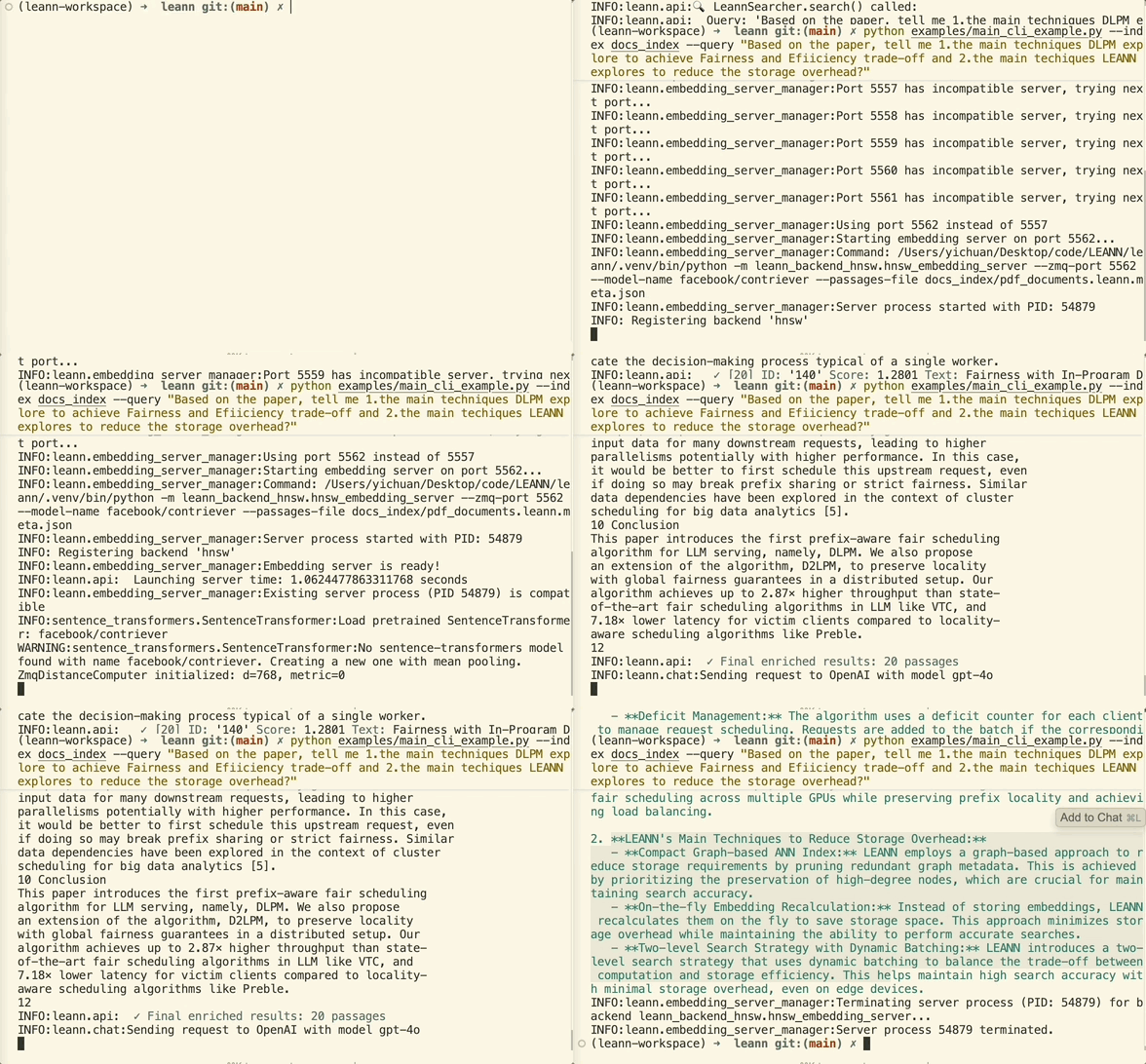
The example below asks a question about summarizing our paper (uses default data in data/, which is a directory with diverse data sources: two papers, Pride and Prejudice, and a Technical report about LLM in Huawei in Chinese), and this is the easiest example to run here:
source .venv/bin/activate # Don't forget t


 LEANN is a vector database that lets you run retrieval-augmented generation (RAG) over millions of personal documents on your own laptop using 97% less storage than traditional vector databases, with no accuracy loss.