








What is this?
 OpenNHP is a lightweight, cryptography-powered, open-source Zero Trust toolkit: it hides server ports, IP addresses, and domain names so your infrastructure stays invisible until a client is cryptographically authorized.
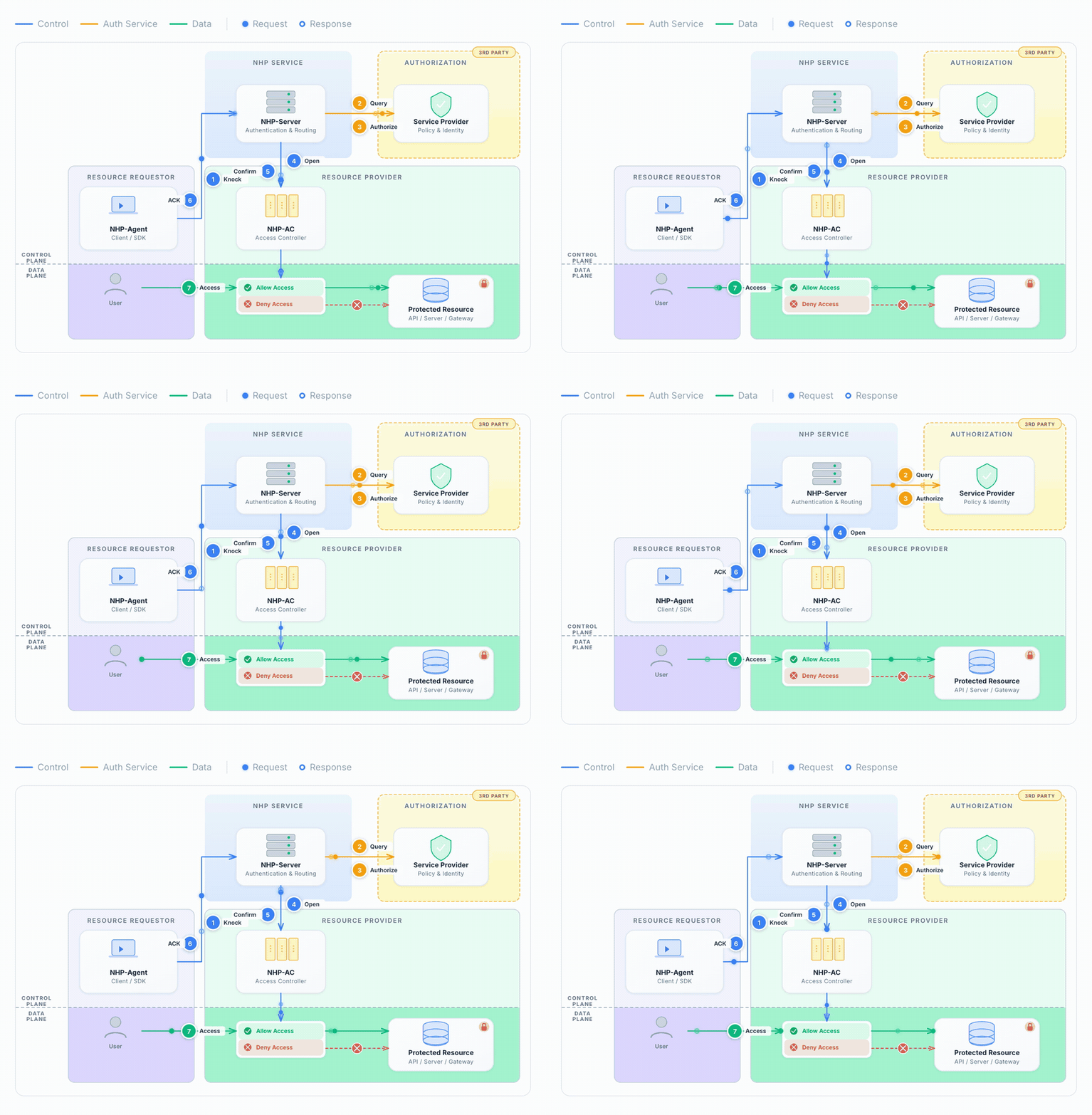
Is this a single program, or several components I deploy together?It's a kit of cooperating components, not one app: NHP-Agent (the client), NHP-Server (authenticates knocks, runs decoupled from the protected host), and NHP-AC (manages firewall rules on the protected server).
It's a kit of cooperating components, not one app: NHP-Agent (the client), NHP-Server (authenticates knocks, runs decoupled from the protected host), and NHP-AC (manages firewall rules on the protected server).How do I get it running?You need Go 1.26+ and make to build, plus Docker and Docker Compose for the demo. The Quick Start tutorial simulates the full authentication workflow in a Docker environment.
You need Go 1.26+ and make to build, plus Docker and Docker Compose for the demo. The Quick Start tutorial simulates the full authentication workflow in a Docker environment.Do clients need special software to connect — will my regular browser work?Clients must speak the NHP knock protocol; a plain browser can't send the UDP knock directly. For browser-based agents there's NHP-Relay, an HTTP-to-UDP bridge that sends knocks over HTTPS.
Clients must speak the NHP knock protocol; a plain browser can't send the UDP knock directly. For browser-based agents there's NHP-Relay, an HTTP-to-UDP bridge that sends knocks over HTTPS.Where does this actually run?It deploys on your own servers (typically Linux) as Go-built components, with the Quick Start running the whole stack in Docker Compose.
It deploys on your own servers (typically Linux) as Go-built components, with the Quick Start running the whole stack in Docker Compose.Does it do anything about protecting the data itself, not just the network?Yes — that's the second protocol: DHP uses encryption and confidential computing so data stays 'usable but not visible' even while it's processed.
Yes — that's the second protocol: DHP uses encryption and confidential computing so data stays 'usable but not visible' even while it's processed.What is the difference between NHP and DHP?NHP works at the network layer: ports, IP addresses, and domain names stay hidden until an authorized knock opens them. DHP works at the data layer: encryption and confidential computing keep data 'usable but not visible' even where it's processed.
NHP works at the network layer: ports, IP addresses, and domain names stay hidden until an authorized knock opens them. DHP works at the data layer: encryption and confidential computing keep data 'usable but not visible' even where it's processed.How is NHP different from older port-knocking approaches?It's positioned as the third generation. Port knocking sent plaintext sequences and was replay-prone; Single Packet Authorization added crypto but used shared secrets, was one-way, and typically hid only ports. NHP brings modern Noise-framework crypto, bi-directional status, hides domains along with IPs and ports, and is stateless so it scales horizontally — all in memory-safe Go.
It's positioned as the third generation. Port knocking sent plaintext sequences and was replay-prone; Single Packet Authorization added crypto but used shared secrets, was one-way, and typically hid only ports. NHP brings modern Noise-framework crypto, bi-directional status, hides domains along with IPs and ports, and is stateless so it scales horizontally — all in memory-safe Go.Why hide servers at all when AI-driven scanners exist?Because in the authors' words, in the AI era visibility equals vulnerability: LLM-backed attackers fingerprint and exploit exposed services at machine speed. OpenNHP's answer is default-deny — attackers can't exploit what they can't discover.
Because in the authors' words, in the AI era visibility equals vulnerability: LLM-backed attackers fingerprint and exploit exposed services at machine speed. OpenNHP's answer is default-deny — attackers can't exploit what they can't discover.What is NHP-KGC for?It's the Key Generation Center for Identity-Based Cryptography — an optional mode where keys tie to identities and are issued by the KGC, instead of pre-distributing certificates between every agent and server.
It's the Key Generation Center for Identity-Based Cryptography — an optional mode where keys tie to identities and are issued by the KGC, instead of pre-distributing certificates between every agent and server.What are similar projects?flowsint, pangolin, cloudflared, scuttle, trufflehog, nebula, netbird, gun
flowsint, pangolin, cloudflared, scuttle, trufflehog, nebula, netbird, gunWhich topics is it in?zero-trust, cryptography, infrastructure, authentication, cybersecurity, encryption, security-tools, docker-compose, networking, go, privacy, security
zero-trust, cryptography, infrastructure, authentication, cybersecurity, encryption, security-tools, docker-compose, networking, go, privacy, security