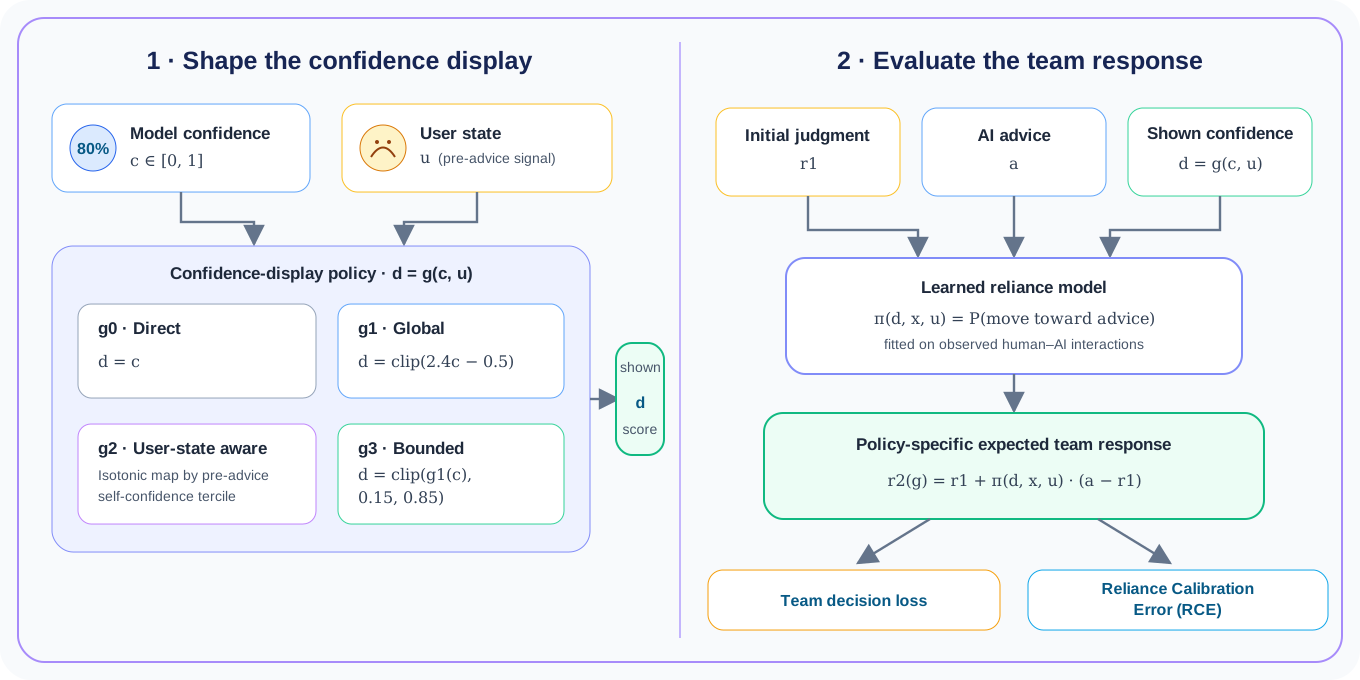
From Calibrated Confidence to Calibrated Reliance
Human-Aware Confidence Communication for AI-Assisted Decision Making





Accepted for publication in ACM Transactions on Social Computing (TSC).
Most calibration work asks whether a model is correct 80% of the time when it reports 80%
confidence. We ask a different question: after a person sees that confidence and makes the final
decision, is the human-AI team correct 80% of the time?
This repository provides the accepted paper's CPU-only offline analysis, the implementation of
Reliance Calibration Error (RCE), the g0-g3 confidence-display policies, deterministic data
setup, compact reference outputs, and numerical regression checks.
Quick start: use the policies
Install the package from a local clone; using the policy and metric APIs does not require the
HAIID dataset.
git clone https://github.com/OliverDOU776/From-Calibrated-Confidence-to-Calibrated-Reliance.git
cd From-Calibrated-Confidence-to-Calibrated-Reliance
python3 -m venv .venv
source .venv/bin/activate
python -m pip install -e .
Apply the three fixed display policies and compute RCE on your own logged team outcomes:
import numpy as np

from calibrated_reliance import bounded_g1, g0, g1, g3, rce

confidence = np.array([0.35, 0.55, 0.80])
final_team_correct = np.array([0, 1, 1])

displayed = {
    "g0_direct": g0(confidence),
    "g1_global": g1(confidence),
    "g3_bounded": g3(confidence),
    "g1_max_shift_10pct": bounded_g1(confidence, delta=0.10),
}

for name, values in displayed.items():
    print(name, values, "RCE =", rce(values, final_team_correct))
Fit g2 on training interactions, then apply it to held-out or future interactions. The three
aligned training arrays are model confidence, pre-advice self-confidence, and final team
correctness:
from calibrated_reliance import apply_g2, fit_g2

g2_policy = fit_g2(
    confidence_train,
    self_confidence_train,
    final_team_correct_train,
)
display_g2 = apply_g2(g2_policy, confidence_test, self_confidence_test)
To compare a display under the paper's fitted human-reliance model, use prepared HAIID-format
training and test frames:
from calibrated_reliance import evaluate_policy, fit_reliance_model, g3

reliance_model = fit_reliance_model(train)
display_g3 = g3(test["advice_prob"])
evaluation = evaluate_policy(reliance_model, test, display_g3)

print(evaluation.mse, evaluation.rce, evaluation.mean_reliance)
Here evaluation.rce is a model-predicted off-policy diagnostic. For observed team outcomes, use
rce(displayed, final_team_correct) directly. The expected columns and estimands are documented in
docs/METHOD.md.
Before deployment: g1, g2, and g3 encode estimates and safeguards from the paper; they
are not universal calibration maps. Refit or validate a policy on your population, preserve a
held-out evaluation set, and retain a direct-display fallback.
What you can do with this repository
- Audit your own human-AI logs: call
rce(displayed, final_team_correct) to quantify whether a
shown score matches final team correctness.
- Prototype a display layer: call
g0, g1, g3, or bounded_g1 without modifying or
retraining the underlying predictor.
- Learn a user-state-aware map: use
fit_g2 on training interactions and apply_g2 on new
interactions; sparse or missing self-confidence groups use the global fallback.
- Compare candidate displays offline: fit the baseline reliance model once, then call
evaluate_policy for each candidate display vector.
- Reproduce and inspect the paper: regenerate the accepted analysis tables from pinned public
data and verify them numerically against the checked-in reference outputs.
Why calibrated confidence is not enough
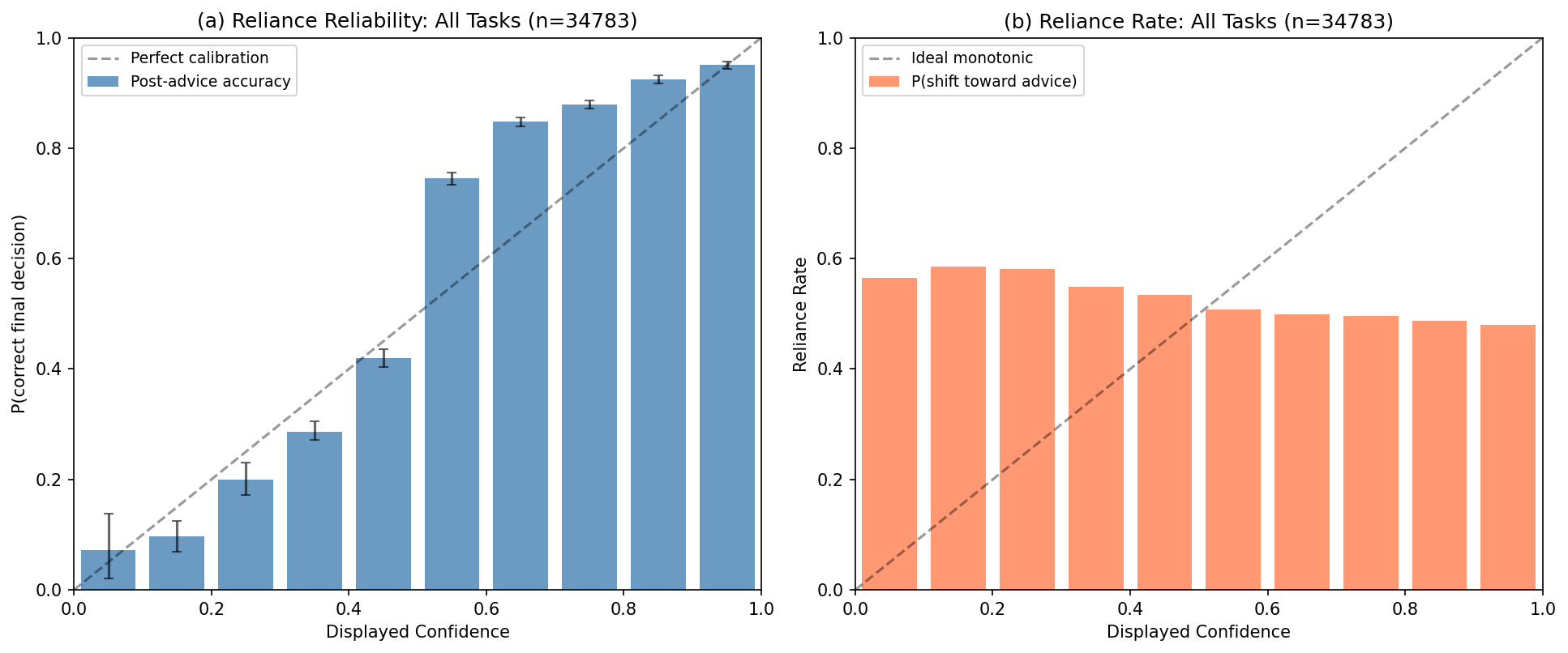
A statistically calibrated model can still induce poorly calibrated human reliance. People combine
AI advice with their own beliefs, confidence, and task context; the displayed number is therefore
filtered through human judgment before it affects the final decision.
We formalize calibrated reliance as a team-level property. For a display policy g, the shown
confidence is calibrated when
$$
\Pr(\text{final human-AI decision is correct} \mid D_g=d)=d.
$$
RCE summarizes deviations from that ideal:
$$
\mathrm{RCE}(g)=\mathbb{E}\left[\left|\eta_g(D_g)-D_g\right|\right].
$$
The distinction matters empirically: in the primary HAIID condition, conventional model ECE is
0.018, while direct-display plug-in RCE is 0.114.
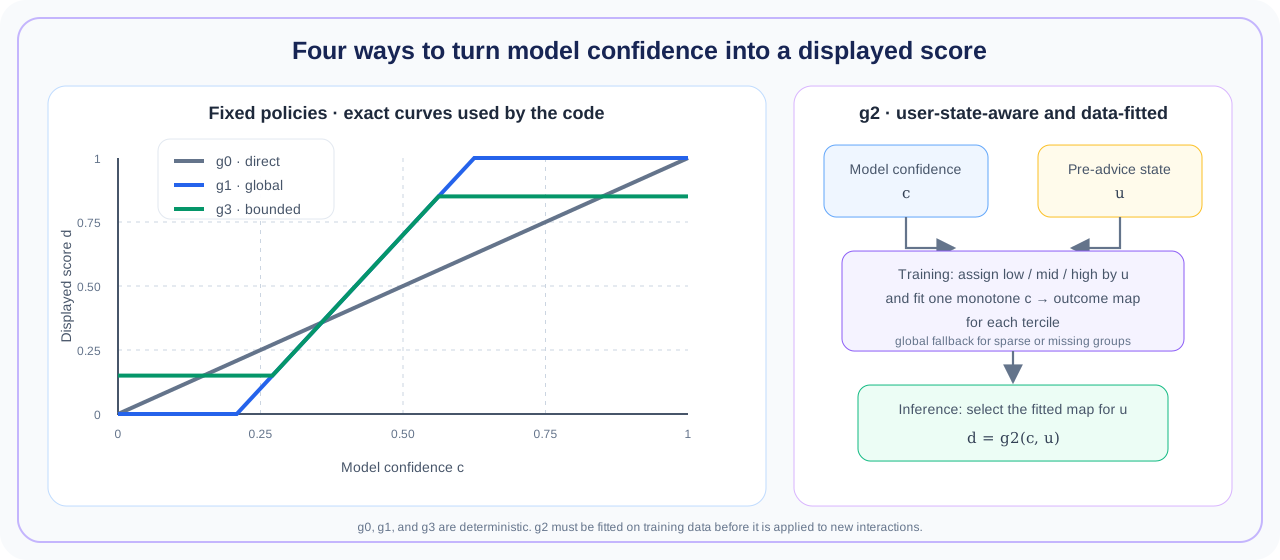
The confidence-display policies
| Policy |
Definition |
Interpretation |
g0 |
d = c |
Directly display the model confidence. |
g1 |
d = clip(2.4c - 0.5, 0, 1) |
Global human-aware diagnostic mapping. It is intentionally treated as unconstrained, not automatically deployment-ready. |
g2 |
Isotonic mapping fitted within pre-advice self-confidence terciles |
Captures user-state heterogeneity. It requires reliable elicitation, governance checks, and a safe fallback. |
g3 |
d = clip(g1(c), 0.15, 0.85) |
Bounded global mapping that avoids 0/1 displays. |
g2 is not presented as a fairness guarantee. If self-confidence is missing, noisy, correlated
with protected attributes, or strategically reported, the system should fall back to g0 or a
bounded population-level policy.
See docs/METHOD.md for equations, estimands, and implementation details.
Key findings
The accepted paper deliberately distinguishes a held-out display-alignment diagnostic from
model-dependent off-policy simulations.
| Policy |
Model-predicted MSE ↓ |
Plug-in observed-outcome RCE ↓ |
Model-predicted RCE ↓ |
Displays at 0 or 1 |
g0 direct |
0.571 |
0.114 |
0.040 |
5.0% |
g1 global |
0.518 |
0.104 |
0.162 |
57.8% |
g2 subgroup-aware |
0.623 |
0.009 |
0.125 |
14.3% |
g3 bounded global |
0.530 |
0.047 |
0.070 |
0.0% |
Metric note. Plug-in observed-outcome RCE keeps held-out team outcomes fixed and evaluates
numerical display-outcome alignment. Model-predicted MSE and counterfactual RCE re-simulate
outcomes under a fitted reliance model. They are off-policy estimates, not randomized causal
effects.
Three patterns are especially important:
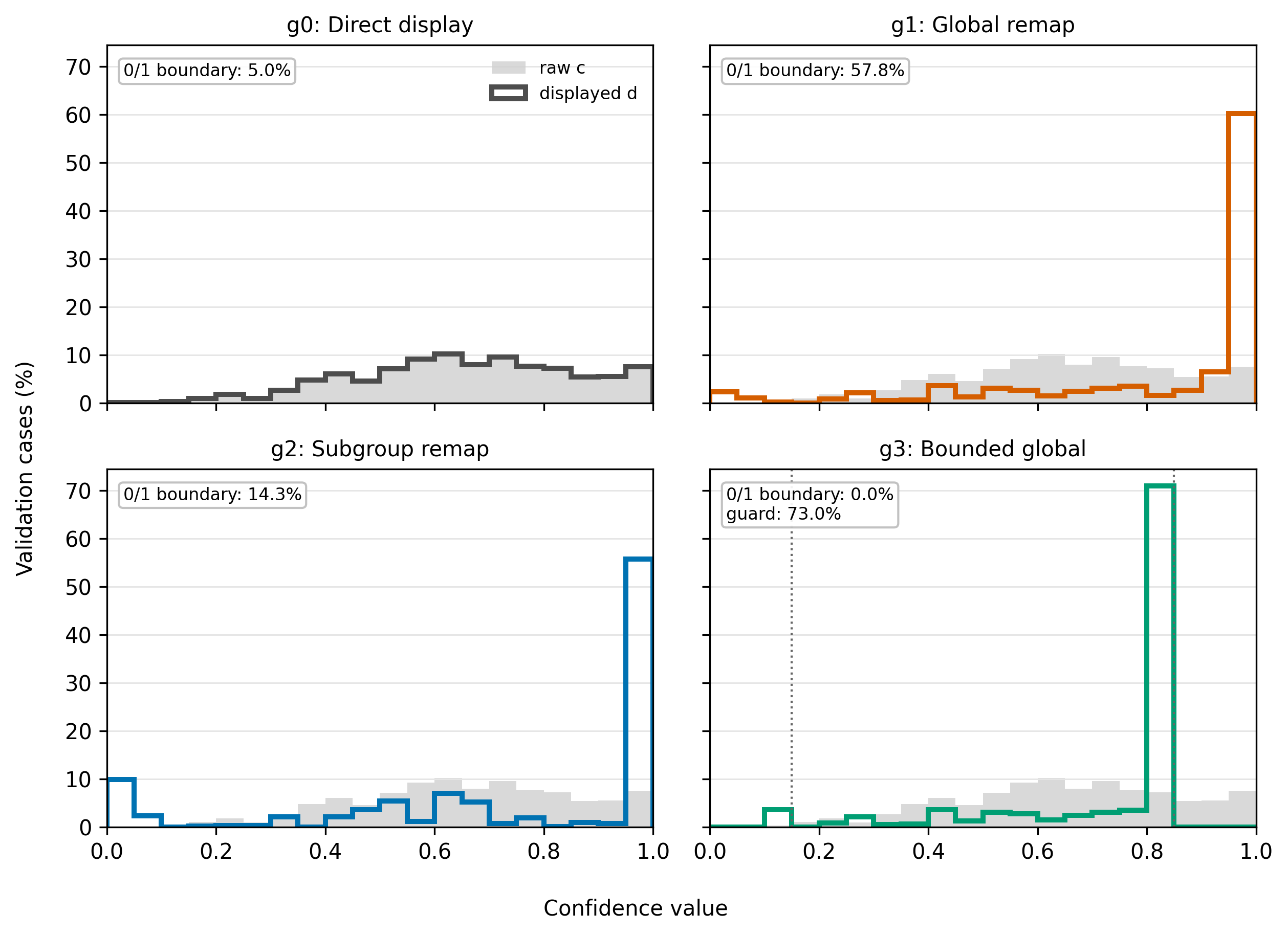
g1 produces the lowest simulated MSE, but 57.8% of its displays lie at 0 or 1. It is best read
as a diagnostic estimate of the correction required under the fitted model.g2 produces the strongest plug-in RCE alignment, but its model-predicted MSE and RCE are worse
than direct display. It exposes heterogeneity; it does not justify immediate personalized
deployment.g3 preserves much of the simulated MSE gain while eliminating 0/1 displays, making bounded
policies the more defensible design direction.
The verified release replaces legacy task/subgroup plots from earlier analysis specifications with
the canonical numeric
task/user-state sensitivity table.
It uses the same final cohort, split, and reliance model as the main policy comparison and can be
regenerated without any plotting scripts.
Reproduce the accepted-paper analysis
1. Create the environment
git clone https://github.com/OliverDOU776/From-Calibrated-Confidence-to-Calibrated-Reliance.git
cd From-Calibrated-Confidence-to-Calibrated-Reliance

python3 -m venv .venv
source .venv/bin/activate
python -m pip install --upgrade pip
python -m pip install -e .
Python 3.10+ is supported. The accepted-paper offline pipeline is CPU-only; it does not require a
GPU, an API key, or a language-model checkpoint.
For the exact dependency versions used in the release verification run (Python 3.12.3):
python -m pip install -r requirements-lock.txt
python -m pip install -e . --no-deps
The lock file requires Python 3.11 or newer. On Python 3.10, use the compatible dependency
resolution from python -m pip install -e .; that path is covered by the test matrix.
2. Download and verify HAIID
python scripts/download_data.py
The downloader is pinned to upstream commit 24881cc7586180a9c9742a7dd838aea97d008235 and
fails if either SHA-256 checksum differs. Raw data remain Git-ignored. See
data/README.md for provenance and licensing.
3. Run the core analysis
python scripts/reproduce.py --profile core
python scripts/verify_results.py --profile core
Generated files are written to results/generated/. Reference outputs are never overwritten.
4. Run the full diagnostic matrix
python scripts/reproduce.py --profile full
python scripts/verify_results.py --profile full
The full profile additionally fits the alternative reliance-model specifications and runs random,
participant-disjoint, and item-disjoint split sensitivity analyses.
Equivalent shortcuts are available:
make data
make reproduce       # core
make verify
make reproduce-full  # full diagnostic matrix
make test            # data-free unit tests
What is reproduced
| Scope |
Public command |
Status |
| HAIID preprocessing and accepted 70/30 task-stratified split |
scripts/reproduce.py |
Reproduced from pinned public data |
g0-g3, model-predicted MSE/RCE, plug-in RCE |
scripts/reproduce.py |
Reproduced |
Canonical task- and user-state sensitivity for g1 versus g0 |
scripts/reproduce.py |
Reproduced as a verified numeric table |
| Support, clipping, and display-shift diagnostics |
scripts/reproduce.py |
Reproduced |
| Binning, jackknife, user-state, subgroup, and bounded-policy checks |
--profile core |
Reproduced |
| Reliance-model and disjoint-split sensitivity |
--profile full |
Reproduced |
| Published GRACE comparison values |
data/external/grace_verbalized_results.csv |
Auditable context only; not a reproduction of the GRACE raw pipeline |
| 20-participant prospective pilot |
— |
Not claimed: participant-level data are not in the research workspace |
For the complete output-to-claim map and numerical tolerance policy, see
docs/REPRODUCIBILITY.md.
Repository structure
.
├── src/calibrated_reliance/   # Reusable data, metric, policy, and reliance-model code
├── scripts/
│   ├── download_data.py       # Pinned, checksum-verified HAIID setup
│   ├── reproduce.py           # Accepted-paper offline analysis
│   └── verify_results.py      # Generated-vs-reference numerical checks
├── data/
│   ├── external/              # Small cited aggregate table for GRACE
│   └── raw/                   # Downloaded data; ignored by Git
├── results/
│   ├── reference/             # Compact accepted-paper reference outputs
│   └── generated/             # Local reproduction outputs; ignored by Git
├── docs/                      # Method and reproducibility documentation
├── tests/                     # Data-free unit tests
├── CITATION.cff
├── pyproject.toml
└── Makefile
Evidence boundaries and responsible use
This repository is designed to make the paper inspectable, including its uncomfortable results.
- The HAIID study is observational. Self-confidence moderation is consistent with anchoring, but it
does not identify anchoring as the unique causal mechanism.
- Off-policy estimates depend on conditional response modeling, overlap, and the absence of major
unobserved confounding.
- A confidence display can improve simulated decisions while becoming less semantically honest
about the model's epistemic state. Do not deploy an undisclosed remapping as if it were raw model
confidence.
- Subgroup-conditioned policies require measurement-quality, privacy, disparate-impact, and gaming
audits.
- The small prospective pilot in the paper is feasibility evidence, not confirmatory validation.
- Nothing here establishes safety or effectiveness in high-stakes clinical, legal, financial, or
public-sector deployment.
Citation
The DOI and final volume/issue metadata were not available when this repository was prepared. Until
they are assigned, please cite the accepted paper as:
@article{wang2026calibratedreliance,
  title   = {From Calibrated Confidence to Calibrated Reliance:
             Human-Aware Confidence Communication for AI-Assisted Decision Making},
  author  = {Wang, Zijia and Hu, Kejia},
  journal = {ACM Transactions on Social Computing},
  year    = {2026},
  note    = {Accepted for publication}
}
GitHub can also read CITATION.cff directly.
Data and third-party acknowledgements
HAIID remains governed by its upstream MIT License and citation requirements. GRACE raw files are
not redistributed. See data/README.md and
THIRD_PARTY_NOTICES.md for exact versions, checksums, sources, and reuse
boundaries.
License
The original code in this repository is released under the MIT License. Third-party
datasets and aggregate results remain governed by their own licenses and citation requirements;
the project license does not override those terms.
Report a reproducibility issue
Reproducibility reports are welcome through GitHub Issues. When reporting a discrepancy, include
your Python version, dependency versions, command, and the relevant generated/reference filenames.

 这是一篇已被 ACM TSC 接收的论文的配套代码:它实现了 Reliance Calibration Error(RCE)指标、g0-g3 置信度展示策略,并提供了一套可复现的、仅用 CPU 的分析,用来衡量人机团队对所展示置信度的校准程度。