



From-Calibrated-Confidence-to-Calibrated-Reliance README

The project's README from github.com/OliverDOU776/From-Calibrated-Confidence-to-Calibrated-Reliance. As one markdown file: README.md.

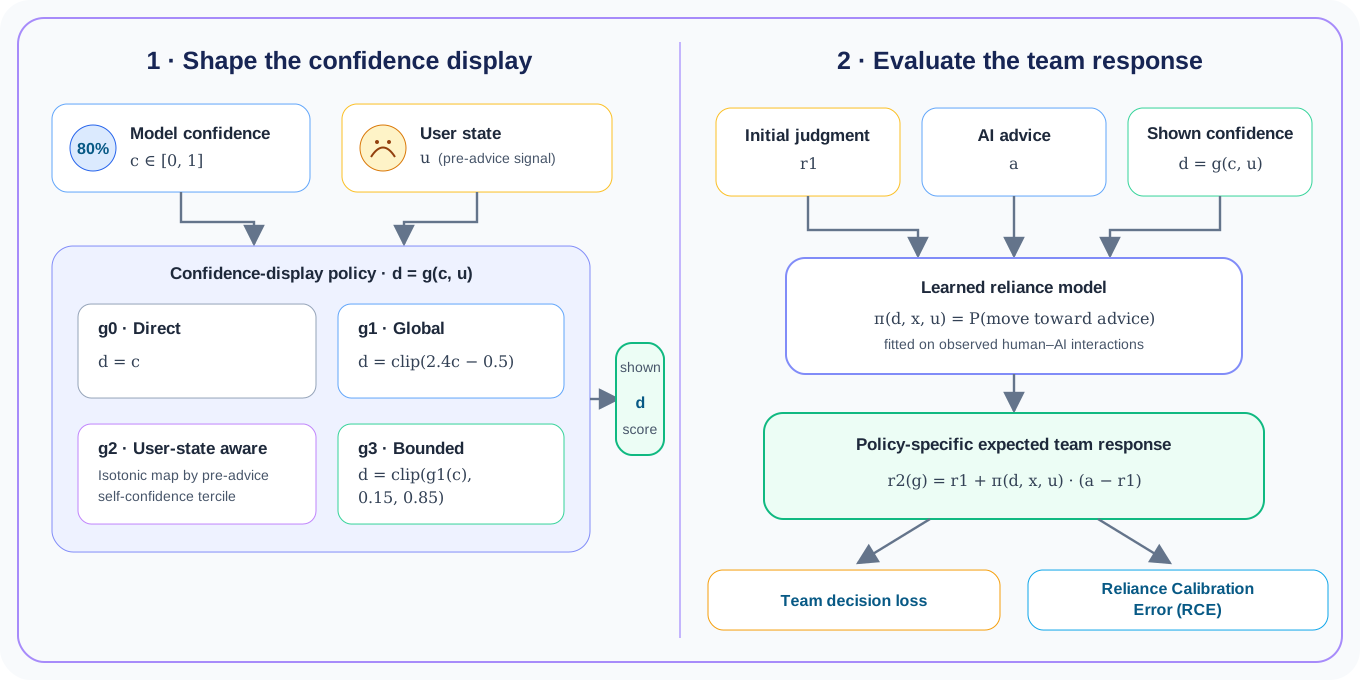
Calibrated reliance teaser: from model confidence to better human-AI team decisions

From Calibrated Confidence to Calibrated Reliance

Human-Aware Confidence Communication for AI-Assisted Decision Making

tests Python 3.10+ MIT License Accepted at ACM TSC Reproducibility package

Accepted for publication in ACM Transactions on Social Computing (TSC).

Most calibration work asks whether a model is correct 80% of the time when it reports 80% confidence. We ask a different question: after a person sees that confidence and makes the final decision, is the human-AI team correct 80% of the time?

This repository provides the accepted paper's CPU-only offline analysis, the implementation of Reliance Calibration Error (RCE), the g0-g3 confidence-display policies, deterministic data setup, compact reference outputs, and numerical regression checks.

Quick start: use the policies

Install the package from a local clone; using the policy and metric APIs does not require the HAIID dataset.

git clone https://github.com/OliverDOU776/From-Calibrated-Confidence-to-Calibrated-Reliance.git
cd From-Calibrated-Confidence-to-Calibrated-Reliance
python3 -m venv .venv
source .venv/bin/activate
python -m pip install -e .

Apply the three fixed display policies and compute RCE on your own logged team outcomes:

import numpy as np

from calibrated_reliance import bounded_g1, g0, g1, g3, rce

confidence = np.array([0.35, 0.55, 0.80])
final_team_correct = np.array([0, 1, 1])

displayed = {
    "g0_direct": g0(confidence),
    "g1_global": g1(confidence),
    "g3_bounded": g3(confidence),
    "g1_max_shift_10pct": bounded_g1(confidence, delta=0.10),
}

for name, values in displayed.items():
    print(name, values, "RCE =", rce(values, final_team_correct))

Fit g2 on training interactions, then apply it to held-out or future interactions. The three aligned training arrays are model confidence, pre-advice self-confidence, and final team correctness:

from calibrated_reliance import apply_g2, fit_g2

g2_policy = fit_g2(
    confidence_train,
    self_confidence_train,
    final_team_correct_train,
)
display_g2 = apply_g2(g2_policy, confidence_test, self_confidence_test)

To compare a display under the paper's fitted human-reliance model, use prepared HAIID-format training and test frames:

from calibrated_reliance import evaluate_policy, fit_reliance_model, g3

reliance_model = fit_reliance_model(train)
display_g3 = g3(test["advice_prob"])
evaluation = evaluate_policy(reliance_model, test, display_g3)

print(evaluation.mse, evaluation.rce, evaluation.mean_reliance)

Here evaluation.rce is a model-predicted off-policy diagnostic. For observed team outcomes, use rce(displayed, final_team_correct) directly. The expected columns and estimands are documented in docs/METHOD.md.

Before deployment: g1, g2, and g3 encode estimates and safeguards from the paper; they are not universal calibration maps. Refit or validate a policy on your population, preserve a held-out evaluation set, and retain a direct-display fallback.

What you can do with this repository

Why calibrated confidence is not enough

A statistically calibrated model can still induce poorly calibrated human reliance. People combine AI advice with their own beliefs, confidence, and task context; the displayed number is therefore filtered through human judgment before it affects the final decision.

We formalize calibrated reliance as a team-level property. For a display policy g, the shown confidence is calibrated when

$$ \Pr(\text{final human-AI decision is correct} \mid D_g=d)=d. $$

RCE summarizes deviations from that ideal:

$$ \mathrm{RCE}(g)=\mathbb{E}\left[\left|\eta_g(D_g)-D_g\right|\right]. $$

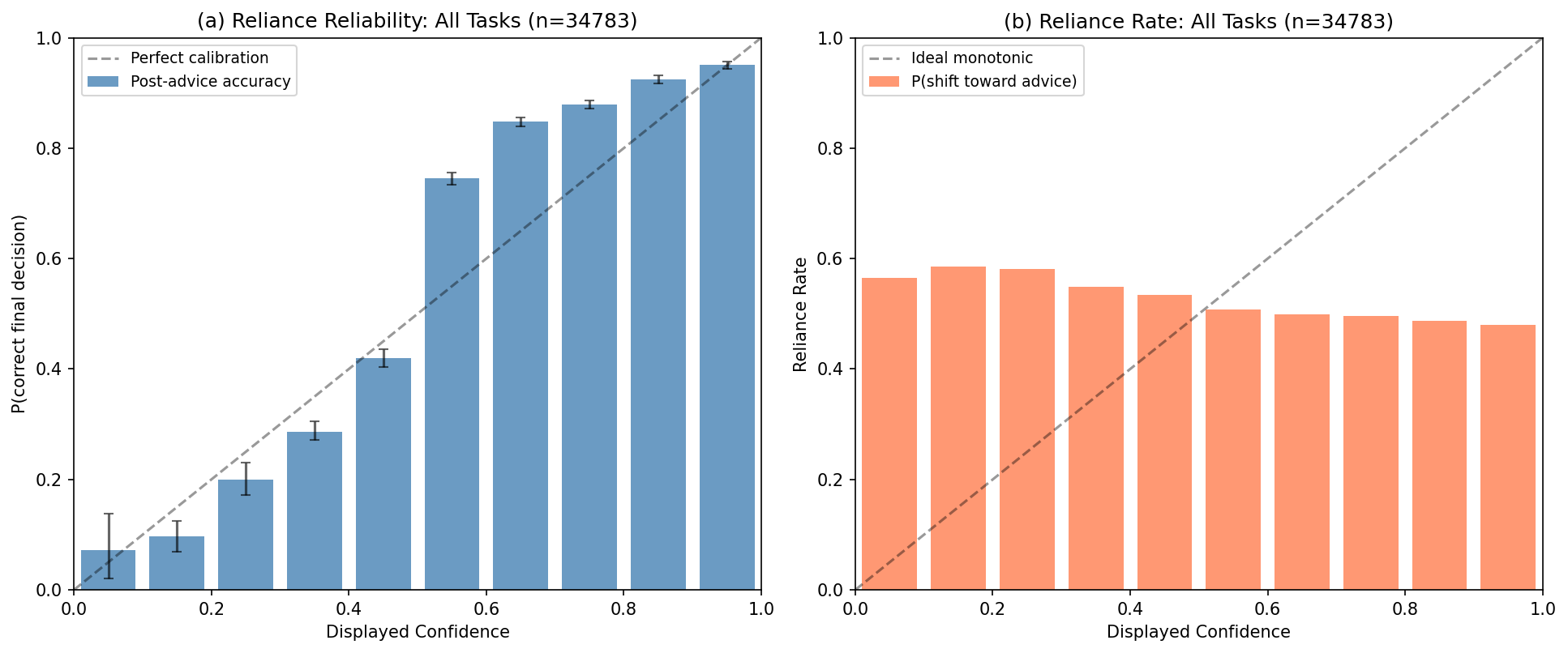
The distinction matters empirically: in the primary HAIID condition, conventional model ECE is 0.018, while direct-display plug-in RCE is 0.114.

Reliance reliability diagram across HAIID tasks

The confidence-display policies

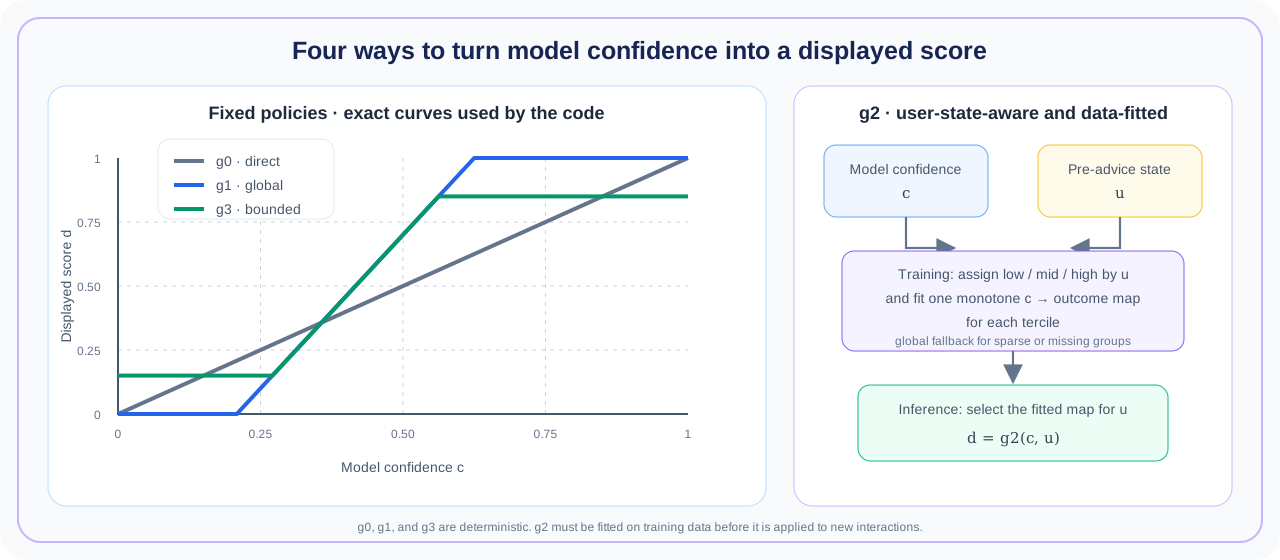
Exact g0, g1, and g3 display curves and the training and application flow for g2

Policy Definition Interpretation
g0 d = c Directly display the model confidence.
g1 d = clip(2.4c - 0.5, 0, 1) Global human-aware diagnostic mapping. It is intentionally treated as unconstrained, not automatically deployment-ready.
g2 Isotonic mapping fitted within pre-advice self-confidence terciles Captures user-state heterogeneity. It requires reliable elicitation, governance checks, and a safe fallback.
g3 d = clip(g1(c), 0.15, 0.85) Bounded global mapping that avoids 0/1 displays.

g2 is not presented as a fairness guarantee. If self-confidence is missing, noisy, correlated with protected attributes, or strategically reported, the system should fall back to g0 or a bounded population-level policy.

See docs/METHOD.md for equations, estimands, and implementation details.

Key findings

The accepted paper deliberately distinguishes a held-out display-alignment diagnostic from model-dependent off-policy simulations.

Policy Model-predicted MSE ↓ Plug-in observed-outcome RCE ↓ Model-predicted RCE ↓ Displays at 0 or 1
g0 direct 0.571 0.114 0.040 5.0%
g1 global 0.518 0.104 0.162 57.8%
g2 subgroup-aware 0.623 0.009 0.125 14.3%
g3 bounded global 0.530 0.047 0.070 0.0%

Metric note. Plug-in observed-outcome RCE keeps held-out team outcomes fixed and evaluates numerical display-outcome alignment. Model-predicted MSE and counterfactual RCE re-simulate outcomes under a fitted reliance model. They are off-policy estimates, not randomized causal effects.

Three patterns are especially important:

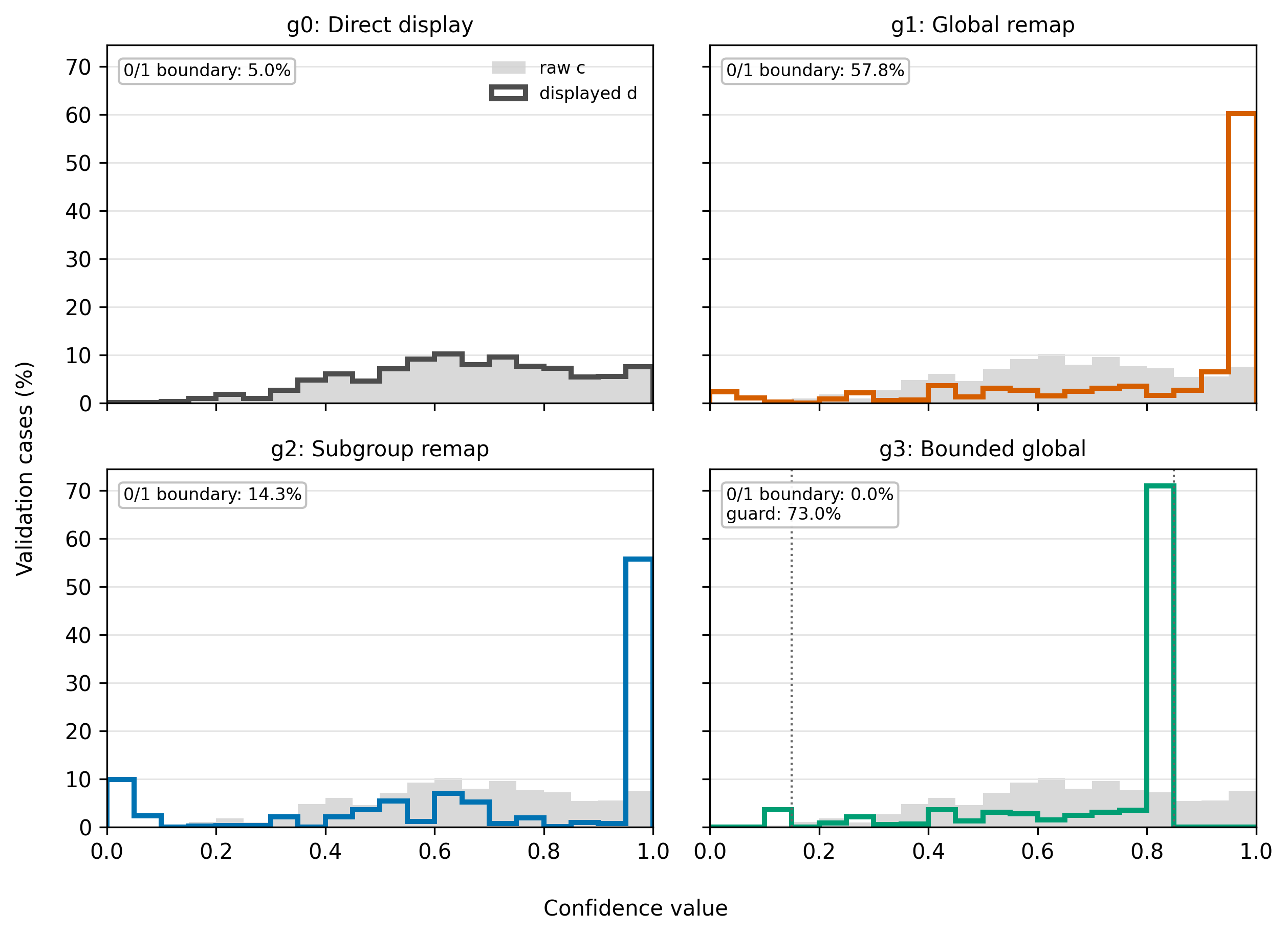
  1. g1 produces the lowest simulated MSE, but 57.8% of its displays lie at 0 or 1. It is best read as a diagnostic estimate of the correction required under the fitted model.
  2. g2 produces the strongest plug-in RCE alignment, but its model-predicted MSE and RCE are worse than direct display. It exposes heterogeneity; it does not justify immediate personalized deployment.
  3. g3 preserves much of the simulated MSE gain while eliminating 0/1 displays, making bounded policies the more defensible design direction.

The verified release replaces legacy task/subgroup plots from earlier analysis specifications with the canonical numeric task/user-state sensitivity table. It uses the same final cohort, split, and reliance model as the main policy comparison and can be regenerated without any plotting scripts.

Reproduce the accepted-paper analysis

1. Create the environment

git clone https://github.com/OliverDOU776/From-Calibrated-Confidence-to-Calibrated-Reliance.git
cd From-Calibrated-Confidence-to-Calibrated-Reliance

python3 -m venv .venv
source .venv/bin/activate
python -m pip install --upgrade pip
python -m pip install -e .

Python 3.10+ is supported. The accepted-paper offline pipeline is CPU-only; it does not require a GPU, an API key, or a language-model checkpoint.

For the exact dependency versions used in the release verification run (Python 3.12.3):

python -m pip install -r requirements-lock.txt
python -m pip install -e . --no-deps

The lock file requires Python 3.11 or newer. On Python 3.10, use the compatible dependency resolution from python -m pip install -e .; that path is covered by the test matrix.

2. Download and verify HAIID

python scripts/download_data.py

The downloader is pinned to upstream commit 24881cc7586180a9c9742a7dd838aea97d008235 and fails if either SHA-256 checksum differs. Raw data remain Git-ignored. See data/README.md for provenance and licensing.

3. Run the core analysis

python scripts/reproduce.py --profile core
python scripts/verify_results.py --profile core

Generated files are written to results/generated/. Reference outputs are never overwritten.

4. Run the full diagnostic matrix

python scripts/reproduce.py --profile full
python scripts/verify_results.py --profile full

The full profile additionally fits the alternative reliance-model specifications and runs random, participant-disjoint, and item-disjoint split sensitivity analyses.

Equivalent shortcuts are available:

make data
make reproduce       # core
make verify
make reproduce-full  # full diagnostic matrix
make test            # data-free unit tests

What is reproduced

Scope Public command Status
HAIID preprocessing and accepted 70/30 task-stratified split scripts/reproduce.py Reproduced from pinned public data
g0-g3, model-predicted MSE/RCE, plug-in RCE scripts/reproduce.py Reproduced
Canonical task- and user-state sensitivity for g1 versus g0 scripts/reproduce.py Reproduced as a verified numeric table
Support, clipping, and display-shift diagnostics scripts/reproduce.py Reproduced
Binning, jackknife, user-state, subgroup, and bounded-policy checks --profile core Reproduced
Reliance-model and disjoint-split sensitivity --profile full Reproduced
Published GRACE comparison values data/external/grace_verbalized_results.csv Auditable context only; not a reproduction of the GRACE raw pipeline
20-participant prospective pilot — Not claimed: participant-level data are not in the research workspace

For the complete output-to-claim map and numerical tolerance policy, see docs/REPRODUCIBILITY.md.

Repository structure

.
├── src/calibrated_reliance/   # Reusable data, metric, policy, and reliance-model code
├── scripts/
│   ├── download_data.py       # Pinned, checksum-verified HAIID setup
│   ├── reproduce.py           # Accepted-paper offline analysis
│   └── verify_results.py      # Generated-vs-reference numerical checks
├── data/
│   ├── external/              # Small cited aggregate table for GRACE
│   └── raw/                   # Downloaded data; ignored by Git
├── results/
│   ├── reference/             # Compact accepted-paper reference outputs
│   └── generated/             # Local reproduction outputs; ignored by Git
├── docs/                      # Method and reproducibility documentation
├── tests/                     # Data-free unit tests
├── CITATION.cff
├── pyproject.toml
└── Makefile

Evidence boundaries and responsible use

This repository is designed to make the paper inspectable, including its uncomfortable results.

Raw versus displayed confidence distributions under g0 through g3

Citation

The DOI and final volume/issue metadata were not available when this repository was prepared. Until they are assigned, please cite the accepted paper as:

@article{wang2026calibratedreliance,
  title   = {From Calibrated Confidence to Calibrated Reliance:
             Human-Aware Confidence Communication for AI-Assisted Decision Making},
  author  = {Wang, Zijia and Hu, Kejia},
  journal = {ACM Transactions on Social Computing},
  year    = {2026},
  note    = {Accepted for publication}
}

GitHub can also read CITATION.cff directly.

Data and third-party acknowledgements

HAIID remains governed by its upstream MIT License and citation requirements. GRACE raw files are not redistributed. See data/README.md and THIRD_PARTY_NOTICES.md for exact versions, checksums, sources, and reuse boundaries.

License

The original code in this repository is released under the MIT License. Third-party datasets and aggregate results remain governed by their own licenses and citation requirements; the project license does not override those terms.

Report a reproducibility issue

Reproducibility reports are welcome through GitHub Issues. When reporting a discrepancy, include your Python version, dependency versions, command, and the relevant generated/reference filenames.

From-Calibrated-Confidence-to-Calibrated-Reliance (OliverDOU776/From-Calibrated-Confidence-to-Calibrated-Reliance)

Searching Database…

What is this?Companion code for an accepted ACM TSC paper: it implements the Reliance Calibration Error (RCE) metric, the g0-g3 confidence-display policies, and a reproducible CPU-only analysis of how well human-AI teams calibrate on displayed confidence.
Is this an installable library or just the paper's analysis scripts?Both: a pip-installable Python package whose policy and metric APIs run on your own logged team outcomes, plus scripts that regenerate the paper's analysis tables from pinned public data.
How do I get it running?Clone the repository and run pip install -e . Python 3.10+ is supported, but the pinned lockfile requires Python 3.11 or newer; the release was verified on 3.12.3.
Can I take the fitted g2 policy and deploy it with my own model right away?No — the policies encode this paper's estimates, not universal calibration maps: refit and validate on your population, keep a direct-display fallback, and never ship an undisclosed remapping as raw model confidence.
Does the repository include the study participants' data?No raw study data ships with it: HAIID stays git-ignored and is fetched through a checksum-pinned downloader, and the README calls for privacy audits before deploying subgroup-conditioned policies.
Is the MIT license the whole story?MIT covers the original code, but the HAIID dataset and GRACE-derived aggregate results keep their own licenses and citation requirements that this project's license does not override.
What is Reliance Calibration Error (RCE)?It is the paper's team-level calibration metric: a displayed confidence d counts as calibrated when the probability that the final human-AI decision is correct equals d, and RCE averages the absolute deviation from that ideal. Unlike model ECE, it scores the confidence number after a person has acted on it.
What do the g0-g3 display policies do?They reshape the model confidence shown to the user: g0 displays it directly, g1 applies a global linear correction, g2 fits an isotonic map within pre-advice self-confidence terciles to capture user-state differences, and g3 bounds g1 to the 0.15-0.85 range so 0 or 1 is never displayed.
What did the paper find?Direct display looked well calibrated at the model level (ECE 0.018) yet poorly calibrated at the team level (plug-in RCE 0.114). The user-state-aware g2 achieved the best observed alignment (RCE 0.009), while the bounded g3 kept most of the simulated gain and eliminated all 0/1 displays.
Can I apply this to my own human-AI logs?Yes, that is the intended quick start: audit logged outcomes with rce(displayed, final_team_correct), prototype a display layer with g0, g1, g3 or bounded_g1 without retraining your predictor, and fit the user-state-aware g2 on training interactions, with a global fallback for sparse self-confidence groups.
How do I reproduce the paper's numbers?Install the package, run the pinned HAIID download (SHA-256 verified, fails on mismatch), then run scripts/reproduce.py — add --profile core or --profile full for the extended sensitivity matrix. Results go to results/generated/ and are checked numerically against checked-in reference outputs; docs/REPRODUCIBILITY.md maps every output to a claim.
Size
0.4 MB
Stars
304
Updated
CommitAug 12
Age
2mo
Commits · 90 Days