English · Русский
Paper Aquarium
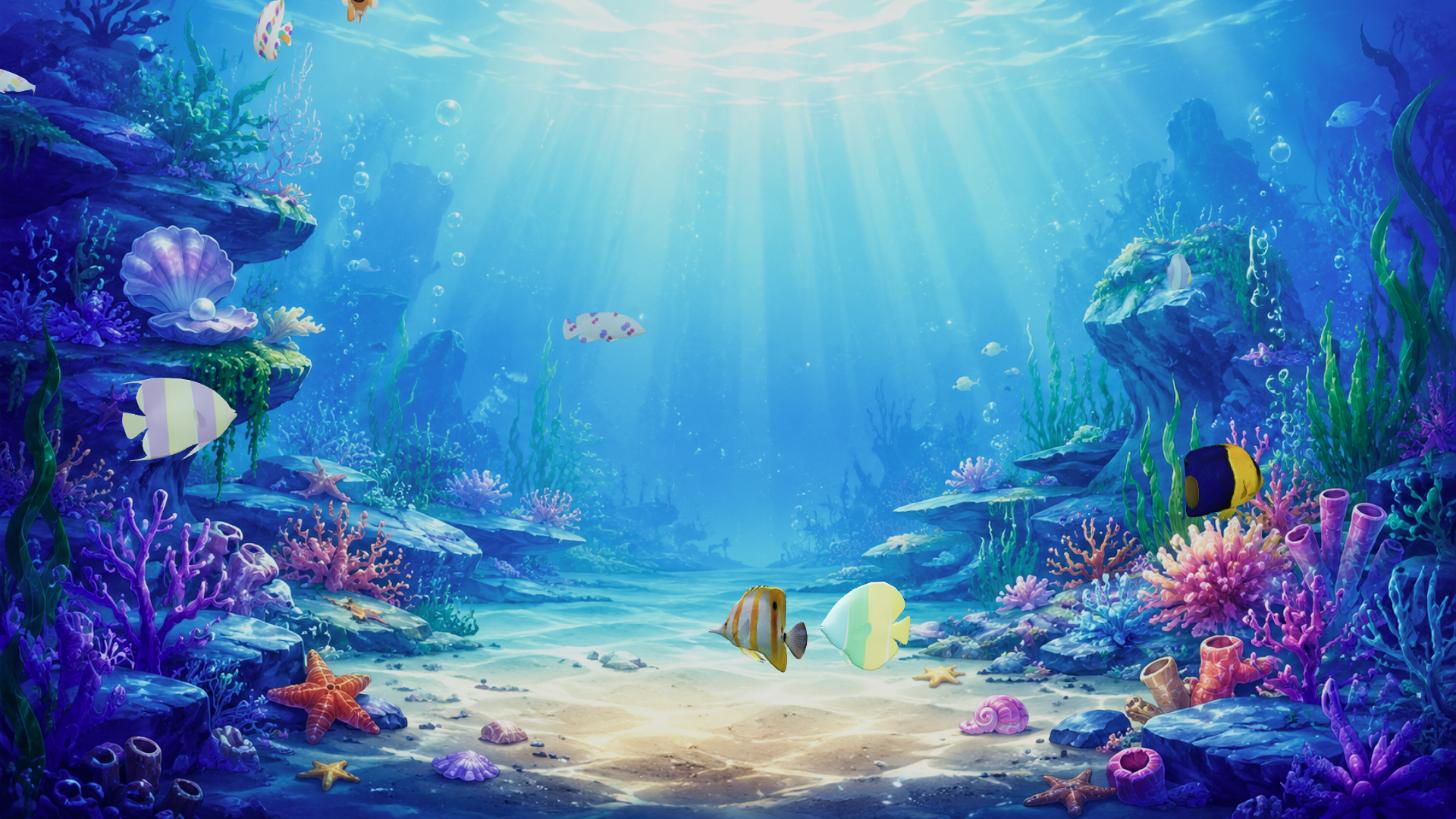
A home game for a child, in the spirit of teamLab's Sketch Aquarium: print
a sheet, colour it with markers, take a photo with a phone — and the fish
starts swimming in an aquarium on the big screen.
A4 colouring sheet → phone photo → texture → 3D fish in the scene
The server is plain Node with zero dependencies, the scene is three.js, and
everything the game owns lives in data/.
Questions, ideas and "it won't start for me" — the project chat:
t.me/+5PkSBR1C6LtmOTM0.
|
|
 |
 |
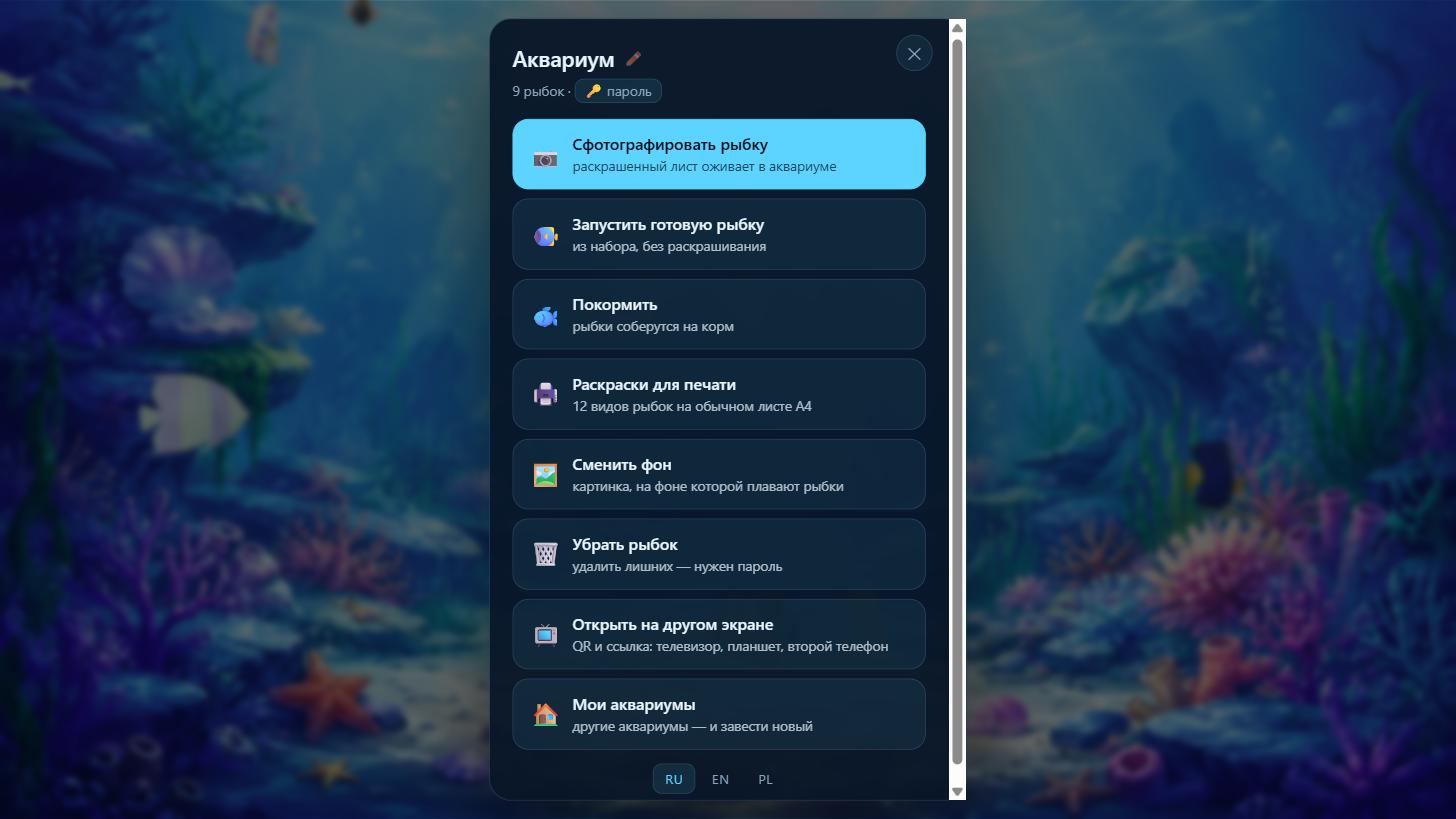
| Tap anywhere — a menu with every road out |
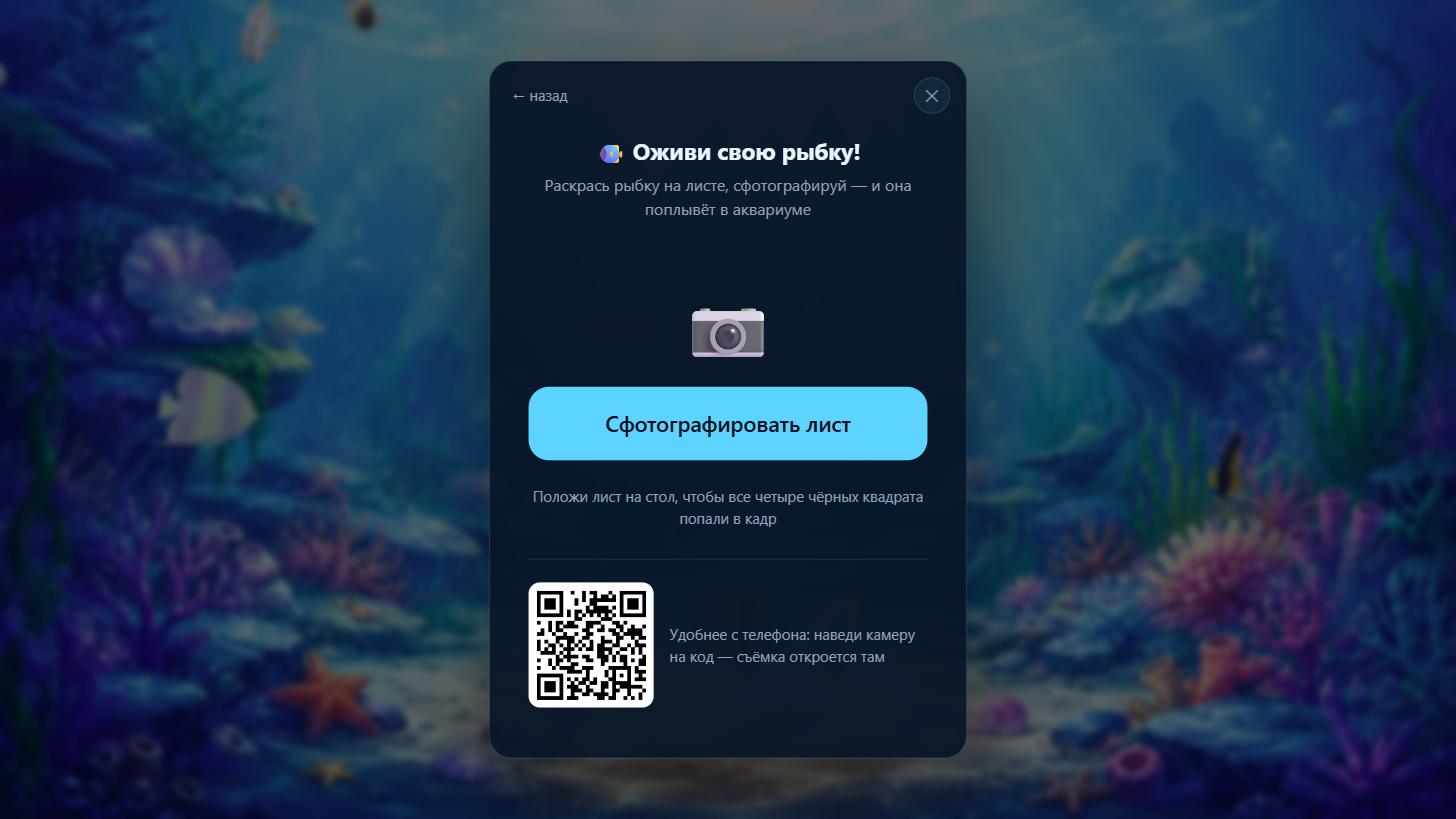
The sheet is photographed right there, in a frame |
 |
 |
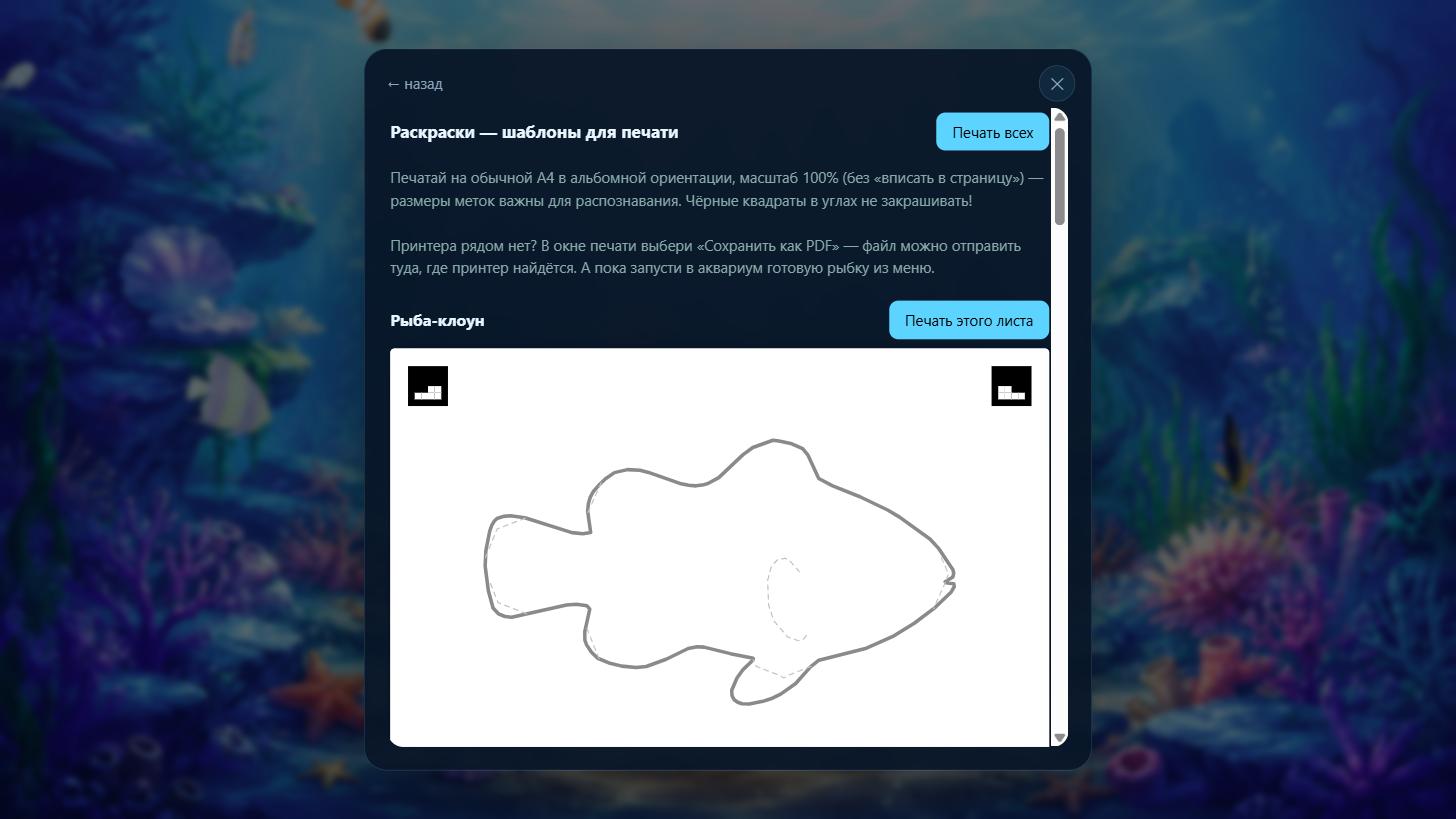
| Twelve A4 sheets with markers in the corners |
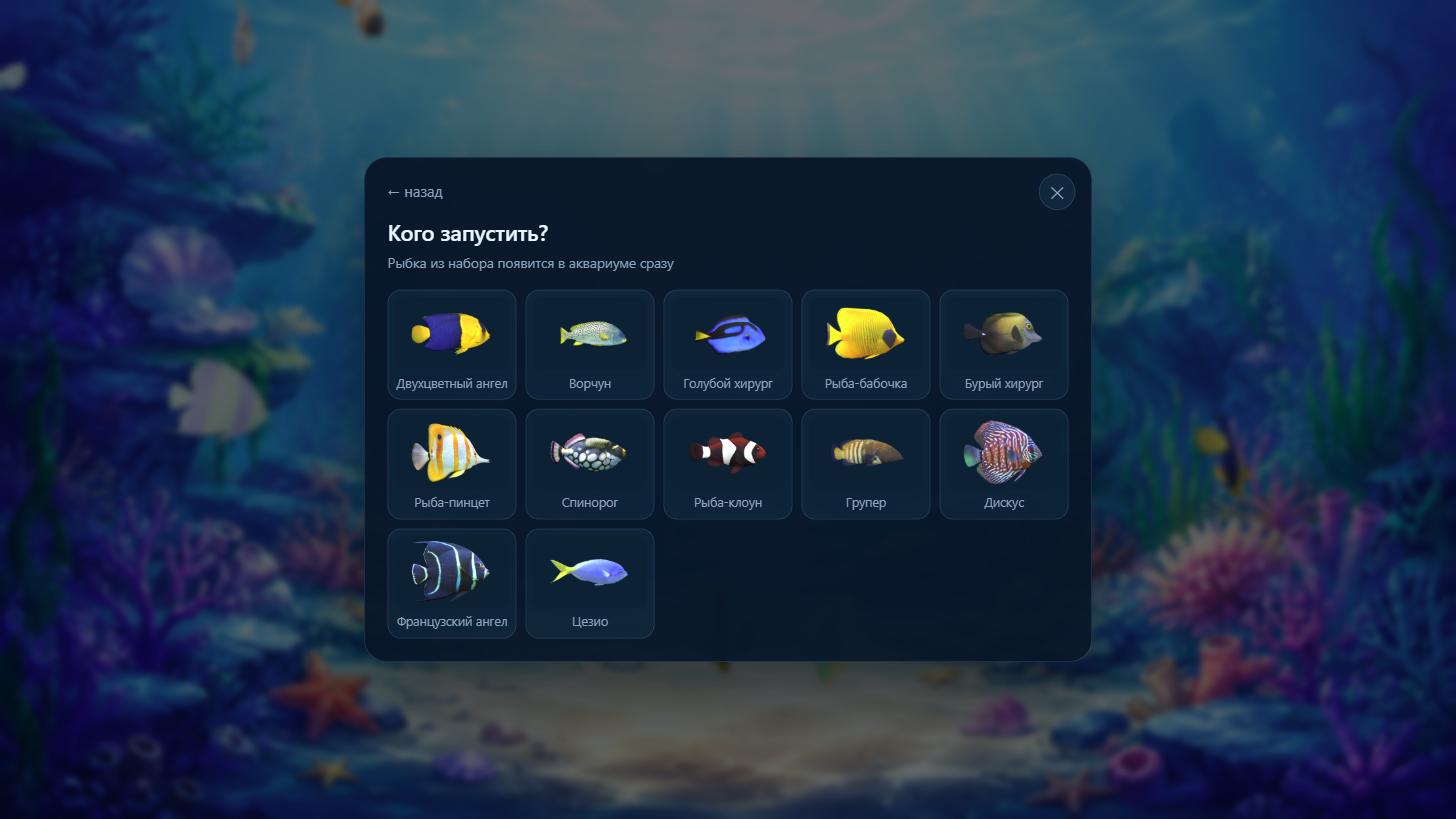
Ready-made fish, when there is no time to colour |
More: the list of fish with their drawings,
choosing a background,
the list of aquariums.
How it works
The colouring sheet. Four black 6×6 markers in the corners: their 16 inner
cells encode the species and the corner number. The capture step uses them to
find the sheet in a photo and undo the perspective — the markers must stay
uncoloured, everything else is fair game. The fish outline is printed as a thin
grey line and the fin areas as a pale dashed one, so they are visible without
the child taking the hint for part of the drawing.
Capture. assets/capture.js looks for the markers by sweeping brightness
thresholds, undoes the perspective, cuts the drawing along the species contour
from the manifest and trims a strip along the printed line itself — otherwise
it would stay as a dark rim on the fish. The result is a texture, mapped onto
the 3D model through a planar unwrap of its side silhouette.
The aquarium. demos/realistic-tank.html: the fish swim inside a volume
that follows the camera frustum rather than a box — against a box, fish near
the far wall would huddle towards the centre of the screen. The scene works out
the model's orientation (where the nose is, where the back is) on its own, from
the tail beats in the animation: assets/fish-frame.js.
The menu. A tap anywhere in the aquarium opens the menu: capture, ready-made
fish from the pack, food, colouring sheets, background, removing fish and
“Open on another screen” — a QR code, a link and a five-digit TV code.
Capture, background and sheets open right there in a frame — they are the
same pages (?embed=1), not copies of them.
The showcase. The AQUA_DEMO_TANK variable turns one aquarium into
a public showcase: the home page offers newcomers a “Peek at a live
aquarium” card, and a ?demo link opens it with a trimmed menu — feed the
fish or start your own. A screen opened with a PIN (?tv) never pops the
menu by itself: that screen is for watching, the phone is for driving.
Languages. Russian, English and Polish; on the first visit the device
language is used, after that whatever the switcher was set to. All strings live
in assets/i18n.js and the markup is annotated with data-t attributes. The
colouring sheets are trilingual too: the caption under the fish is printed in
the language of the page, while the corner markers are identical in every
version — any printed sheet is recognised.
Running it
node server.js # http://localhost:8000
Node 18+ is required. There is nothing to install: no dependencies, and
three.js sits in vendor/. The port is set by PORT.
The server prints the addresses of every network interface — use them to open
the aquarium from a phone or a TV on the same Wi-Fi.
Access
There are no accounts. Every aquarium has a 10-character code (which is also
its address) and a password:
|
code (the link) |
password |
| watch the aquarium |
✅ |
|
| add a fish, feed them, change the background |
✅ |
|
| delete fish or the aquarium, rename it |
|
✅ |
Capture and feeding are deliberately password-free: the child opens the link on
a phone, and asking for a password there would kill the whole idea. Nothing can
be spoiled that way — everything irreversible is behind the password.
For a TV there is a shortcut: “Open on another screen” in the aquarium
menu hands out a temporary five-digit code (lives 5 minutes, kept in the
server's memory). It goes into the same field on the home page as the
regular code; guessing is choked by a growing per-address pause.
The code is long on purpose: 31¹⁰ ≈ 8·10¹⁴ combinations, so somebody else's
drawings cannot be found by guessing. A five-digit code (100,000 combinations)
would be brute-forced in minutes. The password is protected by a pause after
five misses, growing to ten minutes.
Deployment
Everything a server needs sits next to the code: Dockerfile,
docker-compose.prod.yml and .env.example. The aquarium is a single
container with no proxy of its own: HTTPS, the domain and the certificate are
handled by Traefik through the external web network. The order of steps,
backups and the usual breakages are in DEPLOY.md (in Russian).
cp .env.example .env      # DOMAIN
docker compose -f docker-compose.prod.yml --env-file .env up -d --build
The model pack never enters the image — it is mounted from the server as
a volume.
What to know before putting it on the open internet
The password travels in plain text in the X-Tank-Pass header. Inside
a home network that is acceptable; on the internet HTTPS is mandatory, and
the proxy provides it. On the server only a salted scrypt hash of the
password is stored.
Adding fish and uploading backgrounds without a password is a deliberate
decision: the child opens capture from a link on a phone. So that nobody can
fill the disk with it, there are limits (all of them environment variables):
| Variable |
Default |
What it limits |
AQUA_MAX_TANKS |
200 |
aquariums on the server in total |
AQUA_TANKS_PER_HOUR |
5 |
new aquariums from one address per hour |
AQUA_MAX_FISH |
40 |
fish in a single aquarium |
AQUA_MAX_BG |
8 |
custom backgrounds in a single aquarium |
AQUA_MAX_DATA_MB |
2048 |
the size of the whole data/ folder |
AQUA_DEMO_TANK |
— |
code of a showcase aquarium: the home page offers newcomers a “Peek at a live aquarium” button |
Plus hard limits per picture: 3 MB for a fish, 6 MB for a background, 12 MB
for the request body.
The server only serves what staticFor() lists: the pages, assets/,
vendor/, demos/, tools/, and from data/ — nothing but scene snapshots
and uploaded backgrounds. Everything else, including .git and server.js
itself, gets a 404.
The fish models: what to buy and where to put it
The fish are not in this repository and cannot be: the game uses a purchased
pack whose licence allows use but forbids redistributing the files. Without the
models everything still starts, but the aquarium stays empty. Four steps get
them swimming — about fifteen minutes including the download.
1. Buy the pack
Coral Reef Fish Collection animated — Game Ready pack 8
by JosKata, on CGTrader. Thirty reef fish with skeletal animation, Royalty Free
licence.
This exact pack is not strictly required — any fish will do, see "Other models"
below. But the colouring sheets in this repository were traced from it, and
without rebuilding the sheets the species will not match.
2. Lay out the files
From the download you only need the fbx folder — thirty .fbx files. The
textures are already embedded in them; the separate .rar archives in
textures/ do not need unpacking (they are only useful if you want to rebuild
the pack at the original resolution).
paper-aquarium/
└── купил 3д рыбок/          ← "the 3D fish I bought"
    └── fbx/
        ├── Auriga Butterflyfish.fbx
        ├── Bicolor Angelfish.fbx
        └── … 30 files in total
The folder купил 3д рыбок/ is in .gitignore — your purchase stays yours.
The name can be changed, in which case the path is passed to the script:
-Pack "your\folder".
3. Convert to glTF
You will need the FBX2glTF converter (Windows, PowerShell):
npm install --no-save fbx2gltf

# the path inside the package depends on the version — let PowerShell find it
$env:FBX2GLTF = (Get-ChildItem node_modules -Recurse -Filter FBX2glTF.exe)[0].FullName

powershell -ExecutionPolicy Bypass -File tools\convert-pack.ps1
The script unpacks every fish, squeezes the textures down to 1024 px JPEG (the
originals are 2048×2048 PNGs of 3–4 MB each — 110 MB per pack instead of 12),
fixes the alpha channel that makes some fish arrive invisible, and lays out the
result:
assets/models/pack/
├── clownfish/
│   ├── clownfish.gltf
│   ├── buffer.bin
│   └── clownfish_basecolor_COLOR.jpg
├── bluetang/
└── … 28 folders + pack.json
Twenty-eight, not thirty: two fish in the pack have no embedded textures or
empty geometry, so the script drops them and says so in the console.
4. Check
node server.js
Open http://localhost:8000, create an aquarium, tap it and choose
"🐠 Release a ready-made fish" — you should see 12 cards with thumbnails.
Twelve, not twenty-eight: only species that have a colouring sheet make it into
the picker — what can be coloured is what swims. The full list of converted
models is served by http://localhost:8000/api/pack (28 there, with
sheet: true on the species that have a sheet). Empty means the pack was not
built — look for "пропуск" ("skipped") lines in the script's output.
Other models
The script is tailored to this pack and to Windows (it resizes textures with
System.Drawing). Any .glb/.gltf files of your own go into
assets/models/pack/ by hand — one folder per species, with a pack.json
listing them next to it.
The species in the game are defined by assets/coloring/manifest.json, which is
built from the silhouettes of the models. So a different set of fish means the
sheets have to be rebuilt: /tools/silhouettes.html → node tools/make-coloring.js. Model requirements, how to add a species and the
conversion pitfalls are in
assets/models/README.md (in Russian).
| What |
Where |
Why |
| Silhouettes |
/tools/silhouettes.html |
traces the pack models, produces contours.json and the fins drawn over the body |
| Sheets |
node tools/make-coloring.js |
builds 12 A4 sheets in three languages plus the manifest |
| PDF |
node tools/make-pdf.js |
prints the sheets into raskraski.<lang>.pdf via headless Chrome; run after make-coloring |
| Capture test |
/tools/test-capture.html |
runs every sheet through skew, rotation and noise |
| Pack build |
tools/convert-pack.ps1 |
FBX from the purchased archive → glTF |
After the sheets change, the capture test must report no failures: the markers
are chosen so that the codes of any two species differ in at least four cells.
Data
Everything lives in data/tanks/<code>/: meta.json (name, salt and password
hash), settings.json (background), fish/ (drawings and their descriptions),
backgrounds/ (uploaded backgrounds), preview.jpg (the snapshot for the
card). Deleted things move to trash/ and data/trash-tanks/ instead of being
erased: there are children's drawings inside.
Deleted items stay in the trash for 30 days (AQUA_TRASH_DAYS) and are then
erased for good: a child deletes a drawing by accident and it has to be
recoverable, but an eternal trash bin on a public server is a warehouse of
other people's children's drawings that they believe are deleted.
The data/ folder is not part of the repository — it is one family's data.
A backup of the game is a copy of that folder.
For a public server there is a Terms and data page
(/terms.html): what is stored, how long it lives, how to get it deleted, GDPR
rights and a contact. The server itself keeps no access log: it only writes
"a fish was added to such and such aquarium", with no addresses. Check what the
proxy in front of it writes — either turn its access log off, or leave the terms
text as it is (it already says that the proxy keeps such a log). Details are
under "Журнал обращений" in DEPLOY.md.
Licence
The code is MIT. The aquarium backgrounds in assets/backgrounds/
were made by the author of the project and come under the same terms.
The fish models are not covered by the project licence: the pack is bought
separately and is not part of the repository. The silhouettes in
assets/coloring/*.svg, tools/contours.json and
assets/coloring/manifest.json were traced from the pack models — they are
derived 2D contours, not the models themselves, and for a different set of fish
they are rebuilt from scratch.

 Paper Aquarium 能把手工涂色的纸鱼变成大屏幕上游泳的 3D 鱼:孩子给打印好的纸页涂色,用手机拍照,这条鱼就会出现在用 three.js 构建的网页水族馆场景中游动。