Code graph and memory for your coding agents, in one Rust program.
Graphicle maps your repository into a code graph, remembers your project's docs, decisions and past agent sessions,
and gives your coding agent cited excerpts from both: the exact files and lines. It runs on your machine: no API key needed, no account, no telemetry. Works with Claude Code · Cursor · Codex · VS Code · Claude Desktop · any MCP client
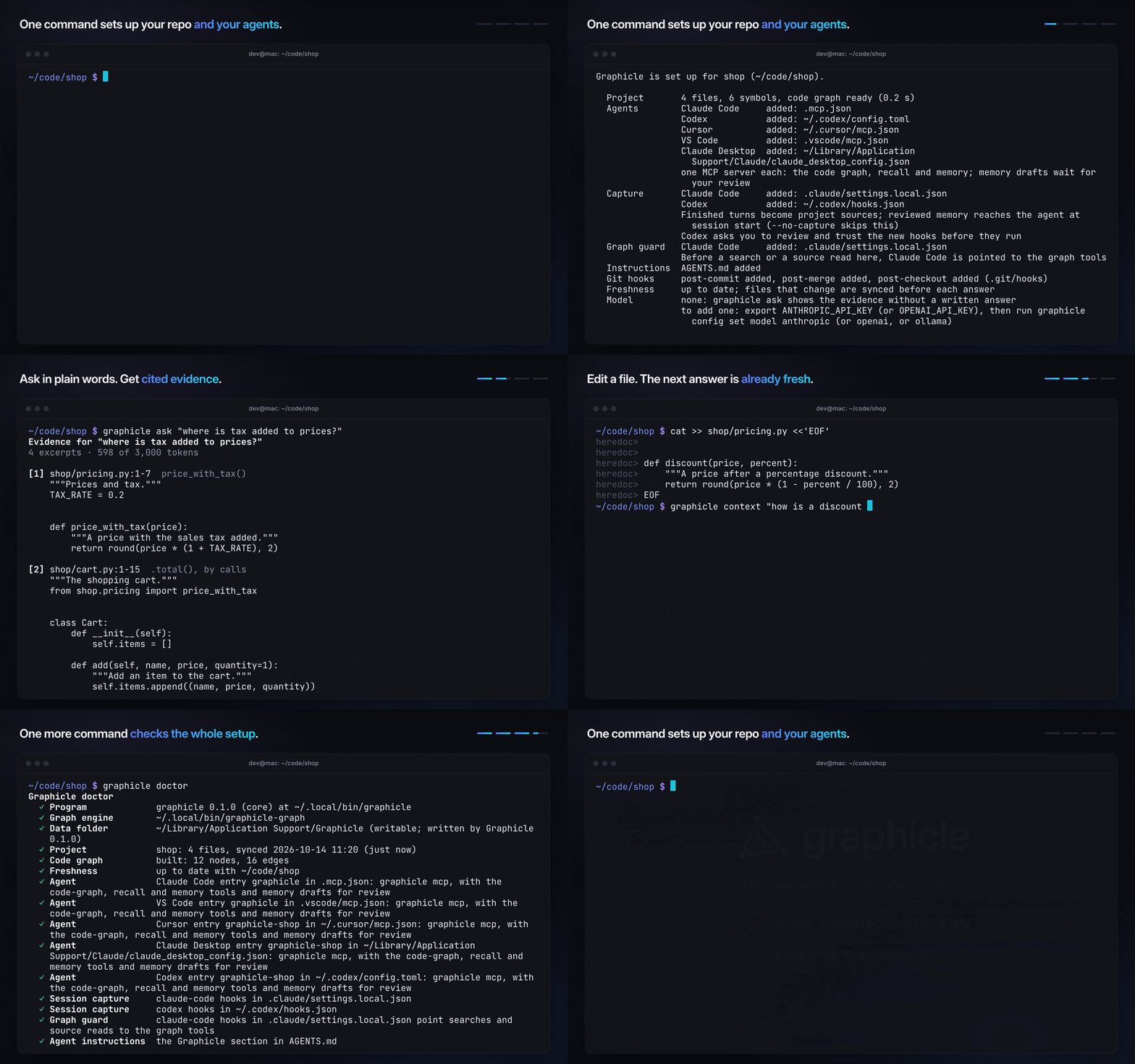
graphicle setup indexes the repository, builds its code graph and connects the coding agents it finds. It also turns on session
capture, points Claude Code's searches to the code graph first, adds a short section to AGENTS.md and installs Git hooks that keep the project current. It lists every file it changes and
backs each one up first; graphicle disconnect undoes it all.
Then ask your agent to "use graphicle to find where failed requests are retried", or ask from the terminal:
$ graphicle ask "where is tax added to prices?"
Evidence for "where is tax added to prices?"
4 excerpts · 598 of 3,000 tokens

[1] shop/pricing.py:1-7  price_with_tax()
    """Prices and tax."""
    TAX_RATE = 0.2


    def price_with_tax(price):
        """A price with the sales tax added."""
        return round(price * (1 + TAX_RATE), 2)
Real output, cut after the first excerpt. With no model configured, ask shows the evidence; graphicle config set model anthropic (or openai, ollama) adds written answers.
Let your coding agent install it
Paste this into Claude Code, Codex or Cursor:
Install Graphicle with `brew install graphicle-ai/tap/graphicle` (or, without Homebrew,
`curl -fsSL https://github.com/graphicle-ai/graphicle/releases/latest/download/install.sh | sh`),
then run `graphicle setup --yes` in this repository and list every file it changed.
Start here
You want to
Run
Give your coding agent the code graph and your project's memory
graphicle setup in the repository
Ask a question from the terminal
graphicle ask "how are failed requests retried?"
Browse the graph, the sources and the memory
graphicle open
See what a change to a symbol touches
graphicle graph extract . --code-only, then graphicle graph affected "retry()"
Native and fast. One Rust program. On Kubernetes (31k files), the 0.1.0 engine ran a code-only extract in 3 min 18 s, against 26 min 38 s for Graphify 0.9.88, and built the same graph (one exploratory run each, one Linux host, the same 16 CPUs, 8 workers).
Context, not re-reading. Your agent asks Graphicle and gets the relevant code, docs and decisions as cited excerpts, within a token budget.
Answers you can check. Every excerpt names its file and lines. Memories an agent proposes wait for your approval.
One program, not a stack. The code graph, the memory, one MCP server, the web app and the command line come in one install, with one SQLite file. No Python, Docker or database server.
Local and private. No account and no telemetry. Nothing leaves your machine unless you ask.
What it does
Code graph. Files, functions, classes, calls and imports, parsed with tree-sitter and no model. graphicle graph searches it, explains a symbol,
traces a path and exports an interactive HTML graph. After graphicle graph extract . --code-only, graphicle graph affected "retry()" lists what depends on a symbol.
Project memory. Docs (Markdown, PDF, Office, HTML), reviewed decisions and procedures, and past Claude Code and Codex sessions, searchable alongside the code.
Cited context on a budget.graphicle context and the MCP tools return excerpts with their sources, within a token budget, without calling a model.
One MCP server.graphicle mcp serves the code-graph tools, under Graphify's tool names such as query_graph, get_neighbors and shortest_path, next to the memory tools.
Memory tied to your code. Reviewed memories are tied to the functions they are about: a memory goes stale when that code changes, and edits elsewhere in the file usually leave it current (the exact rule). Mentions of code in your docs are linked to the definitions they name (graphicle call graph.doc_links lists them).
Across repositories. Recall can span the repositories of a workspace: graphicle context --workspace, or the workspace MCP endpoint.
Always current. Before each answer Graphicle syncs the few files you changed; Git hooks sync after each commit, merge and checkout.
No re-explaining. Session capture keeps each finished turn, and each new session starts with your reviewed memories and the latest turns.
An app.graphicle open shows the graph, the sources and the memory in your browser. It is where you approve memories.
Works with your agents
graphicle setup connects every client it finds over MCP. Each file is backed up once as <file>.graphicle-bak, and graphicle disconnect removes what it added.
Client
Where setup connects it
Session capture
Claude Code
.mcp.json in the repository
hooks in .claude/settings.local.json
Codex
~/.codex/config.toml
hooks in ~/.codex/hooks.json (Codex asks you to trust them)
Cursor
~/.cursor/mcp.json
VS Code
.vscode/mcp.json in the repository
Claude Desktop
claude_desktop_config.json in Claude's settings folder
Sync. Graphicle reads the folder (it respects .gitignore and skips secrets), keeps a versioned copy of each source and builds the code graph.
Recall. When your agent calls a tool, Graphicle syncs what changed, ranks excerpts from code, documents, sessions and reviewed memory, and returns them with citations. The tools call no model; your agent's own model reads the excerpts.
Remember. Captured sessions become sources. Memories that agents propose wait for your approval in the app.
Graphicle, or a code-graph tool plus a memory server
A code-graph tool + a memory server
Graphicle
Install
Two tools, often on different runtimes, and often a database server
One install
Connect your agents
Configure each tool in each agent
graphicle setup connects the agents it finds; graphicle disconnect undoes it
MCP servers in your agent
Two, configured separately
One, with the graph and the memory tools
Storage
Graph files plus the memory server's database
One SQLite file in one data folder
Code structure: calls, imports, impact
The graph tool
graphicle graph
Docs, decisions, past sessions
The memory server
Built in
Citations and review
Varies
A file and its lines on every excerpt; agent memories wait for approval
Benchmarks
Speed. The chart above: Kubernetes (31k files), the 0.1.0 engine (a Linux test build of the release source) against Graphify 0.9.88, one exploratory run each, both building the same graph (Kubernetes run). Earlier, on Django, a pre-release build ran a code-only extract in 7.5 s against 72.8 s for Graphify 0.9.77 (medians of five alternating runs, one shared Linux host, 8 workers), both building the same graph (the 8 October record).
Memory. In a comparison with seven memory systems, registered before any answer was scored and run with one open model as every system's reader and judge, a pre-release build of Graphicle trails none on three development sets. Every score, with its method and caveats.
FAQ
Privacy and local first
One data folder. Your sources, memories and the code graph that setup builds live in one SQLite store: ~/Library/Application Support/Graphicle on macOS, ~/.local/share/graphicle on Linux. graphicle graph extract writes its graph file to .graphicle/ in the project.
Loopback by default. The app and its HTTP and MCP endpoints listen on 127.0.0.1.
No telemetry, no account. Graphicle connects to the network only when you ask it to: a model or a connector you configure, a full graphicle graph extract
(it sends documents and images to the LLM whose API key it finds), the GitHub CLI for graphicle graph add, clone and the graph server's pull-request tools, and graphicle update with a feed you name.
A build from source also downloads the parser sources once. Details
Careful sync.sync respects .gitignore and skips .env files, keys and credentials. Session capture drops <private>…</private> spans and redacts credentials.
Forgetting with a receipt. Deleting a memory or a captured session also removes what was derived from it, and you get a hash-chained deletion receipt.
Do I need an API key or a model?
No, for most of it. The code graph (with --code-only), sync, context, the MCP server, session capture and the app work without one.
A model writes the answers of graphicle ask, proposes memories from sources and reads documents and images in a full graphicle graph extract.
Local models through Ollama or any OpenAI-compatible server work (configuration).
Is Graphicle a fork of Graphify?
The code-graph engine is a Rust port of Graphify, kept in step with Graphify's releases and credited in its file headers and in NOTICE. The parity checks name the release it follows.
The memory, the memory tools, the app and session capture are not part of Graphify. Coming from Graphify? graphicle setup offers to switch a repository,
backs up each file and never deletes graphify-out/ (Moving from Graphify).
Will it handle my large repository?
By default a project can hold up to 100,000 text files and 1 GiB of text; you can raise both (see Limits in docs/configuration.md).
A very large file is analysed in part or kept as searchable text instead of stopping a sync.
Is there a version for teams?
Graphicle is free and open source under Apache-2.0, for individuals and teams alike. A commercial edition for teams is in private preview.
To talk to us, start a discussion: https://github.com/graphicle-ai/graphicle/discussions, or chat with us on Discord.
What is the licence?
Graphicle is Apache-2.0: free to use, change and ship, commercially too. Third-party parts keep their own licences, listed in NOTICE.
Contributions are welcome under the Apache License 2.0, with a Developer Certificate of Origin sign-off (git commit -s) and no CLA.
See CONTRIBUTING.md. To report a security problem, follow SECURITY.md rather than opening a public issue.
License and credits
Graphicle is licensed under the Apache License 2.0. Copyright 2026 KarLex AI, Inc.
The code-graph engine is a Rust port of Graphify by Safi Shamsi and the Graphify
contributors, licensed under Apache-2.0, with portions that remain available under the MIT License. Thank you.
NOTICE, NOTICE.md and the licenses/ folders hold the attributions and the licences of every adapted project and third-party component.
Что это такое?Graphicle — это программа на Rust, которая строит граф кода вашего репозитория и хранит память проекта (документацию, решения, прошлые сессии с агентами), чтобы вашему кодинг-агенту приходили цитируемые, релевантные фрагменты вместо перечитывания всей кодовой базы.
Это один инструмент или набор отдельных сервисов, которые придётся связывать между собой?Это один бинарник на Rust, в котором собраны движок графа кода, хранилище памяти, MCP-сервер, веб-приложение и CLI — и всё это опирается на один файл SQLite. Отдельный сервер базы данных или стек разворачивать не нужно.
Как его запустить?Установите командой 'curl -fsSL ... | sh' (также подойдут Homebrew и архивы релизов), затем выполните 'graphicle setup' внутри своего репозитория — он проиндексирует код, построит граф и автоматически подключит все найденные кодинг-агенты.
Для него нужен API-ключ или модель?Для большей части — нет: граф кода, синхронизация, поиск по контексту, MCP-сервер и запись сессий работают без ключа. Модель (Anthropic, OpenAI или локальная через Ollama) нужна только для 'graphicle ask', чтобы записывать ответы и предлагать заметки в память.
Он нативно работает на Windows?Пока нет — нативной сборки под Windows не существует. Под WSL2 Linux-версия, по ожиданиям, должна работать, но это не проверялось, а нативная поддержка Windows только в планах.
Куда деваются мой код и данные?Всё хранится в одной локальной папке данных SQLite (например, ~/.local/share/graphicle на Linux), приложение и его HTTP/MCP-эндпоинты слушают только 127.0.0.1, и наружу ничего не отправляется, пока вы сами не настроите модель или не запустите функцию, которая явно обращается во внешний сервис.
Graphicle — это форк другого проекта?Его движок графа кода — это портирование Graphify на Rust, которое синхронизируется с релизами Graphify и упоминается в заголовках файлов; система памяти, приложение и запись сессий — собственные добавления Graphicle, а не часть Graphify.
Насколько он быстрее похожих инструментов?На репозитории Kubernetes из 31 тыс. файлов движок Graphicle построил тот же граф кода за 3 минуты 18 секунд против 26 минут 38 секунд у Graphify 0.9.88 — в одном пробном запуске на одинаковом железе.
С какими кодинг-агентами он работает?С Claude Code, Codex, Cursor, VS Code, Claude Desktop и любым другим MCP-клиентом — 'graphicle setup' сам находит каждый на вашей машине и подключает автоматически.
Какой объём репозитория он выдержит?По умолчанию — до 100 000 текстовых файлов и 1 ГиБ текста, причём оба лимита настраиваются; слишком большие файлы анализируются частично или сохраняются как текст, доступный для поиска, вместо того чтобы ломать синхронизацию.







 Graphicle — это программа на Rust, которая строит граф кода вашего репозитория и хранит память проекта (документацию, решения, прошлые сессии с агентами), чтобы вашему кодинг-агенту приходили цитируемые, релевантные фрагменты вместо перечитывания всей кодовой базы.