codebase-memory-mcp: local MCP server for code search, lower token usage and visualization














Search your code, follow call graphs, and explore software architecture in your browser. codebase-memory-mcp is a local Model Context Protocol (MCP) server that gives Claude Code, Codex, and other coding agents a persistent code knowledge graph. It indexes functions, classes, imports, HTTP routes, and their relationships across 162 languages. Hybrid LSP adds semantic type resolution for Python, TypeScript, JavaScript, JSX/TSX, PHP, C#, Go, C, C++, Java, Kotlin, Rust, and Perl.
About 120× fewer tokens in the project's reported five-query comparison: ~3,400 vs ~412,000 with file-by-file exploration. Published backend benchmarks also report Linux kernel indexing in ~3 minutes (28M lines of code) and Cypher relationship queries under 1 ms on an Apple M3 Pro. Benchmark details.
CBM Lens Beta helps you understand unfamiliar code and stay in control as it grows. Use it to get up to speed in a new codebase, tackle rescue engineering on an inherited project, or make sense of 50,000 lines of AI-generated code from a single day. Its IDE-style source reader, local code chat, 3D architecture map, and Galaxy graph let you see how the code fits together and follow dependencies and call paths back to the source. Use that context to review changes, investigate fragile areas, and keep code quality high. Architecture decisions stay alongside the project's index.
The native C backend exposes 17 MCP tools and supports 45 automatic or conditional client integrations. Indexing and graph queries need no hosted service or API key.
CBM Lens Beta is new on main: it arrived with PR #2068 and is not part of the current v0.11.0 release, whose installer still ships the previous graph UI. To run the interface shown below now, build from source.
Quick start · Explore CBM Lens · Chat with your codebase locally · MCP tools · Build from source
Research: The preprint compares agents across 31 repositories, reporting 10× lower token use and 2.1× fewer tool calls, with answer-quality scores of 83% for CBM versus 92% for file-by-file exploration. These backend results are separate from the five-query comparison above and from CBM Lens.
Local processing: Source analysis and graph storage run on your machine. CBM Lens can optionally download a model for browser AI after you enable it; inference stays on the device. The installer writes agent configuration for the clients you select. See Security for release verification and SECURITY.md for reporting issues.
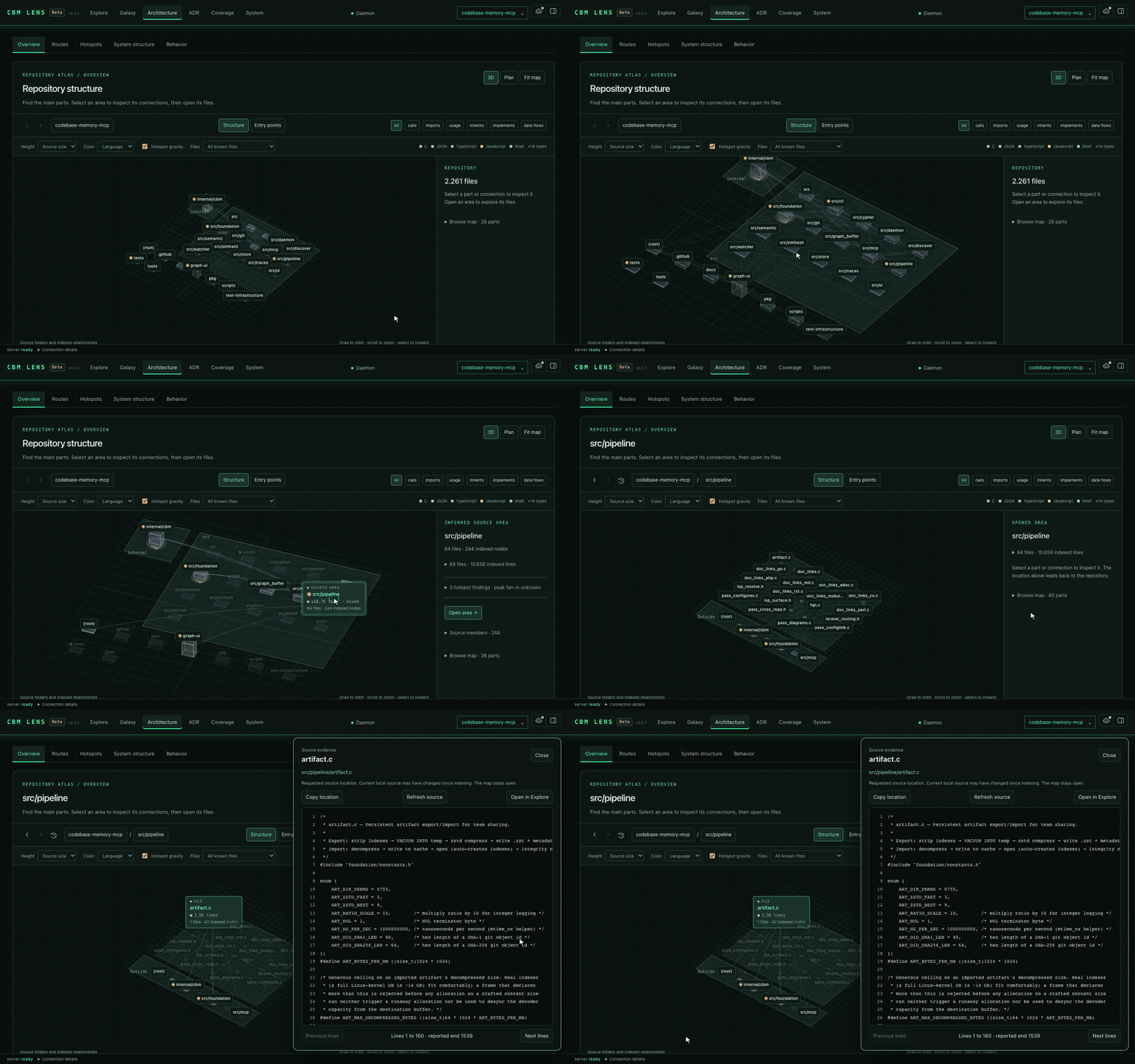
Architecture overview. Folders become nested platforms, files and symbols become selectable blocks, and arrows show indexed relationships. The recording zooms into the map of this repository, selects src/pipeline, opens the area, selects artifact.c and opens its source. Height can show source size; hotspot gravity reflects static fan-in. Still image.
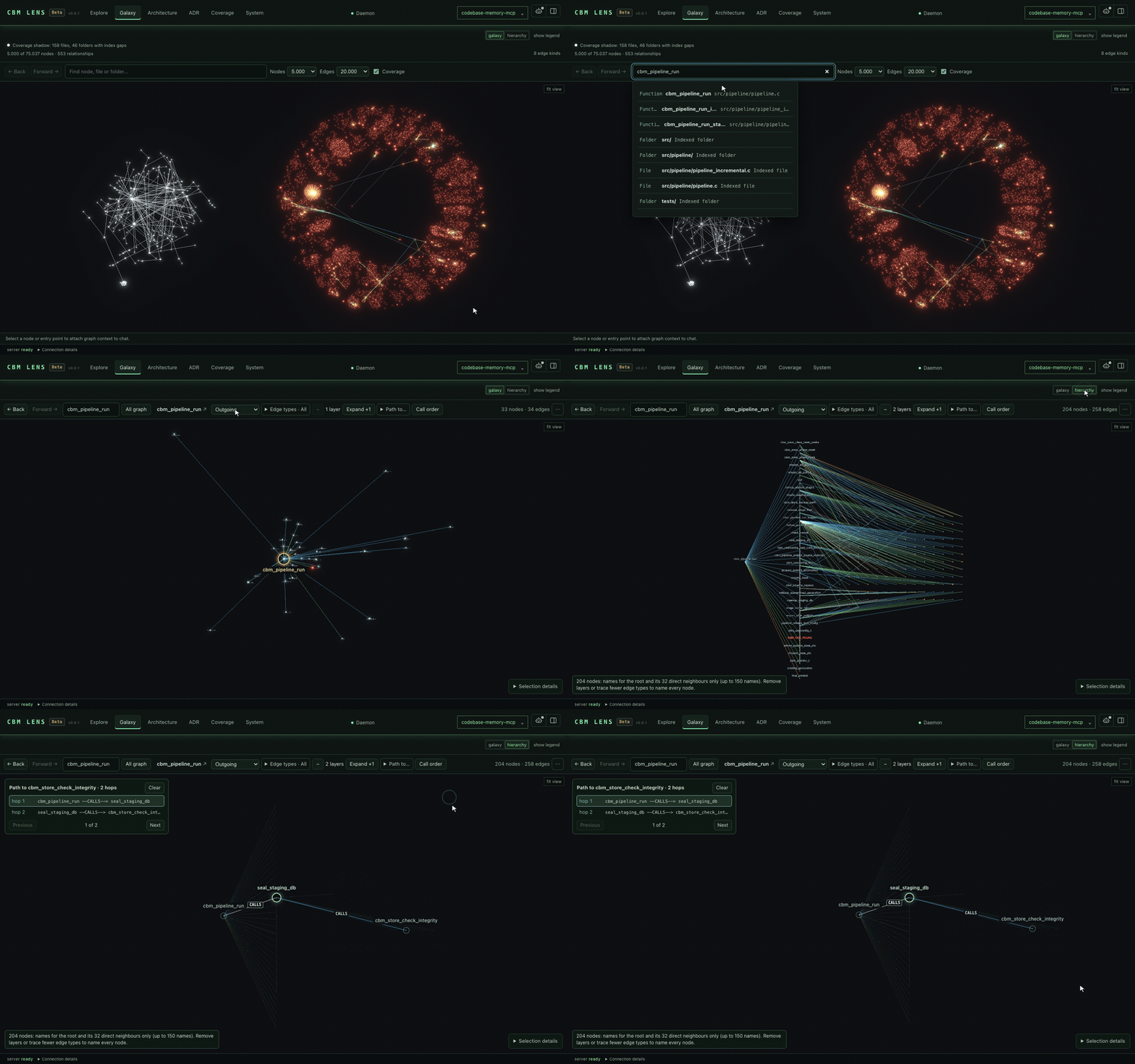
Galaxy. Explore the code knowledge graph in 3D. The recording searches cbm_pipeline_run, follows its outgoing calls one layer further, switches to the hierarchy and shows the path to cbm_store_check_integrity. Edge pulses show relationship direction; they do not represent live execution. Current still: two dependency layers around cbm_max_file_bytes.
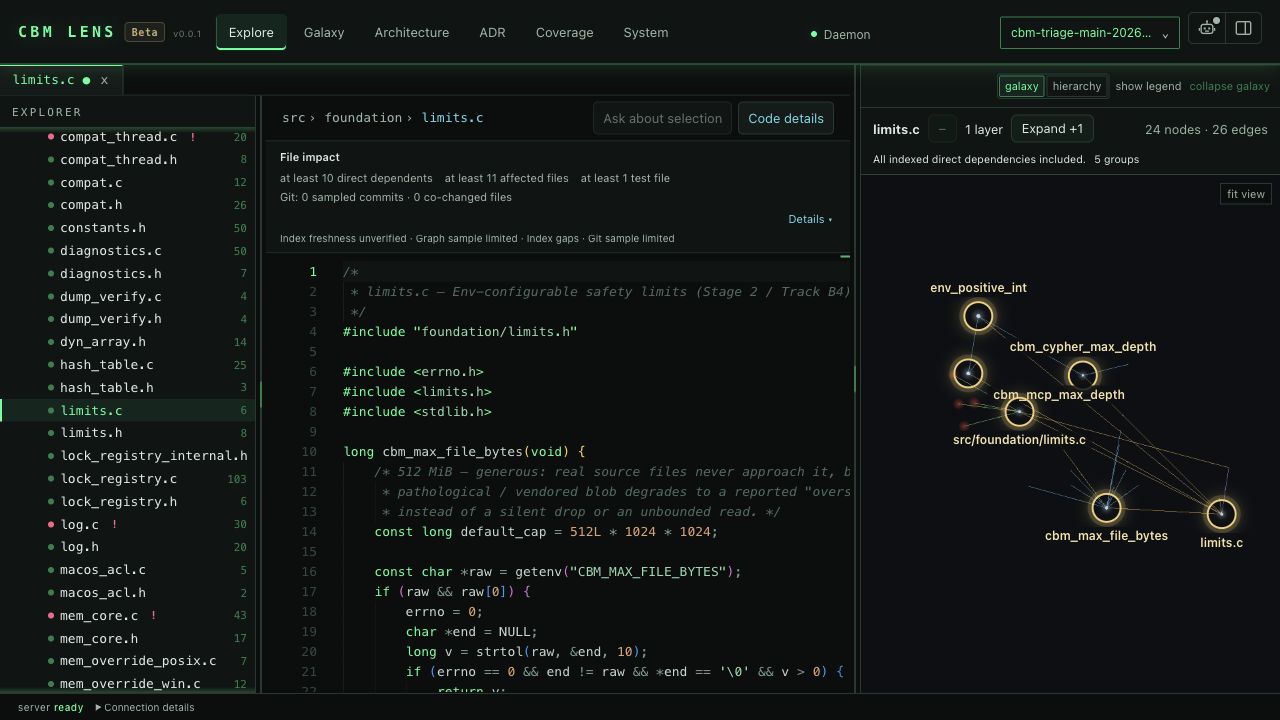
Explore. Browse files in an IDE-style workspace, read syntax-highlighted source in Monaco, and keep the code graph alongside it. File impact shows what depends on the open file, and Code details shows the callers and calls of the symbol under the caret. Select code to ask the local chat about it.
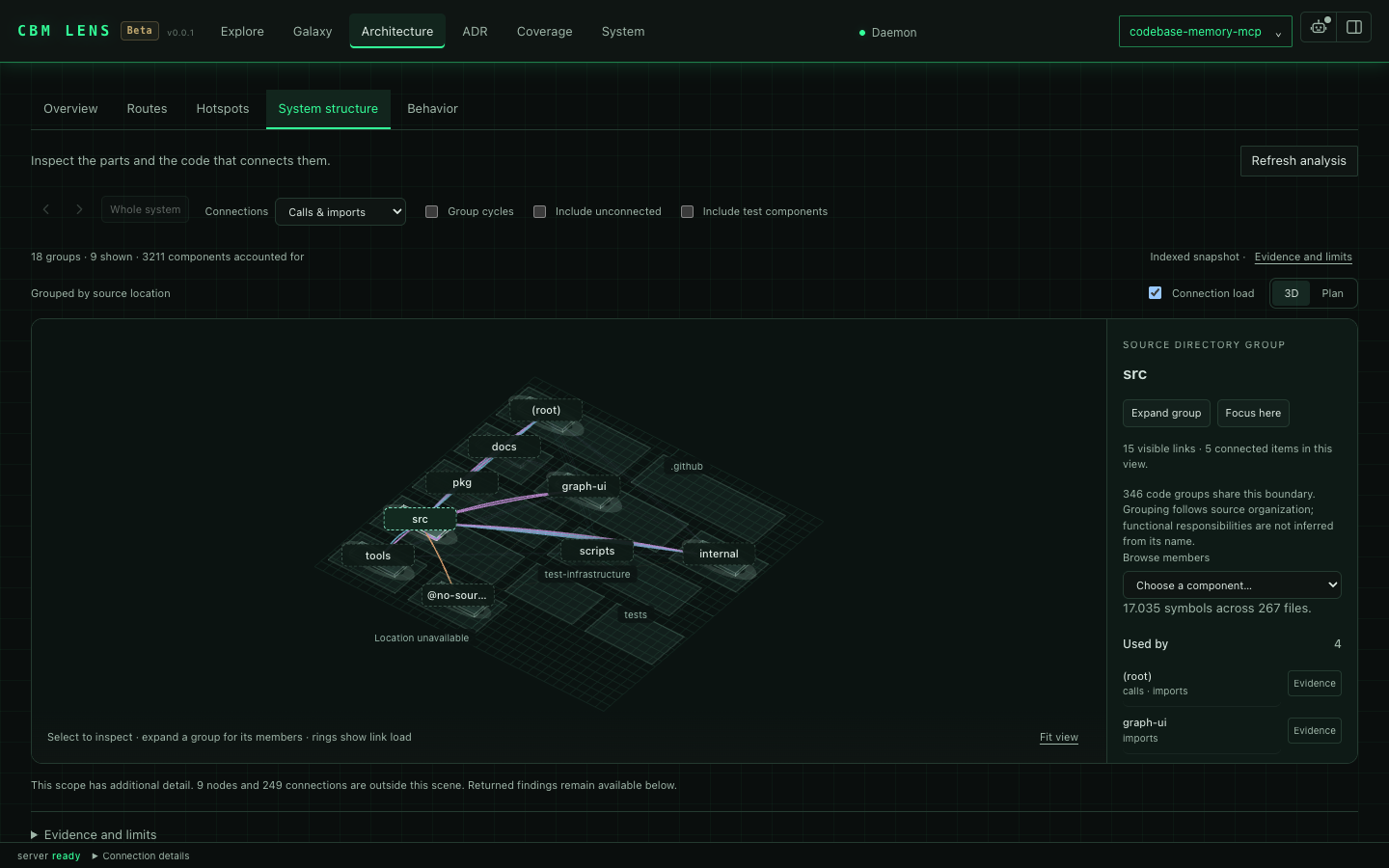
More views: system structure and behavior
System structure groups symbols into components and lets you inspect their dependencies.
Behavior shows possible calls from a selected operation and the source evidence behind them.
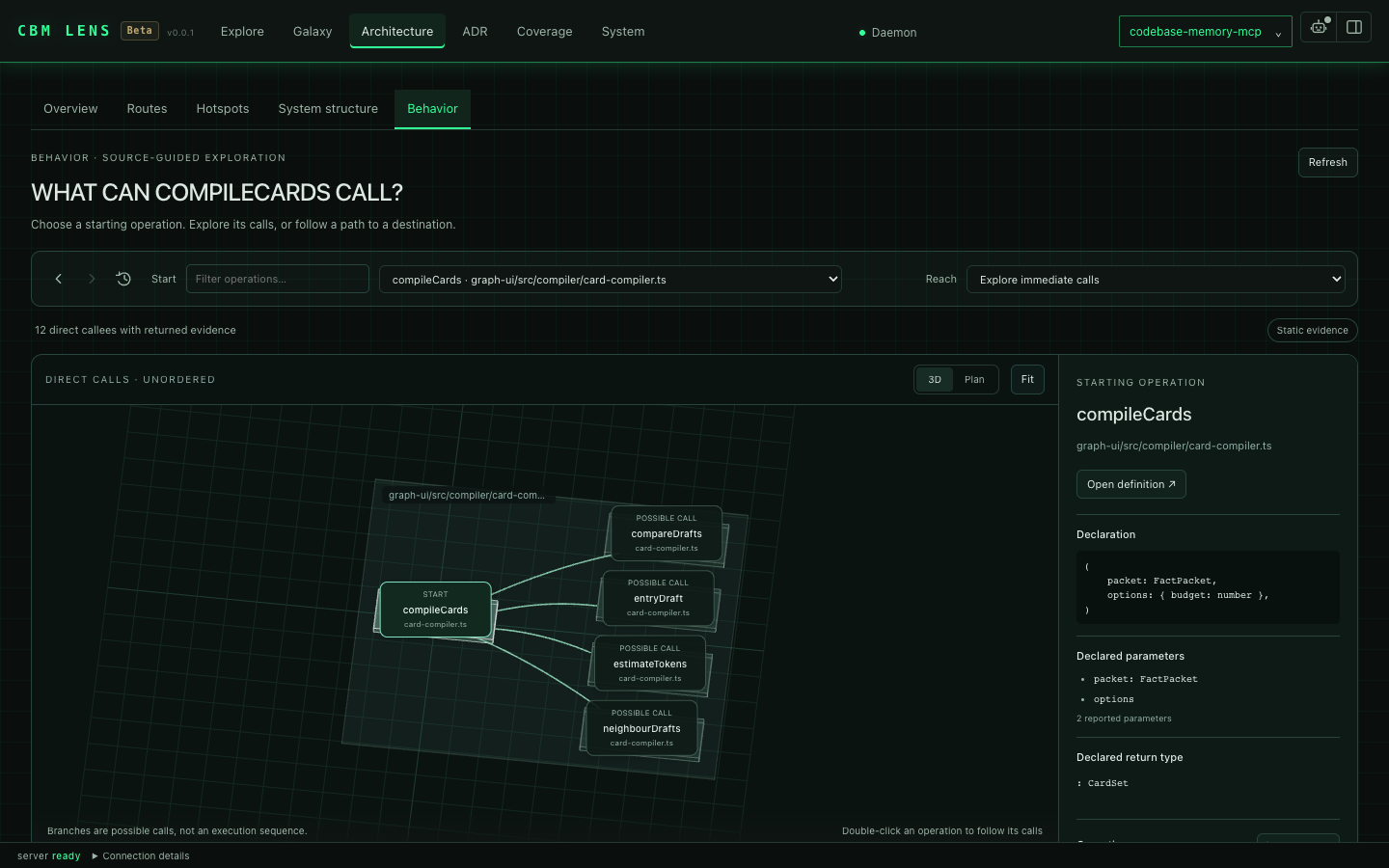
These captures show CBM Lens Beta on 12–13 October 2026, using public source from this repository. See capture details for each capture's build, indexed scope and recording setup.
Why codebase-memory-mcp
- Indexing performance: Linux kernel (28M LOC, 75K files) in 3 minutes. RAM-first pipeline: LZ4 compression, in-memory SQLite, fused Aho-Corasick pattern matching. Memory released after indexing.
- Plug and play: native executable plus authenticated release-owned assets for macOS (arm64/amd64), Linux (arm64/amd64), and Windows (arm64/amd64). The native install needs no Docker, language runtime, or API keys. Download →
install → restart agent → done.
- 162 languages: vendored tree-sitter grammars compiled into the binary. No separate parser installation.
- About 120× fewer tokens in the reported five-query comparison: ~3,400 tokens vs ~412,000 via file-by-file search. See Performance for the scope and sources.
- 45 supported automatic/conditional client surfaces:
install configures detected clients and safely activates conditional clients only when their documented platform, marker, or explicit existing config path is present. See Multi-Agent Support for the complete matrix and manual/UI-only boundaries.
- CBM Lens Beta: read source, chat about selected code with a local model, explore architecture and call graphs, inspect coverage gaps, and edit architecture decision records in your browser.
- Infrastructure-as-code indexing: Dockerfiles, container images, docker compose, Kubernetes manifests, and Kustomize overlays indexed as graph nodes with cross-references.
Resource nodes for K8s kinds and compose services, Image nodes joining the images that are built and run, Module nodes for Kustomize overlays with IMPORTS edges to referenced resources; a Service walks to the program its container runs.
- 17 MCP tools: search, trace, architecture, impact analysis, targeted index-coverage checks, Cypher queries, dead code detection, cross-service HTTP linking, ADR management, and more.
Quick Start
Install the latest release (macOS / Linux). For CBM Lens Beta shown above, build from source until the next release.
curl -fsSL https://raw.githubusercontent.com/DeusData/codebase-memory-mcp/main/install.sh | bash
The released graph UI is included in the standard installer.
Windows (PowerShell):
# 1. Download the installer
Invoke-WebRequest -Uri https://raw.githubusercontent.com/DeusData/codebase-memory-mcp/main/install.ps1 -OutFile install.ps1

# 2. (Optional but recommended) Inspect the script
notepad install.ps1

# 3. Unblock the downloaded file (removes Mark-of-the-Web restriction added by browsers/Invoke-WebRequest)
Unblock-File .\install.ps1

# 4. Run it
.\install.ps1
Note: If you see a script execution policy error, run Set-ExecutionPolicy -Scope Process Bypass first, or invoke with PowerShell -ExecutionPolicy Bypass -File .\install.ps1.
Options: --skip-config (binary only, no agent setup), --dir=<path> (custom location).
Antivirus note: Microsoft Defender may flag a release binary as
Trojan:Script/Wacatac.B!ml. This is a known false positive; typically 61 of
~62 engines return clean, and the same detection family hits gh, llama.cpp,
Godot and Microsoft's own Go toolchain. See
Antivirus False Positives for the
evidence, how to verify the artifacts yourself, and how to report it if you
think we are wrong.
Restart your coding agent. Say "Index this project": done.
Manual install
Download the archive for your platform from the latest release:
codebase-memory-mcp-<os>-<arch>.tar.gz (macOS/Linux) or .zip (Windows)
Extract and install (each archive includes install.sh or install.ps1):
macOS / Linux:
tar xzf codebase-memory-mcp-*.tar.gz
./install.sh
Windows (PowerShell):
Expand-Archive codebase-memory-mcp-windows-amd64.zip -DestinationPath .
Unblock-File .\install.ps1
.\install.ps1
Restart your coding agent.
The install command automatically strips macOS quarantine attributes and ad-hoc signs the binary; no manual xattr/codesign needed.
The install command auto-detects installed coding agents and configures their documented MCP entries plus durable instructions, skills, and lifecycle hooks where supported.
Session Coordination Daemon
CBM automatically shares one per-account coordination daemon across Claude Code, Codex, OpenCode, and every other configured client. There is no opt-in setting for MCP servers or hook clients: the first daemon-backed CBM session starts it, each session registers its own work, and a session-managed daemon stops after the final session. A daemon started with daemon start remains running until stopped. The daemon owns long-lived background services such as watchers, shared indexing jobs, and the optional UI. Closing one session cancels work owned only by that session, while work still needed by another session continues.
The detached daemon does not depend on an MCP frontend's stderr. It keeps owner-only durable records under the canonical ${CBM_CACHE_DIR}/logs directory (default ~/.cache/codebase-memory-mcp/logs):
| File |
Contents |
cbm-daemon.log |
Daemon lifecycle, watcher/indexing, UI, resource, and error events. |
daemon-conflicts.ndjson |
Exact-build, coordination-ABI, and cache-root admission conflicts. |
activation-events.ndjson |
Install/update/uninstall activation progress and outcomes. |
Thin frontends still write immediate startup and session-specific errors to their own stderr; MCP JSON-RPC stdout remains clean.
All active CBM processes must run the exact same version, executable build, coordination ABI, and canonical cache root. Equivalent CBM_CACHE_DIR aliases resolve to the same root; a genuinely different root is rejected while any CBM process is active. MCP servers, hooks, one-shot CLI commands, temporary index workers, and the daemon share a crash-safe OS admission barrier; starting an ordinary conflicting process fails before doing work and records an explicit conflict in ${CBM_CACHE_DIR}/logs/daemon-conflicts.ndjson.
The native install, update, and uninstall commands are the deliberate exception to that conflict rule. Download, verification, and private same-filesystem staging happen first so a bad candidate never disrupts active work. Activation then publishes account-wide maintenance intent, asks the daemon and every temporary local operation to cancel, and waits to a finite deadline for all coordinated CBM processes to exit. It holds the admission and lifetime barriers exclusively while changing the active binary, configuration, PATH, or indexes. New CBM work cannot enter during this window. Activation progress and results are recorded in ${CBM_CACHE_DIR}/logs/activation-events.ndjson, and a successful command tells you to restart open coding-agent sessions so they launch the activated build.
Package-manager setup (npm, PyPI, or Go) verifies and caches the native executable for that package. It does not replace the active native installation and therefore does not stop running CBM sessions. When that cached binary is executed, it still enters the same exact-build admission barrier. The shell and PowerShell installers invoke the verified candidate's native install command, so they do receive the full account-wide activation guarantee.
The ordinary cli mode runs one command locally, but it is not disconnected from the daemon above: it connects to the shared coordination daemon (starting one if none is already running) for that same admission barrier plus per-project locks on graph mutations. Its connection is a cli_session: it never registers with the background watcher and never starts a UI, and it holds the admission lease only for the command's lifetime. If the command's own connection is what started the daemon, that daemon exits again once the command closes and no other session is attached; if a daemon was already running, the command simply joins and leaves it exactly as found. While the command is running, a temporary monitor separately lets activation cancel that operation and its supervised worker safely; the monitor exits with the command and never becomes a standing daemon. See CLI Mode for details.
CBM Lens Beta: code visualization and source navigation
CBM Lens Beta is the browser interface built into the binary. It builds on CodeAtlasWeb by Bernhard Jackiewicz (design and tracking in #1964). It runs on loopback; the only request that leaves your machine is the optional model download from Hugging Face, and only after you start it. Each panel names where its facts come from, and what the index did not record is shown as a gap. Start the local server:
./build/c/codebase-memory-mcp daemon start --open --port=9749
The browser opens at http://127.0.0.1:9749. A permanent daemon keeps the UI available after the command exits. Use daemon status to inspect it and daemon stop when you are finished. For an MCP session, --ui=true --port=9749 enables the same shared UI. Active clients must use the same executable build and cache directory.
Open your first repository
- Open the project menu and choose Add project index. You can also use
Alt+P.
- Choose a local repository folder and name the index. Files stay in place.
- Start indexing and follow its reported status. You can close the dialog while it runs and reopen its activity from the project menu.
- Open the indexed project. Start with Architecture for an overview or Explore to read a file.
To bookmark a view, use ?project=<name>&workspace=architecture. Other workspace values are explore, galaxy, adr, coverage, and system.
| Workspace |
What you can do |
| Explore |
Navigate the indexed file tree and read source in Monaco. File impact shows what depends on the open file; Code details shows the callers, calls, references and related tests of the symbol under the caret. |
| Galaxy |
Search and focus graph nodes, load their neighbors layer by layer, switch to hierarchy, follow a path, and open source. Back and Forward return to earlier views. The coverage shadow marks known gaps around the loaded graph. |
| Architecture |
Explore the folder map, entry points, routes, hotspots, system structure, and behavior paths. Select a node or connection to inspect its evidence. |
| ADR |
Read and edit the project's architecture decision record. Save explicitly; the document is stored with the index and shared with manage_adr. |
| Coverage |
Check indexed, partially parsed, skipped, and excluded paths, together with available freshness information. |
| System |
Inspect daemon activity, indexes, and logs. Filter logs by project, severity, or text. |
Architecture views
- Overview: move through source folders and files on a 3D map. Choose source-size or uniform height, language or kind colors, and relationship filters. Switch to Entry points to follow a static call graph from a starting symbol.
- Routes: switch between the service map and endpoint connections. Deployment metadata and indexed route evidence are shown separately; unresolved registrations remain visible.
- Hotspots: inspect symbols using measured signals such as fan-in and complexity. Gravity wells help locate frequently referenced areas. They are not a code-quality score.
- System structure: inspect component dependencies, expand groups, isolate cycles, and follow connections back to source evidence.
- Behavior: choose a source and a reachable destination to inspect static call paths and their source statements. These paths show possible relationships, not a recorded execution order. Runtime observations require separately ingested traces.
Drag a 3D view to orbit, scroll to zoom, and select a node or edge to inspect it. Edge colors distinguish relationships, and pulses indicate their direction. Reduced-motion preferences pause the pulses. Large views show their limits and omitted counts. A missing edge can reflect an indexing or display limit, so check Coverage and the source before drawing conclusions.
Chat with your codebase locally
Open Chat with the panel button at the top right to ask about the code you are looking at. In Explore it uses the open file or the exact text you have selected; in Galaxy it uses the selected node and its loaded neighbors. You can also attach graph evidence through Add context.
- Click the robot icon at the top right to open the agent configuration.
- Choose a local model. The default Qwen2.5 Coder 0.5B downloads about 567 MB; Qwen3 0.6B, LFM2.5 1.2B and Qwen3.5 2B are larger options. All need WebGPU with
shader-f16 support.
- Click Download & load. Model files come from Hugging Face; inference runs in your browser, with no hosted chat API or API key. A model that is already in the browser cache loads with Load model (cached, no download).
- Ask a question. The composer shows the file or selection that will accompany it. Select a smaller range when you want to focus the answer.
Questions about callers and callees, such as "Who calls cbm_pipeline_run?", are answered from the loaded graph without the model, and the answer says so. When you select a symbol, the chat lists its indexed facts and the lines of its code, and the model adds one sentence; that sentence is left out when it claims something the source does not show. Text written by the model is labelled as such.
The recording shows a question about callers answered from the indexed graph, next to the automatic explanation of the selected symbol. Still image.
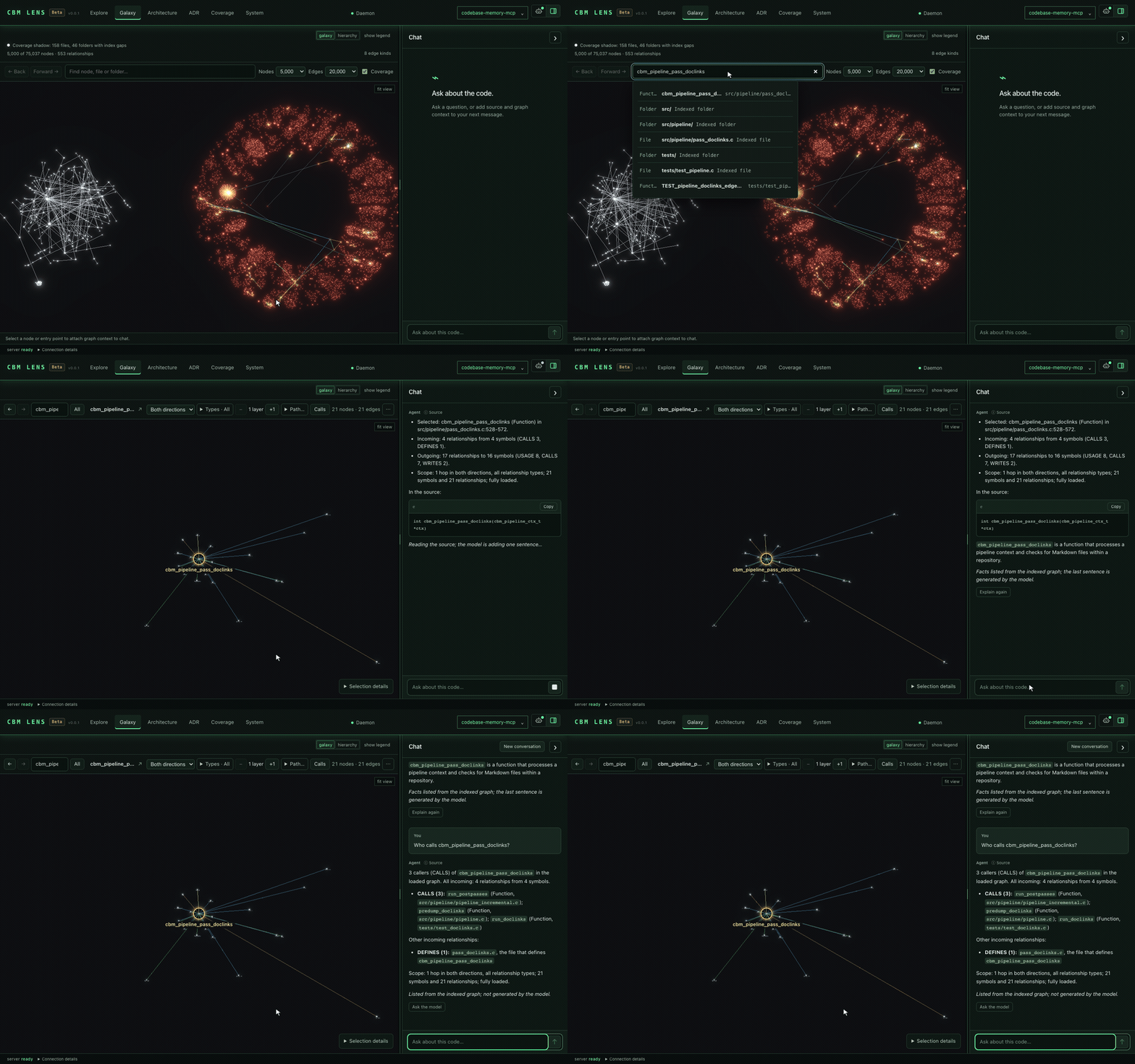
The chat history is kept for 24 hours in this browser, per project. Each new message uses the source currently open in the reader; earlier source snapshots are not silently accumulated, and messages about another file or selection are not sent along. If a prompt is too long for the model, older messages are left out first; if it still does not fit, CBM Lens asks you to select less code instead of cutting the code. This chat explains the context you give it; it cannot edit files or run tools. Check its answers against the source. The small default model words things loosely, especially in languages other than English.
Search
Cmd+K or Ctrl+K opens the Galaxy search. It finds symbols, files and folders by name or path in the whole index, also nodes that are not loaded yet. For callers and callees, ask in the chat; the answer is listed from the graph.
Architecture decisions
The ADR workspace keeps an unsaved draft per project in this browser tab. It checks whether the stored document changed before saving, but the API does not provide an atomic document lock. The editor accepts up to 8,000 UTF-8 bytes. Saving changes the indexed decision document, not a file in your repository.
Experimental agent activity
The Agents workspace and activity overlays are hidden in normal builds. To include them in a source build:
VITE_EXPERIMENTAL_AGENTS=true scripts/build.sh --with-ui
Activity comes from explicitly configured tool hooks. The bundled adapter supports Claude Code PostToolUse; other clients need their own adapter. Recorded events go to the local daemon, and the reader must enable activity before the browser polls them. This does not automatically observe every agent. See the frontend setup guide.
For troubleshooting, open System logs. Frontend errors and failed requests are recorded locally. GET /api/ui-log reads frontend entries from the daemon's SQLite journal; ${CBM_CACHE_DIR}/logs/ui.log is also retained as a rotating JSONL export. See the frontend README for log scope, model setup, and development details.
Auto-Index
Enable automatic indexing on MCP session start:
codebase-memory-mcp config set auto_index true
When enabled, new projects are indexed automatically on first connection. Previously-indexed projects are registered with the background watcher for ongoing git-based change detection. Configurable file limit: config set auto_index_limit 50000.
The watcher follows MCP sessions: it watches the project each open MCP session is rooted in (the client's working directory) and stops when the last session for that project closes. A repository indexed with cli index_repository, or indexed from a session rooted somewhere else, is not watched; re-run index_repository after changing it. index_status reports this in its watch object: watched, and either the poll cadence and last scan time or the reason it is not watched.
Watcher registration is controlled separately by auto_watch (default true). Set config set auto_watch false to keep a session from registering its project with the background watcher; useful when working across many projects and you want each session contained to explicit indexing.
To turn the watcher off entirely, set config set watcher_enabled false (default true): the background poll thread never starts and no project is registered, while auto_index and manual index_repository keep working. Unlike auto_watch, which is consulted per session, watcher_enabled is read once when the background daemon starts, so run codebase-memory-mcp daemon stop after changing it; reconnecting your MCP client alone will not restart the daemon. See docs/CONFIGURATION.md.
The watcher follows git projects only by default: a project indexed from a directory that is not a git repository is not watched and stays at its last index until you run index_repository again. To have such roots polled too, set config set watch_non_git true (default false, read when the daemon starts): they are then checked on the same cadence with a file-tree scan that uses the indexer's own ignore rules.
Keeping Up to Date
Updates run from the install script on every platform, not from inside the running binary. codebase-memory-mcp update validates your flags and then prints the exact command to run:
# macOS / Linux
bash "<install-dir>/install.sh"
# Windows
powershell -ExecutionPolicy Bypass -File "<install-dir>\install.ps1"
The install script is placed next to the binary at install time, so the printed path resolves beside the executable. It is idempotent, so re-running it is the update: it stops the daemon, retires the running binary, installs the new one, and cleans up.
Why it works this way. On Windows it is a hard requirement; a running executable cannot replace its own image, so the swap has to happen from a process that is not the binary being replaced. On macOS and Linux it is a deliberate choice: an in-process updater is structurally a downloader (fetch an archive, verify it, unpack it, mark a file executable, run it), and shipping that composite in every binary to serve a command most people run a handful of times is a poor trade. The release archives now carry no download URLs at all, and cbm makes no network request of its own accord: it does not check for new versions in the background, and nothing phones home. You find out about releases from the install script, your package manager, or GitHub.
If PowerShell refuses to run the script because the file came from the internet, Unblock-File it first.
Installed through npm or pip? Update with your package manager on every platform (npm install -g codebase-memory-mcp@latest / pip install -U codebase-memory-mcp).
Uninstall
codebase-memory-mcp uninstall
Removes owned agent config entries, skills, hooks, instructions, and the installed binary. Existing graph indexes are listed and kept by default. -y/--yes, -n/--no, and noninteractive input keep them unless --delete-indexes is explicitly given. An interactive terminal without that flag is asked separately; the default answer is to keep them.
codebase-memory-mcp uninstall -y --delete-indexes   # also delete every project index
codebase-memory-mcp uninstall --dry-run --delete-indexes   # preview; change nothing
--delete-indexes is explicit consent and takes precedence over --no; --dry-run always preserves the files. When indexes are kept, uninstall prints their cache directory (${CBM_CACHE_DIR:-~/.cache/codebase-memory-mcp}) and how to remove them.
The install script placed beside the binary is reported, not deleted: uninstall prints its path and the rm command for it. It is left alone on purpose: it may be your own copy, a symlink into a checkout, or managed by a package manager, and an uninstaller should not delete a file it cannot prove it owns.
Features
Graph & analysis
- Architecture overview:
get_architecture returns a compact summary by default. Request specific aspects for routes, hotspots, dependencies, clusters, or cycles. system_structure provides the projection used by CBM Lens and must be requested on its own.
- Architecture Decision Records:
manage_adr persists architectural decisions across sessions
- Louvain community detection: Discovers functional modules by clustering call edges
- Git diff impact mapping:
detect_changes maps uncommitted changes to affected symbols with risk classification
- Call graph: Resolves function calls across files and packages (import-aware, type-inferred)
- Dead code candidates: find functions with no indexed callers, excluding entry points. Check dynamic dispatch, coverage gaps, and framework conventions before removing code.
- Cypher-like queries:
MATCH (f:Function)-[:CALLS]->(g) WHERE f.name = 'main' RETURN g.name
Search
- Semantic search (the
semantic_query parameter of search_graph, not a separate tool): vector search across the entire graph, powered by bundled Nomic nomic-embed-code embeddings (40K tokens, 768d int8) compiled into the binary; no API key, no Ollama, no Docker. 11-signal combined scoring (TF-IDF, RRI, API/Type/Decorator signatures, AST profiles, data flow, Halstead-lite, MinHash, module proximity, graph diffusion).
- BM25 full-text search via SQLite FTS5 with
cbm_camel_split tokenizer (camelCase / snake_case aware)
- Structural search (
search_graph): regex name patterns, label filters, min/max degree, file scoping
- Code search (
search_code): graph-augmented grep over indexed files only
Cross-service linking
- HTTP route ↔ call-site matching with confidence scoring
- gRPC, GraphQL, tRPC service detection with protobuf Route extraction
- Channel detection (
EMITS / LISTENS_ON) for Socket.IO, EventEmitter, and generic pub-sub patterns across 8 languages with constant resolution
Cross-repo intelligence
CROSS_* edges link nodes across multiple repos indexed under the same store- Cross-repo architecture summary combining services, routes, and dependencies across the indexed fleet
- Run status:
index_status (and the UI layout next to linked_projects) carries a cross_repo object, {"status":"never_run"} until index_repository(mode="cross-repo-intelligence") has run with that project as the source, then "ran" with last_run_at, outcome, targets, projects_scanned, total_cross_edges and skipped_projects. That is how you tell "never linked" apart from "linked, nothing matched". The status is stored in the project's own index next to its CROSS_* edges, so a reindex that rebuilds the index drops both at once and the status goes back to never_run.
- Skipped stores:
target_projects: ["*"] skips an index built before the #768 schema change rather than failing the whole run. The response lists each one as skipped_projects: [{"name", "reason": "pre_768_schema", "hint": "reindex this project"}].
Edge types (selected)
CALLS: a callable is invoked at the source siteCALL_REFERENCE: a callable is used at a supported reference site (for example, a direct value argument) and resolves to one exact targetUSAGE: an identifier is used, but a unique callable target is not proven (including ambiguous or complex expressions)IMPORTS, DEFINES, IMPLEMENTS, INHERITSHTTP_CALLS, ASYNC_CALLS (cross-service); a shell script, Make recipe or CI step running curl / wget on a URL it states (constant words resolved, unknown parts {}) to its Route with the method its flags give: a Kubernetes Service of the repository by the path, as code clients do, any other host (a download, localhost) with the host kept; the edge keeps via, method, url_path, host, never the user info or the querySPAWNS: the caller starts another program (subprocess.run, exec.Command, posix_spawn, Process.Start, a shell command or Make recipe running a program by path, ...); the target is a Process node named after the program, or <dynamic> when the program is not a literal. When a shell script, Make recipe, GitHub Actions step or Prow job runs a script of the repository (./hack/x.sh, bash hack/x.sh), the target is that script's Module (else its File); make TARGET (also $(MAKE), -C, -f) targets the rule of that target, followed through included makefiles; edges from CI carry ci and job. A Dockerfile's last stage ENTRYPOINT (else CMD) spawns what the container runs (api: dockerfile): the repository script or source copied into the image, the Go main of a binary a stage builds with go build -o, else a ProcessINFRA_MAPS: a Kubernetes Service to each workload whose pod labels carry every key: value of the Service's selector, within one namespaceCONNECTS_TO: a Kubernetes workload or compose service to the Service its containers' environment addresses (PRODUCT_CATALOG_SERVICE_ADDR: productcatalogservice:3550, a URL's host, <svc>.<ns>.svc..., a bare name on an *_ADDR / *_HOST / *_URL / ... key; compose: the project's .env interpolated): a Kubernetes Service of the same bundle and namespace, or a compose service of the same file. The edge keeps via: env, key and container, never the valueUSAGE with ref: image: a Kubernetes workload (any pod template: containers, initContainers, CronJobs, custom resources) or a docker compose service to the Image it runsDEPLOYS: what puts manifests, kustomizations or charts on a cluster, to what it puts there: a Flux Kustomization or Argo Application to the kustomizations / manifests / chart of its path, a Flux HelmRelease to its chart (spec.chart or chartRef → OCIRepository), a shell command or Make recipe (kubectl apply -f/-k, kustomize build | kubectl apply, helm install/upgrade/template), a Go installer loading a chart with the Helm SDK, a Terraform helm_release, a Terraform kubernetes_* resource the object it declares (a Resource like a manifest's, ecosystem: terraform, when its name is a literal), a kustomization inflating a chart (helmCharts; its values file an IMPORTS). A chart outside the repository is an external Chart, keyed by its publisher when its repository URL is stated (__chart__<repository>/<name>, the same node in every project, the URL in repository), else one per project and name; the edge says via (flux, argo, helmrelease, kubectl, kustomize, helm, helm-sdk, terraform, helmcharts, ...)DEPENDS_ON: a Helm chart to the charts it declares (the local chart for a resolvable file:// repository, otherwise an external Chart; the edge keeps repository), and a go.mod / requirements.txt file to an external Package; a Dockerfile to the Images it builds on (via: from, copy-from); an Image to the Dockerfile it is built from (via: build; tool: skaffold, compose, docker-build for docker / podman / nerdctl / buildah build commands in scripts, Make and CI); a compose service to the services its depends_on / links nameCONFIGURES: code reading an environment variable to the shared EnvVar of that name (strategy: env_access); a Kubernetes container, compose service or Dockerfile (ENV of the image) setting one to that container's own EnvVar (strategy: env_set, with source: value, configMapKeyRef, secretKeyRef, fieldRef, ..., compose, dockerfile; values are never stored); and that container's EnvVar to the code reading the name inside the files its image is built from (strategy: env_read, with dockerfile): the image's files are the sources its Dockerfile's COPY / ADD put into it, less the context's .dockerignoreCONFIGURES with strategy: key_symbol: a code symbol to the config key it names (config_key). A YAML, JSON, HCL (Terraform, OpenTofu, tfvars), TOML or INI key links by exact name (maxRetryCount = max_retry_count) and only to code inside the config file's component: its directory, or the one around a config/, configs/, conf/, settings/ or etc/ directory. A .env or .properties key also links by substring (confidence 0.75)OVERRIDE with via: patch: a Kustomize patch to each object of its kustomization's build it changes (child → base): a patch file's documents to the object of the same kind and name; an inline patch (from the kustomization) or a JSON6902 operation file to what its target selects (group, version, kind, name, namespace, label selector); a component's in the build of each kustomization including it. The edge keeps kustomization, patch and line; a patch file is an IMPORTS (local_name: patches) of its kustomization, never a member of the buildOVERRIDE with via: namePrefix / nameSuffix: an object a kustomization renames, from its variant: a Resource named with the deployed name (capi- + controller-manager; the prefixes of nested kustomizations outermost first, suffixes innermost first) in the namespace that build gives it, ecosystem: kustomize, which the kustomization's file DEFINES. CRDs, Namespaces and API services keep their names, as kustomize does. The edge keeps kustomization and lineUSAGE with via: terraform: a Terraform / OpenTofu reference (var.X, local.X, module.X, data.T.N, T.N) from the top-level block holding it to the block of its module (the .tf / .tofu files of its directory) that declares it (a locals entry: its locals block); an entry of the block's depends_on list is a DEPENDS_ON instead. The edge keeps ref (var, local, module, data, resource) and line; a name only mentioned in string text is no reference. A module call with a local source (module "net" { source = "./modules/net" }) IMPORTS (local_name: the module's name) the Folder of that directory (the root directory: the Project), and module.net.id (also module.net[0].id, module.net[*].id) USAGEs (ref: output) the output "id" there, beside module.netOVERRIDE with via: tfvars: a .tfvars assignment to a variable the module of its own directory declares, from the file's Variable to that variable block (the edge keeps line); a .tfvars file whose own directory declares none of its names sets the nearest ancestor module's that does, the edge marked inferred (such a file is applied by a -var-file the repository does not state)- Terragrunt (
via: terragrunt): a unit (terragrunt.hcl), evaluated in its own context: an include IMPORTS (local_name) the file its path names; a read_terragrunt_config IMPORTS (read: the file holding the call) the file it names, from the block holding the call or, for a call in an included file, from the unit's include block that brings it in; a dependency DEPENDS_ON the other unit; a local terraform source IMPORTS its Folder. Paths may use find_in_parent_folders, dirname and get_terragrunt_dir; anything else is unknown and links nothing
- Ansible (
via: ansible): a playbook or task file (a YAML file whose top level is a sequence) IMPORTS (local_name: the directive) what its directives name: import_playbook a playbook, include_tasks / import_tasks / include a task file (from its directory, else its role's tasks/), roles: items and include_role / import_role a role's Folder (roles/<name> at or above its directory). A templated target links nothing. Each task and handler is a Function (named by its name:, else its module; source: ansible, kind, module) that its file DEFINES: in a playbook's plays, a role's tasks/ and handlers/ files, and the files those include; a block's tasks, not the block. A notify CALLS (via: notify) each handler of that name or listen topic in the task's own role (else its file). A kube (kubespray's module) or kubernetes.core.k8s task DEPLOYS (via: ansible, module) the repository file its play rendered the applied manifest from: the template (in the role's templates/) or copy (its files/) task whose dest is the task's filename, item by item through register / with_items / loop lists the play states (a literal list, a set_fact, the role's defaults / vars), or a k8s template: argument
EMITS, LISTENS_ON (channels)DATA_FLOWS with arg-to-param mapping + field access chainsSIMILAR_TO (MinHash + LSH near-clone detection, Jaccard scored)SEMANTICALLY_RELATED (vocabulary-mismatch, same-language, score ≥ 0.80)
Indexing pipeline
- 162 vendored tree-sitter grammars compiled into the binary
- Generic package / module resolution: bare specifiers like
@myorg/pkg, github.com/foo/bar, use my_crate::foo resolved via manifest scanning (package.json, go.mod, Cargo.toml, pyproject.toml, composer.json, pubspec.yaml, pom.xml, build.gradle, mix.exs, *.gemspec)
- Infrastructure-as-code indexing: Dockerfiles (
Dockerfile.*, *.Dockerfile, Containerfile: bases, what the container runs, ENV), container images (Image: the normalised repository, tag and digest on the edges; a repository built from several Dockerfiles, one per component tag, gets an Image per component), docker compose services (Resource), Kubernetes manifests (Resource, with group, version, kind, namespace, labels as k=v,k2=v2), Kustomize overlays (IMPORTS to their entries and patch files, OVERRIDE from their patches), Helm charts (Chart, DEPENDS_ON), Terraform / OpenTofu (.tf, .tofu, .tfvars) as graph nodes. A Service walks to the code it runs: Service → workload → Image → Dockerfile → main
- Hybrid LSP semantic type resolution for Python, TypeScript / JavaScript / JSX / TSX, PHP, C#, Go, C, C++, Java, Kotlin, Rust, and Perl; a lightweight C implementation of language type-resolution algorithms, structurally inspired by and compatible with major language servers including tsserver / typescript-go, pyright, gopls, Roslyn, Eclipse JDT, and rust-analyzer (parameter binding, return-type inference, generic substitution, JSX component dispatch, JSDoc inference for plain JS files, namespace + trait + late-static-binding resolution for PHP, file-scoped namespaces + records + LINQ method syntax for C#, class-hierarchy + overload + lambda resolution for Java, extension-function + scope-function resolution for Kotlin, trait-method + UFCS resolution for Rust)
- RAM-first pipeline: LZ4 compression, in-memory SQLite, single dump at end. Memory released after.
Distribution & operation
- Native runtime set, zero infrastructure services: SQLite-backed, persists to
~/.cache/codebase-memory-mcp/
- Auto-sync: Background watcher detects file changes in the project an MCP session is working in and re-indexes it automatically (other indexed repos: re-run
index_repository)
- Route nodes: REST endpoints are first-class graph entities
- CLI mode:
codebase-memory-mcp cli search_graph --project my-project --name-pattern ".*Handler.*"
- Available on: npm, PyPI, Homebrew, Scoop, AUR,
go install
Indexing modes
| Mode |
Use it for |
full |
Full indexing with semantic analysis. This is the default. |
moderate |
A filtered index with semantic analysis. |
fast |
A filtered index without semantic analysis. |
cross-repo-intelligence |
Link services across indexed projects, optionally limited by target_projects. |
Team-Shared Graph Artifact
Share a compressed graph snapshot so teammates can reuse an indexed baseline.
.codebase-memory/graph.db.zst is a zstd-compressed snapshot of the knowledge graph that lives next to your source. The artifact is opt-in: index_repository writes it only with persistence: true (the default is false), and once it exists later indexes refresh it. Local indexes persist regardless. When a teammate indexes a clone with an existing artifact, CBM imports that baseline and applies their local changes incrementally.
The artifact provides a shared baseline while each developer keeps a local query database.
How It Works
codebase-memory-mcp is a structural analysis backend: it builds and queries the knowledge graph. The backend does not require a generative model. It relies on your MCP client (Claude Code, or any MCP-compatible agent) to be the intelligence layer.
You: "what calls ProcessOrder?"

Agent calls: trace_path(function_name="ProcessOrder", direction="inbound")

codebase-memory-mcp: executes graph query, returns structured results

Agent: presents the call chain in plain English
With MCP, your coding agent translates a question into tool calls. CBM Lens can also use an optional browser model for explanations; this does not change how the backend indexes or queries code.
Published backend benchmarks on Apple M3 Pro. These are separate from the CBM Lens checks:
| Operation |
Time |
Notes |
| Linux kernel full index |
3 min |
28M LOC, 75K files → 4.81M nodes, 7.72M edges |
| Linux kernel fast index |
1m 12s |
1.88M nodes |
| Django full index |
~6s |
49K nodes, 196K edges |
| Cypher query |
<1ms |
Relationship traversal |
| Name search (regex) |
<10ms |
SQL LIKE pre-filtering |
| Dead code detection |
~150ms |
Full graph scan with degree filtering |
| Trace call path (depth=5) |
<10ms |
BFS traversal |
RAM-first pipeline: All indexing runs in memory (LZ4 HC compressed read, in-memory SQLite, single dump at end). Memory is released back to the OS after indexing completes.
Token efficiency: The project's original README report lists ~3,400 tokens for five structural queries via codebase-memory-mcp versus ~412,000 via file-by-file exploration. That is approximately 120× fewer tokens, or a 99.2% reduction, for that comparison. The separate 31-repository study reports a 10× token reduction. Its system-performance measurements include Linux kernel indexing in about 3 minutes and Cypher relationship queries under 1 ms on an Apple M3 Pro.
To measure comparable quality, latency, and agent-efficiency metrics on your own workload, see Measuring quality, latency, and agent savings. Exact reproduction of the figures above requires the original inputs and raw artifacts.
Troubleshooting & Diagnostics
codebase-memory-mcp runs 100% locally and collects no telemetry: your code, queries, environment, and usage never leave your machine. That privacy guarantee also means that when you hit something we can't reproduce on our side (a slow memory climb over hours, a performance regression, a leak that only appears after days of real use), we have no data at all unless you choose to send it. Here is how to capture it yourself.
Capture a diagnostics log
Set CBM_DIAGNOSTICS=1 before the first daemon-backed MCP session starts, then reproduce the problem (let it run as long as it takes; a slow leak needs time to show in the trend). The shared daemon captures this setting from the session that starts it. If it is already running, close all daemon-backed sessions so it exits before changing the setting. The daemon creates a fresh owner-private cbm-diagnostics-<pid>-<random> directory below the system temp directory ($TMPDIR or /tmp on macOS/Linux, %TEMP% on Windows). The exact paths are recorded by the diagnostics.start event in ${CBM_CACHE_DIR}/logs/cbm-daemon.log:
| File |
What it is |
trajectory.ndjson |
The memory trajectory: one JSON line every 5 s with rss, committed (Windows commit charge), peak_*, page_faults, fd, and queries. This is the file we need for memory/leak reports: the trend over time is what pinpoints a leak. It is kept on disk after the server exits (so you can grab it post-mortem) and rotates to trajectory.ndjson.1 past ~8 MB. |
snapshot.json |
The latest snapshot only; handy for a quick live check. Removed on clean exit. |
The private randomized directory prevents another local account from pre-placing a link or special file at a predictable diagnostics path. Its <pid> component is the shared daemon's process ID, also recorded by the daemon.start event. Set the variable consistently in the env block of each agent's MCP server config, or export it before launching the first session.
What to share
When you open a memory/performance issue, attach the .ndjson trajectory: it contains no source code or query text, only resource counters. If you'd rather not attach a file, paste it (or an agent's summary of it) into the issue: your assistant can read the NDJSON directly and report whether rss/committed grow monotonically, how fast, and relative to query count; which is exactly what we need to find the cause.
Installation
Pre-built Binaries
| Platform |
Archive |
| macOS (Apple Silicon) |
codebase-memory-mcp-darwin-arm64.tar.gz |
| macOS (Intel) |
codebase-memory-mcp-darwin-amd64.tar.gz |
| Linux (x86_64) |
codebase-memory-mcp-linux-amd64.tar.gz |
| Linux (ARM64) |
codebase-memory-mcp-linux-arm64.tar.gz |
| Windows (x86_64) |
codebase-memory-mcp-windows-amd64.zip |
Every release includes checksums.txt with SHA-256 hashes. The executable is self-contained; no adjacent data file is required. Linux -portable archives contain the fully static builds; ordinary platform archives use their native system ABI.
Windows note: SmartScreen may show a warning for unsigned software. Click "More info" → "Run anyway". Verify integrity with checksums.txt.
Setup Scripts
Automated download + install
macOS / Linux:
curl -fsSL https://raw.githubusercontent.com/DeusData/codebase-memory-mcp/main/scripts/setup.sh | bash
Windows (PowerShell):
irm https://raw.githubusercontent.com/DeusData/codebase-memory-mcp/main/scripts/setup-windows.ps1 | iex
AUR (Arch Linux)
yay -S codebase-memory-mcp-bin
paru -S codebase-memory-mcp-bin
The codebase-memory-mcp-bin package is available at: https://aur.archlinux.org/packages/codebase-memory-mcp-bin
Nix (flake)
The flake exposes two server packages plus the standalone frontend:
| Package |
Contents |
default (codebase-memory-mcp) |
Standard server, no UI |
codebase-memory-mcp-ui |
Server with CBM Lens embedded (--ui=true works) |
graph-ui |
Just the built CBM Lens assets (dist/) |
Run directly without installing:
# Standard server
nix run github:DeusData/codebase-memory-mcp

# Server with CBM Lens embedded
nix run github:DeusData/codebase-memory-mcp#codebase-memory-mcp-ui -- --ui=true --port=9749
# then open http://127.0.0.1:9749
Or build a binary into ./result/bin/codebase-memory-mcp:
nix build github:DeusData/codebase-memory-mcp                          # standard
nix build github:DeusData/codebase-memory-mcp#codebase-memory-mcp-ui   # with UI
Working in a clone? Use . in place of the flake URL, e.g. nix run .#codebase-memory-mcp-ui -- --ui=true, or drop into a shell that puts the binary on PATH with nix shell .#codebase-memory-mcp-ui.
Note: launched by hand (not from an MCP client) the server exits as soon as stdin closes; that's normal MCP behaviour. Keep stdin open while testing the UI, e.g. sleep infinity | codebase-memory-mcp --ui=true --port=9749. The codebase-memory-mcp-ui package embeds the UI at build time; nix run'ing the standard default package with --ui=true will refuse to start the HTTP server.
Install via Claude Code
You: "Install this MCP server: https://github.com/DeusData/codebase-memory-mcp"
Build from Source
Prerequisites: C/C++ compiler, zlib, and Node.js for CBM Lens
| Requirement |
Check |
Install |
| C compiler (gcc or clang) |
gcc --version or clang --version |
macOS: xcode-select --install, Linux: apt install build-essential |
| C++ compiler |
g++ --version or clang++ --version |
Same as above |
| zlib |
n/a |
macOS: included, Linux: apt install zlib1g-dev |
| Git |
git --version |
Pre-installed on most systems |
| Node.js 22+ and npm |
node --version and npm --version |
Required for --with-ui |
git clone https://github.com/DeusData/codebase-memory-mcp.git
cd codebase-memory-mcp
scripts/build.sh --with-ui          # the shipped composition (CBM Lens embedded, needs Node.js)
scripts/build.sh                    # without the UI (development only)
# Binary at: build/c/codebase-memory-mcp   (codebase-memory-mcp.exe on Windows)
The --with-ui build embeds CBM Lens and the agent integration templates into the native executable. You do not need Node.js to run that executable. Optional browser model weights are downloaded separately after opt-in.
Tests
Counts on main at 4d9592b5, where CBM Lens arrived. Native and Go counts use the macOS configuration; platform-specific registrations differ.
| Suite |
Count |
Checked for this README |
| Native C |
9,388 tests across 189 suites |
9,376 passed, 11 skipped, 1 failed on macOS (regex_compile_refuses_overlong_pattern) |
| UI unit tests (Vitest) |
3,970 tests in 310 files |
All passed |
| Go package wrapper |
30 top-level tests |
Counted in the source |
| npm package wrapper |
24 tests |
Counted in the source |
| Python package wrapper |
43 tests |
Counted in the source |
Run the test suite (9,388 tests across 189 suites):
scripts/test.sh                     # full: clean sanitizer build + all suites + guards
scripts/test.sh --suites <name>     # one suite, incremental, seconds
build/c/test-runner --list-suites   # what is available
Frontend development and validation:
cd graph-ui
npm ci
npm run test:unit
npm run build
npm run dev
The dev server listens on port 5173 and proxies /api and /rpc to port 9749. Start the matching CBM backend first.
Package wrappers have their own test commands: go test ./... in pkg/go, npm test in pkg/npm, and python3 -m unittest discover -s tests -p 'test_*.py' in pkg/pypi. The Go wrapper requires Go 1.26.1 or newer.
scripts/test.sh is the C test entry point used by CI. The canonical local artifact-flow check builds both stripped/unstripped candidates, defaults to the stripped candidate for this explicitly unscanned local run, packages those exact bytes, extracts the archive, and smokes it:
scripts/ci/smoke-artifact.sh <linux|darwin|windows> <amd64|arm64>
scripts/package-release.sh is intentionally a lower-level immutable boundary:
it accepts only an already-final --selected-binary plus its
--expected-sha256; it never builds, strips, signs, or relinks the executable.
Manual MCP Configuration
If you prefer not to use the install command
Add to ~/.claude.json (user scope) or project .mcp.json:
{
  "mcpServers": {
    "codebase-memory-mcp": {
      "command": "/path/to/codebase-memory-mcp",
      "args": []
    }
  }
}
Restart your agent. Verify with /mcp; you should see codebase-memory-mcp with 17 tools.
Multi-Agent Support
install configures 45 client surfaces: 39 detected automatically and 6
conditional or explicit. “Conditional” means the installer writes only when the
documented platform or an explicit, already-existing config path proves the
target is active. It never flips experimental feature flags, enables plugins,
YOLO modes, global permission bypasses, or third-party instruction trust.
Where a client has a documented custom-agent format, the installer creates three
exact-owned definitions from one canonical contract:
- Scout (Tier 1): about 3 to 4 narrow calls for fast positive, provisional discovery; no absence, exhaustive-impact, or dead-code claims.
- Verify (Tier 2, default): task-directed graph evidence, exact source checks, path coverage for every cited file, and scope coverage before negative claims.
- Auditor (Tier 3): bounded scope, current index generation, complete relevant pagination, broader relationship checks, and explicit unresolved limitations.
Every direct tier batches check_index_coverage for its evidence paths and reads
flagged ranges or skipped/excluded files directly. A clean coverage result means
only “no recorded gap,” never proof of completeness. Clients without safe child
MCP access receive the same three tiers as parent-handoff agents; the parent must
supply project, generation, pagination state, graph evidence, and coverage
results. Updates migrate only byte-identical prior Verify definitions and never
overwrite user-modified agents.
| Agent |
Activation |
MCP config |
Durable context / augmentation |
| Claude Code |
Detected |
~/.claude.json |
Skill + three exact-tool graph agents; SessionStart, SubagentStart, non-blocking PreToolUse for Grep/Glob/Bash, and post-Read coverage |
| Codex CLI |
Detected |
$CODEX_HOME/config.toml |
Managed AGENTS.md activation pointer, skill, three read-only agents; SessionStart + SubagentStart |
| Gemini CLI |
Detected |
.gemini/settings.json |
GEMINI.md, three explicit read/graph-tool subagents; BeforeTool, AfterTool read_file coverage, and SessionStart |
| Zed |
Detected |
platform settings.json (JSONC) |
AGENTS.md + shared skill |
| OpenCode |
Detected |
$OPENCODE_CONFIG or resolved global config |
AGENTS.md, skill, three deny-by-default read-only agents; plugin adds grep/glob graph lookup, post-read coverage, first-tool-result session context, and post-compaction reinjection |
| Antigravity |
Detected |
.gemini/config/mcp_config.json |
.gemini/GEMINI.md |
| Aider |
Detected |
none |
CONVENTIONS.md via .aider.conf.yml |
| KiloCode |
Detected |
.config/kilo/kilo.jsonc |
Rule + three graph-tool subagents with deny-by-default permissions |
| VS Code |
Detected |
platform Code/User/mcp.json |
~/.copilot/skills, three read-only agents, sessionStart + subagentStart |
| Cursor |
Detected |
.cursor/mcp.json |
Skill + three read-only parent-handoff agents; context hooks withheld because session injection races and readonly blocks MCP |
| Windsurf |
Detected |
~/.codeium/windsurf/mcp_config.json |
Always-on global_rules.md |
| Augment / Auggie |
Detected |
~/.augment/settings.json |
Rule, three read-only handoff subagents, SessionStart + post-view coverage |
| OpenClaw |
Detected |
$OPENCLAW_CONFIG_PATH or state openclaw.json |
Active-workspace AGENTS.md + TOOLS.md; compaction reinjection |
| Kiro |
Detected |
$KIRO_HOME/settings/mcp.json |
Steering, skill, three JSON agents with isolated Scout/Analysis-profile MCP and explicit graph-tool selectors (includeMcpJson: false) |
| Junie |
Detected |
.junie/mcp/mcp.json |
Skill + three graph subagents for EAP-capable builds; Scout and Analysis server aliases hard-limit the tier tool surfaces; no ineffective EAP SessionStart hook |
| Hermes |
Detected |
$HERMES_HOME/config.yaml |
Skill + fail-open pre_llm_call context augmentation |
| OpenHands |
Detected |
.openhands/mcp.json |
Shared .agents/skills/codebase-memory/SKILL.md |
| Cline |
Detected |
~/.cline/mcp.json + ${CLINE_DATA_DIR:-~/.cline/data}/settings/cline_mcp_settings.json |
Rule + skill; automatic file hooks withheld because they auto-activate and their output is not reliably consumed; child agents cannot use MCP |
| Warp |
Detected, skill only |
UI, Warp Drive, or per invocation (manual) |
Shared ~/.agents/skills/codebase-memory/SKILL.md |
| Qwen Code |
Detected |
.qwen/settings.json |
QWEN.md, skill, three explicit read/graph-tool agents; SessionStart, SubagentStart, and post-ReadFile coverage |
| GitHub Copilot CLI |
Detected |
$COPILOT_HOME/mcp-config.json |
Instructions, skill, three read-only agents; sessionStart + subagentStart |
| Factory Droid |
Detected |
.factory/mcp.json |
AGENTS.md, skill, three droids with exact per-tier graph-tool lists (without additive whole-server exposure); SessionStart + post-Read coverage on macOS/Linux, withheld on Windows |
| Crush |
Detected |
.config/crush/crush.json |
Managed context path with explicit parent-to-child handoff |
| Goose |
Detected |
.config/goose/config.yaml |
.goosehints |
| Mistral Vibe |
Detected |
$VIBE_HOME/config.toml |
AGENTS.md, skill, and three matched agent/prompt pairs with explicit read-only graph-tool allowlists |
| Grok Build |
Detected |
$GROK_HOME/config.toml |
Owned rules/codebase-memory.md, skill, three graph agents with named-server mcpInheritance and exact server__tool dispatcher ids; context hooks withheld because its passive hook events discard stdout |
| Qoder CLI |
Detected |
~/.qoder/settings.json |
Skill, three directly MCP-attached agents with named-server scoping and exact per-tier graph-tool lists; SessionStart, SubagentStart, and post-Read coverage, including documented PowerShell execution on Windows |
| Kimi Code CLI |
Detected |
$KIMI_CODE_HOME/mcp.json (default ~/.kimi-code) |
Same-root AGENTS.md + skill; fail-open UserPromptSubmit hook in config.toml |
| GitLab Duo CLI |
Detected |
$GLAB_CONFIG_DIR/duo/mcp.json or platform fallback |
Fail-open user SessionStart on macOS/Linux; hook withheld on Windows; no experimental global skill enablement |
| Rovo Dev CLI |
Detected |
configured override or ~/.rovodev/mcp.json |
Global AGENTS.md, skill + three read-only handoff subagents; no undocumented hook |
| Amp |
Detected |
~/.config/agents/skills/codebase-memory/mcp.json |
Colocated skill + ~/.config/amp/AGENTS.md; no plugin |
| Devin CLI / Local |
Detected |
~/.config/devin/config.json (platform app-data path on Windows) |
Same-root AGENTS.md + skill; macOS/Linux UserPromptSubmit + PostCompaction, and SessionStart only when Claude does not already provide it; hooks withheld on Windows |
| Tabnine |
Detected |
~/.tabnine/mcp_servers.json |
MCP only; no experimental/YOLO setting |
| Continue / cn |
Conditional |
Existing ~/.continue/config.yaml or $CBM_CONTINUE_CONFIG_PATH |
MCP only |
| Visual Studio |
Conditional, Windows |
~/.mcp.json |
MCP only |
| TRAE |
Conditional |
Existing $CBM_TRAE_CONFIG_PATH |
MCP only |
| Roo Code |
Conditional |
Existing $CBM_ROO_CONFIG_PATH |
MCP only |
| Amazon Q Developer IDE |
Detected |
~/.aws/amazonq/default.json (preserves an existing agents/default.json or legacy mcp.json) |
MCP only |
| CodeBuddy Code CLI |
Detected |
~/.codebuddy/.mcp.json (preserves an active deprecated/legacy file) |
CODEBUDDY.md, skill, three read-only graph agents; beta hooks are not auto-installed |
| IBM Bob Shell |
Detected by bob |
~/.bob/mcp_settings.json |
Shared rule; no invented hook or agent |
| Pochi |
Detected |
~/.pochi/config.jsonc (mcp) |
README.pochi.md, skill, and three readFile-only parent-handoff agents |
| Pi |
Detected |
none |
~/.pi/agent/AGENTS.md + skill; MCP/subagents require an explicit reviewed extension |
| IBM Bob IDE |
Conditional |
Existing ~/.bob/mcp.json |
Shared rule + IDE skill; no invented hook or agent |
| Oh My Pi (omp) |
Detected |
Effective agent directory (OMP_PROFILE / PI_CODING_AGENT_DIR; default ~/.omp/agent/mcp.json) |
Skill and three direct-MCP graph-tool subagents (Scout/Verify/Auditor); preserves user AGENTS.md |
| Sourcegraph Cody |
Explicit opt-in |
Existing $CBM_CODY_CONFIG_PATH |
MCP only |
For Codex, install keeps only a tiny managed activation pointer in global
$CODEX_HOME/AGENTS.md; all detailed behavior lives in the installed codebase-memory skill.
Fresh installs create the pointer, upgrades replace the legacy full managed block while preserving
all user-owned bytes, and uninstall removes only the managed pointer.
Sessions, compaction, and subagents
Hooks installed by this project are fail-open and context-only. Claude Code's
PreToolUse observes Grep/Glob/Bash and injects matching graph symbols as
additionalContext; PostToolUse on Read adds targeted coverage context when
the graph could not fully parse or index that file. It never denies or replaces
the requested tool call.
Claude Code, Codex CLI, Qwen Code, GitHub Copilot CLI, and VS Code's Copilot
runtime receive paired session/subagent context where the vendor exposes a
documented context-output contract. Codex users must review and trust installed
hooks through /hooks; changing a hook definition changes its trust hash, so an
update can require re-trust. Qoder uses SessionStart, SubagentStart, and
post-Read coverage, including its documented PowerShell executor on Windows.
Kimi uses UserPromptSubmit, while Hermes uses pre_llm_call; both retain their
documented Windows execution paths. Devin installs
UserPromptSubmit and PostCompaction on macOS/Linux and adds SessionStart
only when Claude's equivalent managed hook is not present. GitLab Duo gets a
narrowly scoped macOS/Linux user SessionStart entry on its experimental hook
surface. GitLab Duo, Devin, and Factory hooks are withheld on Windows
because those vendors do not document a deterministic shell/executor contract
there. Gemini CLI, Factory Droid, and Augment also add documented post-read/view
coverage context but expose no equivalent documented child-start context.
For runtimes without a stable context-producing lifecycle event, durable files
carry the contract across fresh sessions and compaction: verify the graph project
and index freshness, query structural facts in the parent, then pass the project,
qualified symbols, paths, and call-chain evidence in every delegated task.
Claude, Codex, Gemini, Kiro, Qwen, Copilot, CodeBuddy, OpenCode, Kilo, Vibe,
Qoder, Junie, Factory, and Grok Build receive Scout, Verify, and Auditor graph profiles.
Kiro embeds this MCP server with --tool-profile scout for Scout and
--tool-profile analysis for Verify/Auditor. Junie registers equivalent named
server aliases because its subagent schema filters by server rather than by
individual tool. Both process profiles use positive allowlists: Scout exposes
seven fast inspection tools, Analysis exposes eleven, and future or mutating
tools remain unavailable until explicitly reviewed. If either Junie alias
collides with user configuration, the installer preserves it and installs
parent-handoff profiles instead. Qoder combines its documented named-server
selection with exact tier-specific MCP tool IDs. Factory uses exact registered
MCP tool IDs without its additive mcpServers field, which would expose the
whole server. Codex, Kilo, Vibe, and other capable formats likewise enumerate
the narrowest supported tool set. Rovo, Cursor, Augment, Pochi, and Cline use parent handoff where direct
child MCP is unavailable or unsafe; Pochi is limited to readFile, and Cline
child agents cannot use MCP.
Cline's file hooks auto-activate when present, and current Cline does not
reliably consume their context output, so automatic adapters are withheld and
older owned adapters are cleaned up. CodeBuddy's beta, version-gated hooks are
not auto-installed. Junie's EAP
SessionStart output is documented as ignored, so no context hook is installed.
Junie custom agents remain EAP-dependent. Qoder can resolve higher-priority
project or plugin agents before user agents with the same name; reload the
client after installation or profile changes.
Cursor context
hooks are withheld: session context injection has a known race, subagentStart
is control-only, and read-only subagents cannot safely receive MCP access. Grok Build's
passive hook events (SessionStart, SubagentStart, PostToolUse) discard
stdout and PreToolUse honors only deny/rewrite decisions, so its context hooks
are withheld; Grok also reads Claude and Cursor MCP, skill, and hook files
through its compat layer, and the native config.toml entry shadows that copy
by name. Rovo
has no documented session context-output hook, and Bob
documents neither a suitable hook nor a custom-agent surface. Those surfaces are
not approximated with invented augmentation. Kimi plugins, Amp plugins, and
GitLab experimental global skills remain opt-in.
OpenClaw reinjects the Codebase Knowledge Graph (codebase-memory-mcp) AGENTS
section after compaction and places the same guidance in TOOLS.md, the bootstrap
files inherited by its subagents. Automatic augmentation covers the active/default
workspace. Separate agents.list[].workspace directories require making that
workspace active for installation or copying the managed block there.
The installed Claude shim is named cbm-code-discovery-gate for backward
compatibility; despite the legacy name, it never gates or blocks.
Manual or UI-managed integrations
These are intentionally not counted as automatic installs: Qodo MCP is added
through its UI and may be governed by enterprise allowlists; Warp MCP is managed
through Warp Drive/UI or per invocation (only the shared skill is automatic);
JetBrains AI Assistant / ACP is IDE-managed; GitHub Copilot coding agent, Jules,
and CodeRabbit are cloud/repository-managed; Replit exposes a remote/service
integration rather than a stable local user-global client; BLACKBOX AI does not
document a stable arbitrary user-global MCP/instruction/agent schema; Plandex has
no stable global registry safe to mutate; and SWE-agent uses explicit YAML and is
no longer a suitable automatic global target.
CLI Mode
Every MCP tool can be invoked as a local, one-shot command. CLI tools connect to the shared coordination daemon (starting one if none is already running) to get a crash-safe exact-build admission lease for the command's lifetime; they never register with the background watcher, and a daemon a command had to start itself exits again once the command's connection closes and no other session is using it. index_repository is the only exception internally: it starts a temporary, exact-build supervised worker for the index, then stops that worker before the CLI command exits; the worker holds its own lease until exit.
Commands that mutate graph data use shared OS-backed, per-project locks. This serializes conflicting work from CLI and MCP sessions on the same project while allowing unrelated projects to proceed independently.
When stderr is an interactive terminal, the CLI automatically shows lifecycle and indexing progress. Pass --progress to force the same feedback when stderr is redirected or the command is run non-interactively. Pass --quiet to disable automatic terminal progress and ordinary diagnostics while retaining errors; it cannot be combined with --progress or outer cli --verbose. Routine informational logs are quiet by default; pass outer cli --verbose to include them. Progress and logs use stderr while stdout remains reserved for the command result. Read tools return a compact tree by default; pass a tool's --format json for machine-readable payload JSON, or outer --json for the full MCP envelope.
Large compact-tree tables may start with a response-local <section>_refs directory and an explicit <section>_ref_rule. A cell such as @0+handler.go reconstructs to ref 0's prefix plus handler.go. References are local to that sibling <section> table and expansion is non-recursive: entries inside <section>_refs are always literal prefixes. This is limited to declared path and qualified-name columns and activates only when the exact rendered table is at least 15% and 64 bytes smaller and a conservative model-neutral token-shape proxy also improves by at least 1%. Search and trace likewise render direct and prefix-grouped tree shapes and keep the smaller complete representation, so singleton or scattered answers do not pay directory overhead. Keys are declared once per table but never cryptically abbreviated, and --format json keeps stable literal strings for machine consumers. Both gates are deterministic; exact token counts still depend on the caller's tokenizer.
Lean responses truncate semantically, never by cutting arbitrary bytes from code or identifiers. Ranked graph rows are retained ahead of raw grep rows and diagnostic summaries; omitted rows/sections report totals, has_more, and a strictly advancing continuation offset or cursor. If even the first whole row cannot fit, CBM asks for a higher budget and emits no self-looping cursor. max_output_tokens is model-neutral sizing guidance: CBM enforces a deterministic ceiling of four UTF-8 bytes per requested token, so it is not a tokenizer-exact count. Detail flags such as diagnostics, source_mode, and detail opt into heavier fields. search_code pages ranked rows with result_limit/result_offset (limit remains a compatibility alias), raw rows with raw_limit/raw_offset, and directory summaries with directory_limit/directory_offset. Raw lines default to a UTF-8-safe match-centered preview; each row reports content_start_byte, returned/total byte counts, match byte bounds when known, and a content continuation offset. Pass raw_content_offset to page the original line without moving the raw-row cursor. match_limit and source_max_lines bound per-result details, with exact omission metadata. detect_changes pages changed files, impacted symbols, and module summaries independently; prefer its snapshot-bound *_cursor continuations, which reject changed commits, worktree bytes, graph generation, or semantic arguments instead of silently skipping or duplicating rows.
Every response is standard UTF-8. Identifiers, paths, and raw search previews preserve POSIX byte-string identities: a preserved value containing malformed UTF-8 is emitted reversibly as @bytes:<lowercase hex of every original byte>. A valid preserved value that literally begins with the reserved @bytes: or @utf8: prefix is emitted as @utf8:<original value>, so decoding is unambiguous: strip one @utf8: prefix for literal UTF-8, or hex-decode one @bytes: prefix for original bytes. Ordinary valid UTF-8 is unchanged and pays no output-token overhead. To keep code readable, source bodies replace malformed UTF-8 with U+FFFD; use the pageable raw search preview when byte-exact source inspection is required.
Use cli <tool> --help to see the flags generated from that tool's input schema:
codebase-memory-mcp cli index_repository --repo-path /path/to/repo
codebase-memory-mcp cli list_projects

# Use the "name" returned by list_projects as the project value.
codebase-memory-mcp cli search_graph --project my-project --name-pattern '.*Handler.*' --label Function
codebase-memory-mcp cli trace_path --project my-project --function-name Search --direction both
codebase-memory-mcp cli query_graph --project my-project --query 'MATCH (f:Function) RETURN f.name LIMIT 5'

# Force human-readable progress without contaminating stdout.
codebase-memory-mcp cli --progress index_repository --repo-path /path/to/repo
# Suppress automatic terminal progress and non-error diagnostics.
codebase-memory-mcp cli --quiet list_projects --format json
codebase-memory-mcp cli search_graph --project my-project --label Function --format json
codebase-memory-mcp cli list_projects --format json --detail stats | jq '.projects[].name'
JSON arguments can also be piped on stdin, for tools that take arguments. A tool whose input schema declares none; list_projects; never reads stdin, so it stays responsive when it inherits a pipe the caller never closes (the default for child_process.spawn and similar wrappers). Inline JSON remains accepted for backward compatibility but is deprecated in favor of flags, --args-file, or stdin.
Indexing
| Tool |
Description |
index_repository |
Index a repository into the graph. Auto-sync keeps it fresh only while it is the project of an open MCP session; repos indexed from the CLI or from another project's session need a re-run (index_status shows watch). Waits for the whole index by default; pass async: true to start it in the daemon and return at once, then poll with status: true (see below). |
list_projects |
List all indexed projects with node/edge counts. |
delete_project |
Remove a project and all its graph data. |
index_status |
Check indexing status of a project. |
check_index_coverage |
Check whether exact paths or a scope are indexed and fresh. A clean result means no recorded gap, not proof of completeness. |
Long indexes and client call deadlines. A synchronous index_repository on a large
repository can take longer than an MCP client allows one tool call (some IDE clients give up
after a fixed deadline). When a client cancels or disconnects, the daemon cancels an index that
nobody else is waiting for, so retrying the same blocking call never finishes. Use the async
mode instead:
index_repository(repo_path="/abs/path", async: true) starts the index in the daemon (or
joins the one already running for that project) and returns immediately with
state (queued/running). The job keeps running even if the client cancels, times out or
disconnects; only stopping the daemon ends it.index_repository(repo_path="/abs/path", status: true) reports state
(queued, running, cancelling, succeeded, failed, cancelled), started_at,
finished_at and an error summary. Poll it until the state is succeeded, failed or
cancelled. Pass the same repo_path (and name, if the index call used one).
async and status are exclusive; async does not apply to cross-repo-intelligence. Both
need the daemon-backed server (the default codebase-memory-mcp entry point). A temporary
daemon (started on demand rather than by codebase-memory-mcp daemon start) stops, and
cancels its jobs, when its last client disconnects. A connected MCP session keeps it alive, so
async from your editor works. A one-shot codebase-memory-mcp cli index_repository --async
that is the daemon's only client is refused with a clear error, because the job would die the
moment the command exits: run codebase-memory-mcp daemon start first, keep an MCP session
open, or call without --async. status works everywhere. When a synchronous call was cut
short, the next
index_repository or status call for that project carries a notice suggesting the async
mode. index_status keeps describing the published graph and its freshness.
Querying
| Tool |
Description |
search_graph |
Structural, BM25, and semantic search. Page structural rows with offset/limit and ranked semantic rows independently with semantic_offset/semantic_limit. |
trace_path |
Trace callers, callees, data flow, or cross-service paths (alias: trace_call_path). Depth 1 to 15; tests are excluded by default. mode: calls (default), data_flow, cross_service, topology (Kubernetes objects, routes, controllers and what they deploy; start at a Resource or Route), deploy (what a CI job, script or Make rule runs and deploys; outbound from the job, inbound from a chart), run (what a Service or workload runs: workload → Image → Dockerfile → the program its container starts, with the environment each container is given; outbound from a Service, workload or compose service). |
detect_changes |
Map git diff to affected symbols + blast radius with risk classification. |
query_graph |
Execute Cypher-like graph queries (read-only). |
get_graph_schema |
Node/edge counts, relationship patterns, property definitions per label. Run this first. |
compare_graphs |
Compare two indexed snapshots: node/edge additions and removals between a base and a target. |
get_code_snippet |
Read source code for a function by qualified name. |
get_file_outline |
Declaration outline of one repository-relative file in source order, with optional label filter and paging. |
get_architecture |
Codebase overview: languages, packages, routes, hotspots, clusters, ADR. |
search_code |
Grep-like text search within indexed project files. |
manage_adr |
CRUD for Architecture Decision Records (get reads, update replaces the whole document, set_sections rewrites only the named sections and leaves every other byte untouched, sections lists headings). Query modes do not wait behind a same-project reindex; writes remain serialized. |
ingest_traces |
Store observed call paths or caller/callee pairs under a run label. Both endpoints must resolve to indexed symbols; unresolved names are reported. |
manage_adr(mode='set_sections') writes one or more sections by name and splices them into the stored document, so text outside the named sections (including a preamble, code fences and section ordering) is preserved byte-for-byte. Any ## Heading works, not just the conventional PURPOSE / STACK / ARCHITECTURE / PATTERNS / TRADEOFFS / PHILOSOPHY set; names match exactly, including case. Writing the same section twice is a no-op, so a retry after a lost response cannot duplicate content.
manage_adr query modes (get and sections) use the server's cached query store so they can proceed while a same-project reindex is running. If another process publishes a replacement store during reindexing, they can return the pre-publication ADR until idle eviction refreshes that cache. Updates remain serialized through the project mutation guard.
Graph Data Model
Node Labels
Project, Package, Folder, File, Module, Section, Class, Struct, Interface, Trait, Enum, Type, Function, Method, Field, Variable, Constant, Macro, Decorator, Route, Channel, Table, Process, EnvVar, Resource, Chart, Image, Branch
Edge Types
CONTAINS_FOLDER, CONTAINS_FILE, DEFINES, DEFINES_METHOD, IMPORTS, CALLS, CALL_REFERENCE, USAGE, INHERITS, IMPLEMENTS, OVERRIDE, DECORATES, RAISES, THROWS, WRITES, DATA_FLOWS, HTTP_CALLS, GRPC_CALLS, ASYNC_CALLS, EMITS, LISTENS_ON, HANDLES, SPAWNS, CONFIGURES, INFRA_MAPS, CONNECTS_TO, DEPLOYS, DEPENDS_ON, REFERENCES_FILE, MENTIONS, TESTS, TESTS_FILE, SIMILAR_TO, SEMANTICALLY_RELATED, FILE_CHANGES_WITH, HAS_BRANCH, and the cross-repo CROSS_HTTP_CALLS, CROSS_GRPC_CALLS, CROSS_GRAPHQL_CALLS, CROSS_TRPC_CALLS, CROSS_ASYNC_CALLS, CROSS_CHANNEL
MENTIONS links a documented definition to the code its doc comment references (C# <see cref>, <seealso cref>, <exception cref>, <inheritdoc cref>), one edge per pair with via, syntax, tier (exact or unique), first line and count. A reference is bound only when it names exactly one definition under the language's own lookup rules; the rest are counted by reason in index_status under doc_links (samples with diagnostics='full').
Qualified Names
get_code_snippet uses qualified names: <project>.<path_parts>.<name>. Use search_graph to discover them first.
Supported Cypher (openCypher read subset)
query_graph is a read-only openCypher subset:
- Clauses:
MATCH, OPTIONAL MATCH, multiple MATCH, WHERE, WITH (+ WITH … WHERE), RETURN, ORDER BY, SKIP, LIMIT, DISTINCT, UNWIND, UNION / UNION ALL, CASE.
- Patterns: labelled nodes, label alternation
(n:A|B), relationship types/direction, variable-length paths [*1..3], inline property maps.
- WHERE:
= <> < <= > >=, AND/OR/XOR/NOT, IN, CONTAINS, STARTS WITH, ENDS WITH, IS [NOT] NULL, regex =~, label test n:Label, and EXISTS { (n)-[:TYPE]->() } (single-hop existence; great for dead-code, e.g. WHERE NOT EXISTS { (f)<-[:CALLS]-() }).
- Aggregates:
count (+DISTINCT), sum, avg, min, max, collect.
- Functions:
labels, type, id, keys, properties; toLower/toUpper/toString/toInteger/toFloat/toBoolean; size, length, trim/ltrim/rtrim, reverse; coalesce, substring, replace, left, right.
Anything outside this subset (write/MERGE/CALL clauses, unsupported functions, list/map literals, comprehensions, path functions, parameters) fails with a clear unsupported … error rather than returning empty results.
Ignoring Files
Layered: hardcoded patterns (.git, node_modules, etc.) → .gitignore hierarchy → .cbmignore (project-specific, gitignore syntax). Symlinks are always skipped.
See docs/cbmignore.md for the full .cbmignore how-to: syntax, precedence across the ignore layers, and negation semantics.
Configuration
codebase-memory-mcp config list                          # show all settings
codebase-memory-mcp config set auto_index true           # auto-index on session start
codebase-memory-mcp config set auto_index_limit 50000    # max files for auto-index
codebase-memory-mcp config set auto_watch false          # don't register background git watcher (default: true)
codebase-memory-mcp config set doc_candidates false      # skip doc<->code candidate scoring on huge repos (default: auto = on for full, off for moderate/fast)
codebase-memory-mcp config set watcher_enabled false     # stop the watcher thread entirely (default: true)
codebase-memory-mcp config set watch_non_git true        # also poll non-git project roots (default: false)
codebase-memory-mcp config set index_max_files 250000    # optional per-index source-file limit
codebase-memory-mcp config set index_max_source_mb 16384 # optional per-index source-size limit
codebase-memory-mcp config reset auto_index              # reset to default
The two index_max_* settings default to off. Exceeding one fails the complete
index attempt rather than publishing a partial graph; an existing serving index
is preserved. See Index resource limits.
Environment Variables
| Variable |
Default |
Description |
CBM_ALLOWED_ROOT |
(unset) |
Confine index_repository to paths within this directory. When set, a repo_path that resolves (after symlink / .. resolution) outside this root is refused, and the same check now applies to the graph UI's POST /api/index route rather than only to the MCP tool. Unset imposes no containment restriction; but see the always-on limits below, which apply whether or not this is set. Useful when the server may be driven by an untrusted caller, e.g. agentic or multi-tenant deployments. |
CBM_CACHE_DIR |
~/.cache/codebase-memory-mcp |
Override the database storage directory. All project indexes and config are stored here. One account can use only one canonical cache root at a time; close active CBM sessions/commands before switching it. |
CBM_DIAGNOSTICS |
false |
Set to 1 or true to enable the shared daemon's periodic snapshot.json and retained trajectory.ndjson below a fresh owner-private directory in the system temp directory. Exact paths are logged by diagnostics.start. |
CBM_DOWNLOAD_URL |
(GitHub releases) |
Override the download URL for updates. Used for testing or self-hosted deployments. |
CBM_LOG_LEVEL |
role-aware |
Set the minimum log level. Thin MCP/CLI/hook frontends default to warn; the detached daemon and its supervised index workers default to info so lifecycle and liveness records remain available. Accepted values (case-insensitive): debug, info, warn, error, none; or their numeric equivalents 0 to 4. A physical worker retains INFO liveness records even under a stricter override because its private log drives the supervisor's no-progress timeout. Frontend messages go to that session's stderr; detached daemon events go to ${CBM_CACHE_DIR}/logs/cbm-daemon.log. Stdout is reserved for MCP JSON-RPC. |
CBM_WORKERS |
(detected) |
Override the parallel-indexing worker count returned by cbm_default_worker_count. Useful inside containers where sysconf(_SC_NPROCESSORS_ONLN) reports host CPUs rather than the cgroup's effective quota. Range 1 to 256; invalid values are ignored with a warning. |
CBM_MEM_BUDGET_MB |
(detected) |
Override the in-memory graph budget with an explicit cap in MiB, taking precedence over the ram_fraction × total_RAM default. Useful on bare-metal hosts without a cgroup limit, or to pin a budget below the cgroup limit so headroom is left for sibling processes. Must be a positive integer; it is clamped to detected total RAM (logged as mem.budget.clamped), and non-numeric or non-positive values are ignored with a warning (mem.budget.env.invalid). |
CBM_DUMP_VERIFY_MIN_RATIO |
0.5 |
After indexing, compare persisted SQLite node count to the in-memory dump count. When persisted nodes fall below this fraction of committed nodes (and committed > 50), index_repository returns status:"degraded" instead of silent indexed. Range 0 to 1; set 0 to disable. Invalid values are ignored with a warning. |
Environment used by daemon-owned components (such as diagnostics, daemon logging, and process-wide indexing resource limits) is captured from the first daemon-backed session that starts the daemon. Later sessions join that process and cannot replace those values. To change them, close all daemon-backed sessions, update the relevant agent configurations consistently, and restart a session. CBM_ALLOWED_ROOT remains session-specific, a conflicting CBM_CACHE_DIR is rejected, and a one-shot CLI command is not exempt from the rule above: it connects to the coordination daemon like any other session, starting one if none is running. Its own environment becomes the captured daemon-owned environment only when its invocation is the one that starts the daemon; joining an already-running daemon, it inherits that daemon's already-captured values instead.
# Store indexes in a custom directory
export CBM_CACHE_DIR=~/my-projects/cbm-data
Custom File Extensions
The JSON config files support a single key, extra_extensions, which maps additional file extensions to supported languages. Useful for framework-specific extensions like .blade.php (Laravel) or .mjs (ES modules). (For other tunables, see Environment Variables and the config subcommand above.)
Need the full config-file reference? See docs/CONFIGURATION.md.
Per-project (in your repo root):
// .codebase-memory.json
{"extra_extensions": {".blade.php": "php", ".mjs": "javascript"}}
Global (applies to all projects):
// ~/.config/codebase-memory-mcp/config.json  (or $XDG_CONFIG_HOME/...)
{"extra_extensions": {".twig": "html", ".phtml": "php"}}
Each entry maps an extension (which must start with .) to a language name. Language names are matched case-insensitively. Accepted values (aliases in parentheses) are:
bash (sh), c, c++ (cpp), c# (csharp), clojure, cmake, cobol, common lisp (commonlisp, lisp), css, cuda, dart, dockerfile, elixir, elm, emacs lisp (emacslisp), erlang, f# (fsharp), form, fortran, glsl, go, graphql, groovy, haskell, hcl (terraform), html, ini, java, javascript, json, julia, kotlin, lean, lua, magma, makefile, markdown, matlab, meson, nix, objective-c (objc), ocaml, perl, php, protobuf, python, r, ruby, rust, scala, scss, sql, svelte, swift, toml, tsx, typescript, verilog, vimscript, vue, wolfram, xml, yaml, zig.
Project config overrides global for conflicting extensions. An entry whose language name is unknown, or whose extension does not start with ., is skipped and a warning is logged to stderr (shown at the default info log level). Missing config files are ignored.
Persistence
SQLite databases stored at ~/.cache/codebase-memory-mcp/. Persists across restarts (WAL mode, ACID-safe). To reset: rm -rf ~/.cache/codebase-memory-mcp/.
Troubleshooting
| Problem |
Fix |
/mcp doesn't show the server |
Check .mcp.json path is absolute. Restart agent. Test: echo '{}' | /path/to/binary should output JSON. |
index_repository fails |
Pass absolute path: index_repository(repo_path="/absolute/path") |
index_repository times out in the client |
Start it with async: true, then poll with status: true (see Indexing). |
trace_path returns 0 results |
Use search_graph(name_pattern=".*PartialName.*") first to find the exact name. |
| Queries return wrong project results |
Add project="name" parameter. Use list_projects to see names. |
| Binary not found after install |
Add to PATH: export PATH="$HOME/.local/bin:$PATH" |
| UI not loading |
Ensure you ran --ui=true. Check http://localhost:9749. |
| CBM Lens shows "server unreachable" or "Architecture is not available yet." |
Check that ?project= names an indexed project exactly; pick it from the project menu, or see list_projects. Then look at System, tab Logs, or ${CBM_CACHE_DIR}/logs/ui.log. |
Hybrid LSP
Semantic type resolution beyond tree-sitter.
Tree-sitter alone gives a syntactic AST. That handles naming, structure, and call sites well, but it can't tell you that user.profile.display_name() resolves to Profile.display_name declared three modules away; tree-sitter doesn't track imports, generics, inheritance, or stdlib types.
codebase-memory-mcp ships a lightweight C implementation of language type-resolution algorithms, structurally inspired by and compatible with major language servers (tsserver / typescript-go, pyright, gopls, Roslyn, Eclipse JDT, rust-analyzer), embedded directly into the native executable. No language server process, no per-project setup, no API key. We call this layer Hybrid LSP: it runs alongside tree-sitter on every parse and refines invocation resolution (CALLS / RESOLVED_CALLS) and callable-value resolution (CALL_REFERENCE, with ambiguous values retained as USAGE) using type information, so the resulting graph mirrors what an IDE "Go to Definition" would resolve.
Languages with full Hybrid LSP:
| Language |
What it handles |
| Python (new in v0.7.0) |
imports + dotted submodule walks, dataclasses, Self return types, generics, @property, match/case class patterns, SQLAlchemy 2.0 Mapped[T], Pydantic BaseModel, typing.Annotated / ClassVar / Final / InitVar, async/await, classmethod/staticmethod, narrowing (isinstance / is not None / walrus), typing.cast / assert_type, common stdlib (logging, pathlib, json, functools). Target ~95% resolution on idiomatic code. |
| TypeScript / JavaScript / JSX / TSX |
generics, JSX component dispatch, JSDoc inference for plain JS, .d.ts declarations, module re-exports, method chaining via return-type propagation, per-file overlay chained to a shared cross-file registry |
| PHP (new in v0.7.0) |
namespaces, traits, late-static-binding, PHPDoc inference, parameter binding, return-type inference |
| C# (new in v0.7.0) |
global usings, file-scoped namespaces, records (incl. C# 12 primary constructors), LINQ method syntax, async Task<T> / ValueTask<T> unwrap, generic methods, this / base dispatch, var inference, common BCL stdlib |
| Go (sharpened in v0.7.0) |
pre-built per-package cross-file registry, generics, embedded structs, interface satisfaction, package-aware import resolution |
| C / C++ (sharpened in v0.7.0) |
pre-built per-language cross-file registry shared across C and C++; C side handles macros + typedef chains + header-vs-source linking; C++ side handles templates, namespaces, auto inference, and method resolution via class hierarchy |
| Java (new in v0.8.0) |
imports (single-type, on-demand, static), class hierarchies with this / super dispatch, generics, annotations, overload matching by arity and parameter types, lambdas / method references bound to functional interfaces, field-type inference, common JDK stdlib |
| Kotlin (new in v0.8.0) |
imports + same-package resolution, classes / objects / companion objects, extension functions, data classes, nullable-type unwrapping, scope functions (let / apply / run / also / with), infix calls, common stdlib |
| Rust (new in v0.8.0) |
use declarations + module paths, impl blocks and trait methods, struct fields, generics with trait bounds, operator-trait desugaring, derive-macro method synthesis, UFCS static paths, common std prelude |
| Perl |
packages + @ISA / use parent / use base inheritance with method-resolution-order dispatch, SUPER:: calls, Exporter (use Foo qw(...)) import maps, bless / ref($class)||$class self-type inference, qualified Pkg::sub static calls, curated perlfunc + CPAN OOP stdlib; unresolved receivers emit no edge (zero-edge guarantee) |
Two-layer architecture:
- Tree-sitter pass: fast, syntactic, runs for every one of the 162 languages. Extracts definitions, calls, imports.
- Hybrid LSP pass: type-aware, runs above the tree-sitter pass per-language. Refines call edges using the import graph plus a per-file or pre-built cross-file definition registry. Languages without a Hybrid LSP pass yet fall back to textual resolution, with coverage varying by language and construct.
The result is a knowledge graph accurate enough to drive trace_path across packages, inheritance hierarchies, and stdlib calls; without paying for a language server process per project.
Language Support
162 languages, counted by the vendored grammar directories in the parser manifest. Benchmarked against 64 real open-source repositories (78 to 49K nodes):
| Tier |
Score |
Languages |
| Excellent (>= 90%) |
|
Lua, Kotlin, C++, Perl, Objective-C, Groovy, C, Bash, Zig, Swift, CSS, YAML, TOML, HTML, SCSS, HCL, Dockerfile |
| Good (75-89%) |
|
Python, TypeScript, TSX, Go, Rust, Java, R, Dart, JavaScript, Erlang, Elixir, Scala, Ruby, PHP, C#, SQL |
| Functional (< 75%) |
|
OCaml, Haskell |
Also supported (not yet benchmarked): Ada, Agda, Apex, ArkTS, Assembly (NASM), Astro, AWK, Beancount, BibTeX, Bicep, Bitbake, Blade, Cairo, Cap'n Proto, CFML, CFScript, Chialisp, Clojure, CMake, COBOL, Common Lisp, Crystal, CSV, CUDA, D, Devicetree, Diff, .env, Elm, Emacs Lisp, F#, Fennel, Fish, FORM, Fortran, FunC, GDScript, .gitattributes, .gitignore, Gleam, GLSL, GN, Go module, Go template, GraphQL, Hare, HLSL, Hyprlang, INI, ISPC, Janet, Jinja2, JSDoc, JSON, JSON5, Jsonnet, Julia, Just, Kconfig, KDL, Lean 4, Linker Script, Liquid, LLVM IR, Luau, Magma, Makefile, Markdown, MATLAB, Mermaid, Meson, Mojo, Move, Nickel, Nix, ObjectScript (UDL and routines), Odin, Pascal, Pine Script, Pkl, PL/SQL, PO (gettext), Pony, PowerShell, Prisma, .properties, Protobuf, Puppet, PureScript, QML, Racket, Regex, requirements.txt, ReScript, RON, reStructuredText, Scheme, Slang, Smali, Smithy, Solidity, SOQL, SOSL, Squirrel, SSH config, Starlark, Svelte, Sway, SystemVerilog, TableGen, Tcl, Teal, Templ, Thrift, TLA+, Typst, Verilog, VHDL, Vim script, Vue, WGSL, WIT, Wolfram, XML, Zsh.
Architecture
src/
  main.c              Entry point (MCP stdio server + CLI + install/update/config)
  daemon/             Per-account session coordination, IPC, lifecycle, shared jobs/watchers
  mcp/                MCP server (17 tools, JSON-RPC 2.0, session detection, auto-index)
  cli/                Install/uninstall/update/config (45 client surfaces, hooks, instructions)
  store/              SQLite graph storage (nodes, edges, traversal, search, Louvain)
  pipeline/           Multi-pass indexing (structure → definitions → calls → HTTP links → config → tests)
  cypher/             Cypher query lexer, parser, planner, executor
  discover/           File discovery (.gitignore, .cbmignore, symlink handling)
  watcher/            Background auto-sync (git polling, adaptive intervals)
  traces/             Runtime trace ingestion
  ui/                 Local HTTP server + embedded CBM Lens frontend
  foundation/         Platform abstractions (threads, filesystem, logging, memory)
graph-ui/             CodeAtlasWeb: React, Monaco, and Three.js browser frontend
internal/cbm/         Vendored tree-sitter grammars (162 languages) + AST extraction engine
Security
Every release is verified through a multi-layer pipeline before publication:
- VirusTotal: all 24 executable candidates (unstripped, debug-stripped and stripped) across the eight release products are scanned before smoke/soak (clean is preferred and only the single-Microsoft
!ml tolerance documented in SECURITY.md may pass; the number of engines that returned a decisive result is recorded as evidence but is VirusTotal fleet availability, not a pass condition). The selected executable is packaged without changing its SHA-256, release notes link the verdict for the exact bytes shipped, and the full per-candidate evidence is published alongside the release as TSVs for anyone auditing the selection. Every distinct object extracted from the shipped containers; install.sh, install.ps1, LICENSE, THIRD_PARTY_NOTICES.md, the MCPB manifest.json and the unpacked UI assets; is then scanned as well, so the full published surface is covered, not just the executables.
- SLSA Level 3: cryptographic build provenance generated by the trusted GitHub Actions build workflow; verify with
gh attestation verify <file> --repo DeusData/codebase-memory-mcp --signer-workflow DeusData/codebase-memory-mcp/.github/workflows/_build.yml
- Sigstore cosign: keyless signatures on all artifacts; bundles included in every release
- SHA-256 checksums:
checksums.txt published with every release; verified by both install scripts before extraction
- CodeQL SAST: blocks release pipeline if any open alerts remain
- No language-runtime dependency chain: the native backend uses libraries vendored at compile time, and the frontend is embedded by the UI build
VirusTotal release scans
The v0.11.0 release notes report clean scans for all eight shipped binaries. Each result is tied to the exact executable hash. The links below show the reports for those binaries; the displayed hashes are shortened for readability.
| Binary |
SHA-256 prefix |
Reported verdict |
linux-amd64 |
a831cdcafaed7b1f7c23... |
clean |
linux-arm64 |
7812062c19030de15ae2... |
clean |
linux-amd64-portable |
ce11c141431aeadd7885... |
clean |
linux-arm64-portable |
403d0fab6204e7129167... |
clean |
darwin-amd64 |
69ca71b4b62fe2336778... |
clean |
darwin-arm64 |
a67b7ccead5d2ca85205... |
clean |
windows-amd64 |
7edcd3807ebcfd85ec19... |
clean |
windows-arm64 |
5615aa31e3cdbe6155e7... |
clean |
The release also publishes candidate scan results, binary provenance, and selection records. For subsequent versions, use the scan evidence linked from the latest release.
License
MIT

 codebase-memory-mcp 是一个高性能的 MCP 服务器,它会把代码库索引成持久的知识图谱,让 Claude Code、Codex、Cursor、Windsurf 等 AI 编程代理直接查询代码结构,而不必用 grep 逐个翻找文件。