dsh-vision-router
Turn vision on when you need it — eyes for text-only agents on DeepSeek Harness. Free out of the box, no key, no Python, one command.
DeepSeek keeps thinking; the built-in free vision chain and fourteen deep tools do the seeing. When an image matters, enable the composer’s “👁 Vision” control and use image turns like ordinary tool-calling turns — grounded, measurable, repeatable.










Ecosystem:
DSHPlugin.app ·
Awesome Omni DSH Plugins ·
dshpluginhub.ai ·
dsh.plus ·
dshplugins.ai ·
dsh-market
English · 中文
💬 QQ community group: 1105463028
[!WARNING]
📌 Announcement (v2.1.5)
v2.1.5: Supports the current DSH stable 0.1.5-rc.1, reconciles Vision twins as providers change live, preserves Vision across wrapped-model switches, and hardens Web activation plus the release/security pipeline. What’s new →
Contents
Why this exists
Most DSH vision plugins bridge images to DeepSeek as text descriptions — lossy, one-shot, and blind to pixels. This plugin keeps the Host-canonical image pixels on the vision model's side and DeepSeek on the reasoning side, and makes looking at an image an ordinary tool call:
- One command install. The package ships its own composition patch (
dsh.bundle.patch): dsh plugin add wires the row, the admission wrapper and the attachment limits automatically — zero manual file edits. Taking over the official DeepSeek route is an optional setting (stealth mode, off by default).
- Free by default. Vision tools end with a five-model OVHcloud anonymous fallback: no account, no key, 2 requests/minute per IP per model, roughly 10 RPM in theory across independent buckets. User-provided vision models run first.
- No Python. The whole pipeline — downscale, grounding, crop, pixel diff, palette, OCR, SVG trace, cutout, HTML screenshot — runs on sharp / potrace / tesseract / system Chrome.
- Continuous multi-step image work. An image turn is a text turn that calls tools:
vision_ground → vision_crop → vision_describe → vision_pixel_diff → fix → screenshot again. The agent keeps iterating until the work is done.
- DeepSeek stays the brain. Text turns are untouched in model, cost and context. The vision model is only the eyes, called on demand; answers are cached by image content.
- Transparent to the user. Uploaded images keep rendering as images in the conversation UI; the rewrite that points the model at the vision tools happens only inside the model call, never in the session log.
How it compares
One-line take: most dsh vision plugins turn images into text descriptions for DeepSeek
(description bridge — lossy); this plugin hands the image turn straight to a vision model
(routing bridge — pixel-level), with a built-in keyless free fallback.
[!NOTE]
On DSH 0.1.2-alpha.1+, attachments remain Host-owned. Vision Router consumes the Host-persisted canonical image: clean single-frame 8-bit sRGB/sRGBA images inside the configured normalization limits can pass through byte-identically, while images that need orientation, color-space, metadata, animation, or size normalization may be re-encoded. Pixel tools therefore promise the Host-canonical raster, not preservation of the uploader's original encoded bytes.
|
Manual model switching |
MCP vision bridge |
dsh-vision-router |
| Image pixels |
✅ available (when switched) |
❌ text description only |
✅ Host-canonical raster, on the image turn |
| Automatic |
❌ |
✅ |
✅ |
| Daily model untouched |
❌ (whole session swapped) |
✅ |
✅ |
| Provider failure recovery |
❌ |
❌ |
✅ fallback chains |
| Reusable structured queries |
— |
partial |
✅ JSON mode + caching |
| Free out-of-the-box |
❌ |
❌ |
✅ built-in keyless endpoint |
| Fits dsh composition |
— |
external server |
✅ one plugin row |
Difference from existing dsh community projects (all excellent, each with its own focus; descriptions reflect their READMEs as of 2026-08):
| Project |
Approach |
What this plugin adds |
| dsh-vision-sidecar |
Pre-describes images with an external VLM; the description joins the session as a message to DeepSeek; LLM7.io anonymous endpoint by default (OVHcloud listed as a no-key alternative) |
Description bridge; this plugin adds image routing, with vision_describe covering descriptions on demand |
| dsh-vision-proxy |
Wraps a provider route and transcribes images into text in the request stream |
Transcription bridge; this plugin wraps no provider — it rewrites routing through agent/request waterfalls |
| dsh-vision-provider |
Registers DeepSeek + Vision combined routes: images are described by the chosen vision model before reaching DeepSeek |
Two-model bridge idea; this plugin adds automatic routing, fallback chains and tools on top |
| modlens |
The first dsh vision plugin; reuses local Claude Code/Codex/OpenCode/Pi logins as vision engines |
Engine-reuse idea; this plugin ships its own provider chain and depends on no other local CLI |
| dsh-vision-toolkit |
Ten intent-aware visual tools (Q&A/OCR/pixel verification/UI restoration), called explicitly on demand |
Broader tool set; this plugin adds whole-turn auto-routing and a keyless free fallback |
| dsh-tool-vision |
An inspect_image tool plus an agent/pre-step waterfall bridge (pasted images become tool hints before entering the log) |
Similar waterfall bridge; this plugin adds turn routing, fallback chains, caching and the free endpoint |
Design lineage
The deep-vision tool layer and UI-restoration workflow in this project were informed by Anionex/agent-vision-toolkit and its native DSH implementation Anionex/dsh-vision-toolkit. In particular, this project drew on their intent-driven tool selection, progressive tool exposure, pixel-diff verification loop, and parts of the visual-tool decomposition and naming, including long-screenshot OCR, foreground extraction, and HTML screenshot tooling.
All code in dsh-vision-router is independently implemented. On top of those referenced design ideas, this project independently developed its turn-level/tools-first vision routing, DSH admission/wrapper integration, multi-backend provider and failure fallback chains, built-in free vision chain, attachment/image-memory handling, caching, and related runtime resilience mechanisms.
We appreciate Anionex's prior work and the broader DSH community. Clear attribution and independent iteration can coexist; both help keep the DSH ecosystem open, collaborative, and healthy.
Acknowledgements
This project borrows ideas from all of the above — especially the keyless free-endpoint
exploration (LLM7.io and OVHcloud anonymous tiers) by
dsh-vision-sidecar. Thanks to the authors of
dsh-vision-proxy,
dsh-vision-provider,
modlens,
dsh-vision-toolkit, and
dsh-tool-vision.
Quick start
1. Install the plugin
For normal npm/npx installs, installation is a single command:
npx @deepseek-ai/dsh plugin --profile web add dsh-vision-router
[!WARNING]
If this profile already loads community plugins manually through cordis.patch.yml, do not mix that legacy setup with dsh plugin add / dsh plugin list: current DSH CLI behavior can also append bundle-patch dependencies to dsh.profile.bundles, causing those plugins to register twice. Migrate the existing manual plugin rows to bundle-managed loading first, or keep using the manual installation path. See deepseek-harness discussion #2889.
[!NOTE]
Third-party dsh-web-plugin-manager / dshpm v0.4.2+ is also compatible: its quality gate now correctly allows @deepseek-ai/schemastery as a runtime dependency. The official DSH CLI above remains the recommended install path.
If you run DeepSeek Harness from a source checkout with pnpm, use the workspace script instead — dsh is not necessarily on your shell PATH:
cd deepseek-harness
pnpm dsh plugin --profile web add dsh-vision-router
If you already installed the DSH CLI globally and dsh is on PATH, the shorter dsh ... form works too. After installation, start or reload DSH Web as you normally do.
[!NOTE]
If you install the plugin into a Web process that was already running long-term, let that DSH Web process reload once so the plugin bundle itself is discovered. After the plugin is loaded, adding/removing models or changing wrapper scope hot-updates without further DSH restarts.
2. Pick your normal model, then enable “👁 Vision” when needed
The stock model selector in the lower-right corner still chooses your brain/conversation model — DeepSeek, Qwen, or any other ordinary route. Vision Router’s generated “+ Auto Vision” wrappers remain real Host routes for image admission, but are hidden from the stock picker and /model when ownership can be established safely.
When you need image input, explicitly click “👁 Vision” beside the composer:
👁 Vision: the ordinary model is active and Vision is off;👁 Vision ✓: Vision Router has switched the session to that model’s internal vision wrapper;- the mode persists across sends and does not auto-reset;
- turning it off switches back to the same ordinary model; choosing a different ordinary model turns Vision off;
- changing only reasoning effort keeps Vision on.
[!IMPORTANT]
Pasting or uploading an image does not enable Vision automatically. Before sending an image, make sure the control shows 👁 Vision ✓.
The real wrapper route is still present underneath to satisfy DSH image admission. Hiding is presentation-only and fails open: if the browser cannot confidently prove a route belongs to Vision Router, that route remains visible rather than risking hiding a third-party provider.
3. Paste or upload the image
With “👁 Vision” enabled, paste or upload an image normally. By default the complete vision tool schema is stable from session start, so the agent can immediately use vision_describe, vision_ground, vision_crop, and the rest across multiple steps when needed.
If the session already contains images, DSH may reject switching from a vision wrapper back to a text-only route. Vision Router does not bypass that Host rule: it shows a transient error using the same interaction style as the stock model selector, keeps the real current model unchanged, and leaves 👁 Vision ✓ reflecting the actual state so the session stays usable.
The built-in anonymous OVH vision fallback is already configured, so normal image use needs no signup or API key. The lower-right chat picker selects only the brain/conversation model; vision backends do not belong there. Advanced options live under Settings → Vision Router: each vision-backend row may select any callable generative user model already configured under Settings → Models. DSH image-capability metadata is advisory only: undeclared or text-only-labelled models remain selectable and show a warning. At runtime Vision Router always tries the provider's registered DSH adapter first — including WebSocket, RPC and private transports — and falls through on a real failure. The direct compatibility bridge is used only when an http(s) OpenAI Chat Completions endpoint is positively identified. Leaving every user row empty is valid; the OVH chain remains the final fallback. Vision HTTP is an internal transport route, not a model group users should select.
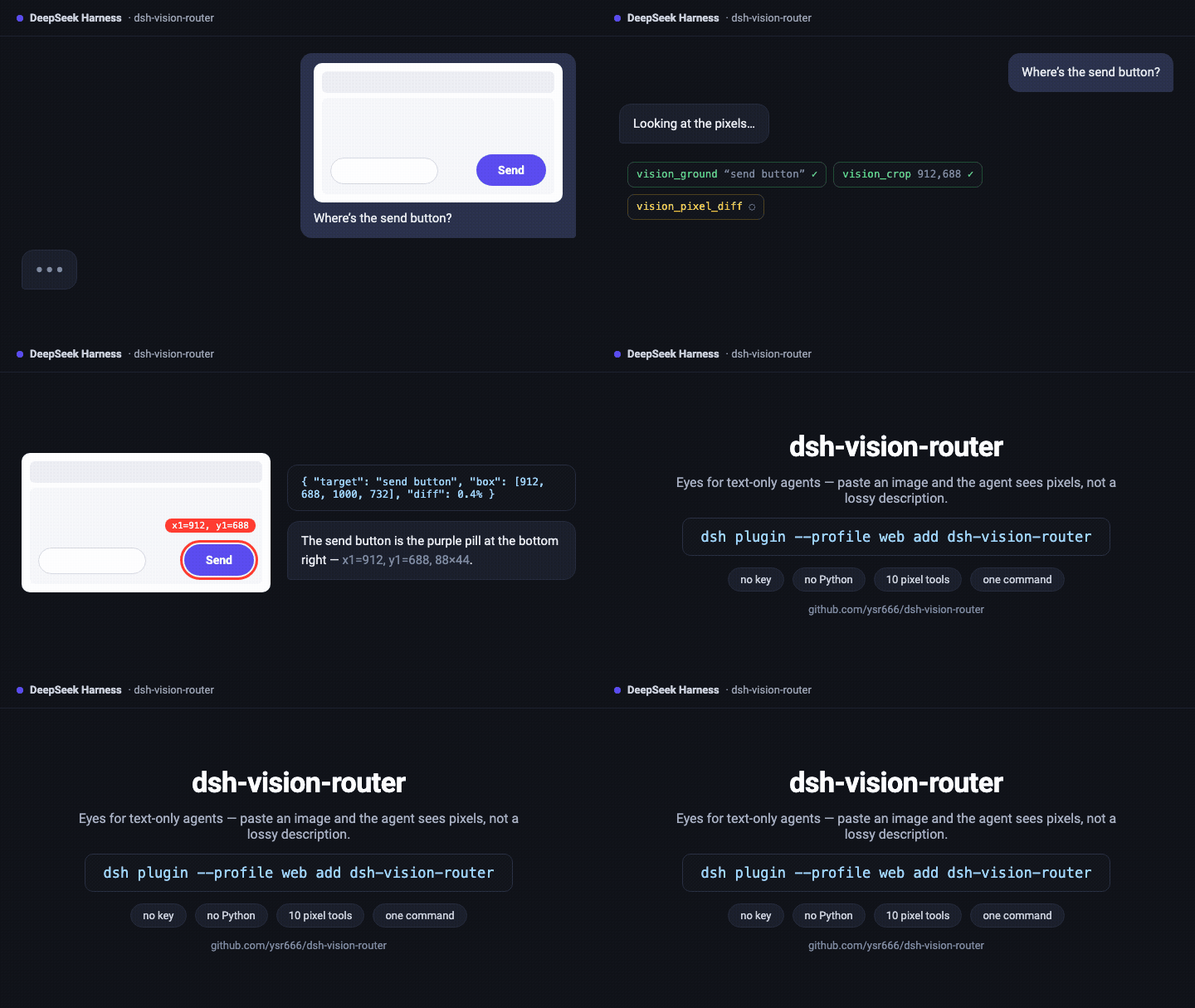
See it in action
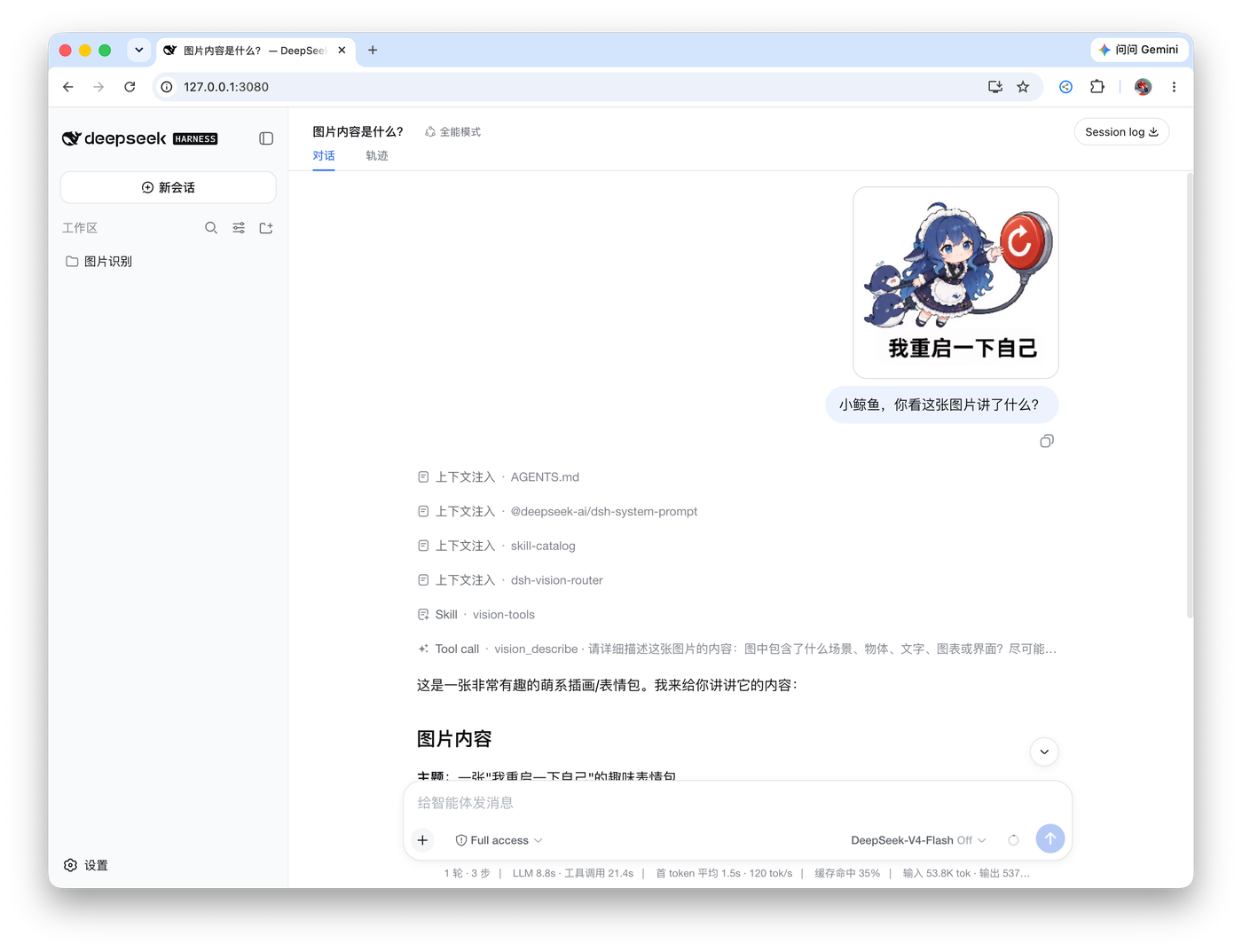
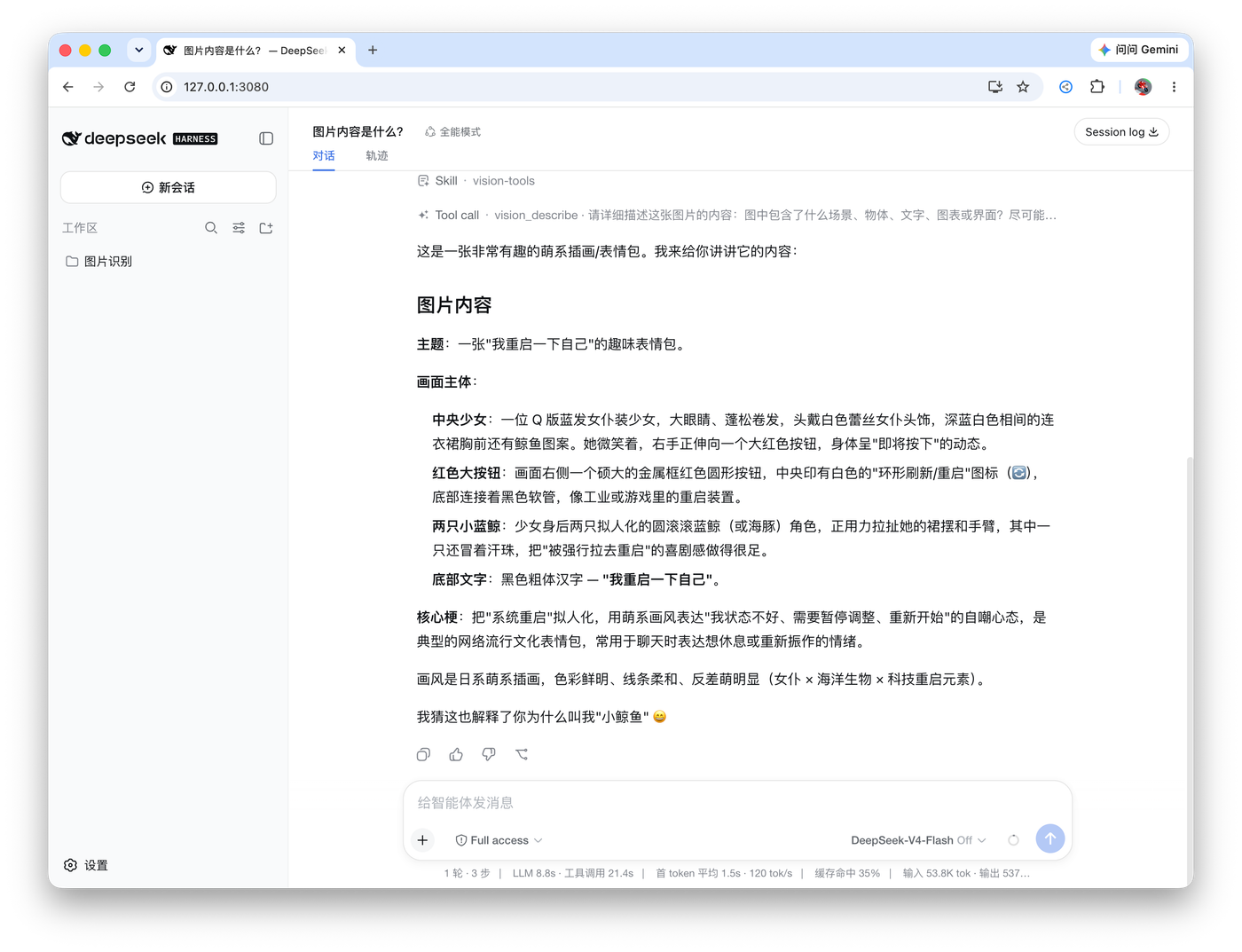
Left: an image turn — the user sends a picture, the agent calls vision_describe through the free chain and answers. Right: the finished structured answer.
Free vision key channels
The built-in OVH fallback is anonymous by design, and OVH caps anonymous use at 2 requests/minute per IP per model. If that feels tight, every channel below offers free vision models with much higher quotas — all of them are free to register, and none charges for the free tier. Free policies rotate often; treat this table as an August 2026 snapshot and double-check each provider's console before relying on it.
| Channel |
Free vision model(s) |
Free quota |
CN direct? |
Where to get the key |
| OVHcloud AI Endpoints (access key) |
Qwen2.5-VL-72B-Instruct — the same endpoint the built-in fallback uses |
400 req/min per project per model (vs 2 anonymous) |
✅ |
OVH account → Public Cloud project (attach a payment method; free models are not charged) → AI Endpoints access key |
| Zhipu (bigmodel.cn) |
glm-4.6v-flash · glm-4.1v-thinking-flash · glm-4v-flash — three permanently free models; chaining them triples capacity |
uncapped tokens |
✅ |
open.bigmodel.cn → API keys |
| DashScope (Aliyun) |
qwen3-vl-flash (limited-time free) and the Qwen-VL series |
new users: 1M tokens per model series / 90 days |
✅ |
bailian.console.aliyun.com |
| Intern AI (Shanghai AI Lab) |
internvl-latest · internvl3.5-latest |
30 RPM, 90M tokens/month |
✅ |
chat.intern-ai.org.cn |
| Groq |
meta-llama/llama-4-scout-17b-16e-instruct (native multimodal, up to 5 images) |
30 RPM / 14,400 req/day, no card |
❌ proxy |
console.groq.com |
| Google AI Studio |
gemini-2.5-flash · gemini-2.5-flash-lite |
10–30 RPM / 500–1,500 req/day |
❌ proxy |
aistudio.google.com |
| NVIDIA NIM |
meta/llama-3.2-11b-vision-instruct · nvidia/nemotron-nano-12b-v2-vl |
40 RPM, no card |
⚠️ |
build.nvidia.com |
| OpenCode Zen |
mimo-v2.5-free (vision + code) |
30 RPM / 500 req/day |
⚠️ |
opencode.ai/zen |
| OpenRouter |
google/gemma-4-26b-a4b-it:free · google/gemma-4-31b-it:free |
50 req/day on unpaid accounts |
❌ proxy |
openrouter.ai |
Any of these channels can join the vision chain as an httpProviders entry (key in the matching environment variable or ~/.dsh/.credentials.yaml), and the chain tries your entries before the anonymous fallback.
[!NOTE]
Free-tier policies change without notice — Cerebras retired its free tier in July 2026 (now a one-time $5 credit), SambaNova's free tier is down to 20 requests/day, and Hugging Face's is $0.10/month. Third-party “:free relay” aggregators are deliberately not listed: they rotate quickly, lack SLAs, and some resell quota in ways that violate upstream terms.
Highlights
- Capability-aware Auto routing. Keep configured order for deterministic control, or explicitly enable Auto to prioritize already-configured models using measured capability evidence. Auto never infers capability from model names, and enabling Auto alone does not start benchmarks.
- Verifiable model profiling. Exact Test Vision sends one request to one exact model; Quick and Full benchmark OCR / general / structured / document / grounding capabilities. Background profiling is separately authorized and yields to real foreground vision work.
- Original pixels, real answers. The vision chain reads the image at original resolution (auto-downscaled only to protect latency/quota); the agent's question travels with the image, so answers are about your question, not a generic description.
- Automatic failover with classified errors. Region blocks, ToS filtering, 402 quota, 429 rate limits, context overflow, network failures — the chain walks providers one by one and only reports after all of them failed, with actionable advice. A 429 immediately advances to the next backend and opens a Retry-After-aware cooldown instead of sleeping inside the request.
- Image memory. Vision answers are cached by attachment content hash; later text turns substitute the recorded de

 dsh-vision-router is a plugin for DeepSeek Harness (DSH) that gives text-only DeepSeek agents the ability to 'see' images. It routes image turns to a free built-in vision chain and fourteen pixel-level tools (Q&A, grounding, crop, pixel diff, colors, OCR, SVG trace, cutout, screenshots) while DeepSeek keeps doing the reasoning.