

hands-on-modern-rl README

The project's README from github.com/walkinglabs/hands-on-modern-rl. As one markdown file: README.md.

Hands-On Modern RL

From Markov decision processes and policy optimization to reasoning models, agents, and multimodal systems

Online Course PDF Download CC BY-NC-SA 4.0 License Node >= 18 VitePress

English · 中文

Train on ModelScope · Run the CartPole Notebook · ModelScope Script

Discussion Group (WeChat)

Book Features · About This Book · News · Contents · Book Structure · Experiment Code · Quick Start · Contributing

📣 Announcement

We sincerely thank everyone for your support of this tutorial! A new version is coming soon. Many sections are still being organized and refined, so we appreciate your patience. Suggestions and feedback are always welcome!

News

Note: This course was created with AI assistance and has not yet been fully reviewed. It may contain factual mistakes or code that does not run as expected. Issues and pull requests are very welcome.

Online Training Notebooks

WalkingLab is collaborating with ModelScope to provide online training environments for classic reinforcement learning experiments. A ModelScope Studio brings the experiment interface, runtime, and training entry point together on one page, so learners can start training in a browser and observe the agent without first configuring a local environment.

Every Studio has a companion notebook under code/online-experiments. The notebook imports the same training runtime as the Studio, exposes the experiment parameters, prints the full training log, plots checkpoint evaluations, and displays the learned-policy replay or result artifact.

Experiment Resource Companion notebook Live Studio
01 · CartPole PPO CPU Run Notebook Open Studio
Gymnasium Playground CPU Run Notebook Open Studio
02 · ViZDoom CPU Run Notebook Open Studio
03 · Atari / ALE xGPU Run Notebook Open Studio
04 · Board Games & Self-Play CPU Run Notebook Open Studio
05 · Multi-Agent Games CPU Run Notebook Open Studio
06 · MiniGrid Adventures CPU Run Notebook Open Studio
07 · JAX MinAtar CPU Run Notebook Open Studio
08 · ManiSkill xGPU Run Notebook Open Studio
10 · MineStudio / Minecraft xGPU Run Notebook Open Studio
11 · Unity ML-Agents xGPU Run Notebook Open Studio
12 · AI2-THOR xGPU Run Notebook Open Studio

CPU entries run on an ordinary notebook instance. Experiments 03, 08, 10, 11, and 12 require a scheduled ModelScope xGPU Notebook and check CUDA before training.

Book Features

Course learning map screenshot
One continuous learning path
Begin with a CartPole trial and progress through value learning, policy optimization, and modern agents.
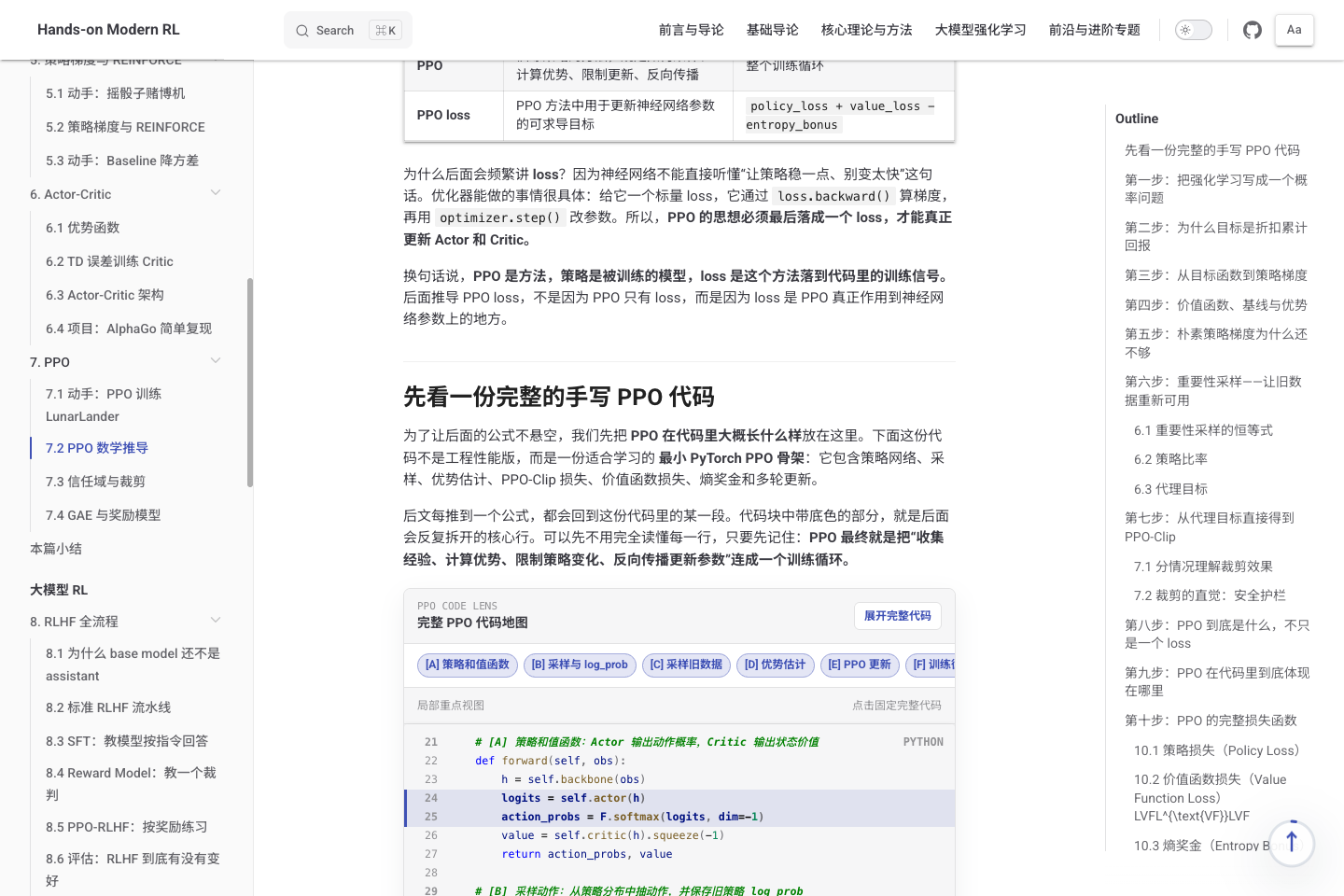
PPO code focus screenshot
Equations meet code
Key PPO, DPO, and GRPO derivations sit beside their implementations, with every tensor accounted for.
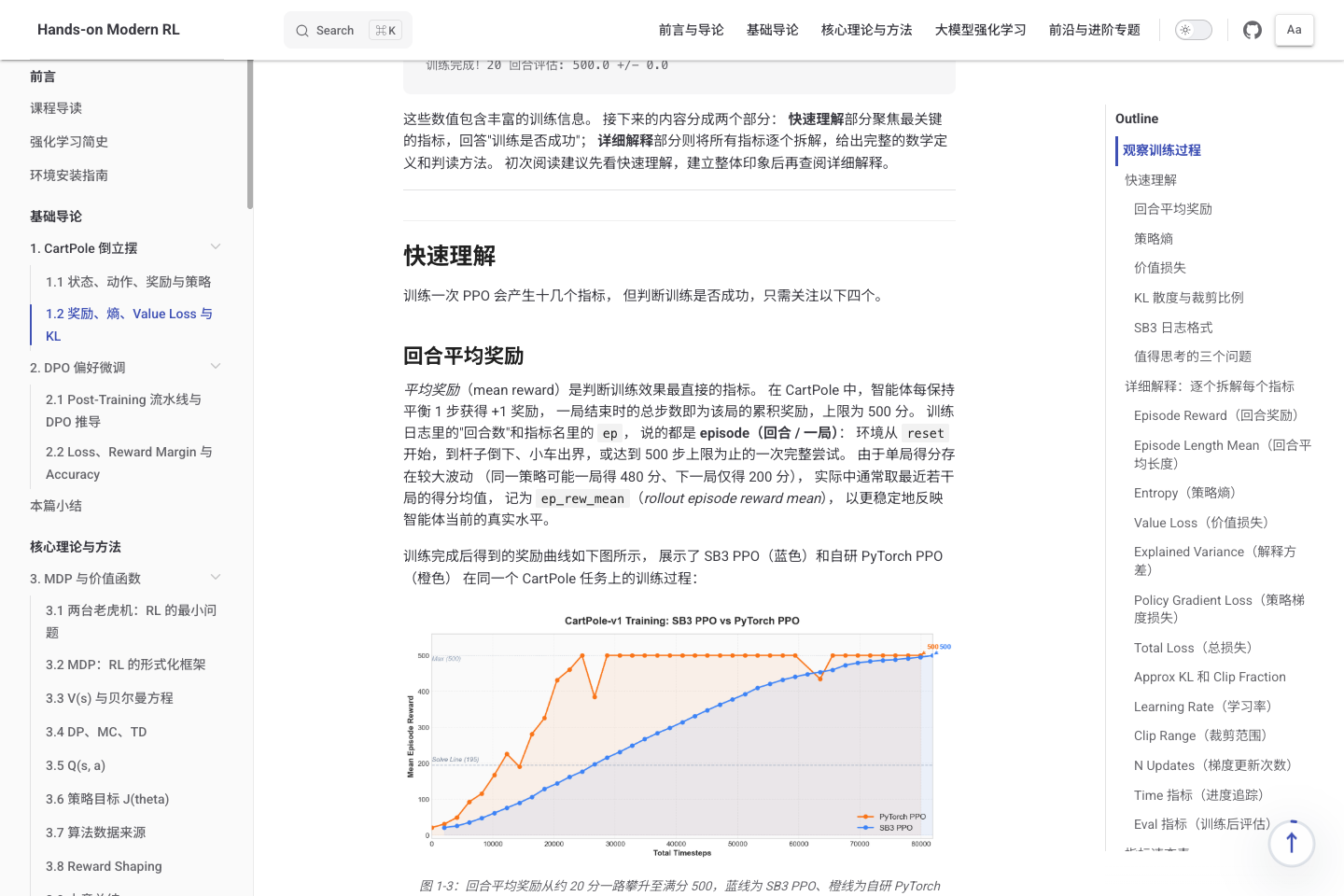
CartPole training metrics screenshot
Claims tested by experiments
Real training curves, ablations, and failure signals show when an algorithm works and when it does not.
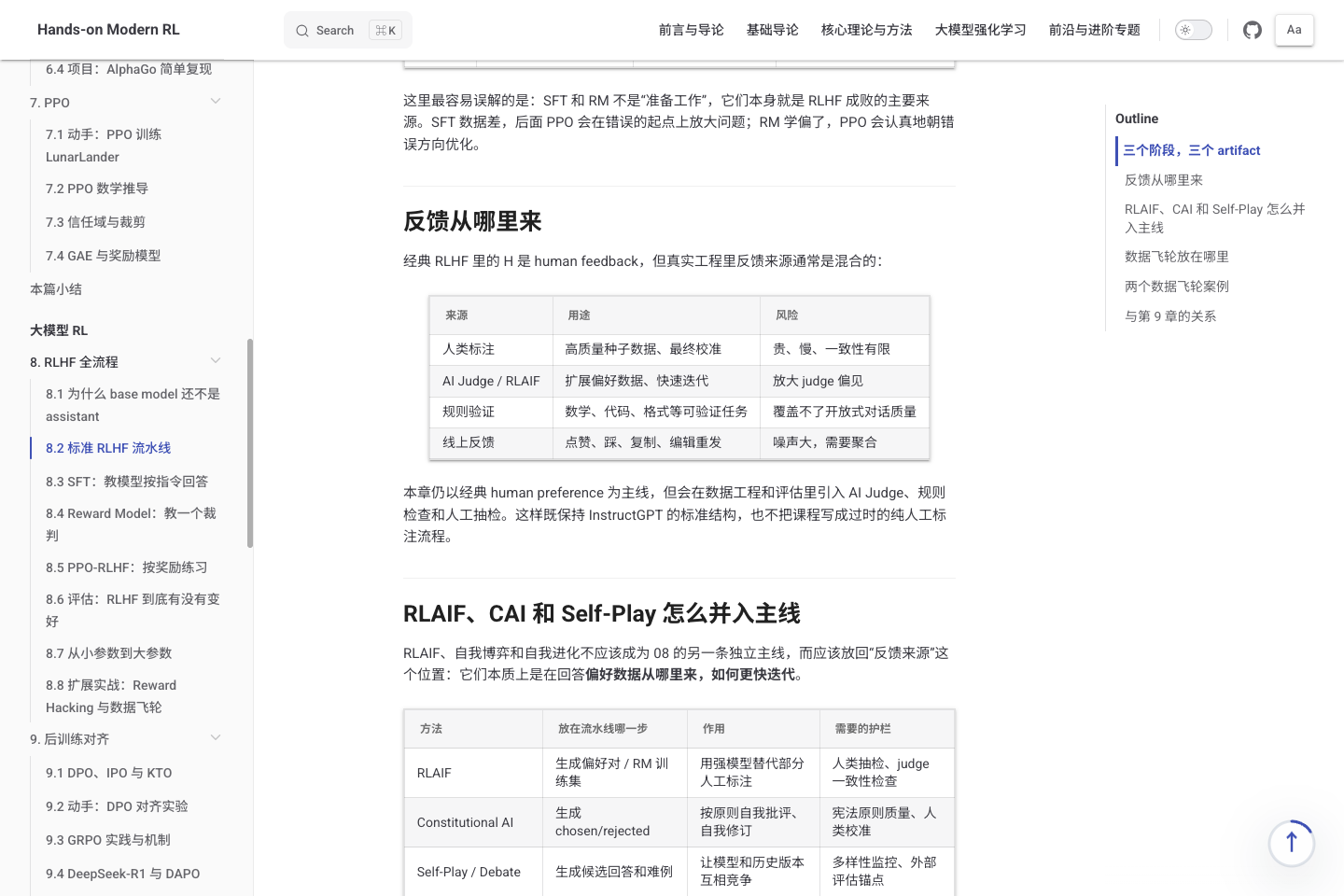
RLHF pipeline screenshot
Classic RL to language models
Policy gradients and PPO lead naturally into RLHF, DPO, GRPO, and RLVR.
Agentic RL experiment page screenshot
Agents as sequential decisions
Tool use, browser interaction, and code repair become problems of states, actions, trajectories, and credit assignment.
Atari Pong DQN experiment page screenshot
Phenomena before abstractions
CartPole, LunarLander, Atari, and LLM experiments pose the problem before introducing the mathematics.

[!NOTE] We hope this open course gives more learners the courage to climb toward the frontier of intelligence and solve more of the hard problems on the path to AGI.

The course is evolving quickly. We recommend focusing on chapters that are not marked as under construction; chapters still in progress may contain mistakes, and corrections or suggestions are welcome.

Help Wanted

Because compute resources are limited, we are seeking GPU support. If you can help with GPU access, please contact [email protected].

Contents

About This Book

Reinforcement learning studies a simple but difficult problem: a system acts, observes the consequences, and uses them to improve its next action. When rewards arrive late, observations are incomplete, and each update changes the distribution of future experience, the familiar supervised-learning model of inputs and labels is no longer enough. We need a language for interaction, a way to estimate long-term return, and methods that improve a policy stably from limited data.

Hands-On Modern RL follows that problem from beginning to end. CartPole and multi-armed bandits first make states, actions, rewards, and policies observable. Markov decision processes, value functions, and Bellman equations then provide a common language. From there, the book develops DQN, policy gradients, actor-critic methods, PPO, continuous control, and offline reinforcement learning. With those foundations in place, RLHF, DPO, GRPO, and RLVR become extensions of the same sequential-decision framework rather than an isolated collection of acronyms.

The second half expands the environment to tools, browsers, code repositories, vision, and audio. An action may be a passage of text, a function call, or a sequence of interface operations. A reward may come from human preference, a rule-based verifier, or a process reward model. The setting changes, but three questions run through the entire book: How should the decision process be represented? How should an outcome be credited to earlier actions? How can we tell whether a policy has actually improved?

How the Material Is Taught

Each chapter follows a problem–method–experiment–reflection rhythm. A concrete task first exposes the difficulty. The concepts and equations needed to solve it come next. Runnable code, training curves, and evaluation metrics then test the argument. The chapter closes by examining assumptions, failure modes, and the limits of the method. Mathematics explains observed behavior; experiments check the mathematics.

Implementations retain the visible skeleton of each algorithm. Readers can trace trajectory collection, advantage estimation, loss construction, and metric changes—and see how reward hacking, KL drift, entropy collapse, distribution shift, or evaluation leakage can invalidate an apparently successful run.

Who Should Read It

This book is for students, researchers, and engineers with basic machine-learning experience who want a systematic understanding of modern reinforcement learning. Readers should be comfortable with Python and basic PyTorch, and should know introductory linear algebra, probability, and calculus. The mathematical appendices rebuild these tools to the depth required by the chapters, so a separate advanced-mathematics sequence is not a prerequisite.

After completing the core chapters and labs, you should be able to:

Current Status

This repository is an active courseware project. Content is being expanded chapter by chapter, with emphasis on correctness, runnable examples, and a stable learning path.

Issues and pull requests are welcome for typo fixes, conceptual corrections, reproducibility improvements, references, and focused course extensions.

Roadmap

The course is under active development. Planned milestones:

Structure of the Book

The book contains seven parts and twenty-six chapters. Parts I–III establish the common language and algorithmic foundations of reinforcement learning. Part IV brings those tools into LLM post-training. Parts V and VI study what changes when the action space expands to tools and multimodal environments. Part VII asks how to detect failures, build trustworthy evaluations, and move the research frontier forward. The appendices provide implementation, mathematics, and engineering references.

Prologue: From Trial and Error to Modern Agents

Reading Central question
Introduction to Reinforcement Learning What does RL study, and how does the book connect classical methods to modern language models?
A History of Reinforcement Learning How did control, TD learning, DQN, AlphaGo, RLHF, and reasoning models develop?
Environment Setup How do you prepare the environments for documentation, control tasks, and LLM experiments?

Part I: The Language of Sequential Decisions

The book first makes an agent's failures and improvements observable, then develops the mathematical objects needed to describe long-term decisions.

Ch. Topic Through line
1 Starting with CartPole Use states, actions, rewards, policies, and training curves to see a complete RL loop.
2 RL Problems and Definitions Move from exploration and exploitation to MDPs, returns, trajectories, and partial observability.
3 Value Functions and Bellman Equations Express how a present action changes the future through state values, action values, and recursion.
4 Classical RL Methods Compare dynamic programming, Monte Carlo, and tempor

hands-on-modern-rl (walkinglabs/hands-on-modern-rl)

Searching Database…

What is this?Hands-On Modern RL is an open-source course and book that walks learners from basic reinforcement learning concepts through LLM alignment (RLHF, DPO, GRPO, RLVR) and into advanced agentic systems, combining theory with runnable code.
Is this a book, a course, or a code library?It is primarily a book/course site (built with VitePress) organized into chapters, paired with runnable experiment code and notebooks rather than an installable library.
How do I start learning and running the experiments?Read the chapters on the course site, then run the companion Jupyter notebooks under code/online-experiments, or launch the paired ModelScope Studio in the browser to train without local setup.
What background and tools do I need before starting?You should be comfortable with Python and basic PyTorch, know introductory linear algebra, probability, and calculus; some experiments also need GPU access via ModelScope.
Is the content finished and reliable?The course is an active work-in-progress created with AI assistance and not yet fully reviewed, so some chapters may still contain factual mistakes or non-working code, and several are marked as under construction.
Who is this course for?Students, researchers, and engineers with basic machine-learning experience who want a systematic, hands-on understanding of modern RL and its extension to LLMs and agents.
Where can I run the training experiments?CPU-only experiments run in an ordinary notebook instance, while GPU-heavy ones (Atari/ALE, ManiSkill, Minecraft, Unity ML-Agents, AI2-THOR) require a scheduled ModelScope xGPU Notebook with CUDA.
How is the book structured?It has seven parts and twenty-six chapters, moving from classical RL foundations (Parts I-III) to LLM post-training like RLHF/DPO/GRPO (Part IV), then tool-use, multimodal and embodied agents (Parts V-VI), and finally evaluation and failure analysis (Part VII), plus math and engineering appendices.
Is the course available in languages other than English?Yes, it has a full Chinese version alongside the complete English translation, with PDF builds for both editions generated automatically via CI.
What distinguishes this from just reading an RL textbook?Every algorithm (DQN, PPO, DPO, GRPO, etc.) comes with runnable code, real training curves, and failure-mode analysis like reward hacking or entropy collapse, so claims are tested by experiments rather than just derived mathematically.
Can I try the experiments without setting up anything locally?Yes, each lab has a live ModelScope Studio you can open in a browser to train and observe the agent immediately, in addition to the companion notebook.
Size
153 MB
Stars
4.7K
Age
6mo
Commits · 90 Days
