Vanna 2.0: Turn Questions into Data Insights
Natural language → SQL → Answers. Now with enterprise security and user-aware permissions.


https://github.com/user-attachments/assets/476cd421-d0b0-46af-8b29-0f40c73d6d83
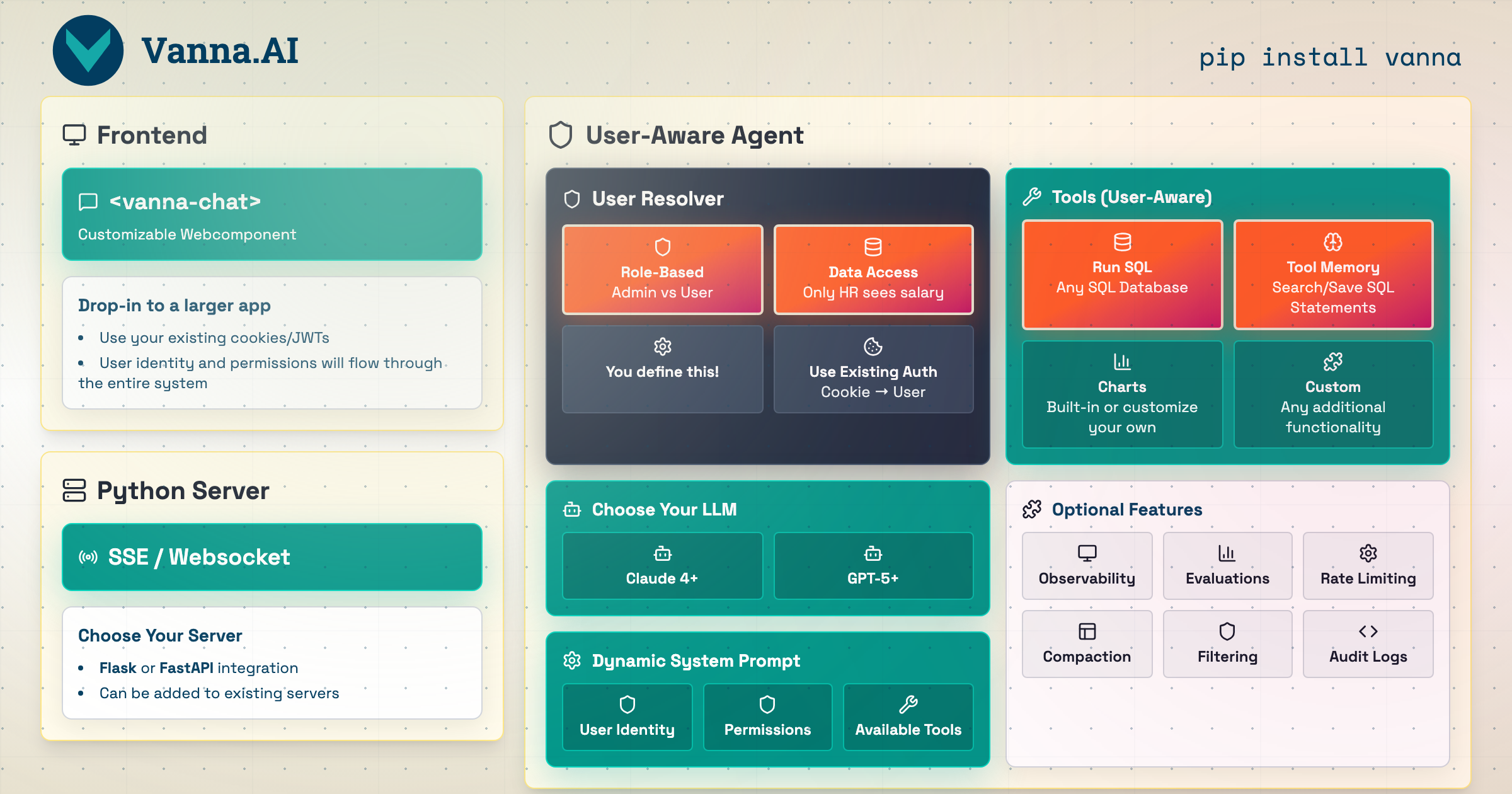
What's New in 2.0
🔐 User-Aware at Every Layer — Queries automatically filtered per user permissions
🎨 Modern Web Interface — Beautiful pre-built <vanna-chat> component
⚡ Streaming Responses — Real-time tables, charts, and progress updates
🔒 Enterprise Security — Row-level security, audit logs, rate limiting
🔄 Production-Ready — FastAPI integration, observability, lifecycle hooks
Upgrading from 0.x? See the Migration Guide | What changed?
Get Started
Try it with Sample Data
Quickstart
Configure
Web Component
<!-- Drop into any existing webpage -->
<script src="https://img.vanna.ai/vanna-components.js"></script>
<vanna-chat
  sse-endpoint="https://your-api.com/chat"
  theme="dark">
</vanna-chat>
Uses your existing cookies/JWTs. Works with React, Vue, or plain HTML.
What You Get
Ask a question in natural language and get back:
1. Streaming Progress Updates
2. SQL Code Block (By default only shown to "admin" users)
3. Interactive Data Table
4. Charts (Plotly visualizations)
5. Natural Language Summary
All streamed in real-time to your web component.
Why Vanna 2.0?
✅ Get Started Instantly
- Production chat interface
- Custom agent with your database
- Embed in any webpage
✅ Enterprise-Ready Security
User-aware at every layer — Identity flows through system prompts, tool execution, and SQL filtering
Row-level security — Queries automatically filtered per user permissions
Audit logs — Every query tracked per user for compliance
Rate limiting — Per-user quotas via lifecycle hooks
✅ Beautiful Web UI Included
Pre-built <vanna-chat> component — No need to build your own chat interface
Streaming tables & charts — Rich components, not just text
Responsive & customizable — Works on mobile, desktop, light/dark themes
Framework-agnostic — React, Vue, plain HTML
✅ Works With Your Stack
Any LLM: OpenAI, Anthropic, Ollama, Azure, Google Gemini, AWS Bedrock, Mistral, Others
Any Database: PostgreSQL, MySQL, Snowflake, BigQuery, Redshift, SQLite, Oracle, SQL Server, DuckDB, ClickHouse, Others
Your Auth System: Bring your own — cookies, JWTs, OAuth tokens
Your Framework: FastAPI, Flask
✅ Extensible But Opinionated
Custom tools — Extend the Tool base class
Lifecycle hooks — Quota checking, logging, content filtering
LLM middlewares — Caching, prompt engineering
Observability — Built-in tracing and metrics
Architecture

How It Works
sequenceDiagram
    participant U as 👤 User
    participant W as 🌐 <vanna-chat>
    participant S as 🐍 Your Server
    participant A as 🤖 Agent
    participant T as 🧰 Tools

    U->>W: "Show Q4 sales"
    W->>S: POST /api/vanna/v2/chat_sse (with auth)
    S->>A: User(id=alice, groups=[read_sales])
    A->>T: Execute SQL tool (user-aware)
    T->>T: Apply row-level security
    T->>A: Filtered results
    A->>W: Stream: Table → Chart → Summary
    W->>U: Display beautiful UI
Key Concepts:
- User Resolver — You define how to extract user identity from requests (cookies, JWTs, etc.)
- User-Aware Tools — Tools automatically check permissions based on user's group memberships
- Streaming Components — Backend streams structured UI components (tables, charts) to frontend
- Built-in Web UI — Pre-built
<vanna-chat> component renders everything beautifully
Production Setup with Your Auth
Here's a complete example integrating Vanna with your existing FastAPI app and authentication:
from fastapi import FastAPI
from vanna import Agent
from vanna.servers.fastapi.routes import register_chat_routes
from vanna.servers.base import ChatHandler
from vanna.core.user import UserResolver, User, RequestContext
from vanna.integrations.anthropic import AnthropicLlmService
from vanna.tools import RunSqlTool
from vanna.integrations.sqlite import SqliteRunner
from vanna.core.registry import ToolRegistry

# Your existing FastAPI app
app = FastAPI()

# 1. Define your user resolver (using YOUR auth system)
class MyUserResolver(UserResolver):
    async def resolve_user(self, request_context: RequestContext) -> User:
        # Extract from cookies, JWTs, or session
        token = request_context.get_header('Authorization')
        user_data = self.decode_jwt(token)  # Your existing logic

        return User(
            id=user_data['id'],
            email=user_data['email'],
            group_memberships=user_data['groups']  # Used for permissions
        )

# 2. Set up agent with tools
llm = AnthropicLlmService(model="claude-sonnet-4-5")
tools = ToolRegistry()
tools.register(RunSqlTool(sql_runner=SqliteRunner("./data.db")))

agent = Agent(
    llm_service=llm,
    tool_registry=tools,
    user_resolver=MyUserResolver()
)

# 3. Add Vanna routes to your app
chat_handler = ChatHandler(agent)
register_chat_routes(app, chat_handler)

# Now you have:
# - POST /api/vanna/v2/chat_sse (streaming endpoint)
# - GET / (optional web UI)
Then in your frontend:
<vanna-chat sse-endpoint="/api/vanna/v2/chat_sse"></vanna-chat>
See Full Documentation for custom tools, lifecycle hooks, and advanced configuration
Extend Vanna with custom tools for your specific use case:
from vanna.core.tool import Tool, ToolContext, ToolResult
from pydantic import BaseModel, Field
from typing import Type

class EmailArgs(BaseModel):
    recipient: str = Field(description="Email recipient")
    subject: str = Field(description="Email subject")

class EmailTool(Tool[EmailArgs]):
    @property
    def name(self) -> str:
        return "send_email"

    @property
    def access_groups(self) -> list[str]:
        return ["send_email"]  # Permission check

    def get_args_schema(self) -> Type[EmailArgs]:
        return EmailArgs

    async def execute(self, context: ToolContext, args: EmailArgs) -> ToolResult:
        user = context.user  # Automatically injected

        # Your business logic
        await self.email_service.send(
            from_email=user.email,
            to=args.recipient,
            subject=args.subject
        )

        return ToolResult(success=True, result_for_llm=f"Email sent to {args.recipient}")

# Register your tool
tools.register(EmailTool())
Advanced Features
Vanna 2.0 includes powerful enterprise features for production use:
Lifecycle Hooks — Add quota checking, custom logging, content filtering at key points in the request lifecycle
LLM Middlewares — Implement caching, prompt engineering, or cost tracking around LLM calls
Conversation Storage — Persist and retrieve conversation history per user
Observability — Built-in tracing and metrics integration
Context Enrichers — Add RAG, memory, or documentation to enhance agent responses
Agent Configuration — Control streaming, temperature, max iterations, and more
Use Cases
Vanna is ideal for:
- 📊 Data analytics applications with natural language interfaces
- 🔐 Multi-tenant SaaS needing user-aware permissions
- 🎨 Teams wanting a pre-built web component + backend
- 🏢 Enterprise environments with security/audit requirements
- 📈 Applications needing rich streaming responses (tables, charts, SQL)
- 🔄 Integrating with existing authentication systems
Migration Notes
Upgrading from Vanna 0.x?
Vanna 2.0 is a complete rewrite focused on user-aware agents and production deployments. Key changes:
- New API: Agent-based instead of
VannaBase class methods
- User-aware: Every component now knows the user identity
- Streaming: Rich UI components instead of text/dataframes
- Web-first: Built-in
<vanna-chat> component and server
Migration path:
- Quick wrap — Use
LegacyVannaAdapter to wrap your existing Vanna 0.x instance and get the new web UI immediately
- Gradual migration — Incrementally move to the new Agent API and tools
See the complete Migration Guide for step-by-step instructions.
License
MIT License — See LICENSE for details.
Built with ❤️ by the Vanna team | Website | Docs | Discussions

 Vanna 是一个开源的 Python 框架,用来和你的 SQL 数据库对话:用户用日常语言输入一个问题,就能得到 SQL、数据表、图表和一段自然语言总结,并且内置了按用户划分的权限控制。