



What is this?
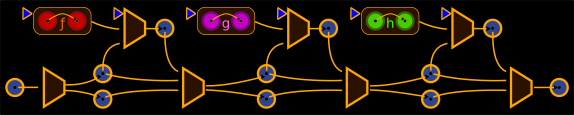
 Morloc is a strongly-typed, polyglot compiler: it composes functions written in different languages under one common type system and turns each module into a CLI, an API and an MCP server.
Morloc is a strongly-typed, polyglot compiler: it composes functions written in different languages under one common type system and turns each module into a CLI, an API and an MCP server.Is it a programming language, a compiler, or a framework?It is a compiler for its own small functional scripting language. You write functions in ordinary languages, source them into a Morloc script, give them types, and the compiler builds everything else.
It is a compiler for its own small functional scripting language. You write functions in ordinary languages, source them into a Morloc script, give them types, and the compiler builds everything else.How do I install and build it?Run the install script to get the Morloc Installation Manager (mim), which builds Morloc natively on Linux, macOS on new ARM chips, and Windows WSL. Add the --engine docker flag to build in a container instead.
Run the install script to get the Morloc Installation Manager (mim), which builds Morloc natively on Linux, macOS on new ARM chips, and Windows WSL. Add the --engine docker flag to build in a container instead.Do I need to install anything else first?Nothing manual: mim pulls build dependencies automatically via the Pixi package manager. Docker, Podman or Apptainer are only needed for container builds, and mim freeze turns an environment into a Docker image.
Nothing manual: mim pulls build dependencies automatically via the Pixi package manager. Docker, Podman or Apptainer are only needed for container builds, and mim freeze turns an environment into a Docker image.Is it stable enough to build on?Not yet: after roughly ten years of development Morloc is still in beta, many bugs remain and the author regularly makes backwards-incompatible changes. Play with the cutting edge and you might bleed.
Not yet: after roughly ten years of development Morloc is still in beta, many bugs remain and the author regularly makes backwards-incompatible changes. Play with the cutting edge and you might bleed.How does a Python function call a C++ function in Morloc?The compiler generates all the glue for you: the call happens across a process boundary and you write no bindings, no serializers and no argument parsers — you just give both functions types in the Morloc module.
The compiler generates all the glue for you: the call happens across a process boundary and you write no bindings, no serializers and no argument parsers — you just give both functions types in the Morloc module.What do I get when I build a Morloc module?One build produces a CLI with derived help text, an MCP server (--mcp-tools emits JSON Schema tool definitions), an HTTP, TCP and Unix-socket service, and an importable module — all generated from the same types, so interfaces cannot drift from the code.
One build produces a CLI with derived help text, an MCP server (--mcp-tools emits JSON Schema tool definitions), an HTTP, TCP and Unix-socket service, and an importable module — all generated from the same types, so interfaces cannot drift from the code.Which languages can my functions be written in?The README demonstrates C++ and Python composing side by side, and Morloc is explicitly polyglot. Language support is still growing — the author invites contributors to bring new languages into the ecosystem.
The README demonstrates C++ and Python composing side by side, and Morloc is explicitly polyglot. Language support is still growing — the author invites contributors to bring new languages into the ecosystem.The author says the hard part is done — what help does he want?Bug reports, typed modules for libraries you already maintain, editor tooling, new languages, and type-system theory. Contact is [email protected].
Bug reports, typed modules for libraries you already maintain, editor tooling, new languages, and type-system theory. Contact is [email protected].What are similar projects?swift, unison, crystal, reason, scala, TypeScript, carbon-lang, elixir
swift, unison, crystal, reason, scala, TypeScript, carbon-lang, elixirWhich topics is it in?polyglot, type-system, apis, haskell, interoperability, wsl, language, functional-programming, programming-language, code-generation, compiler, cpp
polyglot, type-system, apis, haskell, interoperability, wsl, language, functional-programming, programming-language, code-generation, compiler, cpp