Carbon Language:
An experimental successor to C++
Why? |
Goals |
Status |
Getting started |
Join us
See our announcement video from
CppNorth. Note that Carbon is
not ready for use.
Fast and works with C++
- Performance matching C++ using LLVM, with low-level access to bits and
addresses
- Interoperate with your existing C++ code, from inheritance to templates
- Fast and scalable builds that work with your existing C++ build systems
Modern and evolving
- Solid language foundations that are easy to learn, especially if you have
used C++
- Easy, tool-based upgrades between Carbon versions
- Safer fundamentals, and an incremental path towards a memory-safe subset
Welcoming open-source community
- Clear goals and priorities with robust governance
- Community that works to be welcoming, inclusive, and friendly
- Batteries-included approach: compiler, libraries, docs, tools, package
manager, and more
Why build Carbon?
C++ remains the dominant programming language for performance-critical software,
with massive and growing codebases and investments. However, it is struggling to
improve and meet developers' needs, as outlined above, in no small part due to
accumulating decades of technical debt. Incrementally improving C++ is
extremely difficult, both due to
the technical debt itself and challenges with its evolution process. The best
way to address these problems is to avoid inheriting the legacy of C or C++
directly, and instead start with solid language foundations like
modern generics system, modular code organization, and consistent,
simple syntax.
Existing modern languages already provide an excellent developer experience: Go,
Swift, Kotlin, Rust, and many more. Developers that can use one of these
existing languages should. Unfortunately, the designs of these languages
present significant barriers to adoption and migration from C++. These barriers
range from changes in the idiomatic design of software to performance overhead.
Carbon is fundamentally a successor language approach, rather than an
attempt to incrementally evolve C++. It is designed around interoperability with
C++ as well as large-scale adoption and migration for existing C++ codebases and
developers. A successor language for C++ requires:
- Performance matching C++, an essential property for our developers.
- Seamless, bidirectional interoperability with C++, such that a library
anywhere in an existing C++ stack can adopt Carbon without porting the rest.
- A gentle learning curve with reasonable familiarity for C++ developers.
- Comparable expressivity and support for existing software's design and
architecture.
- Scalable migration, with some level of source-to-source translation for
idiomatic C++ code.
With this approach, we can build on top of C++'s existing ecosystem, and bring
along existing investments, codebases, and developer populations. There are a
few languages that have followed this model for other ecosystems, and Carbon
aims to fill an analogous role for C++:
- JavaScript → TypeScript
- Java → Kotlin
- C++ → Carbon
Language Goals
We are designing Carbon to support:
- Performance-critical software
- Software and language evolution
- Code that is easy to read, understand, and write
- Practical safety and testing mechanisms
- Fast and scalable development
- Modern OS platforms, hardware architectures, and environments
- Interoperability with and migration from existing C++ code
While many languages share subsets of these goals, what distinguishes Carbon is
their combination.
We also have explicit non-goals for Carbon, notably including:
Our detailed goals document fleshes out these ideas
and provides a deeper view into our goals for the Carbon project and language.
Project status
Carbon Language is currently an experimental project. We are hard at work on a
toolchain implementation with compiler and linker. You can try out the current
state at compiler-explorer.com.
We want to better understand whether we can build a language that meets our
successor language criteria, and whether the resulting language can gather a
critical mass of interest within the larger C++ industry and community.
Currently, we have fleshed out several core aspects of both Carbon the project
and the language:
- The strategy of the Carbon Language and project.
- An open-source project structure, governance model, and evolution process.
- Critical and foundational aspects of the language design informed by our
experience with C++ and the most difficult challenges we anticipate. This
includes designs for:
- Generics
- Class types
- Inheritance
- Operator overloading
- Lexical and syntactic structure
- Code organization and modular structure
- An under-development compiler and toolchain that will compile
Carbon (and eventually C++ code as well) into standard executable code. This
is where most of our current implementation efforts are directed.
- Historically, there was also a prototype
explorer interpreter that
implemented an older version of the Carbon language design, but is no
longer under development and has been archived.
If you're interested in contributing, we're currently focused on developing the
Carbon toolchain until it can
support Carbon ↔ C++ interop.
Beyond that, we plan to continue developing the design and toolchain until we
can ship the
0.1 language
and support evaluating Carbon in more detail.
You can see our full roadmap for more details.
Carbon and C++
If you're already a C++ developer, Carbon should have a gentle learning curve.
It is built out of a consistent set of language constructs that should feel
familiar and be easy to read and understand.
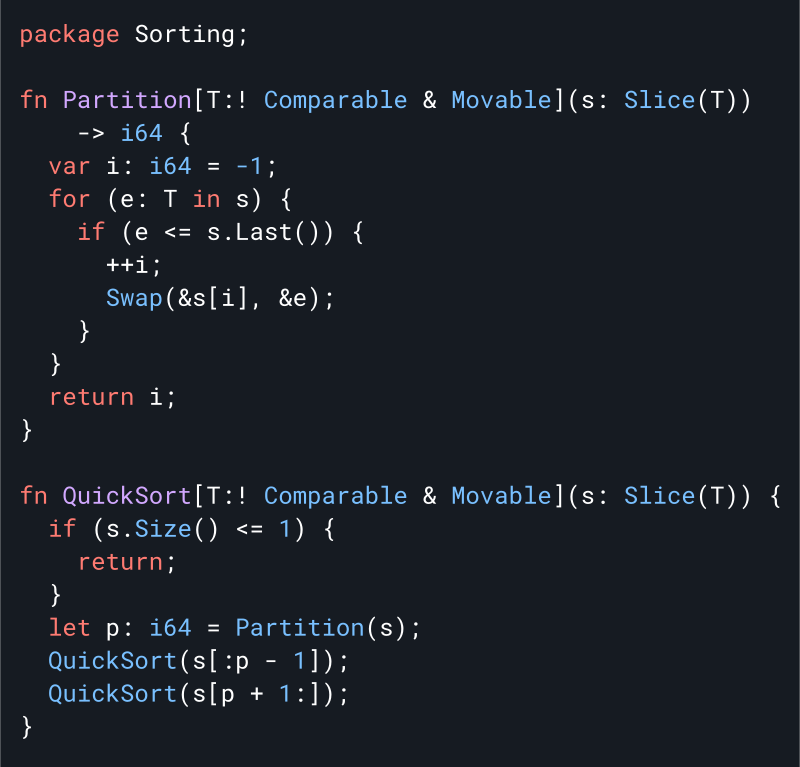
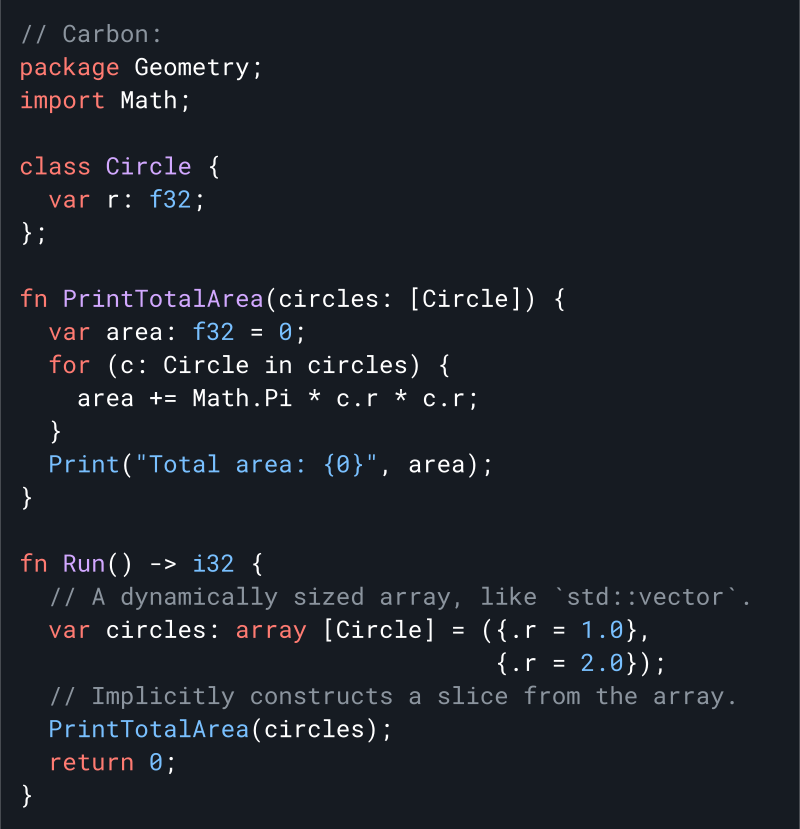
The Carbon code here is hypothetical and meant to show the look and feel of the
language.
C++ code like this:
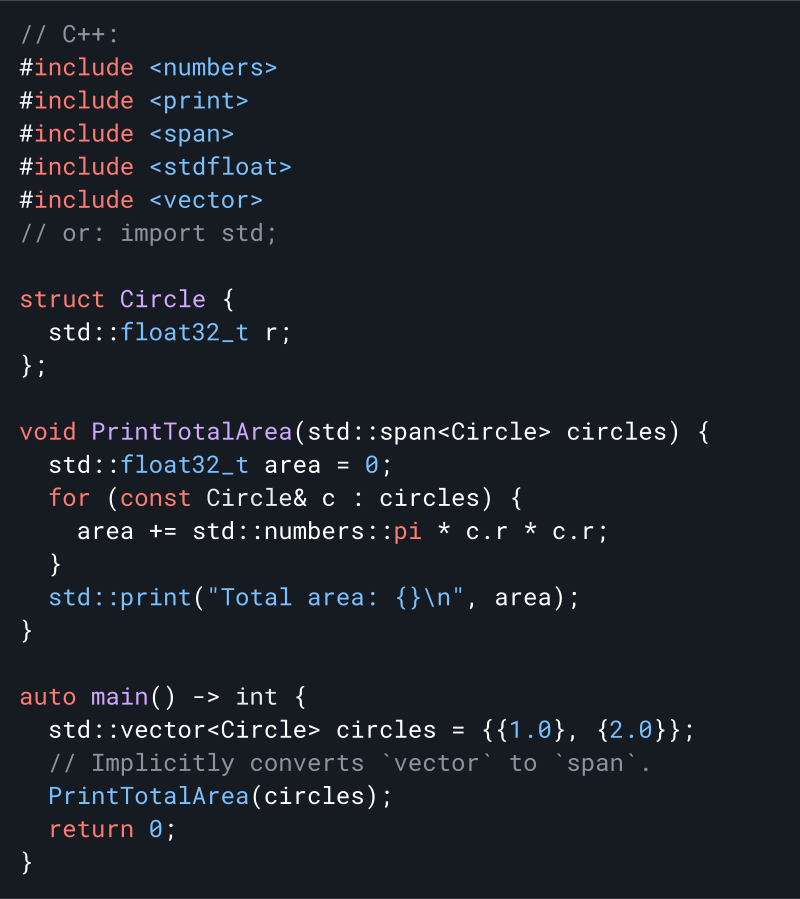
corresponds to this Carbon code:
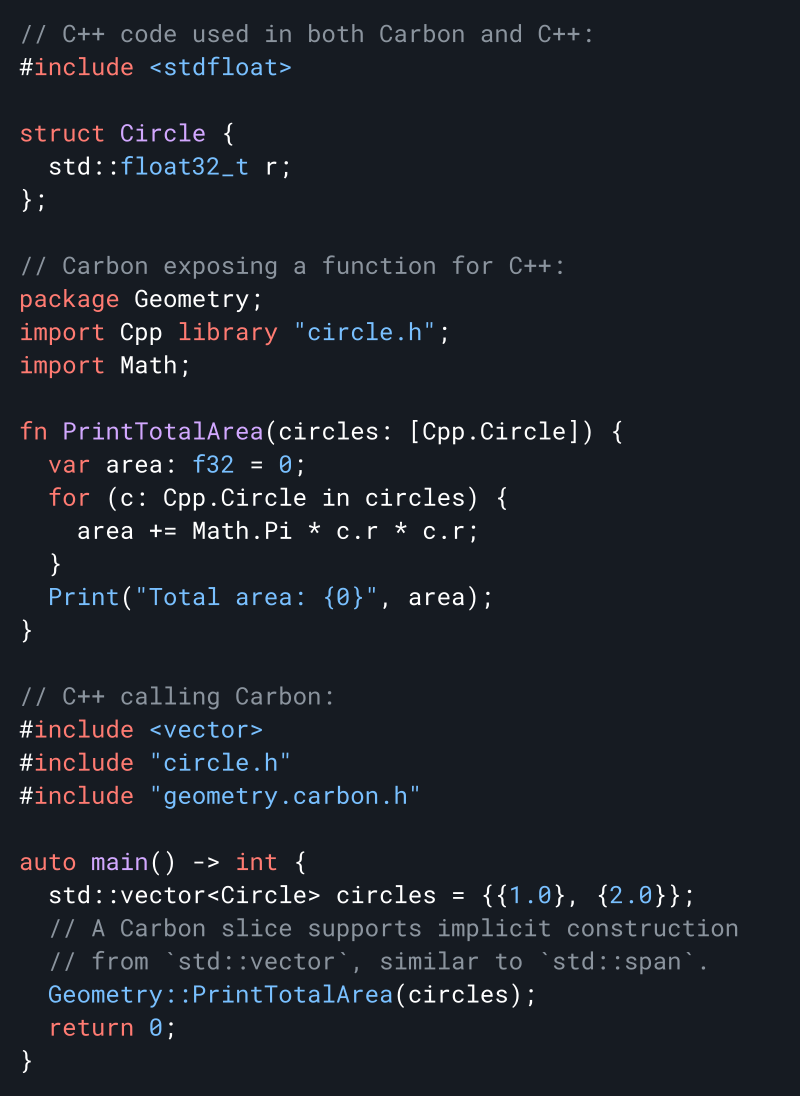
You can call Carbon from C++ without overhead and the other way around. This
means you migrate a single C++ library to Carbon within an application, or write
new Carbon on top of your existing C++ investment. For example:
Read more about
C++ interop in Carbon.
Beyond interoperability between Carbon and C++, we're also planning to support
migration tools that will mechanically translate idiomatic C++ code into Carbon
code to help you switch an existing C++ codebase to Carbon.
Generics
Carbon provides a
modern generics system
with checked definitions, while still supporting opt-in
templates for seamless C++ interop. Checked
generics provide several advantages compared to C++ templates:
- Generic definitions are fully type-checked, removing the need to
instantiate to check for errors and giving greater confidence in code.
- Avoids the compile-time cost of re-checking the definition for every
instantiation.
- When using a definition-checked generic, usage error messages are
clearer, directly showing which requirements are not met.
- Enables automatic, opt-in type erasure and dynamic dispatch without a
separate implementation. This can reduce the binary size and enables
constructs like heterogeneous containers.
- Strong, checked interfaces mean fewer accidental dependencies on
implementation details and a clearer contract for consumers.
Without sacrificing these advantages, Carbon generics support
specialization, ensuring it can fully address performance-critical use cases
of C++ templates. For more details about Carbon's generics, see their
design.
In addition to easy and powerful interop with C++, Carbon templates can be
constrained and incrementally migrated to checked generics at a fine granularity
and with a smooth evolutionary path.
Memory safety
Safety, and especially
memory safety, remains a key
challenge for C++ and something a successor language needs to address.
We plan to support a two step migration process:
- Highly automated, minimal supervision migration from C++ to a dialect of
Carbon designed for C++ interop and migration.
- Incremental refactoring of the Carbon code to adopt memory-safe designs,
patterns, and APIs.
We also want to address important, low-hanging fruit in the safety space
immediately when migrating into Carbon:
- Tracking uninitialized states better, increased enforcement of
initialization, and hardening against initialization bugs when needed.
- Designing fundamental APIs and idioms to support dynamic bounds checking.
- Switching from undefined behavior to erroneous behavior wherever possible,
and marking the remaining undefined behavior with visible
unsafe syntax.
- Having a default debug build mode that has less runtime overhead while being
more comprehensive than existing C++ debug build modes combined with
Address Sanitizer.
For more details, see our safety design.
Getting started
To try out Carbon immediately in your browser, you can use the toolchain at:
carbon.compiler-explorer.com.
We are developing a traditional toolchain for Carbon that can compile and link
programs. However, Carbon is still an early, experimental project, and so we
only have very experimental nightly releases of the Carbon toolchain available
to download, and only on limited platforms. If you are using a recent Ubuntu
Linux or similar (Debian, WSL, etc.), you can try these out by going to our
releases page and
download the latest nightly toolchain tar file:
carbon_toolchain-0.0.0-0.nightly.YYYY.MM.DD.tar.gz. Then you can try it out:
# A variable with the nightly version from yesterday:
VERSION="$(date -d yesterday +0.0.0-0.nightly.%Y.%m.%d)"

# Get the release
wget https://github.com/carbon-language/carbon-lang/releases/download/v${VERSION}/carbon_toolchain-${VERSION}.tar.gz

# Unpack the toolchain:
tar -xvf carbon_toolchain-${VERSION}.tar.gz

# Create a simple Carbon source file:
echo "import Core library \"io\"; fn Run() { Core.Print(42); }" > forty_two.carbon

# Compile to an object file:
./carbon_toolchain-${VERSION}/bin/carbon compile \
  --output=forty_two.o forty_two.carbon

# Install minimal system libraries used for linking. Note that installing `gcc`
# or `g++` for compiling C/C++ code with GCC will also be sufficient, these are
# just the specific system libraries Carbon linking still uses.
sudo apt install libgcc-11-dev

# Link to an executable:
./carbon_toolchain-${VERSION}/bin/carbon link \
  --output=forty_two forty_two.o

# Run it:
./forty_two
As a reminder, the toolchain is still very early and many things don't yet work.
Please hold off on filing lots of bugs: we know many parts of this don't work
yet or may not work on all systems. We expect to have releases that are much
more robust and reliable that you can try out when we reach our
0.1 milestone.
If you want to build Carbon's toolchain yourself or are thinking about
contributing fixes or improvements to Carbon, you'll need to install our
build dependencies (Clang,
LLD, libc++) and check out the Carbon repository. For example, on Debian or
Ubuntu:
# Update apt.
sudo apt update

# Install tools.
sudo apt install \
  clang \
  libc++-dev \
  libc++abi-dev \
  lld

# Download Carbon's code.
$ git clone https://github.com/carbon-language/carbon-lang
$ cd carbon-lang
Then you can try out our toolchain which has a very early-stage compiler for
Carbon:
# Build and run the toolchain's help to get documentation on the command line.
$ ./scripts/run_bazelisk.py run //toolchain -- help
For complete instructions, including installing dependencies on various
different platforms, see our
contribution tools documentation.
Learn more about the Carbon project:
Conference talks
Carbon focused talks from the community:
2026
- Carbon memory safety: a first deep dive (July 10,
video,
transcript,
slides)
- Benchmarking and optimizing the Carbon compiler, NDC {Toronto} (May 5-8)
(video,
slides)
- Carbon: graduating from the experiment, NDC {Toronto} (May 5-8)
(video,
slides)
2025
- Carbon: from C++ to Memory Safety, REBASE - ICFP/SPLASH
(slides)
- Memory safety everywhere with both Carbon and Rust, RustConf
(video,
slides)
2024
- Generic implementation strategies in Carbon and Clang, LLVM Developers'
Meeting (video,
slides)
- The Carbon Language: Road to 0.1, NDC {TechTown}
(video,
slides)
- How designing Carbon with C++ interop taught me about C++ variadics and
overloads, CppNorth (video,
slides)
- Generic Arity: Definition-Checked Variadics in Carbon, C++Now
(video,
slides)
- Carbon: An experiment in different tradeoffs, panel session, EuroLLVM
(video,
slides)
- Carbon's high-level semantic IR lightning talk, EuroLLVM
(video)
2023
- Carbon’s Successor Strategy: From C++ interop to memory safety, C++Now
(video,
slides)
- Definition-Checked Generics, C++Now
- Modernizing Compiler Design for Carbon’s Toolchain, C++Now
(video,
slides)
2022
- Carbon Language: Syntax and trade-offs, Core C++
(video,
slides)
- Carbon Language: An experimental successor to C++, CppNorth
(video,
slides)
Other videos
We additionally have toolchain videos.
Join us
We'd love to have folks join us and contribute to the project. Carbon is
committed to a welcoming and inclusive environment where everyone can
contribute.
Contributing
You can also directly:
You can check out some
"good first issues",
or join the #contributing-help channel on
Discord. See our full
CONTRIBUTING documentation for more details.


 An experimental successor language to C++: C++-level performance, seamless interop with existing C++ code, and modern, safer foundations. This repo holds its documents, design, and toolchain implementation.